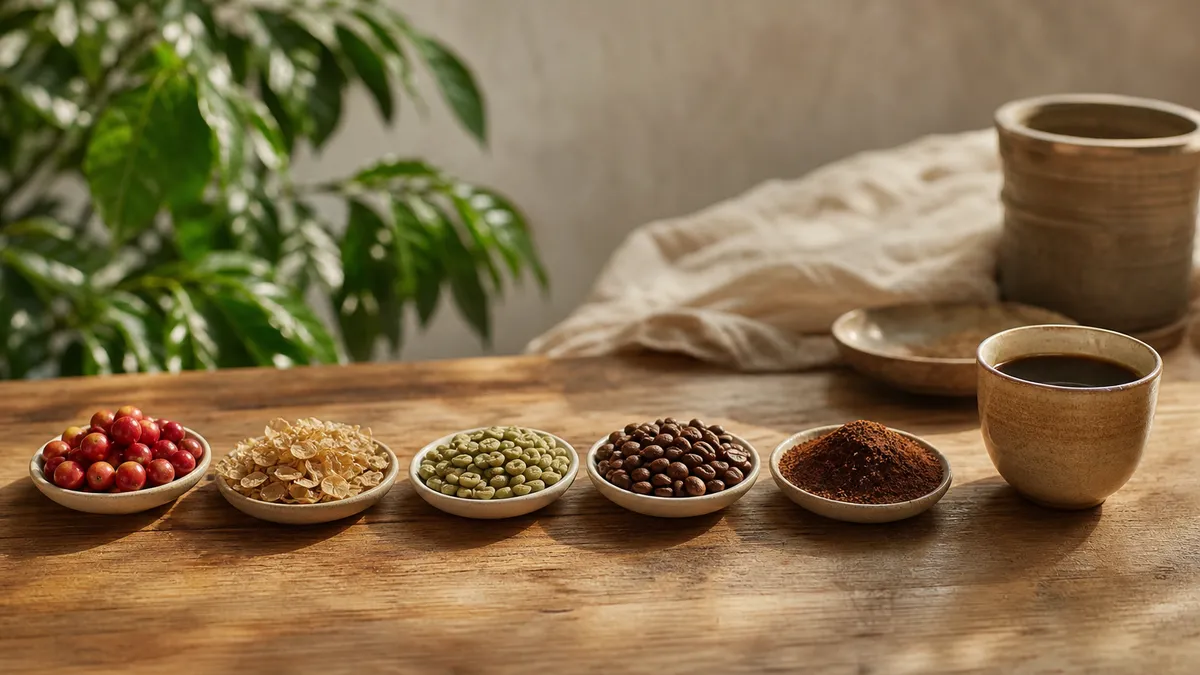
Coffee is made by harvesting the fruit of a coffee plant, separating and drying its seeds, then roasting, grinding and brewing them with water. Those seeds are the coffee beans: their journey involves growers, harvest workers, processors, millers, traders, roasters and, finally, whoever makes your drink.
In short
- A newly planted coffee tree typically takes about 3 to 4 years to bear fruit, depending on the variety.
- Processing removes the fruit around the seeds, either before or after drying.
- Green coffee is dried, hulled and sorted before it is ready for roasting.
- Roasting creates much of coffee’s familiar brown colour and aroma; grinding prepares it for extraction.
- Brewing draws soluble material from the grounds into water, rather than dissolving the whole bean.
How coffee is made: the journey at a glance
The simplest way to follow coffee is to watch what happens to the seed. It begins inside a fruit, becomes a dry green bean, turns brown in the roaster and is broken into particles before brewing.
| Stage | What happens | Who usually does it |
|---|---|---|
| Growing | Young plants become fruit-bearing trees | Nursery workers and growers |
| Harvesting | Coffee cherries are picked and sorted | Harvest workers or machinery operators |
| Processing | Fruit layers are removed before or after drying | Growers, co-operatives or processing stations |
| Drying and milling | Moisture is reduced; dry coverings and defects are removed | Drying teams and mill workers |
| Export and transport | Green coffee is prepared for shipment and delivered to buyers | Exporters, importers and logistics teams |
| Roasting | Heat changes the beans’ structure, colour and flavour chemistry | Roasters |
| Grinding | Roasted beans are broken into particles suited to brewing | A roastery, barista, home user or automatic machine |
| Brewing | Water extracts material from the grounds | A barista, home user or automatic machine |
This is a useful map, not a rigid arrangement of separate businesses. A producer may grow, process and export coffee, while a roaster may also import it.
For the basic distinction between the plant, the bean and the drink, see what coffee is.
Growing: the bean begins as a seed
Coffee grows on flowering shrubs or trees. The two main commercially cultivated species are Coffea arabica, usually called arabica, and Coffea canephora, commonly traded as robusta.
A grower’s first decisions include which species and variety suit the farm’s conditions. A variety is a distinct type within a species, not a roast level or a processing method.
Many coffee plants begin as seeds raised in nurseries, although vegetative propagation, producing plants from existing plant material, is also used. Nursery workers manage watering, shade, nutrition and plant health before the young plants are ready for the field.
Once planted out, the trees need continuing care. Growers manage weeds, soil nutrition, pruning, pests and diseases, with shade and irrigation depending on the farming system and local conditions.
Coffee is not a quick crop. Newly planted trees typically take about 3 to 4 years to bear fruit, depending on the variety. Flowers develop into fruits known as coffee cherries, with the seeds protected inside their surrounding layers.
Harvesting: picking the coffee cherries
Harvesting brings the fruit off the tree, but the method varies with the terrain, farm layout and production system.
Selective picking means taking ripe cherries while leaving less mature fruit on the branch. Workers return as more fruit ripens. Strip picking removes the cherries from a branch together, so the collected crop may need more separation afterwards.
Harvesting can also be mechanised where the farm’s conditions allow it. The important distinction is not simply hand versus machine: it is how effectively the harvested fruit is separated into suitable lots for processing.
After picking, teams remove leaves, twigs and unsuitable fruit. Sorting may use visual inspection, screens or water-based separation. These methods identify different characteristics, so floating a batch of cherries in water is not a complete test of ripeness or quality.
Processing must begin promptly after harvest to limit spoilage. At this point, coffee is still fresh fruit containing seeds, not the dry beans found in a shop.
Processing: removing the fruit around the seeds
Processing is where the journey branches. The main question is how much fruit remains around the seeds while they dry.
Inside a coffee cherry, the seeds are surrounded by skin, pulp and a sticky layer called mucilage. A protective covering called parchment sits around the seed.
Washed coffee
In washed processing, a pulping machine removes the skin and much of the flesh. The remaining mucilage is removed before drying, commonly through fermentation followed by washing, or through mechanical removal.
Fermentation involves biological activity that helps break down the mucilage. It is a managed processing stage, not automatically a sign that the coffee has spoiled.
The seeds are then dried while still enclosed in parchment. That covering is removed later at the mill.
Natural coffee
In natural processing, the whole cherries dry with their seeds inside. Workers spread and turn the fruit, managing exposure to sun, airflow and rain.
Once drying is complete, machinery removes the dried fruit coverings. Compared with washed processing, the major difference is the order: dry the whole fruit first, then remove it.
Honey and pulped-natural coffee
In honey processing, the skin and pulp are removed, but some mucilage remains during drying. The name refers to its sticky texture, not to added honey.
Pulped-natural and honey terminology overlaps, and usage varies between producing countries. These labels explain the broad route, but do not describe every detail of a producer’s method.
Processing can influence flavour, but it does not determine the cup on its own. The plant, growing conditions, drying and roasting all remain part of the explanation.
Drying and milling: preparing green coffee
Drying reduces moisture sufficiently for subsequent handling and storage. It is not the same operation as roasting.
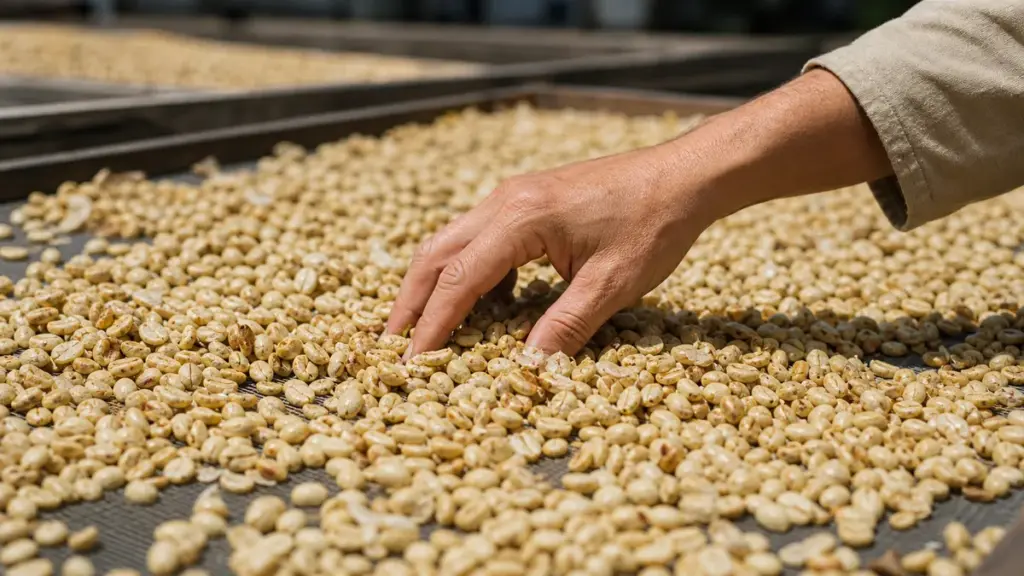
Coffee may dry on raised beds, patios or other suitable clean surfaces, in mechanical dryers, or through a combination of methods. Workers manage spreading, turning and protection from rain to encourage even drying and prevent rewetting.
Technical guidance commonly describes a final moisture content around 11% to 12%, although the appropriate specification depends on the coffee and its handling requirements. Drying inadequately, or allowing dried coffee to become damp again, can cause deterioration.
Next comes dry milling. Hulling machines remove the parchment from washed coffee or the dried fruit coverings from natural coffee.
The mill then cleans and sorts the beans, using characteristics such as size, density and colour. Workers or optical equipment may remove defective material.
The result is green coffee, meaning unroasted coffee. Milling here means removing coverings and preparing beans for trade, not grinding roasted coffee into brewing particles.
Export: moving coffee from producer to roaster
Green coffee can pass through several organisations before reaching a roastery. Exporters prepare shipments and documentation; importers arrange supply to destination markets; transport and warehouse teams handle the physical movement and storage.
International shipments commonly travel in containers, with coffee packed in bags or transported in bulk. Protection from moisture and contaminating odours matters throughout the journey.
Quality assessment also happens along the chain. Buyers and quality-control staff inspect samples and taste brewed samples through cupping, a structured way of evaluating coffee.
Cupping helps people compare lots and assess flavour and defects. It is not a manufacturing step that every bean physically passes through.
Export is also not universal. Coffee can be roasted and consumed in the country where it grows, without crossing an international border.
Roasting: creating familiar coffee aromas
Green beans do not yet smell like a freshly opened bag of roasted coffee. Roasting changes their chemistry and physical structure, developing much of the colour, aroma and flavour associated with the drink.
A roaster controls how heat reaches the beans over time. Beans lose moisture, change colour and expand as roasting progresses.
Among the important chemical changes are Maillard reactions, reactions involving sugars and amino compounds that create brown pigments and aromatic substances. Roasting therefore does more than dry or darken the seeds: it produces new flavour chemistry.
Roasters monitor the batch and decide when to finish it, then cool the beans rapidly to limit further development. There is no single time or temperature that describes every successful roast.
The chosen roast affects how the coffee tastes and behaves during brewing. For the differences between lighter and darker results, read understanding roast levels, rather than treating darker colour as a simple measure of quality.
Roasting also cannot reliably repair poor earlier handling. A damaged or badly stored raw material does not become sound simply because it has been heated.
Grinding: making the bean accessible to water
Grinding breaks roasted beans into smaller particles. This makes material within the bean more accessible during brewing.
The grind must suit the brewing method. Particle size affects both extraction and, where water flows through a bed of grounds, resistance to that flow.
That is why a grinder setting is part of a brewing recipe rather than merely a preference for coarse or fine powder. Changing it can alter what reaches the cup even when the beans and water remain the same.
Grinding happens at different points. A roastery may supply pre-ground coffee, a barista may grind each dose, or an office bean-to-cup machine may grind automatically before brewing.
For freshness, the National Coffee Association advises waiting to grind until shortly before brewing. Whole beans also need protection from air, moisture, heat and light.
When buying, use choosing your first coffee beans to connect these production details with a manageable choice.
Brewing: turning prepared seeds into a drink
Brewing brings the grounds into contact with water. Extraction is the transfer of soluble material from the coffee into that water.
Different brewing methods manage contact differently. In a cafetière, grounds steep in water before a mesh separates much of the solid material. Espresso pushes water through a compact bed of finely ground coffee under pressure.
The grounds do not disappear. A substantial solid residue remains after brewing, unlike instant coffee granules, which are designed to dissolve.
Grind, coffee-to-water ratio, contact time, water temperature, agitation and water composition all affect the result. A brewing method provides a framework, while the recipe controls how that method is used.
This final stage belongs to whoever prepares the drink, including an automatic machine. It can reveal or obscure the characteristics created upstream, but it does not replace them.
Understanding how coffee is made helps separate those decisions: the producer prepares the raw material, the roaster transforms it, and the brewer extracts from it. For a practical learning path beyond the journey, return to coffee for beginners.
FAQ
How is instant coffee made?
Instant coffee is made from coffee that has already been roasted and brewed, then dehydrated. Adding water reconstitutes the dried coffee extract. Ordinary ground coffee is different: it still contains the solid bean material and needs brewing, leaving spent grounds behind rather than dissolving completely.
Does honey-processed coffee contain honey?
Honey processing does not mean honey has been added. The name refers to the sticky mucilage left around the parchment-covered seeds during drying. It describes a production method, not a sweetener or a guaranteed honey flavour. A separately flavoured coffee product would need to be considered on its own ingredients.
Does the same company carry out every stage?
Not necessarily: the journey may involve several independent businesses, co-operatives and logistics providers. Some producers combine growing, processing and exporting, while some roasters also import coffee. The stages describe the work that needs doing, rather than a fixed number of companies or changes of ownership.
Where to go next
Read What Is Coffee? for the essential definitions, then Understanding Roast Levels to explore the transformation in the roaster. How to Choose Your First Coffee Beans turns that background into a buying decision, while Coffee for Beginners provides the wider learning path.
Sources
- World Coffee Research, Good Practice Guide: Coffee Nursery Management, version 2, 2021. Guide PDF. Used for species, variety selection and nursery practices.
- National Coffee Association, Lifecycle of Coffee, undated. Source page. Used for establishment time, harvesting and the broad production sequence.
- National Coffee Association, What is coffee?, undated. Source page. Used for the relationship between coffee fruit, seeds and the drink.
- National Coffee Association, Processes, undated. Source page. Used for natural processing, honey terminology and processing-related flavour variation.
- Food and Agriculture Organization of the United Nations, Arabica Coffee Manual for Lao-PDR, 2005, harvesting and processing chapter. Chapter; publication details. Used for mucilage removal, drying, storage and the consequences of poor handling, not its dated generalisation about natural coffee quality.
- International Trade Centre, The Coffee Guide, fourth edition, 2021. Guide PDF. Used for sorting, milling, transport, supply-chain roles and quality assessment.
- Specialty Coffee Association, Coffee Decoded: Flavor from the Fires: Why Roast Color Matters, 2026. Source page. Used for roasting chemistry and the importance of roast colour.
- Energy Efficiency and Conservation Authority, Technology Scan: Coffee, undated. Report PDF. Used for physical changes during roasting and rapid cooling.
- Specialty Coffee Association, Coffee Skills Program Course Catalog, August 2021 edition. Catalogue PDF. Used for grinding, extraction and brewing variables.
- National Coffee Association, Storage and shelf life, undated. Source page. Used for storage and grinding shortly before brewing.
- National Coffee Association, French press coffee and Espresso, undated. French press page; espresso page. Used for the contrasting brewing mechanisms.
- National Coffee Association, Instant coffee, undated. Source page. Used for the distinction between dehydrated coffee extract and ground coffee.
This article was researched using agricultural manuals, a trade reference, specialist technical education and coffee-industry explanations; no first-hand testing is claimed.
Last checked: November 2026