Selective picking removes individual ripe coffee cherries, strip picking removes the fruit from a branch together, and mechanical harvesting uses powered equipment to detach it. The crucial distinction is that selectivity describes which fruit is collected, while mechanisation describes how it is removed, so the categories can overlap. Here, “processing” means harvest-stage collection and preparation, not the later washed, natural or honey processes.
In short
- Selective hand picking suits uneven ripening and allows workers to leave immature cherries on the tree.
- Stripping collects mixed stages of ripeness together, making harvest timing and subsequent separation particularly important.
- A derricadeira is a portable powered harvesting tool, not a full-sized vehicle.
- Steep ground can prevent large harvesters operating, without ruling out hand-held mechanical assistance.
- Judge quality by the fruit collected and its subsequent handling, not by “hand-picked” or “machine-harvested” alone.
Selective Picking
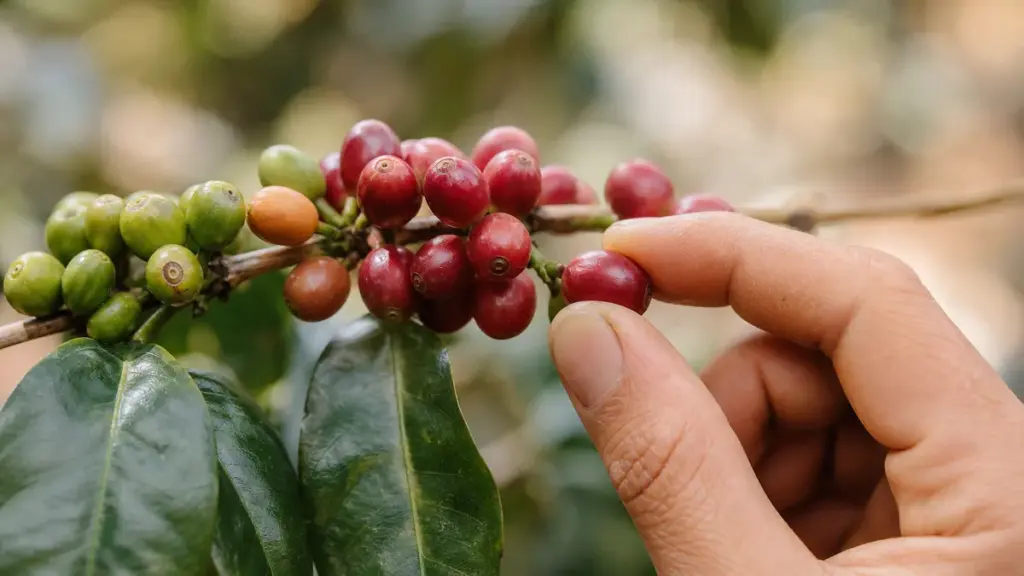
Selective picking means choosing ripe cherries individually and leaving other fruit to mature. Workers revisit the same trees as the crop ripens, rather than trying to collect everything at once.
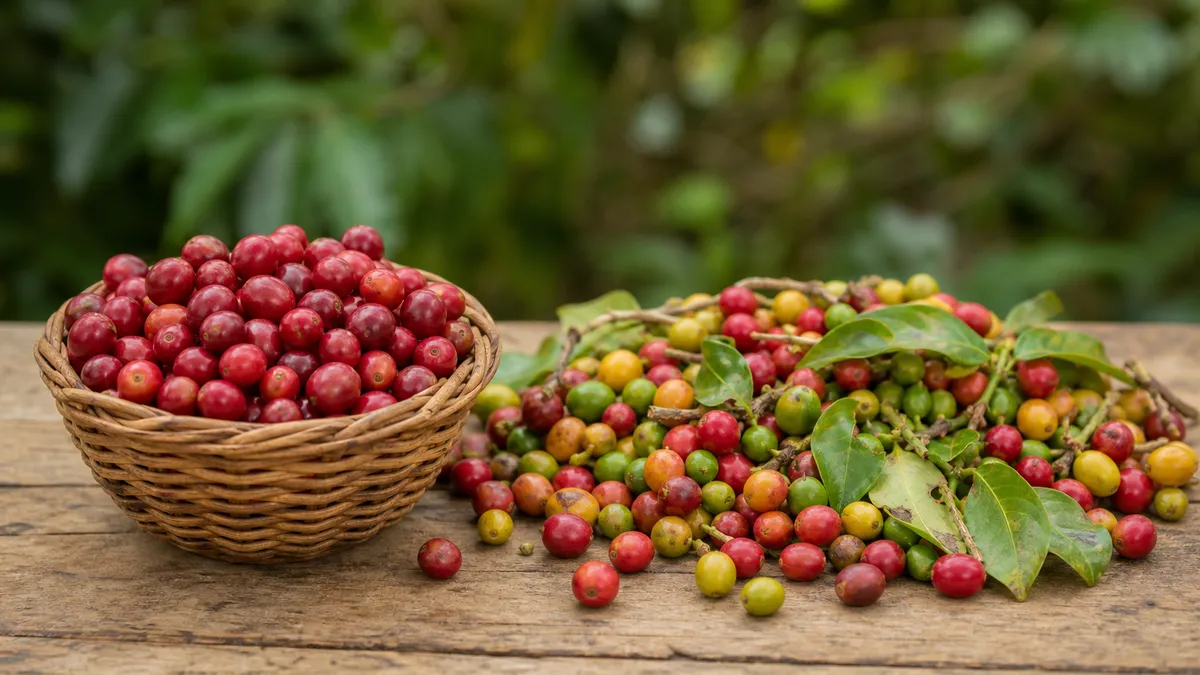
This matters because coffee fruit does not necessarily ripen together. Cenicafé describes Colombian branches carrying cherries at different stages of development, making repeated picking passes necessary. Its guidance identifies selective manual harvesting as the established Colombian approach.
For the wider seasonal picture, start with our coffee harvesting guide.
What the picker selects
The target is sound, appropriately ripe fruit, rather than simply anything that looks colourful. Red is a common ripe colour, but it is not universal: World Coffee Research records both yellow-fruited and red-fruited types of Catuaí. Ripeness therefore needs judging against the variety being harvested.
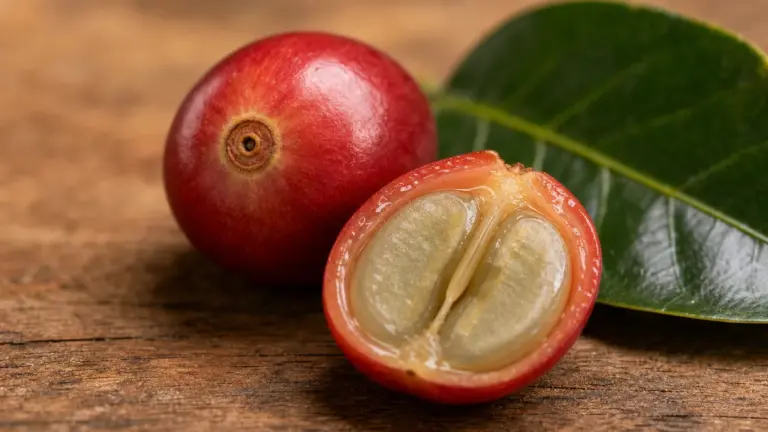
The picker removes the cherry, with the coffee seeds still inside it. Our guide to coffee cherry anatomy explains the surrounding fruit layers.
Selective harvesting offers direct control over what enters the basket. That control is useful where one branch holds ripe fruit beside immature cherries, but it depends on workers recognising and following the required picking standard.
Quality and labour implications
Cenicafé’s quality guidance associates immature and partly ripe fruit with defects including astringency and cereal-like or acrid flavours. Selecting mature fruit helps avoid introducing those problems at the start.
The trade-off is labour. Returning to trees and choosing individual cherries takes more picking effort than removing fruit together. Selective picking therefore suits situations where ripe-fruit separation at the tree is a priority and sufficient skilled labour is available.
It is a way to protect quality potential, not a guarantee of the finished cup. Careful picking still needs appropriate handling afterwards.
Stripping
Strip picking removes the fruit along a branch together, usually by drawing a hand along it. Unlike selective picking, it does not assess and remove each cherry individually.
The collected material can include immature, ripe, overripe and dried fruit, together with leaves and small twigs. In Brazilian terminology, derriça refers to detaching fruit from the plant; derriça total means removing fruit across its stages of maturity.
When stripping makes sense
Stripping suits a harvest strategy that collects a substantial part of the crop together rather than repeatedly selecting individual cherries. Its practical advantage is faster collection, but the composition of the collected fruit becomes especially dependent on timing.
Harvest too early and more immature fruit enters the lot. Waiting for those cherries to ripen can leave earlier fruit further past its intended picking point. Where ripening is uneven, there is no single collection date that makes every cherry equally ready.
Embrapa’s Café na Amazônia documents manual non-selective harvesting in Rondônia. This is a regional example, not a description of every Brazilian farm or a rule that stripping belongs exclusively to one coffee species.
Catching and separating the crop
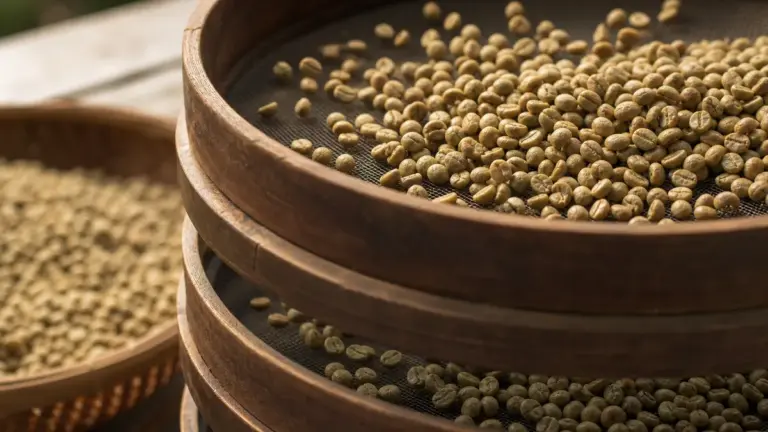
Stripping need not mean dropping coffee onto bare earth. Embrapa describes collection onto cloths or into sieves, followed by removal of leaves, branches and other impurities. Keeping harvested fruit away from soil and previously fallen coffee helps protect the collected lot.
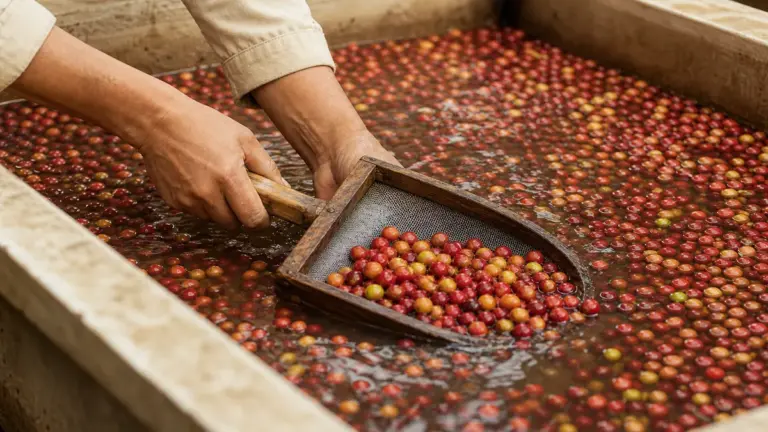
The method shifts more of the selection task from the branch to the receiving and preparation stages. For that next operation, see cherry sorting and floating.
A useful distinction is collection speed versus usable output. A large mixed harvest is not the same thing as an equally large lot of sound, ripe cherries ready for the intended process.
Mechanical Harvesting
Mechanical harvesting uses powered movement to detach cherries. It includes both portable tools guided by workers and larger machines moving through the plantation.
Large coffee harvesters commonly use vibrating rods. The movement applies forces to the fruit; detachment occurs when those forces overcome its attachment to the plant. Machines may be self-propelled or tractor-pulled.
Brazil provides documented examples of mechanised arabica production and research demonstrating mechanical harvesting of conilon, a cultivated form of Coffea canephora. Mechanisation is therefore not confined to either arabica or robusta coffee.
What is a derricadeira?
A derricadeira, also written derriçadeira in Portuguese, is a portable powered coffee-harvesting tool. A worker guides its vibrating fingers or rods into the fruit-bearing branches.
It occupies the middle ground between unaided hand harvesting and a large vehicle. The worker still moves between trees and controls where the tool acts, while powered vibration and contact detach the fruit.
Brazilian research has evaluated portable harvesters in mountainous terrain. Their usefulness there does not mean every slope or working position is safe: access and operating conditions still need assessment.
Can machines harvest selectively?
Mechanical does not automatically mean indiscriminate. Portable-harvester trials have examined both total and selective removal, with results influenced by the proportion of ripe fruit and the crop carried by the tree.
A University of Lavras doctoral study also demonstrated selective semi-mechanised harvesting under its test conditions. However, its selected harvest still contained immature fruit. That is an important qualification: mechanical selectivity is a measured result, not a promise that only ripe cherries will detach.
Machine settings matter because vibration frequency, movement amplitude and exposure affect fruit removal. More aggressive operation is not automatically better.
Terrain and plantation layout
Large machinery needs more than a manageable slope. Row spacing, access routes and room to manoeuvre must accommodate the equipment. Embrapa’s planting guidance treats these as decisions to make when designing the plantation.
There is no useful universal slope limit for every coffee harvester. Suitability depends on the equipment and the field, so a single percentage should not be treated as a general operating permission.
Nor should “mountain coffee” be taken to mean “entirely unmechanised”. Hand-held assistance may be possible where a large harvesting vehicle cannot work.
Coffee harvesting methods compared
The comparison below uses four criteria: selection at collection, terrain and access, labour or equipment requirements, and the situation each method suits. These are practical distinctions, not a ranking of cup quality.
| Method | Selection at collection | Terrain and access | Main resource requirement | Best fit |
|---|---|---|---|---|
| Selective hand picking | Individual ripe cherries chosen | Does not require vehicle-width rows | Skilled labour and repeat visits | Uneven ripening with close control at the tree |
| Manual stripping | Fruit removed together | Does not require a large harvesting vehicle | Picking labour plus separation afterwards | Bulk collection timed around crop maturity |
| Portable derricadeira | Depends on operation and crop condition | Can assist harvesting in some mountainous fields | Operators, powered tools and collection arrangements | Farms needing mechanical assistance without large vehicles |
| Large mechanical harvester | Depends on settings and crop condition | Needs suitable terrain, rows and turning access | Machinery, operators and receiving capacity | Plantations laid out for mechanisation |
Quality depends on the whole harvest system
The most useful question is not simply “Was it picked by hand?” It is “What arrived for processing?”
Assess the proportions of sound ripe fruit, immature cherries, damaged fruit and unwanted material. Cenicafé recommends inspecting incoming cherries and separating damaged, green and dried fruit and impurities. This remains relevant even when the original harvesting method was selective.
Harvesting and processing must also be matched. Collecting fruit faster is only helpful if the receiving operation can handle it appropriately. Cenicafé identifies delayed processing, poor hygiene and inadequate separation among risks to coffee quality.
There is a useful distinction between the emphases of authoritative sources. The International Trade Centre presents selective picking as the route to the best quality. Embrapa stresses that both manual and mechanical systems can produce quality coffee. These positions are compatible when the first is understood as advice about selecting the raw material, rather than proof that machinery necessarily produces an inferior cup.
For buyers, the sensible conclusion is to ask for evidence about the lot, not infer its quality from the harvesting label.
Comparing labour and equipment requirements
Selective picking concentrates effort on recognising ripe fruit and returning as more cherries mature. Stripping reduces individual selection during collection but increases the importance of separating the resulting material.
Mechanisation changes the balance again, introducing equipment, operating inputs, maintenance and operator requirements. It does not remove the need to assess harvest losses, plant damage or unwanted fruit.
To compare arrangements for an actual farm, request itemised written quotations and include:
- Picking and operating labour, including repeat passes.
- Equipment provision, operating inputs, maintenance and repairs.
- Collection, transport, receiving and sorting.
- Fruit left behind, dropped or rejected.
- The quantity of acceptable coffee delivered to the same defined endpoint.
Compare the complete operation, not just the speed at which cherries leave the branch. For a UK buyer reading a coffee description, harvesting information is most useful when accompanied by an explanation of ripeness control, separation and handling.
FAQ
Does “hand-picked” mean selectively picked?
No, hand-picked coffee may have been selectively picked or manually stripped. The phrase identifies human collection but does not establish whether workers chose individual ripe cherries. If selectivity matters to your purchase, ask what the picking instruction was and how the collected fruit was checked before processing.
Does machine harvesting mean the cherries were collected from the ground?
No, mechanical detachment and collection from the ground are different operations. Fruit may be caught during harvesting, while fallen coffee may be collected separately. Ask how the cherries were received and whether previously fallen fruit was kept apart, rather than treating all mechanically harvested coffee as ground-collected coffee.
Can a farm use more than one harvesting method?
Yes, harvesting methods are not mutually exclusive at farm level. Portable-harvester research has evaluated both selective and total removal, and field conditions influence the appropriate approach. When asking about a particular coffee, seek information about that lot rather than assuming every field and picking round on the farm followed an identical method.
Where to go next
Explore Coffee Harvesting for the wider subject, then read Coffee Harvesting: The Complete Guide for harvest timing and organisation. Coffee Cherry Anatomy explains what is being picked, while Coffee Cherry Sorting and Floating follows picking and processing into the separation stage.
Sources
-
International Trade Centre, The Coffee Guide, fourth edition, 2021, especially “Quality and coffee cultivation”.
https://www.intracen.org/sites/default/files/uploadedFiles/intracenorg/Content/Publications/ITC_Coffee_4th_Report_20210930_web_pages.pdf -
Cenicafé, Pabón and Osorio, Factores e indicadores de la calidad física, sensorial y química del café, 2019, especially “Recolección”.
https://biblioteca.cenicafe.org/bitstream/10778/4227/1/Cap07.pdf -
World Coffee Research, Arabica Coffee Varieties: Catuaí, undated online catalogue entry.
https://varieties.worldcoffeeresearch.org/varieties/catuai -
Embrapa, Alves, Costa and Santos, “Procedimentos de colheita do café”, in Café na Amazônia, first edition, 2015. Historical regional descriptions are attributed accordingly.
https://www.alice.cnptia.embrapa.br/alice/bitstream/doc/1023755/1/LivroCafenaAmazoniaDigital2015.pdf -
Pesquisa Agropecuária Brasileira, published by Embrapa, Souza, Queiroz and Rafull, Derriçadora portátil na colheita total e seletiva de frutos do cafeeiro, volume 41, 2006.
https://ainfo.cnptia.embrapa.br/digital/bitstream/item/180694/1/Derricadora-portatil-na-colheita-total-e-seletiva.pdf -
Universidade Federal de Lavras, Maciel, Desenvolvimento de uma derriçadora semimecanizada para a colheita seletiva do café, doctoral thesis, 2020.
https://repositorio.ufla.br/items/9975a4a0-b582-4aa7-91c4-cf5fbb78e97f -
Embrapa Ater+ Digital, Planejamento do plantio, undated online guidance.
https://www.atermaisdigital.cnptia.embrapa.br/web/cafe/planejamento-do-plantio -
Pesquisa Agropecuária Brasileira, published by Embrapa, Souza and colleagues, Mechanized harvesting of ‘Conilon’ coffee clones, volume 55, 2020.
https://apct.sede.embrapa.br/index.php/pab/article/download/26689/14702 -
Cenicafé, Puerta-Quintero, Riesgos para la calidad por la comercialización de café pergamino húmedo, Avances Técnicos 373, July 2008.
https://www.cenicafe.org/es/publications/avt0373.pdf
This article was researched using national coffee-research guidance, the International Trade Centre handbook, World Coffee Research’s variety catalogue and published harvesting research; no first-hand testing is claimed.
Last checked: November 2026