Honey processed coffee is coffee dried with some or all of its sticky fruit layer, called mucilage, still attached after the cherry’s skin and outer flesh have been removed. No honey is added: white, yellow, red and black honey describe producer-defined processing styles, not a universally standardised scale.
In short
- Honey processing removes the cherry skin before drying, unlike natural processing, which dries the whole fruit.
- The mucilage remains outside the parchment, the protective covering around the coffee seed.
- Colour names can reflect retained mucilage, drying conditions or both. Fixed percentage charts are not reliable across producers.
- Costa Rica is particularly associated with honey processing, while the closely related pulped natural method has strong Brazilian roots.
- Choose by the producer’s explanation and the lot’s tasting notes, not an assumption that black honey must be sweeter or better.
What happens during honey processing?
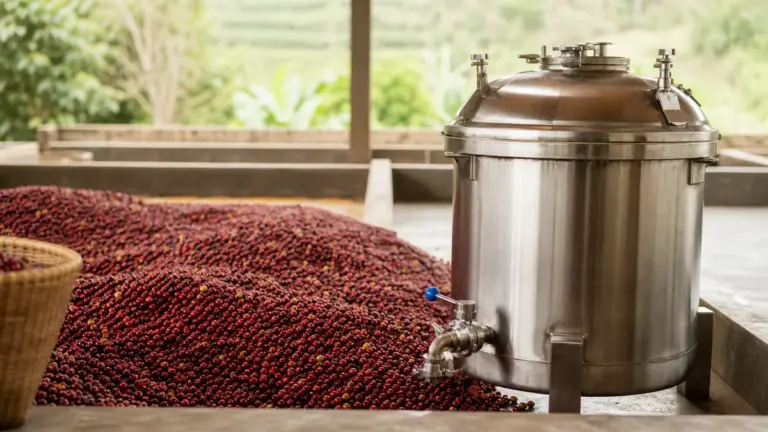
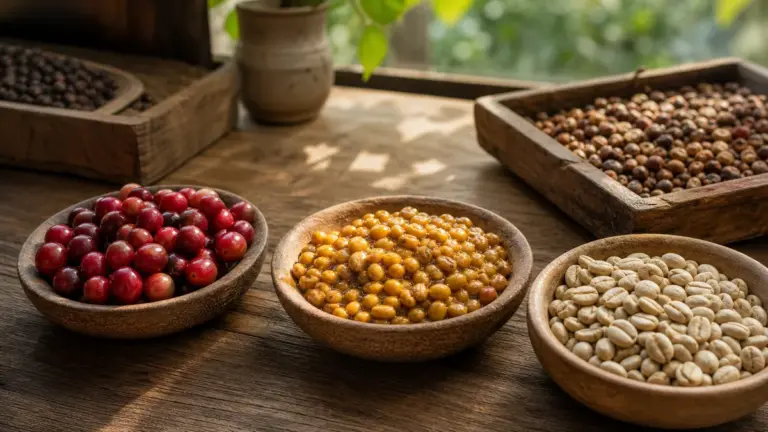
A coffee bean is a seed inside a fruit commonly called a cherry. Honey processing begins by depulping that fruit, meaning mechanically removing its skin and much of its outer flesh while retaining some of the slippery mucilage around the parchment.
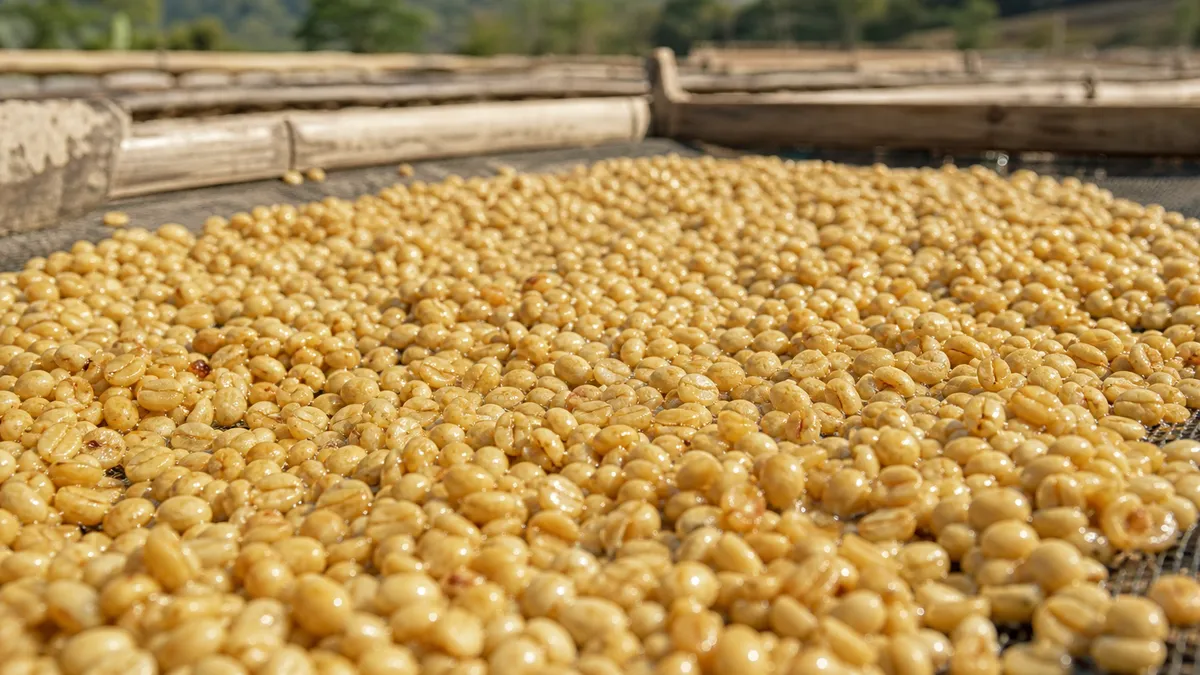
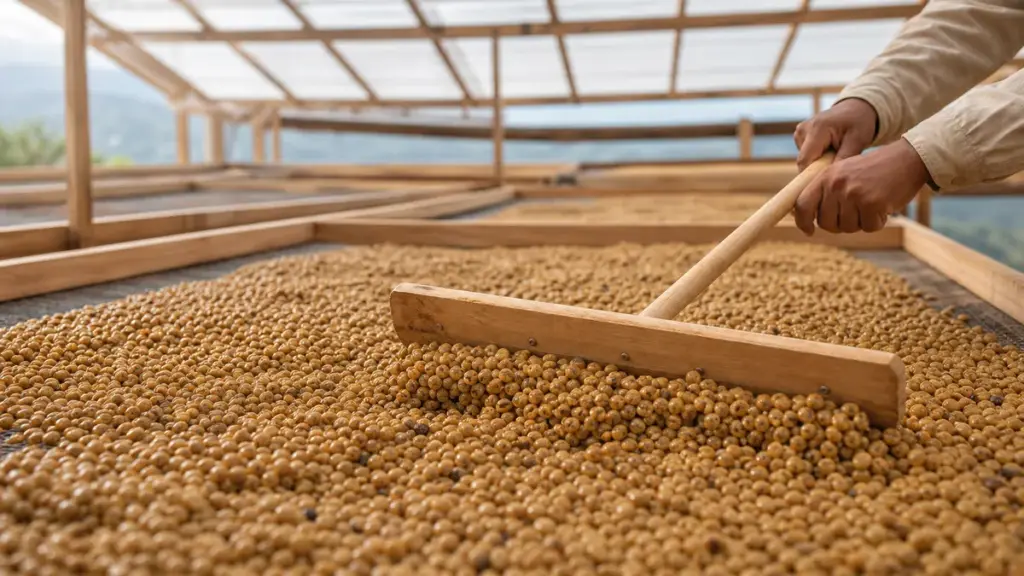
Instead of removing that mucilage completely before drying, the producer dries the parchment coffee with it attached. How much remains, and how the coffee dries, help shape the finished lot.
The basic sequence is:
- Select and sort the cherries. Fruit condition and ripeness provide the starting material for the process.
- Depulp the fruit. Remove the skin and outer flesh without deliberately stripping away every trace of mucilage.
- Adjust mucilage retention where required. A mechanical mucilage remover can take away part of the coating.
- Dry under a documented protocol. Manage exposure, ventilation, layer thickness and turning.
- Prepare the dried coffee. Remove the parchment during dry milling before roasting.
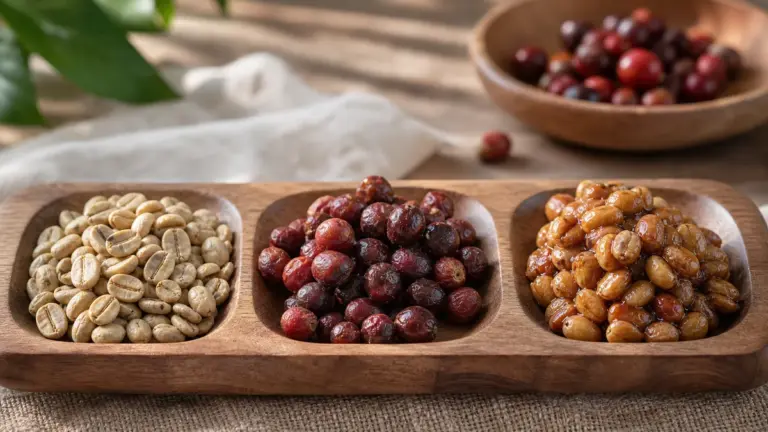
This distinguishes honey from the washed process, which removes the mucilage before drying, and the natural process, which dries the seed inside the whole cherry. Our parent guide to coffee processing methods maps the wider family.
Honey is often described as sitting between washed and natural. That is useful for understanding fruit removal, but it does not mean every honey coffee tastes halfway between them.
Honey and pulped natural: closely related methods
Honey and pulped natural share the same central idea: depulp the cherry, then dry the coffee with mucilage attached.
Pulped natural is particularly associated with Brazil. Honey is especially prominent in Central America, notably Costa Rica. The names overlap substantially, so neither label alone gives a complete account of the processing.
The Specialty Coffee Association describes Brazilian pulped natural production both with all mucilage retained and with some removed to make drying easier. Honey producers likewise use different degrees of removal and different drying treatments.
Do not assume that “pulped natural” always means yellow honey, or that every honey lot includes a separate fermentation tank stage. Ask what happened to the fruit, mucilage and parchment.
“Semi-washed” can also overlap with these terms, but its meaning needs checking in context. The separate semi-washed process guide explains that terminology rather than treating every use as an exact synonym.
Understanding the honey colours
White, yellow, red and black honey are not governed by one universal quantitative standard. They are useful descriptions within a producer’s system, not interchangeable technical specifications between farms.
Some producers distinguish colours mainly through mucilage removal. Others alter drying exposure, movement or duration. A colour can therefore describe a combination of choices rather than a measured percentage.
| Label | Common interpretation | What to check |
|---|---|---|
| White honey | Very little mucilage remains | How removal was achieved and what remained at drying |
| Yellow honey | A lighter honey treatment | Whether the distinction concerns mucilage, drying or both |
| Red honey | A more pronounced honey treatment | Retention, resting periods and turning |
| Black honey | A darker, often more prolonged treatment | The actual drying and fermentation protocol |
These are reading aids, not definitions. The colour name is not a roast level, a quality grade or a promise about the colour of the brewed drink.
White Honey
White honey generally names the lightest end of a producer’s honey range, with little fruit mucilage remaining during drying. It can sit close to mechanically demucilaged coffee, where equipment removes the coating rather than relying on fermentation followed by washing.
The boundary is not tidy. Royal Coffee notes that coffees with almost all mucilage mechanically removed may instead be sold as fully washed. Two suppliers can therefore use different names for closely related workflows.
For a buyer, the useful question is not “What percentage does white always mean?” but “How much mucilage remained when this lot went to dry, and how was it removed?”
Yellow Honey
Yellow honey commonly describes a lighter honey style, but it does not have a fixed retention percentage.
Las Lajas, a Costa Rican producer, describes its yellow honey as depulped coffee retaining a light amount of mucilage, dried on a greenhouse patio with controlled movement. Its published description emphasises sweetness and clarity.
That is a specific producer’s protocol, not a recipe for every yellow honey. Another mill may use the name for a different combination of retained mucilage and drying management.
Read yellow honey as an introduction to the process, then look for the lot details. It is not a guarantee of mild fruit flavour, low fermentation influence or any particular acidity.
Red Honey
Red honey often signals a more pronounced honey treatment than yellow within the same producer’s range. However, it does not universally mean that half the mucilage remains.
Las Lajas provides a useful counterexample: its published red honey description states that all the mucilage is retained. The coffee rests without movement on the first day, then is moved twice daily from the second day.
This differs from the SCA’s broader description of red and yellow honey as coffees dried with less than all their mucilage. The accounts describe different conventions, not a single agreed scale.
For clarity, this guide follows the producer’s own documented protocol when discussing a named coffee, and uses colour labels only as broad shorthand elsewhere.
Black Honey
Black honey is commonly associated with substantial mucilage retention and drying management that allows a more prolonged process. It is not a natural coffee simply because its name is dark: the cherry has still been depulped.
Las Lajas describes its black honey as resting without movement for the first two days after sorting and depulping, followed by controlled movement three to four times daily. The producer associates this treatment with greater sensory intensity and a dense body.
Those are producer-described characteristics, not independent findings that every black honey will taste that way.
Nor should black honey be treated as the top rung of a quality ladder. The label describes an approach; the cup still needs judging on its own merits.
Drying management: where the work happens
Sticky parchment coffee needs careful drying. Thick accumulations and uneven conditions can encourage unwanted fermentation, while excessive heat can damage quality.
Anacafé’s producer guidance recommends thin layers, effective ventilation and frequent turning for even drying. Its general advice is to keep honey coffee grain temperature below 40°C and finish at 10 to 12% moisture content. These are technical recommendations, not definitions of honey colour.
Producers manage several connected variables:
- Layer thickness: deeper accumulations can behave differently from thinly spread coffee.
- Air movement: ventilation helps remove moisture.
- Exposure and covering: shade and covers change drying conditions.
- Turning and resting: movement affects uniformity, while deliberate resting periods form part of some producer protocols.
- Measured progress: records of moisture, temperature and elapsed time are more informative than appearance alone.
There is no universal number of drying days for a colour. A published schedule belongs to its particular conditions and method.
The apparent tension between frequent-turning guidance and a producer’s deliberate resting stages is worth recognising. General drying advice aims to reduce unevenness and defects; an individual mill may use a carefully managed alternative to differentiate its coffee. That is not a reason to copy the schedule without its controls.
Costa Rica’s role
Costa Rica is a major reference point for honey processing, particularly for the use of named colour treatments. Cafe Imports identifies the country as especially prominent in the method’s development across Central America.
Las Lajas illustrates how a Costa Rican mill can offer distinct yellow, red and black honey protocols rather than one generic honey coffee.
It is more accurate to describe Costa Rica as an important centre of honey processing than to claim that it invented every form of drying depulped coffee with mucilage attached. The closely related Brazilian pulped natural tradition matters too.
What does honey processed coffee taste like?
Honey coffees can show caramel-like sweetness, fruit, nuttiness and a rounded texture. Las Lajas describes honey-process notes including peach, plum and red fruit, alongside a silky or creamy body.
These are sensory descriptions, not added ingredients or guarantees. “Honey process” does not require a honey flavour, and sweetness in the cup should not be explained simply as fruit sugar soaking into the bean.
There is experimental evidence for a more complex process. A 2025 study by Hu and colleagues compared different mucilage-retention treatments and found differences in green coffee volatile compounds and microbial communities. Associations between microorganisms and aroma compounds supported a role for fermentation, but did not establish a universal flavour ranking for the colour names.
Honey processing also does not mean fermentation-free processing. Microbial activity can occur during drying, and some protocols include a separate fermentation stage. A label such as “anaerobic honey” adds information about fermentation conditions; see anaerobic fermentation for that distinction.
A practical buying checklist
Before choosing a honey processed coffee, ask:
- Does the roaster identify the producer or mill?
- Is the colour explained through actual processing details?
- Are tasting notes given for this lot rather than copied from a generic colour chart?
- Is any additional fermentation stage disclosed?
- Can you compare related lots from the same producer?
For a useful tasting comparison, keep your brewing method and recipe consistent and record sweetness, acidity, texture and fruit character. Treat the honey process label as a starting question, not the answer.
FAQ
Is honey processed coffee made with bee honey?
No, ordinary honey processing does not involve adding bee honey. The name refers to the sticky fruit mucilage left on the parchment during drying. A separate infused or flavoured product would need its own explanation; the words “honey process” alone describe post-harvest handling, not an added sweetener.
Can a honey coffee also be anaerobic?
Yes, a coffee can combine honey drying with a low-oxygen fermentation stage. The terms describe different parts of production: honey concerns drying with retained mucilage, while anaerobic describes fermentation conditions. Ask whether the fermentation happened in whole cherry or after depulping, and what happened before drying.
Are white and yellow honey always better for filter coffee?
No, colour alone is not a sound basis for assigning a brewing method. It does not fully specify the process or establish the finished coffee’s sensory character. Start with the roaster’s description and intended use, then judge whether you enjoy the particular lot rather than following a colour-based rule.
Where to go next
Read Coffee Processing Methods for the overall framework, then Washed Process and Natural Process to understand the contrasting approaches to fruit removal. Anaerobic Fermentation explains the additional fermentation terminology you may encounter on honey processed coffee.
Sources
-
Cafe Imports, “Honey Process”, undated. Processing definition, Costa Rica’s prominence, producer variation and sensory descriptions.
https://www.cafeimports.com/europe/blog/honey-process/ -
Cafe Imports, “Pulped Natural Process”, undated. Brazilian pulped natural processing and its relationship to honey.
https://www.cafeimports.com/europe/blog/pulped-natural-process/ -
Royal Coffee, Chris Kornman, “Coffee Processing Styles and Terminology (Plus Flowchart)”, 2020. Overlapping names, colour conventions and fermentation terminology.
https://royalcoffee.com/blogs/blog/coffee-processing-styles-and-terminology-plus-flowchart -
Specialty Coffee Association, Carlos Henrique Jorge Brando, “The Impact of Mucilage Removers on Coffee Sustainability and Quality”, 25 Magazine, Issue 6, publication year not displayed on the retrieved page. Mechanical mucilage removal and pulped natural/honey descriptions.
https://sca.coffee/sca-news/25-magazine/issue-6/english/water-saving-demucilagers-y5bwa -
Anacafé, Luis Roberto Soto Fuentes, Guía de buenas prácticas para la innovación en procesos poscosecha, 2023. Honey protocols, colour terminology and drying recommendations.
https://www.anacafe.org/uploads/file/56ff869769ce4f718eea55b33c8424e6/Guia-innovacio%CC%81n-procesos-poscosecha.pdf -
Las Lajas, “Yellow Honey”, undated. Producer’s published yellow honey protocol and sensory description.
https://laslajascoffee.com/yellow-honey/ -
Las Lajas, “Red Honey”, undated. Producer’s published mucilage retention and turning schedule.
https://laslajascoffee.com/red-honey/ -
Las Lajas, “Black Honey”, undated. Producer’s published resting and movement protocol.
https://laslajascoffee.com/black-honey/ -
Hu and colleagues, “Characterization of volatile compounds and microbial diversity of Arabica coffee in honey processing method based on different mucilage retention treatments”, Food Chemistry: X, volume 25, article 102251, 2025. Experimental evidence concerning retention, microorganisms and aroma compounds.
https://pmc.ncbi.nlm.nih.gov/articles/PMC11838140/
This article was researched using national coffee institute guidance, SCA technical material, published producer protocols, importer documentation and peer-reviewed experimental research; no first-hand processing or tasting is claimed.
Last checked: November 2026