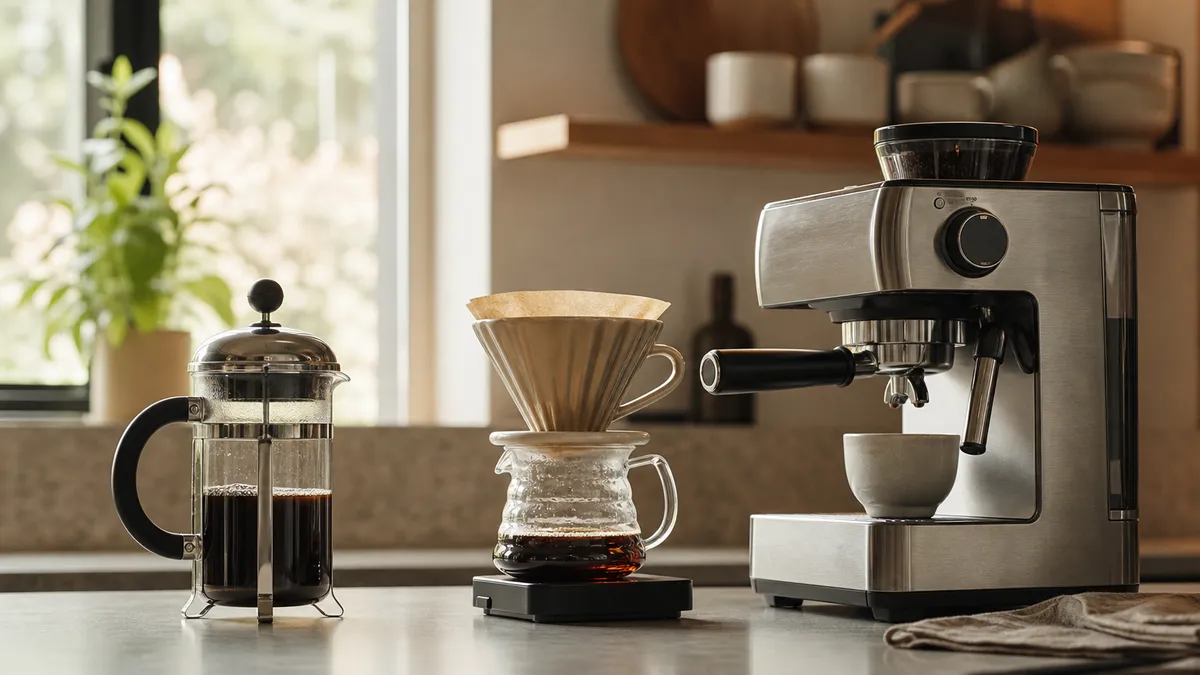
Choosing your first coffee maker starts with the drink you want, then the effort, space and equipment you are willing to give it. Shortlist a cafetière or filter brewer for longer coffees, an espresso machine for hands-on café-style drinks, or a capsule or fully automatic bean-to-cup machine when convenience comes first.
In short
- Decide what you want to drink before comparing machines: a mug of filter coffee and a latte need different equipment.
- Compare preparation and cleaning, not just how quickly coffee appears.
- Check usable capacity in millilitres rather than relying on the word “cups”.
- Pre-ground coffee is a valid starting point for cafetière and filter brewing; traditional espresso benefits from an espresso-capable grinder.
- Include accessories, coffee, filters and maintenance when planning your purchase.
Start with what you like to drink
Think about the coffee you actually order or enjoy at home, rather than the machine you imagine owning.
For a longer black coffee, or coffee with a splash of milk, start by comparing cafetières, pour-over drippers and automatic filter machines. A cafetière steeps the grounds in water before a mesh plunger separates them. A pour-over drains water through coffee held in a filter; an automatic filter machine handles the water delivery for you.
The filter affects texture. Paper generally retains more coffee oils and fine particles, giving a cleaner, lighter-feeling drink. Metal mesh allows more through, producing a fuller texture and sometimes sediment. Neither is automatically better: choose the texture you enjoy.
If your favourite drink is a flat white, cappuccino or latte, consider how you will make both the concentrated coffee and the textured milk. An espresso machine with a steam wand is one route; a suitable capsule or bean-to-cup machine with milk equipment is another.
A moka pot makes concentrated stovetop coffee that can work well with milk, but it does not reproduce pump-machine espresso. Choose it for its own drink, not as a promise of an identical result.
If the terminology still feels unfamiliar, the beginner’s guide provides a useful starting point.
Compare the main coffee maker options
The criteria below are drink style, hands-on work, grinder needs and the main compromise. Effort descriptions are editorial comparisons, not measured preparation times.
| Coffee maker | Best suited to | Preparation and grinder needs | Main compromise |
|---|---|---|---|
| Cafetière | Longer coffee with a fuller texture | Add ground coffee and hot water, steep, then plunge; separate grinder optional | Sediment and wet grounds to clear out |
| Pour-over dripper | Paper-filtered coffee and an enjoyable manual routine | Weigh, pour and manage water delivery; separate grinder optional | Requires attention during brewing |
| Automatic filter machine | A jug of coffee with less pouring work | Load coffee, filter and water; grinder separate unless integrated | Minimum batch size and carafe arrangement need checking |
| Moka pot | Concentrated stovetop coffee | Fill, assemble and supervise on a compatible hob; grinder optional | Not pump-machine espresso; milk needs separate equipment |
| Capsule machine | Repeatable individual drinks with little coffee preparation | Insert a compatible capsule; no separate grinder | Coffee choice is tied to the capsule system |
| Traditional espresso machine | Espresso and hands-on milk drinks | Prepare the grounds in a handled filter basket; usually pair with an espresso-capable grinder | More technique and cleaning |
| Fully automatic bean-to-cup | Freshly ground drinks with automated preparation | Integrated grinder and brewing; milk arrangements vary | Automated brewing still requires maintenance |
Treat this as a shortlist, not a quality ranking. The right category is the one whose drink and routine match yours.
A traditional espresso machine with a built-in grinder is not necessarily fully automatic. You may still have to move the ground coffee into position, tamp it, meaning compress it in the basket, and attach the basket before brewing. Look at the workflow rather than relying on “bean-to-cup” in a product description.
Match the effort to your real morning
Separate three things: preparation, attention during brewing and clearing up afterwards.
A cafetière avoids controlled pouring, but you still need to remove wet grounds and clean its mesh assembly. A pour-over asks you to stay involved while adding water. An automatic filter machine handles that pouring stage, although loading and cleaning remain your jobs.
For espresso, decide whether adjusting the grind and preparing the coffee sounds satisfying or irritating. There is no virtue in choosing a hobby when you wanted a drink.
Milk deserves a separate decision. A manual steam wand asks you to texture the milk yourself. An automatic milk system handles more of that process, but adds milk-contact parts to maintain. Ask to see the complete cleaning routine before buying, including any dismantling the instructions require.
Manufacturers’ automatic cleaning claims are not the same as independent evidence of effortless ownership. Read the manual, not just the product highlights.
For brewing technique after you have chosen the equipment, use making good coffee at home. There is no need to learn every brewing variable before making this decision.
Plan the whole purchase, not just the brewer
Set your own spending limit, then list everything needed to make your preferred drink. Do not use the machine alone as the comparison.
Depending on the method, include:
- A grinder, if you intend to buy whole beans.
- A kettle for a manual brewer.
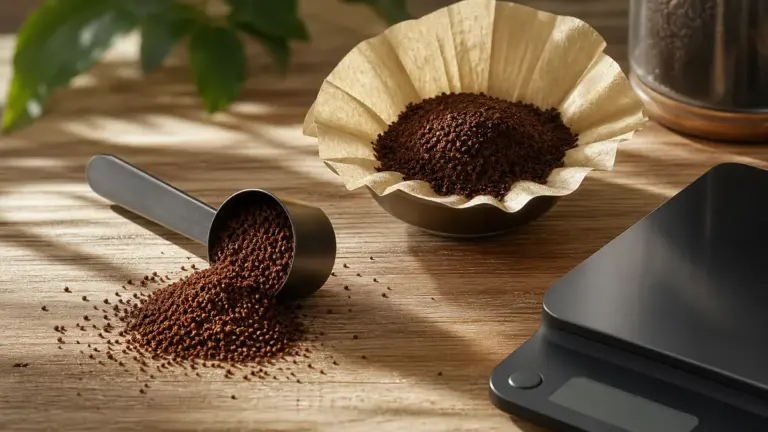
- Scales for repeatable coffee and water measurements.
- Suitable filter papers or compatible capsules.
- A milk jug or separate frother.
- Manufacturer-specified cleaning materials, descaler and replacement filters.
- Replacement parts and repair arrangements.
Compare the equipment you need immediately with optional additions you can leave until later. For example, you can begin filter brewing with appropriately ground coffee rather than buying a grinder at the same time.
For ongoing ownership, record your expected drinks, the coffee used for each, consumables and scheduled maintenance. Apply your chosen suppliers’ current figures to those quantities rather than relying on a headline running-cost claim. For a machine package or service arrangement, get itemised written quotations showing what is included and excluded.
Decide whether you need a grinder
You do not have to own a grinder to start making enjoyable coffee. For a cafetière, pour-over or filter machine, ask the coffee seller to grind for your brewing method.
The important distinction is suitability. Cafetière brewing commonly starts with a coarse grind, filter brewing with a medium grind and espresso with a fine grind. These are starting descriptions, not interchangeable settings across every grinder.
If you choose whole beans, an adjustable burr grinder is the sensible category to investigate. Burrs are the grinding surfaces between which beans are crushed. Adjusting their separation changes the grind size; compared with a blade grinder, this gives more control over the result.
Espresso needs particular care
An espresso grinder needs useful adjustment within its fine range, not merely a setting labelled “espresso”. Small grind changes can alter how quickly water passes through the prepared coffee.
Check which baskets come with the machine. A pressurised, sometimes called dual-wall, basket adds resistance and may be intended for pre-ground coffee. A conventional single-wall basket places more responsibility on the grind and preparation. Sage’s published instructions, for example, distinguish those uses explicitly.
Capsule machines need no separate grinder. Fully automatic bean-to-cup machines incorporate one.
Once you have chosen the method, choosing your first beans will help you select suitable coffee without turning this purchase into a second research project.
Check space, capacity and everyday access
Measure the working area, not simply the rectangle where the machine will stand.
Check width, depth and height against the manufacturer’s published dimensions. Then allow for opening lids, adding beans, removing the water tank and pulling out trays. Include the grinder and milk equipment in your layout.
Use a real mug to assess capacity. As a hypothetical example, two 300 ml mugs require 600 ml of finished drink. That is a statement of your serving requirement, not a brewing recipe: grounds retain some water, so the water added and drink collected are not identical quantities.
For a filter machine, check both maximum and minimum recommended batches. A large advertised capacity does not tell you how well it suits a single morning mug. For an espresso machine, ask to see the sequence for making your usual drinks back to back, including steaming milk.
Check hob compatibility explicitly before buying a moka pot, especially for induction. Do not infer compatibility from appearance alone.
Look beyond the feature list
For an automatic filter brewer, the Specialty Coffee Association’s Certified Home Brewer programme is a useful shortlist tool. It evaluates brewing quality, consistency and performance through third-party testing.
Certification is evidence about the programme’s tested requirements, not a guarantee that you will prefer the coffee or that the machine will be especially reliable. Lack of certification is not, by itself, proof of poor brewing.
For any electrical machine, read the manual before ordering. Check:
- Whether the cleaning routine fits your habits.
- Whether the intended coffee and milk drinks are genuinely supported.
- Which parts the user can remove and clean.
- Whether replacement parts and UK repair support are available.
- Whether a demonstration can show the complete routine.
Be cautious about comparing machines through isolated specifications. A feature is useful only if it improves the drinks or workflow you actually want.
Your decision path for choosing a first coffee maker
- Name your usual drink. Start with longer coffee, concentrated coffee or espresso-based milk drinks.
- Choose the texture. For longer coffee, compare paper-filtered clarity with the fuller texture of metal filtration.
- Choose your involvement. Decide whether you want manual brewing, automated water delivery or automated grinding and brewing.
- Check the complete setup. Include the grinder, milk equipment, consumables and cleaning routine.
- Check the fit. Confirm serving capacity, worktop access and compatibility with your kitchen.
- Remove unnecessary features. Keep only those that solve a need you can name.
My recommendation for an undecided beginner is to shortlist a cafetière and a paper-filter brewer first, then move towards espresso equipment only if espresso or textured milk is central to the drink you want. That recommendation is about matching the method to your needs, not making beginners pass through compulsory stages.
FAQ
Can I put milk in a coffee maker’s water tank?
Do not put milk in a water tank intended for water. Use milk only in the container, attachment or jug specified by the manufacturer. A machine advertising milk drinks may use a separate carafe, a tube drawing from another container or a steam wand, so check the instructions for the exact arrangement.
Do I need special beans for an espresso machine?
Choose beans you enjoy, then have them ground appropriately or adjust your grinder for espresso. Espresso describes a brewing method rather than a separate type of coffee bean. For fully automatic machines, also check the manufacturer’s restrictions on suitable beans rather than assuming every flavoured or treated coffee is acceptable.
Should I choose a manual or automatic milk system?
Choose manual milk steaming if you want to practise controlling texture, and automatic preparation if reducing hands-on work matters more. Neither removes the need to clean milk-contact equipment. Before deciding, compare the complete process for your usual drink, including filling, storing milk, rinsing and any scheduled disassembly.
Where to go next
Read How to Choose Your First Coffee Beans to match the coffee to your new brewer, then How to Make Good Coffee at Home for a repeatable starting routine. Coffee Strength vs Caffeine explains why a more intense-tasting drink is not automatically a more caffeinated one, while Coffee for Beginners maps the wider learning path.
Sources
Manufacturer information below was used for operating principles and published instructions, not as independent evidence of reliability or comparative performance. Undated webpages are identified as such rather than assigned an assumed publication year.
- National Coffee Association, French press coffee, undated. Equipment, filtration, grinding and preparation guidance.
https://www.aboutcoffee.org/brewing/french-press-coffee/ - National Coffee Association, Pour-over coffee, undated. Manual brewing, filter materials and equipment.
https://www.aboutcoffee.org/brewing/pour-over-coffee/ - National Coffee Association, Drip coffee, undated. Automatic filter brewing, capacity and ownership considerations.
https://www.aboutcoffee.org/brewing/drip-coffee/ - National Coffee Association, Espresso, undated. Espresso equipment, automation and grinder guidance.
https://www.aboutcoffee.org/brewing/espresso/ - Lavazza, How to prepare an Espresso perfectly with a Moka Pot, undated. Used for the distinction between moka coffee and pump-machine espresso.
https://www.lavazzausa.com/en/recipes-and-coffee-hacks/making-espresso-at-home - Sage Appliances, The Duo-Temp Pro BES810/SES810 User Guide, revision identified by filename as F23. Basket selection and operating instructions.
https://assets.sageappliances.com/BES810/SES810_EU_UG8_F23_FA_Online.pdf - Baratza, Stepped vs. Stepless: Which is Right for Your Grind?, undated. Burr adjustment and espresso grind precision.
https://www.baratza.com/en-us/blog/product-guides/stepped-vs-stepless - De’Longhi GB, Automatic Bean-to-Cup Coffee Machines, undated. Published descriptions of manual and automatic milk arrangements.
https://www.delonghi.com/en-gb/c/coffee/coffee-machines/automatic-coffee-makers - JURA, FAQs about maintenance & hygiene, undated. Manufacturer cleaning and maintenance instructions.
https://us.jura.com/en/customer-advice/optimum-maintenance/faq - Nespresso UK, Choose Your Nespresso System, undated. Capsule-system compatibility and milk-feature differences.
https://www.nespresso.com/uk/en/choose-your-nespresso-system - Specialty Coffee Association, SCA Certified Home Equipment, current programme webpage, undated. Certification scope and third-party testing.
https://sca.coffee/certified-home-brewer
This guide was researched using live retrieval of coffee-industry guidance, the SCA certification programme and manufacturers’ published instructions; no first-hand equipment testing is claimed.
Last checked: November 2026