To choose your first coffee beans, start with flavours you already enjoy, then check the roast level, freshness and whether you need whole beans or ground coffee. My recommendation for an undecided beginner is a small bag of medium-roasted coffee described as chocolatey, nutty or caramel-like, ground for your coffee maker if you do not have a grinder.
In short
- Choose by taste preference before worrying about a particular country or farm.
- Buy whole beans if you can grind them before brewing; otherwise, ask for a grind matched to your coffee maker.
- A blend is not automatically inferior to a single-origin coffee. Both can be excellent starting points.
- Look for a roast date and ask the seller when they recommend opening the bag.
- Start with roughly one or two weeks’ supply, then record what you liked before choosing the next bag.
Start with the coffee you want to drink
Before reading a bag, answer two questions: will you drink the coffee black or with milk, and would you rather taste chocolate and toasted nuts or fruit and flowers?
You do not need a sophisticated answer. “Something rounded, without much bitterness” is useful information. So is “I like a dark, roasty coffee that I can still taste through milk”.
For your first purchase, I suggest choosing one familiar-sounding flavour direction rather than the most unusual coffee available. That gives you a reference point. You can explore further once you know what you want more or less of.
If the terminology is still unfamiliar, our coffee for beginners guide puts the main ideas in order.
Choose your first coffee beans by roast level
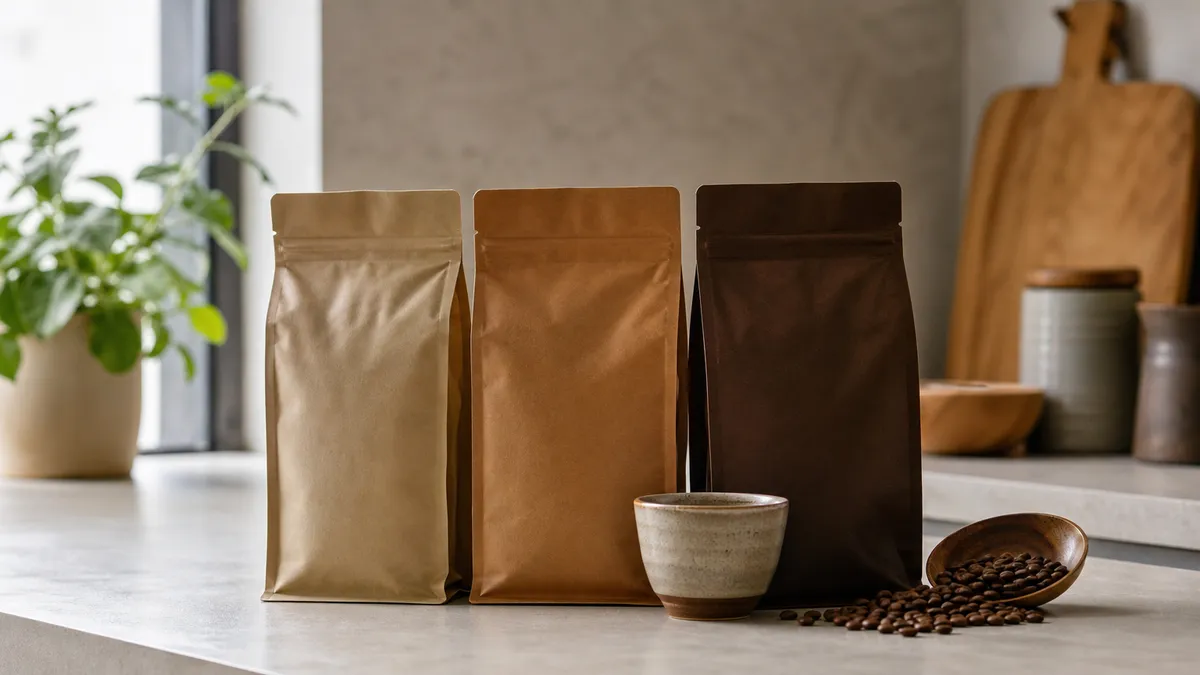
Roast level describes how light or dark the beans have become during roasting. It is a useful first filter, but not a complete flavour description.
Light roasts generally retain more of the coffee’s individual character. They can be lively and acidic, with fruit or floral qualities. Here, acidity means a sour or bright taste sensation, not necessarily an unpleasant cup.
Medium roasts sit between lighter and darker styles. For an undecided beginner, my preference is a medium roast with chocolate or caramel notes: it provides a useful starting point without committing to either extreme.
Dark roasts generally have more pronounced bitterness and less perceived acidity. Choose this direction if you actively enjoy a roasty flavour, rather than because you think beginners ought to drink it.
The labels are not perfectly consistent between sellers. Read the tasting notes alongside the roast description, and ask how that roaster uses the terms. Our guide to understanding roast levels explains the differences in more detail.
Understand tasting notes without taking them literally
On plain, unflavoured coffee, words such as “chocolate”, “apple” and “jasmine” describe sensory resemblances. They are not an ingredient list.
Think of tasting notes as directions rather than promises. A coffee described as chocolatey should suggest that general family of flavours; it will not taste like drinking melted chocolate. Likewise, “caramel” does not promise the sweetness of a caramel syrup.
Start with broad groups:
- Chocolate and nuts: useful search terms when you want familiar cocoa or toasted-nut associations.
- Caramel and brown sugar: descriptions pointing towards sweet-smelling, browned-sugar qualities.
- Fruit and flowers: terms to explore when you want something more aromatic or unfamiliar.
Professional sensory work uses defined references to describe coffee, but you do not need to identify every note on the packet. “More fruity than the last one” is a perfectly useful observation.
Read texture words separately. Body, or thickness in the mouth, concerns how the drink feels. A syrupy coffee and a lighter, tea-like coffee can both have appealing flavours; they simply provide different drinking experiences.
Decide between a blend and a single origin
A blend combines coffees selected to work together. A single-origin coffee comes from a stated geographical source, although that source might mean a country, region, producer group or individual farm.
Neither term guarantees that you will like the contents.
For a regular daily drink, a blend designed around a consistent flavour is a sensible starting point. Some roasters change its component coffees as harvests change, aiming to preserve the intended taste.
A single origin is useful when you want to explore a particular source and learn what distinguishes one coffee from another. Check how specifically the seller identifies that source, rather than assuming every single-origin bag comes from one farm.
Do not make country your only buying rule. Variety, growing conditions, processing and roasting all contribute to flavour. Use origin as another clue, then check the notes on the actual bag.
For the background to those differences, read how coffee is made.
Buy whole beans or the right ground coffee
Choose whole beans if you have a suitable grinder and are willing to grind before brewing. Grinding accelerates the release of gases and aroma, so keeping the coffee whole until you need it helps preserve its character.
Choose ground coffee if you do not have a grinder. There is no need to postpone making coffee while you assemble more equipment.
The crucial instruction is to name your brewer when ordering. Cafetière, paper-filter and espresso preparations generally need different grind sizes. A bag labelled simply “ground” may not give you enough information.
For a cafetière, a coarse grind is a conventional starting point. Paper-filter coffee generally uses a medium grind, while espresso requires a fine one. These are starting descriptions, not interchangeable settings across every grinder.
If you have not chosen a brewer yet, settle that question before ordering ground coffee. Our guide to choosing your first coffee maker helps match the equipment to your routine.
Check freshness and choose where to buy
Look for a roast date, which tells you when the coffee was roasted. A best-before date serves a different purpose and does not, by itself, reveal the roast date.
Freshness is not simply a race to brew the newest beans. Roasted coffee releases carbon dioxide in a process called degassing, while its aroma also changes during storage. Ask the roaster when they recommend starting the bag, rather than applying one fixed resting period to every coffee.
As a practical buying habit, begin with about one or two weeks’ supply. For example, if you use 15 g once a day, you need 105 g for seven days or 210 g for fourteen days. These are consumption calculations, not expiry deadlines.
Store your everyday supply in an airtight, opaque container somewhere cool and dark. Keep it away from heat, moisture and strong light.
Where should you buy?
For a first purchase, my preference is a seller who can explain the coffee and help with grinding. That might be a local roaster, a coffee shop selling beans or an online roaster with clear product information.
Supermarkets and other retailers remain options. Apply the same checks wherever you shop:
- Is the coffee whole bean or clearly described as a particular grind?
- Does the flavour description sound appealing?
- Is there a roast date, or can the seller explain freshness?
- Can you get advice for your brewing method?
If possible, taste a coffee before buying its beans. Ask whether the drink you are enjoying uses that exact coffee and how it was prepared.
Three starter suggestions by taste preference
These are starting recommendations, not guarantees based on origin or roast alone. Use the combination of roast description, tasting notes and your usual drink to narrow the choice.
| Your preference | What to look for | Why try it |
|---|---|---|
| Rounded and familiar | A medium roast, blend or single origin, with chocolate, nut or caramel notes | My suggested first reference point if you are unsure |
| Dark and roasty, often with milk | A medium-dark or dark roast described as dark chocolate, roasted nuts or smoky | Suits someone who deliberately enjoys roast-led flavours |
| Fruity and aromatic, especially black | A light roast with fruit, citrus or floral notes | A useful route into a more vivid, aromatic style |
Give the first bag a fair try before buying several alternatives. Record what you want to change: less bitterness, more body, gentler acidity or a more noticeable aroma. That instruction is more useful to a seller than “something better”.
Taste the first bag fairly before judging it
Brewing changes the result, so an unappealing first cup does not automatically mean you chose the wrong beans. Use one repeatable method before deciding.
The following is a simple cafetière comparison brew, not a requirement to buy another coffee maker. It combines a 60 g per litre starting dose with a conventional timed immersion method.
A numbered first-taste method
You need a cafetière suitable for the batch, scales, a timer, a spoon and a kettle.
- Measure 15 g of coffee. Start with a coarse grind, or ask the seller for cafetière-ground coffee.
- Prepare 250 g of water, approximately 250 ml, at 93 degrees Celsius. The coffee-to-water ratio by weight is approximately 1:16.7.
- Pour and start the timer. Wet all the grounds, using a gentle stir if necessary.
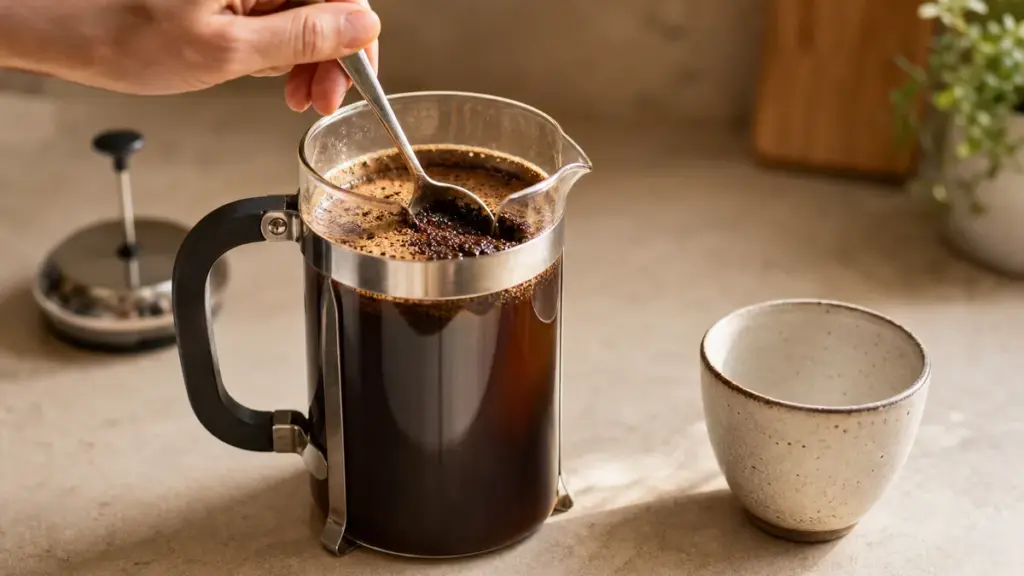
- Wait four minutes. Then gently break the floating crust with a spoon and skim off the foam and floating particles.
- Wait another 30 seconds, fit the lid and lower the plunger gently. Do not force it if it resists.
- Pour into your cup and allow it to cool comfortably. Taste first without additions if you wish, then with your usual milk or sugar. Note the aroma, sourness, bitterness and texture.
Repeat with the same quantities before changing the beans. For broader brewing advice, use how to make good coffee at home.
If the first cup disappoints
These are troubleshooting possibilities, not diagnoses from flavour alone.
| Symptom | Likely cause | Fix |
|---|---|---|
| Thin or watery | Incorrect dose, or a grind too coarse for the method | Check the weighed quantities; then try a slightly finer grind |
| More bitter than expected | A roast-led flavour you dislike, or brewing that needs adjustment | Clean the brewer; try a coarser grind before choosing a lighter roast |
| Flat, with little aroma | Ageing coffee or poor storage | Compare with a newly opened bag and improve storage |
| Gritty or difficult to plunge | Grounds too fine for the cafetière or a filter problem | Check the filter and try a coarser grind; never force the plunger |
The useful result is not a perfect tasting description. It is knowing what you would choose differently next time.
FAQ
Do I need to recognise every flavour on the bag?
No, broad impressions are enough to guide your next purchase. Tasting notes are reference points, not an examination. Begin by noticing whether you find the coffee fruity, chocolatey, bitter, light-bodied or thick. Write down your own impression before rereading the packet, and keep “I enjoyed it” separate from “I recognised the apple note”.
Are espresso beans a different kind of coffee bean?
No, “espresso” on a bag usually describes the roaster’s intended brewing use rather than a separate kind of bean. It does not specify one universal roast level. Tell the seller whether you will make espresso or use another method, and ask whether their suggested coffee and grind suit that preparation.
Must I stop using the bag after two weeks?
No, the suggested buying quantity is a practical way to limit ageing, not a universal discard deadline. Packaging, storage and the coffee itself affect how flavour changes. Keep the coffee dry and well sealed, follow the pack’s instructions, and distinguish a loss of aroma from signs of spoilage such as mould.
Where to go next
For help choosing your first coffee beans, Understanding Roast Levels explains the most useful flavour distinction, while How Coffee Is Made: From Seed to Cup connects flavour with production. Read How to Make Good Coffee at Home to make your brewing more repeatable, or Choosing Your First Coffee Maker if equipment is still the missing piece.
Sources
-
National Coffee Association, “Roasts”, undated web guidance. Used for roast categories, differences between sellers and the meaning of espresso roast.
https://www.aboutcoffee.org/beans/roasts/ -
World Coffee Research, “Sensory Lexicon”, version 2.0, October 2017. Used for the sensory basis of flavour descriptions.
https://worldcoffeeresearch.org/resources/sensory-lexicon -
Counter Culture Coffee, “Coffee Basics: Single-Origin Coffee”, undated web guidance. Used for origin terminology and factors influencing flavour.
https://counterculturecoffee.com/blogs/counter-culture-coffee/coffee-basics-single-origin -
Counter Culture Coffee, “Coffee Basics: Year-Round Coffee”, undated web guidance. Used as a primary example of maintaining flavour through changing blend components.
https://counterculturecoffee.com/blogs/counter-culture-coffee/coffee-basics-year-round-coffee -
National Coffee Association, “Storage and shelf life”, undated web guidance. Used for small-batch purchasing, storage and the distinction between ageing and spoilage.
https://www.aboutcoffee.org/beans/storage-and-shelf-life/ -
Specialty Coffee Association, “The Science of Coffee Freshness”, Samo Smrke, Expo Lectures 2019, lecture and transcript. Used for degassing, aroma loss and storage mechanisms.
https://sca.coffee/sca-news/podcast/81/the-science-of-coffee-freshness-samo-smrke-expo-lectures-2019-6lrbe -
National Coffee Association, “French press coffee”, undated web guidance. Used for method-specific grinding and troubleshooting.
https://www.aboutcoffee.org/brewing/french-press-coffee/ -
Specialty Coffee Association, Coffee Value Assessment: Sample Preparation and Tasting Mechanics, SCA Standard 102-2024, 2024. Used for the descriptive-assessment dose range, water measurement and sensory terminology.
https://sca.coffee/s/AW_SCA-102_Sample-Preparation_281024_Secured.pdf -
Coffee Collective, “French Press”, undated brew guide. Used for the temperature range and timed crust-breaking method. The article adapts its dose to the SCA descriptive-assessment range.
https://coffeecollective.dk/cdn/shop/files/French_press_guide.pdf?v=16904010372972159496
This article was researched using retrieved industry guidance, a sensory research resource, an SCA standard and primary roaster explanations; recommendations are editorial judgements, not first-hand testing.
Last checked: November 2026