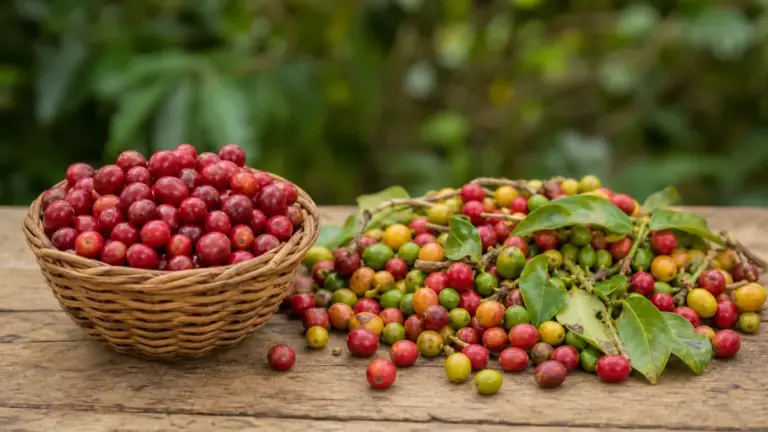
A coffee cherry is the fruit of the coffee plant, usually containing two seeds, the coffee beans, surrounded by skin, pulp, sticky mucilage, parchment and silver skin. Coffee cherry anatomy matters because ripeness and the way these surrounding tissues are removed influence processing, drying and the flavour potential of the seed.
In short
- Outside to inside: skin, pulp, mucilage, parchment, silver skin, then the main body of the bean.
- Pulp and mucilage are related tissues, not two completely separate botanical fruit layers.
- Parchment and silver skin are different: parchment is a protective fruit layer; silver skin closely covers the seed.
- A peaberry is a single, rounded seed that develops instead of the usual pair of flat-sided seeds.
- Processing starts with anatomy: washed, honey and natural methods differ principally in which fruit tissues remain during drying.
Anatomy of a Coffee Cherry
The simplest way to understand a coffee cherry is to work from its coloured surface towards the seeds. What looks like a small, uncomplicated fruit contains tissues with quite different jobs: enclosing the developing seeds, storing water and sugars, and protecting the material that eventually reaches the roaster.
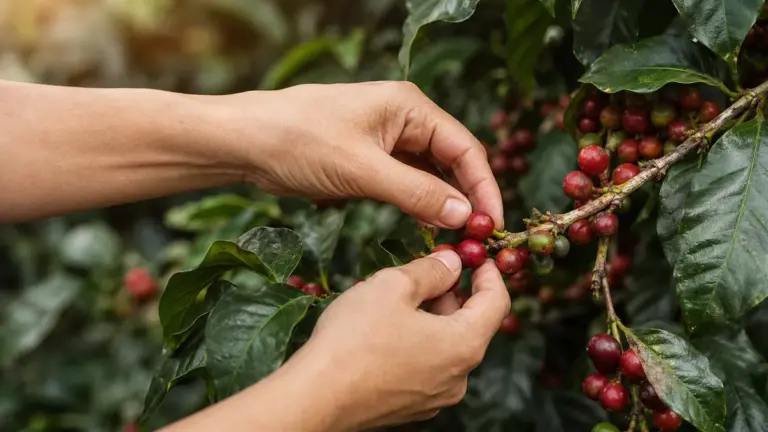
This is the anatomical foundation for coffee harvesting. Picking selects the fruit; processing separates and dries its components.
The layers, from outside to inside
| Part | Botanical description | What to look for |
|---|---|---|
| Skin | Exocarp, the outer fruit layer | The thin, coloured surface of the cherry |
| Pulp | Outer mesocarp, the fleshy middle tissue | Soft flesh immediately beneath the skin |
| Mucilage | Inner, mucilaginous mesocarp | Slippery, sticky material clinging around the parchment |
| Parchment | Endocarp, the innermost fruit-wall layer | A separate protective covering around each seed |
| Silver skin | Thin remnant of the perisperm, associated with the seed | A closely fitting film directly against the bean |
| Bean | The seed, consisting mainly of endosperm and a small embryo | The substantial inner part that is processed, roasted and ground |
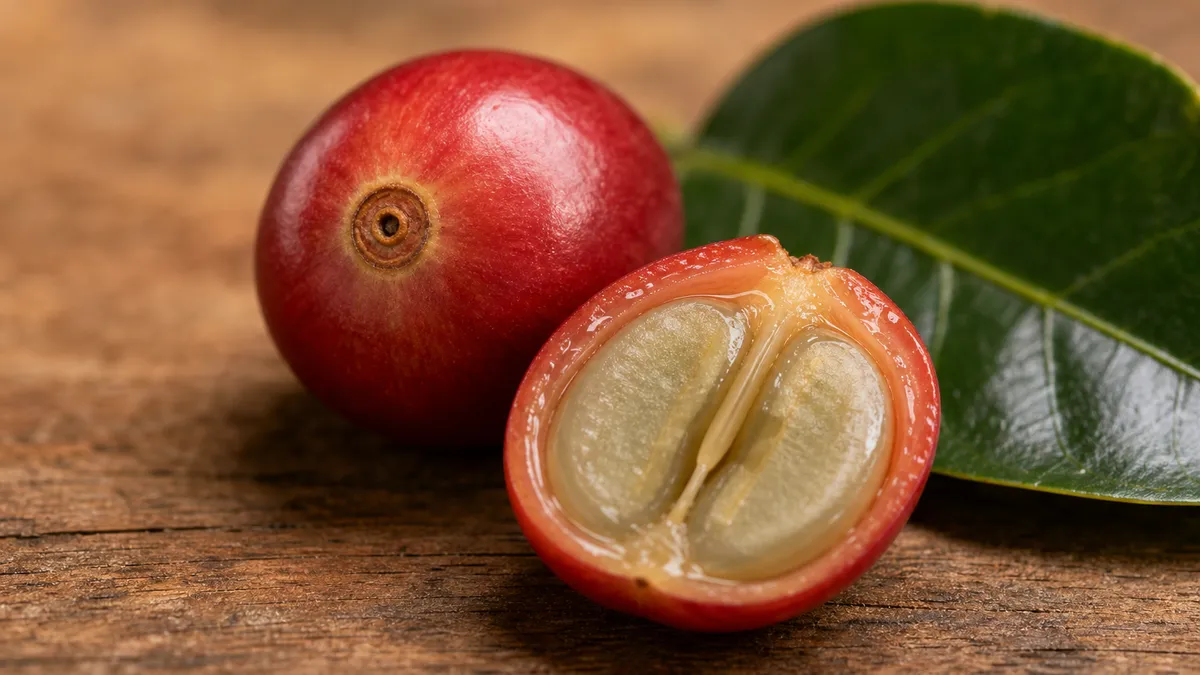
Read a cut cherry like this: find the outer skin, move through the flesh and sticky mucilage, then locate the parchment surrounding each seed. Beneath that covering lies the much thinner silver skin. In an ordinary cherry, the two seeds sit with their flatter faces towards one another.
These are useful distinctions, but the tissues are not equally easy to see. Mucilage is translucent and slippery rather than a neat, solid ring, while silver skin fits tightly against the seed. A simplified diagram can separate these components more clearly than a photograph.
Skin: the coloured outer surface
The skin is the cherry’s outermost fruit tissue. It is generally green during early development, then changes colour as the fruit ripens.
Red is familiar, but it is not the only ripe colour. Some coffee varieties produce yellow fruit, while others can show orange or pink tones. Colour therefore needs to be interpreted in relation to the plant, not against a universal rule that every ripe cherry must be dark red.
Pulp and mucilage: flesh and stickiness
The pulp is the fleshy material beneath the skin. Closer to the parchment, the tissue becomes mucilaginous: wet, slippery and rich in pectic substances, the plant materials associated with gel formation.
Coffee literature does not always use these names consistently. Some descriptions call the entire mesocarp “pulp” or “mucilage”; processing guides commonly distinguish outer pulp from inner mucilage. This article follows that practical distinction.
It explains an otherwise confusing mill term. A pulper removes the skin and much of the flesh, but the seeds emerge with mucilage still adhering to their parchment. “Pulped” does not mean completely stripped of fruit material.
Parchment: a separate protective covering
Parchment is the endocarp, part of the fruit wall rather than the bean itself. Each seed has its own covering.
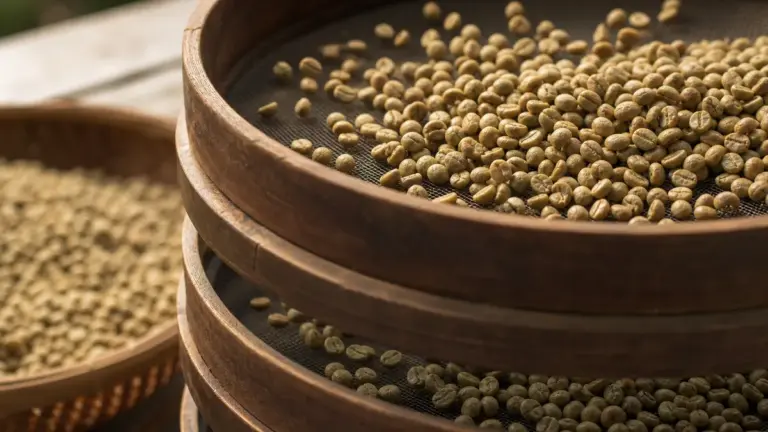
As the fruit develops, this tissue becomes tough. When dried, it forms the pale, papery-looking shell familiar as parchment coffee. In conventional washed processing, the coffee is dried with this covering intact, then hulled, meaning mechanically stripped of parchment, before being sold as green coffee.
Parchment is not simply another name for silver skin. The two coverings occupy different positions and are removed at different stages.
Silver skin: the film against the bean
Silver skin, also written “silverskin”, is the thin tissue directly covering the seed. It is associated with the perisperm, a tissue that occupies much more space earlier in seed development.
Some silver skin comes away during milling, while remaining material separates during roasting. The light flakes released at the roaster are commonly called chaff. A little material can remain in the bean’s central crease.
Unlike mucilage, silver skin is not sticky fruit flesh that needs washing away.
Bean: a seed with stored reserves
The coffee bean is a seed, not a separate object manufactured inside the fruit. Most of its substantial body is endosperm, the reserve tissue that supports the embryo, the small developing plant within the seed.
During development, the endosperm expands and accumulates reserves, including carbohydrates, lipids and proteins. Its chemistry provides material from which roasting develops coffee’s characteristic aromas and flavours.
That makes the bean more than a passive recipient of flavours from surrounding fruit. It is living plant tissue with its own development and metabolism.
Why there are usually two seeds, and what makes a peaberry
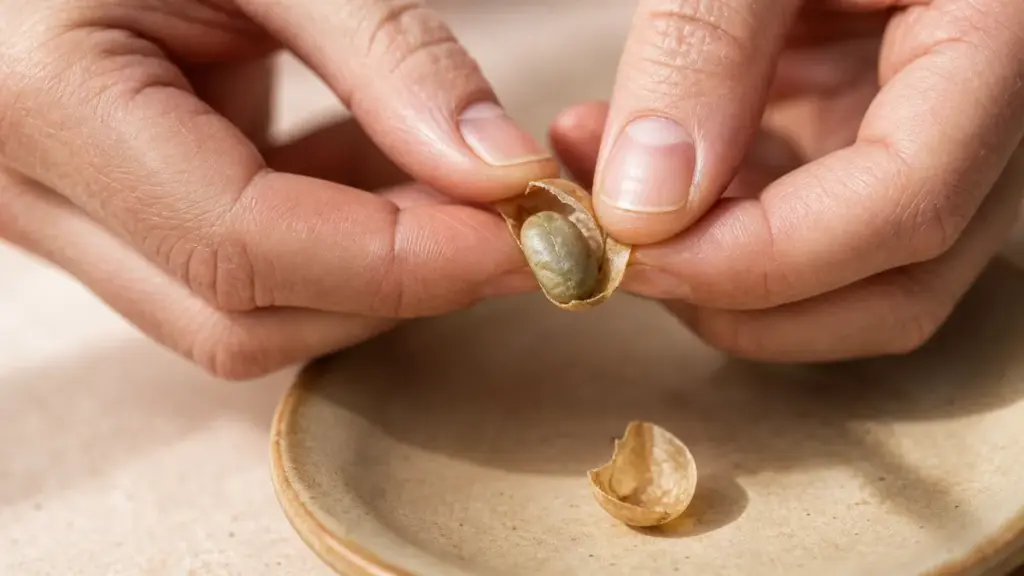
A typical coffee cherry contains two seeds with rounded outer surfaces and flatter inward-facing surfaces. They are separate seeds, not two halves of one bean.
Sometimes only one seed develops. It occupies the available space without the usual neighbouring seed and becomes more rounded: this is a peaberry.
The useful distinction is anatomical. “Peaberry” describes seed formation and shape, not a separate coffee species or a guaranteed flavour. For the separate questions of physical classification and defects, see green coffee grading.
Anatomy’s Influence on Quality
Anatomy connects quality at harvest with the practical decisions made afterwards. Fruit maturity changes the tissues arriving at the mill; processing determines what stays around the seed; drying must then manage the moisture held within that particular structure.
Ripeness changes both flesh and seed
Ripening is not merely the skin changing colour. The flesh softens, sugar metabolism changes, and the developing seed accumulates the reserves and chemical precursors that influence its behaviour during roasting.
Experimental work comparing maturation stages has found that maturity can favour better flavour development. That supports selecting appropriately mature fruit, but it does not establish a simple rule that the darkest cherry always makes the best cup.
A Cenicafé-led study published in 2023 compared three stages within the ripe range. Although some chemical measurements differed, the researchers found no statistically significant difference in overall sensory quality between those stages under their study conditions. The distinction between immature and suitably mature fruit should not be confused with a universal ranking of every shade of ripe red.
For harvesting decisions rather than anatomy, use the complete harvesting guide.
Fruit sugar is not the same thing as sweetness in the cup
Pulp and mucilage contain sugars, but those sugars are not simply preserved as a sweet coating on roasted coffee. Much of the surrounding fruit is removed, while sugars within the seed undergo chemical changes during roasting.
The distinction matters when interpreting claims about “sugary cherries”. A measurement of expressed fruit juice describes that sample of juice; it does not directly measure the sugar concentration inside the seed or predict how sweet the brewed coffee will taste.
Sugar within the developing bean also has its own supply route. Tracer experiments have shown the importance of material produced by leaf photosynthesis and transported into the seed. The cherry’s tissues participate in a living system, not a simple process of soaking a bean in fruit juice.
Processing decides which tissues remain during drying
The familiar processing names become easier to understand when viewed as decisions about layers.
| Processing method | What is removed before drying? | What remains around the seed during drying? |
|---|---|---|
| Washed | Skin and pulp, followed by mucilage removal | Parchment and silver skin |
| Honey | Skin and much of the pulp | Some or much of the mucilage, plus parchment and silver skin |
| Natural | The fruit is kept whole | Skin, pulp, mucilage, parchment and silver skin |
This is an overview, not an exhaustive classification. Producers use variations, including mechanical mucilage removal and different amounts of retained mucilage.
The anatomical question is straightforward: what remains outside the parchment when drying begins? The answer helps explain why different lots need different handling. The operational detail belongs in picking and processing.
Mucilage provides material for fermentation
The sugars and other nutrients associated with mucilage support microbial activity during processing. Microorganisms use these materials and produce metabolites, substances formed through their metabolism, while the seed itself also remains metabolically active.
A controlled wet-processing experiment published in 2019 found that fermentation duration influenced bean composition and cup quality. Longer fermentation produced a fruitier, more acidic cup in that experiment, but the authors also emphasised the importance of variety and local conditions.
This is evidence that processing can influence flavour, not permission to predict a cup from one layer alone. “More mucilage means sweeter coffee” leaves out microbial activity, fermentation conditions, seed chemistry and subsequent drying.
Protective layers also affect drying and handling
The surrounding tissues protect the seed, but they also affect the movement of water. Parchment presents a physical barrier, while retained fruit and mucilage add material that must be managed during drying.
This is why leaving fruit attached is neither automatically beneficial nor inherently defective. It is a processing choice that requires suitable handling. Poor management can permit unwanted fermentation, mould or deterioration.
Anatomy also explains why pulping needs care: the aim is to remove surrounding fruit without nicking or crushing the seeds. Sorting addresses a different question, which cherries belong in the lot, explored in Coffee Cherry Sorting and Floating.
What anatomy can, and cannot, tell you
Coffee cherry anatomy explains where processing acts and why ripeness matters. It cannot, by itself, reveal whether a finished coffee will taste floral, chocolatey, bright or flat.
The most useful reading of a coffee description therefore combines anatomical and processing information without turning either into a quality guarantee. A rounded peaberry, a yellow-ripe cherry and a mucilage-retaining process each describe something real, but none substitutes for assessing the finished coffee.
FAQ
Why does green coffee come from red fruit?
“Green coffee” refers to the unroasted seed, not the colour of the cherry it came from. The coloured skin and surrounding fruit tissues are removed during processing and milling. A red-ripe cherry can therefore yield green coffee without any contradiction: fruit colour and seed condition describe different things.
Should I remove pale flakes from roasted beans?
Small, dry flakes can be remnants of silver skin released during roasting, rather than pieces of parchment or fruit pulp. Some material may remain in the central crease. Appearance alone cannot identify every unfamiliar substance, however, so ask the roaster about anything that looks unlike ordinary loose, papery chaff.
Does “peaberry” tell me which coffee variety I am buying?
No, “peaberry” describes a seed that developed singly and became rounded, rather than identifying a variety. Treat it as one piece of information about the beans. The variety, origin and processing description provide different information; the word “peaberry” alone does not establish how the coffee will taste.
Where to go next
Read Coffee Harvesting: The Complete Guide for the decisions surrounding picking, then Picking and Processing to follow the fruit through the mill. Coffee Cherry Sorting and Floating explains lot selection, while Green Coffee Grading, Screen Sizes and Defects moves from coffee cherry anatomy to assessing the separated seeds.
Sources
-
TechnoServe, Coffee Wet Mill Processing Guide, undated, hosted in March 2022. Practical guidance on cherry structure, processing methods, pulping, mucilage removal and drying.
https://www.technoserve.org/wp-content/uploads/2022/03/TechnoServe-Wet-Mill-Processing-Guide.pdf. -
University of Hawai‘i at Mānoa, College of Tropical Agriculture and Human Resources, Bittenbender and Smith, Growing Coffee in Hawaii, revised March 2008. Fruit structure, paired seeds, peaberries, parchment and hulling.
https://www.ctahr.hawaii.edu/oc/freepubs/pdf/coffee08.pdf. -
Royal Society of Chemistry, Ferreira and colleagues, “Introduction to Coffee Plant and Genetics”, in Coffee: Production, Quality and Chemistry, 2019. Botanical terminology, pulp and mucilage usage, and parchment properties.
https://books.rsc.org/books/edited-volume/1829/chapter/2242994/Introduction-to-Coffee-Plant-and-Genetics. -
UPOV, Coffee: Guidelines for the Conduct of Tests for Distinctness, Uniformity and Stability, TG/249/1, 9 April 2008. Official descriptions of fruit-colour variation.
https://www.upov.int/documents/d/upov/tg-documents-en-tg249.pdf. -
New Phytologist, Joët and colleagues, Metabolic pathways in tropical dicotyledonous albuminous seeds: Coffea arabica as a case study, 2009. Original research on seed development, tissue replacement and reserve accumulation.
https://pmc.ncbi.nlm.nih.gov/articles/PMC2713855/. -
Journal of Experimental Botany, Geromel and colleagues, Biochemical and genomic analysis of sucrose metabolism during coffee (Coffea arabica) fruit development, 2006. Original biochemical, tracer and histological research.
https://academic.oup.com/jxb/article-pdf/57/12/3243/1228865/erl084.pdf. -
Molecules, Wang and colleagues, Morphological Changes and Component Characterization of Coffee Silverskin, 2021. Original chemical and microscopic research on unroasted and roasted silver skin.
https://www.mdpi.com/1420-3049/26/16/4914. -
Journal of Agricultural and Food Chemistry, Montavon and colleagues, Evolution of green coffee protein profiles with maturation and relationship to coffee cup quality, 2003. Experimental biochemical and sensory assessment of maturation.
https://pubmed.ncbi.nlm.nih.gov/12670177/. -
Cenicafé, University of Caldas and Specialty Coffee Association researchers, Osorio Pérez and colleagues, Chemical Composition and Sensory Quality of Coffee Fruits at Different Stages of Maturity, Agronomy, 2023. Original comparison of three ripe maturity stages.
https://pdfs.semanticscholar.org/3b78/4ddccab61e4e1aa3ce3a98339884adbc6c1d.pdf. -
Frontiers in Microbiology, Zhang and colleagues, Influence of Various Processing Parameters on the Microbial Community Dynamics, Metabolomic Profiles, and Cup Quality During Wet Coffee Processing, 2019. Controlled processing experiment examining microbes, bean chemistry and sensory outcomes.
https://pubmed.ncbi.nlm.nih.gov/31798557/.
Research combined university extension guidance and botanical reference material with original studies of seed development, maturation, silver skin and wet processing; no first-hand testing was undertaken.
Last checked: November 2026