Specialty coffee means coffee recognised for distinctive qualities that give it particular value, including its flavour, origin and how it was produced. The familiar definition of coffee scoring at least 80 out of 100 is a historical grading convention, not the whole of the Specialty Coffee Association’s current definition.
In short
- Historically, specialty-grade arabica combined a cupping score of 80 or above with physical quality requirements.
- The SCA’s Coffee Value Assessment separates physical characteristics, flavour descriptions, judgements of quality and information about origin and production.
- A numerical score can still be useful, but it cannot tell you everything about a coffee or predict your favourite.
- Look for specific sourcing information, a roast date and clear flavour descriptions, rather than relying on the word “specialty”.
- Specialty is not, by itself, proof of ethical sourcing, freshness or a particular certification.
What specialty coffee means for a drinker
The useful promise behind specialty coffee is that there is something identifiable and worthwhile about the coffee, and that the seller can explain it. That might be a distinctive aroma, a particular texture, a carefully documented origin or a combination of these things.
The Specialty Coffee Association, usually shortened to SCA, defines specialty through distinctive attributes and the additional value those attributes create in the marketplace. Its definition includes both the coffee itself and the coffee experience. It is therefore broader than a quality mark awarded after a single tasting.
For a beginner, the practical question is simple: what makes this particular coffee special, and is that something I enjoy? A detailed explanation is more useful than an impressive adjective.
You do not need to become a professional taster before answering. Start by noticing whether you enjoy the aroma, flavour, texture and finish. Our coffee for beginners guide puts this terminology into a wider, practical context.
The historical 80-point threshold
The older explanation of specialty coffee centred on professional cupping, a controlled way of preparing and tasting coffee samples for comparison. Under the SCA’s legacy scoring system, coffee receiving at least 80 points on a 100-point scale fell within the specialty quality classifications.
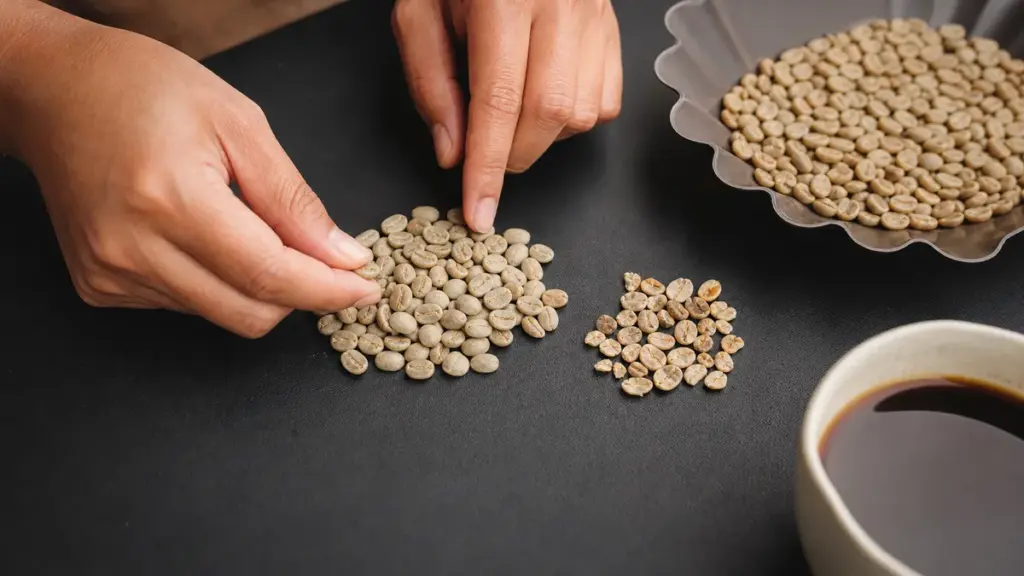
That was not the only requirement. The legacy green arabica grading protocol also required a 350 g sample of unroasted coffee to contain:
- Zero Category 1, or primary, defects.
- No more than five Category 2, or secondary, full-defect equivalents.
“Full-defect equivalents” matters. Depending on the defect type, several imperfect beans can count as one full defect. It does not simply mean that a grader finds five imperfect beans and rejects the next one.
These were complementary checks: inspecting unroasted beans assessed physical condition, while cupping assessed the prepared sample. A tasting score alone did not describe the entire grading process.
You will still encounter “80+” as shorthand, including in sellers’ explanations based on the older framework. Read it as a reference to a particular assessment convention, not a complete modern definition or a guarantee about every cup you brew.
How the Coffee Value Assessment changes the picture
The SCA’s Coffee Value Assessment, or CVA, provides a more detailed account of coffee than a single overall number. Its four assessment types answer different questions.
| Assessment | What it records | What it helps you understand |
|---|---|---|
| Physical | Characteristics such as bean size, colour, moisture and defects | The condition and physical properties of the coffee |
| Descriptive | Sensory characteristics, their intensity and relevant descriptors | What the coffee smells, tastes and feels like |
| Affective | The evaluator’s impression of quality | How positively that evaluator or their market values the sensory experience |
| Extrinsic | Information such as origin, processing, traceability and certifications | What is known about the coffee beyond its sensory and physical properties |
The distinction between descriptive and affective assessment is especially useful. Describing a coffee as intensely fruity is different from judging that fruitiness desirable. Two drinkers can recognise the same characteristic while disagreeing about how much they enjoy it.
CVA does not abolish numerical scoring. Its affective assessment can produce a score on a 100-point scale. The change is that a score sits alongside other information rather than being asked to represent everything valuable about the coffee.
Nor should old and new scores automatically be treated as interchangeable. The SCA’s CVA documentation explains that the newer scoring approach is designed to use a wider part of the scale.
What changed, and when?
CVA was introduced in 2023. On 4 November 2024, the SCA announced that Standards 102-2024, 103-2024 and 104-2024 had superseded its 2004 Cupping Protocol and Form. These cover sample preparation and tasting mechanics, descriptive assessment and affective assessment.
The current standards catalogue also lists SCA-105 for extrinsic assessment. However, the four-part framework should not be confused with four components all receiving final standard status together: the SCA still lists its wider green-coffee grading standard, SCA-110, as under development.
The Q Grader programme, which trains and assesses professional coffee evaluators, moved from the Coffee Quality Institute to SCA operation on 1 October 2025, using CVA. References that describe CQI as its current administrator are therefore outdated.
Why traceability matters
Traceability means being able to follow the coffee’s identity and sourcing information back through its supply chain. The useful question is how far that information goes, and what evidence supports it.
When reading a bag or product page, look for details such as:
- A named producer, producer group or co-operative.
- The farm, washing station or other processing location, where applicable.
- The producing region and country.
- The processing method and identification of the particular lot, where available.
Treat this as a reading checklist, not a compulsory recipe for specialty status. Ask the seller what the named origin actually represents. A place name might identify a farm, a processing site or a wider producing area, and those are different levels of information.
Traceability gives you something concrete to investigate and compare. It does not, on its own, demonstrate good working conditions, environmental performance or adequate producer income.
The CVA’s separation of sensory and extrinsic information is helpful here. A coffee’s flavour and its sourcing documentation can both matter without one being treated as proof of the other.
Freshness matters, but “freshest” is not a grade
Specialty status does not stop roasted coffee changing during storage. A coffee with a carefully documented origin and an excellent assessment can still lose the aromas that made it appealing.
The SCA’s review of coffee-staling research describes changes involving aroma loss and chemical reactions, with oxygen, temperature and moisture affecting deterioration. Its freshness guidance also explains degassing, the release of carbon dioxide held within roasted beans. Grinding accelerates that release substantially.
For buying, look for a roast date and ask the roaster when they recommend brewing that coffee. For storage, follow their advice and limit unnecessary exposure to air and heat.
Do not turn freshness into an inflexible countdown. The research does not justify one universal best-before window for every roast, package and brewing method. Nor does the youngest roast date establish that one coffee is better than another.
The practical aim is to preserve the characteristics you bought the coffee for. For the brewing side, use making good coffee at home rather than treating a specialty label as a substitute for a sound method.
What specialty tells you about price and producer payment
The SCA’s definition connects distinctive attributes with additional market value. That does not make the amount asked for a bag an independent test of quality.
Separate three questions: what qualities the coffee offers, what the seller tells you about sourcing, and what evidence exists about producer payment. One does not automatically answer the others.
The Specialty Coffee Transaction Guide makes an important distinction between the amount paid at export, commonly reported as FOB, and the amount reaching the farm gate. Its guidance explicitly warns that export transaction data do not establish whether farmers cover production costs or earn a living income.
If producer welfare matters to your choice, ask what payment information is available and what stage of the supply chain it describes. Treat a detailed explanation as evidence to examine, not an automatic ethical guarantee.
How to judge a specialty coffee claim
Use this short sequence when the word appears on a bag, menu or website.
- Ask what is distinctive. Look for a specific explanation of flavour, physical quality, origin or production rather than “premium” repeated in different words.
- Check the supporting information. Read the sourcing details and roast information, and investigate any certification separately.
- Put scores in context. If a score influences your decision, ask which assessment system was used and who assessed the sample.
- Choose for your own taste. A positive professional assessment is useful information, not an instruction to enjoy a flavour you dislike.
This is where marketing and assessment can become muddled. The word on the packaging does not tell you whether a particular lot was independently evaluated, which protocol was followed or whether an advertised certification applies.
Likewise, sensory descriptions and quality judgements are not the same thing. The CVA deliberately separates them. Use descriptions to decide whether a coffee sounds appealing, and use documented assessments to understand the evaluator’s judgement.
Finally, keep separate questions separate. Specialty is not a brewing-strength measurement; our strength and caffeine explainer covers that distinction.
The most useful specialty coffee claim is one you can investigate: identifiable characteristics, understandable evidence and a cup you actually want to drink.
FAQ
Is “speciality coffee” different from “specialty coffee”?
In this article, both spellings refer to the same concept. We use “specialty coffee” to match the terminology of the Specialty Coffee Association and its assessment documents. When comparing sellers, concentrate on their definition and supporting information rather than treating a spelling choice as evidence of a different grade.
Do I need to recognise every tasting note?
No, you can use tasting descriptions without identifying every aroma or flavour yourself. The CVA distinguishes describing sensory characteristics from judging their quality. Start with broad observations, such as fruity or nutty, and whether you enjoy the cup. You do not need to reproduce an evaluator’s vocabulary to make a worthwhile choice.
Can a coffee have a CVA assessment without a numerical score?
Yes, an evaluator can use a CVA assessment without producing an overall numerical score. The framework allows individual assessments or combinations of them, depending on the purpose. A descriptive assessment can record a sensory profile, for example, while the numerical quality score comes from the affective assessment rather than from all four assessments combined.
Where to go next
Read How to Make Good Coffee at Home to turn your chosen beans into a repeatable brew, then Common Beginner Mistakes to troubleshoot disappointing results. If you are still deciding how to brew, Choosing Your First Coffee Maker helps you match the method to your routine rather than buying equipment simply because it is associated with specialty coffee.
Sources
- Specialty Coffee Association, What Is Specialty Coffee?, undated current definition page. Source.
- Specialty Coffee Association, Protocols and Best Practices, undated legacy document containing the 2004-era cupping and green-grading protocols, particularly sections 2.1 and 3.5. Source.
- Specialty Coffee Association, Coffee Value Assessment, undated current framework page. Source.
- Specialty Coffee Association, A System to Assess Coffee Value, June 2024 revision, particularly sections 8.5 and 11. Source.
- Specialty Coffee Association, The SCA Officially Adopts CVA Descriptive and Affective Assessments as New Cupping Standards, 4 November 2024, retrieved from the SCA’s Squarespace-hosted archive. Source.
- Specialty Coffee Association, Standards, current catalogue listing SCA-102, SCA-103, SCA-104 and SCA-105, and standards in development. Source.
- Specialty Coffee Association and Coffee Quality Institute, The Specialty Coffee Association and the Coffee Quality Institute Announce Historic Partnership to Provide Better Support and Education to the Coffee Industry, 22 April 2025, retrieved from the SCA’s Squarespace-hosted archive. Source.
- Specialty Coffee Association, Emma Sage, What Is the Shelf Life of Roasted Coffee? A Literature Review on Coffee Staling, 2012. Source.
- Specialty Coffee Association, Peter Giuliano, Coffee Decoded: What Is “Freshly Roasted” Coffee?, undated web article drawing on published degassing research and The Coffee Freshness Handbook (2018). Source.
- Specialty Coffee Transaction Guide, 2024 Specialty Coffee Transaction Guide, 2024 reporting edition, especially its interpretation and limitations guidance. Source.
Researched using the SCA’s current definition and standards catalogue, its original assessment documents and transition announcements, its research-based freshness guidance, and the Transaction Guide’s limitations statement.
Last checked: November 2026