This coffee glossary explains the language of beans, processing, tasting and brewing in plain English. Use the alphabetical reference to look up a term, or start with the anatomy and brewing sections when you want to understand how the terms fit together.
In short
- Arabica and robusta describe coffee species, not roast levels.
- Natural, honey and washed describe processing methods.
- Strength means concentration; extraction means material removed from the grounds.
- Espresso ratios compare dry coffee with the finished drink by weight.
Coffee Industry Glossary
Three abbreviations appear throughout coffee reference material:
- ICO: International Coffee Organization, a source of coffee trade definitions and statistics.
- SCA: Specialty Coffee Association, which publishes coffee standards and assessment resources.
- WCR: World Coffee Research, which maintains a catalogue of coffee varieties.
Use this page alongside the guides accessible from home. Entries give a short definition, followed by an example or alternative name where useful.
Key Terminology Explained
Keep these distinctions in mind:
- Species versus variety: Arabica is a species; Java is a variety within arabica.
- Processing versus roasting: Processing prepares harvested coffee for roasting. Roasting heats green beans to develop roasted coffee.
- Strength versus extraction: A concentrated drink is not necessarily highly extracted. These describe different measurements.
- Body versus flavour: Body describes perceived weight in the mouth, rather than a particular taste.
Glossary of Coffee Terms
A to F
- Arabica: Coffee of the species Coffea arabica.
- Blend: A mixture of coffees, such as beans from different origins.
- Body: Coffee’s perceived weight in the mouth, from light to heavy.
- Burrs: Grinding surfaces that crush coffee beans between them.
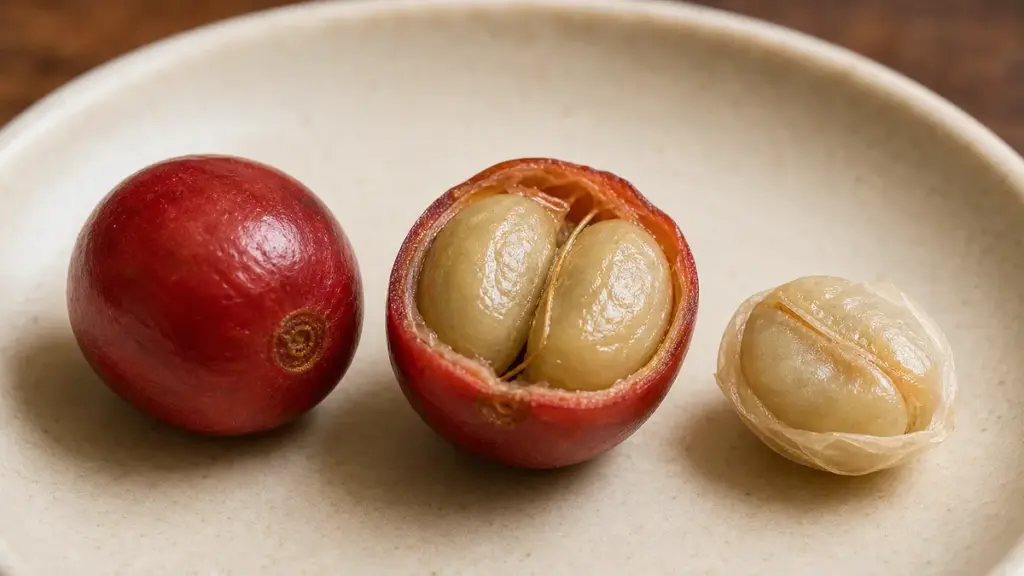
- Cherry: The coffee plant’s fruit, which contains the seeds called beans.
- Crema: The golden-brown foam on an espresso.
- Cultivar: A cultivated plant variety selected or developed by people.
- Cupping: A structured method of tasting and assessing coffee.
- Decaffeinated coffee, or decaf: Coffee from which caffeine has been extracted.
- Dry process: Another name for natural processing.
- Espresso: Concentrated coffee brewed by forcing hot water through finely ground coffee under pressure.
- Fermentation: Microbial activity that breaks down substances during coffee processing.
G to M
- Green coffee: Raw, unroasted coffee beans.
- Honey process: Processing in which depulped coffee dries with some sticky mucilage attached.
- Instant coffee, or soluble coffee: Dried, water-soluble coffee extract.
- Java: An arabica variety; its name alone does not establish where a particular coffee was grown.
- Jute sack: A hessian sack used to store or transport green coffee.
- Lot: An identified batch of coffee.
- Microlot: A small, separately handled lot of coffee.
- Mouthfeel: Coffee’s texture in the mouth, such as creamy or oily.
N to Z
- Natural process: Drying coffee inside the whole cherry before removing its outer layers.
- Peaberry: A rounded bean formed when one seed develops instead of the usual pair.
- Portafilter: The removable handle and basket assembly that holds grounds in an espresso machine.
- Puck: The compacted bed of ground coffee used for espresso.
- Quality control, or QC: Checks against specified requirements.
- Roasting: Heating green coffee to produce roasted beans.
- Robusta: The trade name commonly used for coffee of the species Coffea canephora.
- Screen size: Bean size classified using screens.
- Specialty coffee: Coffee recognised for distinctive attributes that give it additional value. The SCA’s definition is broader than a cupping score alone.
- Tamping: Compacting ground coffee in an espresso basket.
- Variety: A distinct plant type within a species, such as Java within arabica.
- Washed process, or wet process: Removing fruit material and mucilage before drying the coffee in parchment.
- Yield: Output. In farming it concerns the crop; in an espresso recipe it usually means the finished drink’s mass.
- Zero-bypass brewing: A brewer design intended to prevent water escaping around the coffee bed rather than passing through it.
Coffee Bean Anatomy
A coffee bean is a seed, not the whole fruit. Working from the outside towards the centre:
- Exocarp: The cherry’s outer skin.
- Pulp: The fleshy material beneath the skin.
- Mucilage: The sticky inner fruit material surrounding the parchment.
- Parchment, or endocarp: The protective layer outside the seed’s thin silverskin.
- Silverskin, also written silver skin: The thin covering around the bean.
- Endosperm: The seed’s storage tissue, forming most of the bean.
- Embryo: The young plant within the seed.
These names explain processing descriptions: removing pulp is not the same operation as removing parchment.
Brewing Terminology
- Bloom: Initial wetting of grounds at the beginning of brewing, often accompanied by bubbling and expansion as gas escapes.
- Brew ratio: The relationship between coffee and water or beverage, expressed by weight. Always identify which is meant.
- Channelling, US spelling channeling: Uneven flow in which water travels preferentially through particular parts of the coffee bed.
- Contact time: How long water and grounds remain in contact during brewing.
- Dose: The mass of dry ground coffee used.
- Drawdown: The draining phase as liquid passes through the coffee bed and filter.
- Extraction: The removal of soluble material from grounds into brewing water.
- Extraction yield, or EY: The mass extracted, expressed as a percentage of the original dry coffee dose.
- Strength: The concentration of dissolved coffee material in the drink.
- Total dissolved solids, or TDS: A measure used to express that concentration, commonly as a percentage.
For filter and immersion recipes, 1:16 means one part coffee to sixteen parts water by weight: for example, 15 g coffee and 240 g water. For espresso, 18 g in and 36 g out describes a 1:2 dose-to-yield ratio, not the amount of water entering the machine. These examples explain the notation, rather than prescribing a recipe.
Where to go next
Keep the Coffee Glossary open while exploring the guides from home. Read about us for the website’s purpose, and the editorial policy for how its reference material is prepared and checked.
Sources
Publication dates are given where the retrieved material identifies them; otherwise sources are marked undated.
- International Coffee Organization. Data concepts and variables used in the statistics of the Organization, SC 105/21, 11 March 2021. Source document.
- World Coffee Research. Coffee Varieties Catalog: What’s included, undated, live catalogue. Catalogue definitions.
- World Coffee Research. Coffee Varieties Catalog: Java, undated, live variety profile. Java profile.
- Specialty Coffee Association. What is Specialty Coffee, undated, current explanatory page. Definition.
- Specialty Coffee Association. Coffee Brewing Control Chart, March 2019 file, chart labelled Version 3. Brewing chart.
- National Coffee Association. What is coffee?, undated. Fruit and bean anatomy.
- National Coffee Association. Espresso, undated. Espresso terminology.
- National Coffee Association. Processes, undated. Processing terminology.
- Project Origin. Green Coffee Glossary, undated. Used for selected trade, processing and texture terms, not its older specialty-coffee definition. Glossary.
- Royal Society of Chemistry. Coffee: Production, Quality and Chemistry, “Introduction to Coffee Plant and Genetics”, 2019. Fruit anatomy section.
- Barista Hustle. P 2.05: Glossary and Recap; P 1.05: Blooming; P 1.07: Drawdown; B1 3.04: Recap and Glossary, undated training materials. Recipe terminology, blooming, drawdown, channelling.
- NextLevel Brewer Co. NextLevel Pulsar Brewer, undated manufacturer description. Used only to establish the intended meaning of no-bypass design, not to endorse performance. Design description.
Definitions were checked against industry organisations, botanical reference material and primary educational or manufacturer explanations, then rewritten for non-specialist readers.
Last checked: November 2026