Strong coffee is not necessarily high in caffeine: strength describes how concentrated the drink is, while caffeine is the amount of a particular stimulant it contains. Roast colour and intense flavour cannot reliably tell you the caffeine dose, and a large, gentle-tasting filter coffee can contain more caffeine than a small espresso.
In short
- Separate three things: coffee concentration, roast intensity and caffeine per serving.
- TDS measures concentration: it tells you the percentage of dissolved material in the brewed coffee, not its caffeine content.
- Compare the whole drink: caffeine per millilitre and caffeine per serving answer different questions.
- Adding water dilutes coffee, not its total caffeine: provided you drink the whole diluted serving.
- For less caffeine, use caffeine information: choose decaf, reduce the coffee dose or have a smaller portion of the same brew rather than relying on roast colour.
Why “strong coffee” can mean different things
When somebody asks for a strong coffee, they might mean a concentrated espresso, a dark roast with a pronounced roasted flavour, or a drink that delivers plenty of caffeine. Those requests are not interchangeable.
Here are the distinctions worth keeping:
- Brew strength: how much dissolved coffee material is present relative to the mass of the finished drink.
- Roast character: the flavour, aroma and colour developed during roasting.
- Caffeine dose: the milligrams of caffeine in the portion you actually drink.
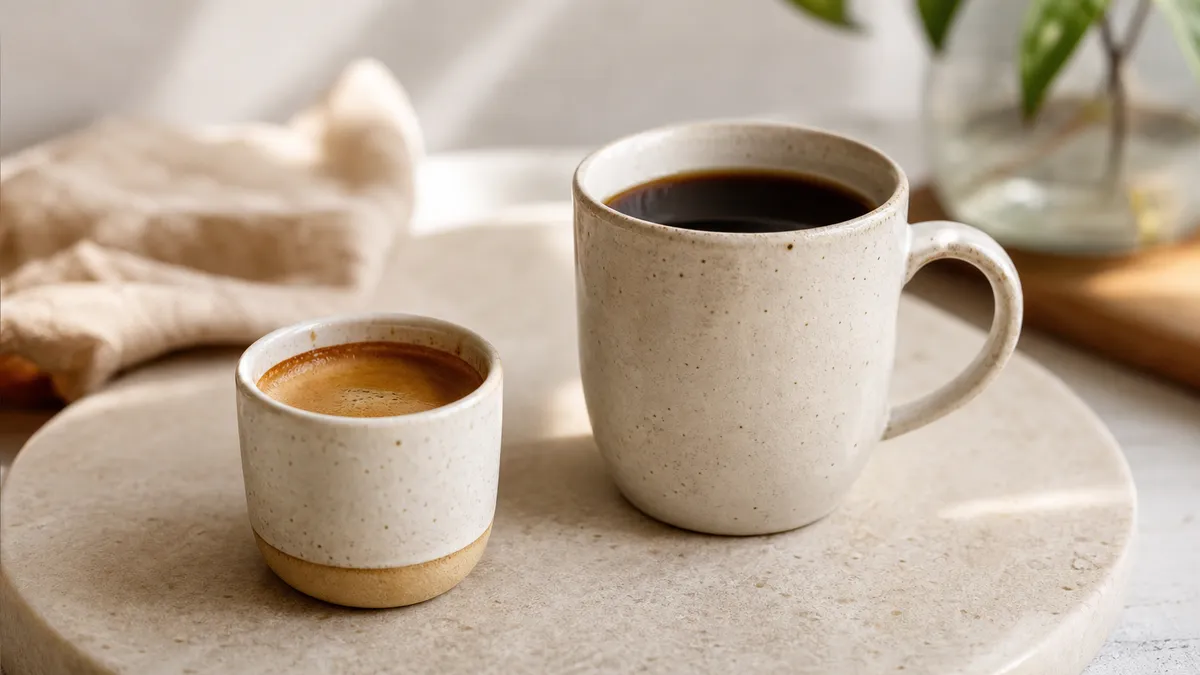
A coffee can score differently on each. Decaf espresso can be concentrated but low in caffeine. A large filter coffee can be comparatively dilute yet deliver a substantial caffeine dose because there is much more of it.
The useful response to “I want something stronger” is therefore: stronger in what sense? If you are still learning the vocabulary, our coffee for beginners guide provides a route through the other essentials.
Coffee strength vs caffeine: what TDS actually measures
In brewing, strength means concentration. It is commonly expressed as total dissolved solids, or TDS, given as a percentage by mass.
A coffee at 1.30% TDS contains approximately 1.30 g of dissolved material in every 100 g of drink. That material is a mixture of substances extracted from the grounds, not a measurement of caffeine alone.
The Specialty Coffee Association’s 2019 brewing control chart marks a filter-coffee strength zone of 1.15 to 1.45%. Treat that as a useful reference range, not a rule that every enjoyable filter coffee must obey.
Espresso is much more concentrated. Around 8 to 12% TDS is a useful approximate comparison range in espresso literature, although recipes can fall outside it. It does not mean espresso contains 8 to 12% caffeine.
Concentration is not extraction
Extraction describes material moving from the grounds into the brewing water. Extraction yield expresses how much of the original dry coffee mass has dissolved into the drink.
Concentration asks a different question: how spread out is that dissolved material?
Imagine dissolving the same amount of coffee material into a small drink and a large one. The smaller drink has higher strength even though both contain the same amount of dissolved material overall.
This is why adding water to finished coffee lowers TDS without removing caffeine. It is also why making a drink more concentrated does not automatically mean that you have extracted more caffeine from the grounds.
You do not need to measure TDS to enjoy coffee. Its main value here is explaining why “strong” and “caffeinated” are not synonyms.
How much caffeine is in the whole drink?
Serving size is the missing detail in many coffee comparisons. Espresso can contain more caffeine per millilitre while a larger filter coffee contains more milligrams altogether.
The following figures show both useful reference amounts and measured variation. They are not interchangeable estimates for an unspecified “cup”.
| Drink or sample | Serving size | Caffeine per serving | What the figure represents |
|---|---|---|---|
| Espresso | 60 ml | Approximately 80 mg | EFSA reference example, not a guaranteed single-shot value |
| Filter coffee | 200 ml | Approximately 90 mg | EFSA reference example |
| Regular brewed coffee | Approximately 355 ml | 113 to 247 mg | FDA published range, originally for a 12 US fluid ounce serving |
| Commercial espresso sampled in Glasgow | 13 to 90 ml across samples | 66 to 276 mg | Laboratory measurements reported in a 2014 study |
| Instant coffee | 2 g instant coffee prepared with 125 ml water | 48 to 88 mg | Laboratory measurements of eight products in that study |
The Glasgow figures describe a historical sample, not the current caffeine content of particular coffee shops. They demonstrate why a narrow promise such as “every espresso contains about the same caffeine” is unreliable.
NHS breastfeeding guidance also uses 140 mg for a mug of filter coffee, but does not specify that mug’s volume. It would therefore be misleading to relabel that figure as the caffeine content of every 250 ml filter coffee.
Why the figures vary
The beans, the amount of dry coffee used, the brewing process and the portion served all matter. Robusta, the coffee traded from Coffea canephora, generally contains more caffeine than arabica, so bean composition can change the result even before brewing begins.
Ask a coffee shop about its published caffeine information and how many shots go into the drink. “Small”, “regular” and “large” tell you less than the actual recipe.
When choosing your first coffee maker, separate the style of drink you enjoy from how much caffeine you want. A brewing method alone does not fix the dose.
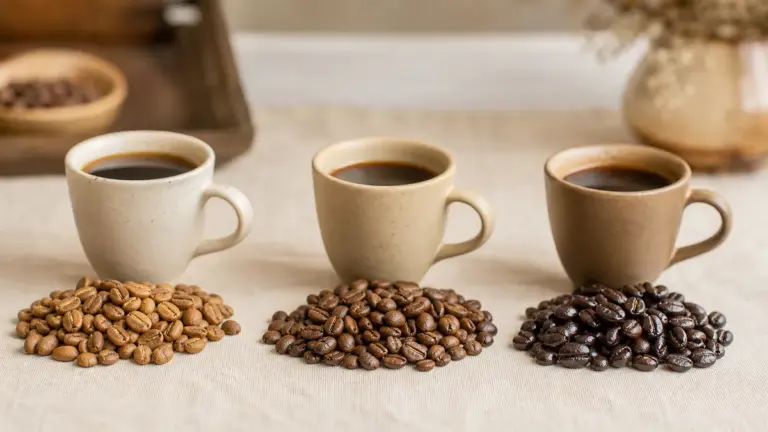
Does darker roasting mean more caffeine?
No. Roast colour is not a dependable caffeine scale.
Roasting changes the bean’s colour and chemistry, but the relationship between roast and caffeine in the finished drink is more complicated than “darker means stronger”. It also matters whether researchers compare identical brewing conditions or drinks with the same extraction yield.
A controlled laboratory study published in 2024 illustrates the problem. Under identical brewing conditions, its darker roasts generally produced lower caffeine concentrations than lighter and medium roasts. At the same extraction yield, however, the darker roasts generally produced higher caffeine concentrations.
Those findings are not contradictory: they answer different comparison questions. They also come from a particular set of coffees and experiments, not every coffee on sale.
Roasting changes bean structure and porosity, affecting how material is extracted. Meanwhile, other changes in soluble compounds affect the relationship between total extraction and caffeine extraction.
The practical lesson is simpler than the chemistry: choose roast level for the flavour you enjoy, not as a substitute for caffeine information. Weighing your coffee helps keep the dose consistent, but weighing alone cannot reveal its caffeine content.
How to change strength without confusing it with caffeine
Start by deciding what you want to change. A drink that tastes too concentrated needs a different adjustment from one that contains more caffeine than you want.
If the coffee tastes too concentrated
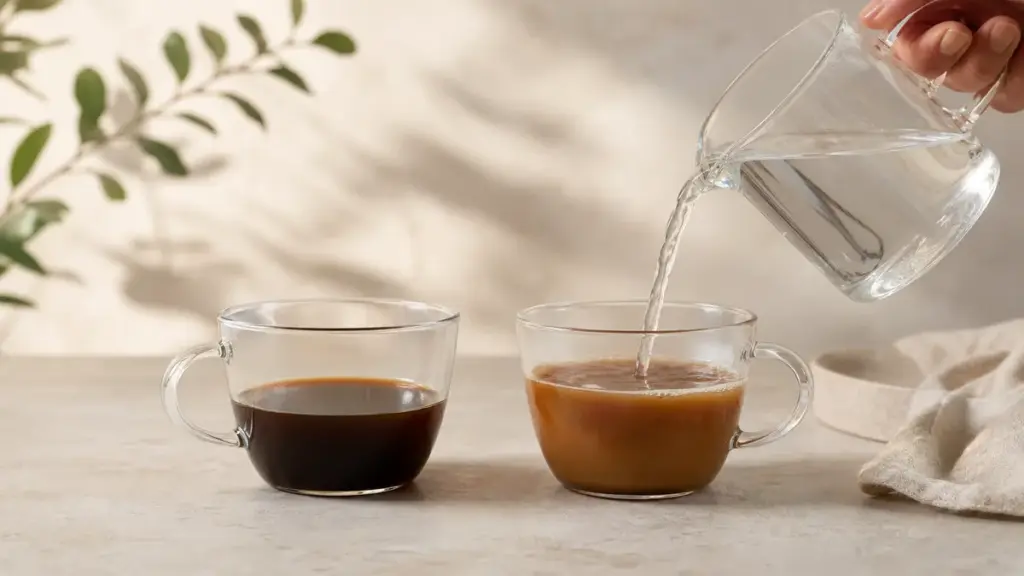
Try diluting a portion after brewing. This changes concentration without changing the original extraction, making it a particularly clear comparison.
- Stir a freshly brewed black coffee, then weigh 100 g into each of two suitable cups.
- Leave the first portion unchanged. Add 50 g of warm drinking water to the second.
- Stir both and compare them once they are at a similar, comfortable drinking temperature.
These are illustrative comparison quantities, not a brewing recipe. There is no prescribed brewing temperature or contact time because you are diluting an already finished drink.
The second portion contains the same amount of caffeine as the first, assuming the original coffee was evenly mixed and none was lost. Its caffeine concentration, however, is only two-thirds as high.
If the starting coffee measured 1.30% TDS, the diluted portion would be approximately 0.87% TDS:
1.30 × 100 ÷ 150 = 0.87
That is a calculated example, not a measurement of your coffee. Taste cannot confirm the starting TDS or caffeine content.
If you want less caffeine
Choose decaf, reduce the amount of caffeinated coffee used, or drink a smaller portion of the same mixed brew. Decaf is lower in caffeine, although it is not necessarily caffeine-free.
Adding water or milk to the same coffee does not remove its caffeine. It only spreads that caffeine through a larger drink.
If you want more concentrated coffee
Using less brewing water relative to the coffee can increase concentration, although changing a recipe can also change extraction. Record the coffee and water weights so that adjustments are repeatable rather than relying on a heaped scoop.
Avoid changing everything together. Our guide to common beginner mistakes explains why changing one variable at a time makes troubleshooting more useful.
Four myths worth leaving behind
“Espresso always has more caffeine than filter coffee.”
This confuses concentration with serving size. A concentrated small drink can contain less caffeine overall than a much larger, more dilute one.
“Dark roast is the highest-caffeine choice.”
Dark colour and pronounced roasted character make this sound plausible, but roast colour does not establish the caffeine content of a serving.
“Adding milk makes the coffee low in caffeine.”
A milky drink may seem gentler, but adding milk to the same espresso does not remove caffeine. The underlying coffee recipe still matters.
“A higher TDS reading tells me the caffeine dose.”
TDS measures the combined dissolved material. Caffeine is only one component, and its relationship with the other extracted substances is not fixed.
Use caffeine guidance, not flavour, to manage intake
For caffeine management, count milligrams from all sources rather than counting “strong coffees”.
EFSA’s 2015 scientific assessment concluded that single doses up to 200 mg, and habitual intake up to 400 mg a day spread across the day, raise no safety concerns for healthy non-pregnant adults. It also found that 100 mg near bedtime can affect sleep in some adults.
These are population-level findings from an evidence review, not intake targets or a guarantee for every individual. Sensitivity, medicines and health conditions can change what is appropriate.
The NHS advises no more than 200 mg daily during pregnancy, from all sources. Its breastfeeding guidance says cutting caffeine out is sensible and, if you do consume it, to try not to exceed 300 mg a day.
Speak to a GP, pharmacist or midwife about personal circumstances. The practical distinction between coffee strength and caffeine remains useful: adjust concentration for taste, and use caffeine information to manage intake.
FAQ
Can decaf coffee still taste strong?
Yes, decaf can be brewed as a concentrated drink. Decaffeination and brew strength describe different things: removing much of the caffeine does not prevent the remaining coffee material from being concentrated in a small serving. Decaf still contains some caffeine, so use product-specific information if that matters for your circumstances.
Does a longer espresso contain less caffeine because it tastes weaker?
Not necessarily. Passing more water through the same grounds can dilute the drink while also extracting additional caffeine. That differs from adding water after brewing, which changes concentration without extracting anything further. Neither the drink’s volume nor its apparent intensity is enough to establish its caffeine dose.
Can I measure caffeine with a coffee refractometer?
No, a coffee refractometer estimates total dissolved solids rather than measuring caffeine selectively. It can help assess brew concentration, but it cannot separate caffeine from the other dissolved substances. The laboratory studies discussed here used chromatography, an analytical technique that separates compounds, to measure caffeine independently.
Where to go next
Read Choosing Your First Coffee Maker to match equipment to the drinks you enjoy, then The Home Coffee Starter Kit for a practical starting setup. What Does Specialty Coffee Mean? explains another distinction worth keeping separate: coffee quality is not the same thing as strength or caffeine content.
Sources
- Specialty Coffee Association. Coffee Brewing Control Chart, version 3, March 2019 revision. Defines strength as solubles concentration and distinguishes it from extraction yield. Source PDF.
- State Polytechnic of Lhokseumawe, Journal Polimesin. Winarso and colleagues, The effect of temperature, pressure, and grind size on Total Dissolved Solids (TDS) and extraction yield of semi-automatic espresso machines, volume 22, June 2024. Used for the approximate espresso TDS comparison, not as verification of an official SCA espresso standard. Research paper.
- European Food Safety Authority. Caffeine, topic page summarising its 2015 assessment and approximate beverage reference amounts, accessed November 2026. EFSA guidance.
- US Food and Drug Administration. Spilling the Beans: How Much Caffeine is Too Much?, 2024, accessed November 2026. Used for the brewed-coffee range and decaf guidance. FDA guidance.
- Royal Society of Chemistry, Food & Function. Ludwig and colleagues, Variations in caffeine and chlorogenic acid contents of coffees: what are we drinking?, 2014. Laboratory analysis of commercial and experimentally prepared coffees. Research paper.
- Nature Portfolio, Scientific Reports. Lindsey and colleagues, Caffeine content in filter coffee brews as a function of degree of roast and extraction yield, 2024. Controlled laboratory experiment. Research abstract and publication details.
- MDPI, Foods. Schmieder and colleagues, Influence of Flow Rate, Particle Size, and Temperature on Espresso Extraction Kinetics, 2023. Controlled laboratory investigation of caffeine and other extracted components. Research paper.
- European Food Safety Authority. Scientific Opinion on the safety of caffeine, EFSA Journal 13(5):4102, 2015. Evidence review and risk assessment. Scientific opinion.
- NHS. Foods to avoid in pregnancy, current online guidance, accessed November 2026. Pregnancy guidance.
- NHS. What to eat and drink, breastfeeding guidance, current online version accessed November 2026. Breastfeeding guidance.
This article was researched using SCA brewing material, laboratory coffee studies and current official caffeine guidance; calculations are illustrative and no first-hand testing is claimed.
Last checked: November 2026