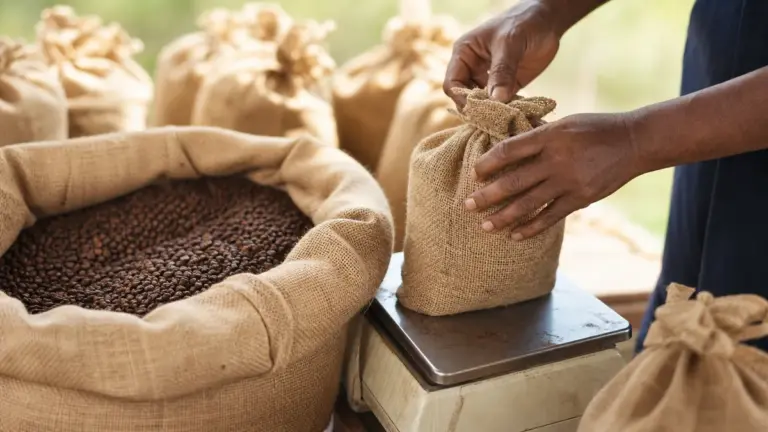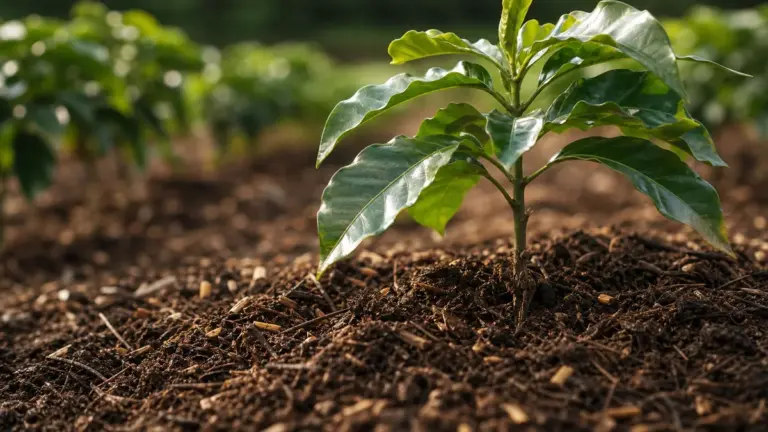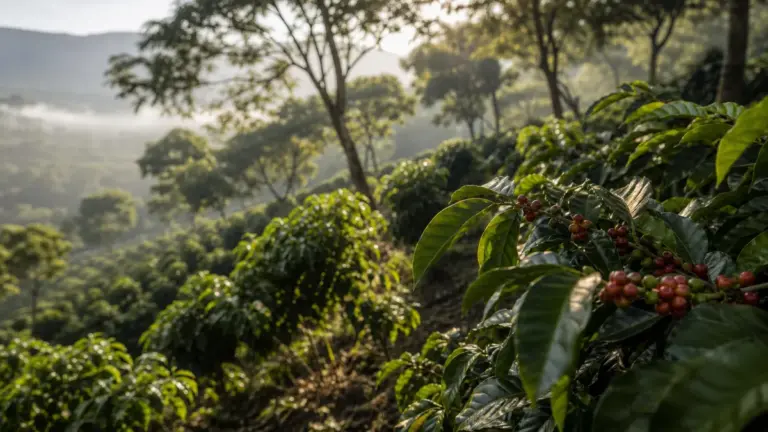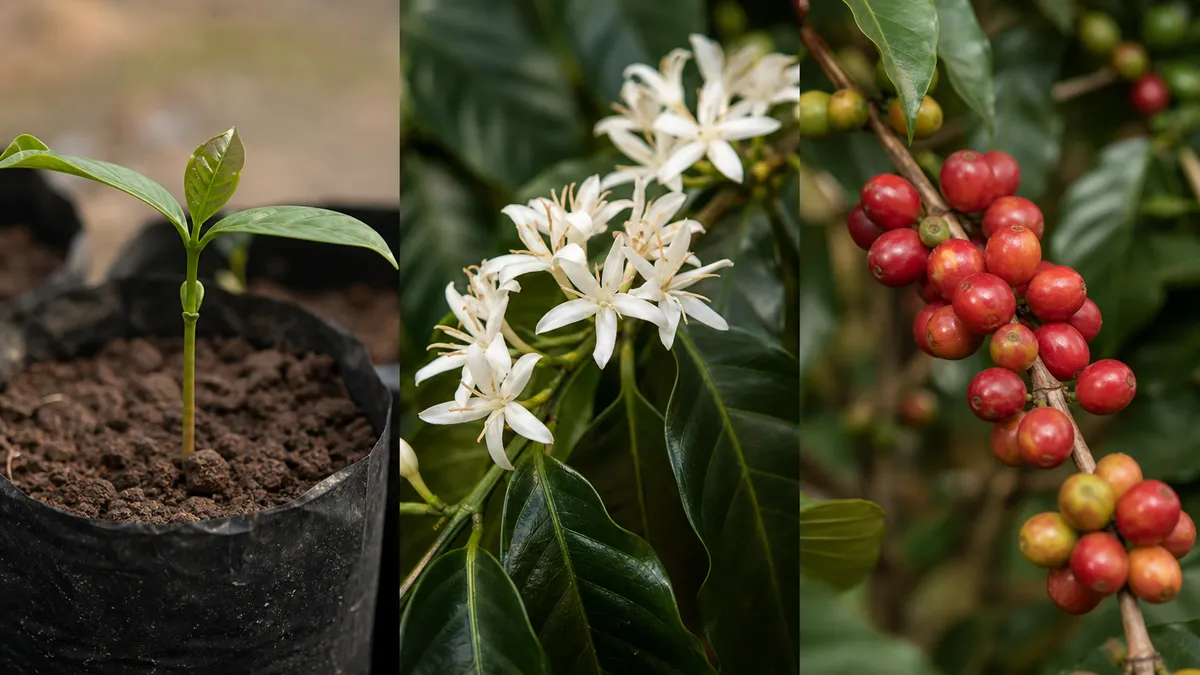
A coffee plant’s life cycle runs from seed to seedling, then to a woody shrub or small tree that repeatedly flowers and produces fruit. Under favourable growing conditions, arabica can produce its first crop at about three years old, but timing varies; the “beans” we roast are the seeds inside its fruit, known as coffee cherries.
In short
- Coffee is a perennial plant: it survives and crops across successive years rather than dying after harvest.
- Germination starts below ground, before the seedling becomes visible.
- Arabica is largely self-pollinating; robusta needs pollen from a genetically compatible plant.
- Cherries take several months to mature, and ripe fruit is not always red.
- A tree’s biological lifespan is different from its productive lifespan. Pruning can renew fruiting growth, but it does not turn an old plant into a new seedling.
The coffee plant life cycle at a glance
Coffee follows a repeating reproductive cycle once it reaches maturity. Harvest removes the fruit, not the whole plant, so a healthy tree can grow new shoots, flower and bear again.
The outline below describes cultivated arabica and robusta. These are different species: Coffea arabica and Coffea canephora, respectively. Robusta is the familiar trading name for the latter.
| Stage | What happens | Timing or useful distinction |
|---|---|---|
| Seed and germination | The embryo grows and its first root emerges | Visible emergence is later than germination itself |
| Seedling | Seed leaves open, followed by true leaves and branching | Nursery development takes months |
| First crop | Mature growth flowers and sets fruit | An arabica example in PROSEA begins cropping at about three years old, after two years in the field |
| Cherry development | Fruit expands, seeds fill and the cherry ripens | PROSEA gives about 8 to 9 months for arabica and 9 to 11 months for robusta |
| Repeated cropping and renewal | New growth supports later crops; pruning replaces ageing wood | Productive life depends on the plant and its management |
These are biological reference points, not a universal harvest calendar. Temperature, rainfall, variety and growing conditions alter development. For the wider sequence of nursery work, planting and harvesting, see the complete farming guide.
Plant anatomy: what each part does
A coffee plant is more than a stem carrying cherries. Its roots, leaves and branches support the developing crop, while the fruit protects the next generation.
Roots, stems and leaves
Seed-grown coffee develops a main root with branching roots and finer feeding roots. Together they anchor the plant and take up water and mineral nutrients. Soil conditions influence how far the root system can explore.
Above ground, coffee has upright stems and spreading side branches. Its glossy leaves grow in opposite pairs, meeting the stem at points called nodes. Flowers appear in clusters in the leaf axils, the angles between leaves and stems.
The leaves supply the sugars needed for growth and fruit development through photosynthesis. This creates a practical connection between foliage and harvest: carrying fruit requires resources that the plant also needs for roots and new shoots.
Flowers, cherries and seeds
Coffee flowers are white and fragrant. They contain pollen-producing stamens and a female reproductive structure with an ovary containing ovules, which can develop into seeds after fertilisation.
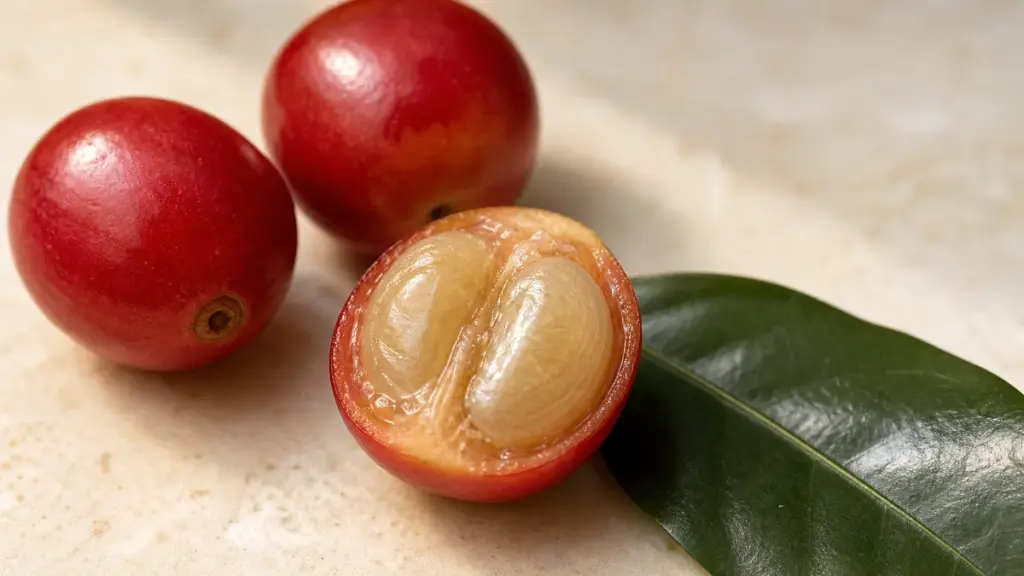
A typical cherry contains two seeds, with their flatter surfaces facing one another. Occasionally only one seed develops, producing the rounded form sold as a peaberry. It is a seed-development outcome, not a separate species.
Working from the outside towards the centre, a cherry has skin, fleshy pulp and a protective layer called parchment around each seed. Inside the seed, a small embryo sits within the endosperm, the reserve tissue that makes up most of what we recognise as a coffee bean.
From seed to germination and seedling
The next plant begins as an embryo inside a viable seed. For propagation, growers select suitable planting material rather than assuming that any green bean intended for roasting will grow.
Germination begins when the seed takes up water and the embryo resumes growth. The surrounding tissue weakens sufficiently for the radicle, the first root, to push through. This happens before there is anything to see above the soil.
That distinction explains apparently conflicting germination times. A laboratory may record the first root emerging from a prepared seed; a nursery may record the seedling appearing above its growing medium. These are different milestones.
A review of coffee seed physiology reports arabica seedling emergence beginning about 50 to 60 days after sowing in warmer conditions, with emergence potentially extending to about 90 days in cooler conditions. Those observations are not a timetable for every species or nursery.
As the seedling develops, its cotyledons, or seed leaves, use the seed’s reserves and eventually open. True leaves follow. The University of Hawai‘i’s nursery guide describes seedlings with several pairs of true leaves after about 6 to 8 months.
At this stage, good root form matters as much as visible height. A seedling with a bent or restricted root system is not necessarily ready for planting simply because it has attractive foliage.
How many years until the first crop?
First fruit, first substantial harvest and full production are different milestones. A young plant may carry a small crop before it has developed the branching structure needed for sustained production.
PROSEA describes an arabica tree producing its first crop at about three years old under ideal conditions, including two years in the field. In a different growing context, the Royal Horticultural Society describes arabica beginning to flower at about four years old.
These accounts should not be turned into competing promises. The starting point, plant material and environment differ, and flowers still need time to become ripe cherries.
A useful question is therefore: “How old is the plant, and how long has it been established here?” Counting only from the day a nursery plant was transplanted can hide much of its early development.
Flowering and pollination
What triggers flowering?
Coffee flower buds develop before the blossom opens. In many seasonal growing environments, a dry period followed by rain helps synchronise flowering, producing a conspicuous flush of white flowers.
The response depends on buds being sufficiently developed. Rain does not make every bud flower regardless of its condition, and more evenly distributed rainfall can produce less sharply defined flowering periods.
Individual flowers are short-lived. University of Florida guidance describes them opening in the morning and withering in about two days. Several flowering events can create groups of cherries of different ages on the same plant.
Arabica and robusta reproduce differently
Arabica is self-fertile and largely self-pollinating. Its own pollen can fertilise its ovules, so a single plant can potentially produce seed without another coffee plant nearby.
That does not make visiting insects irrelevant. A controlled field experiment comparing pollination treatments found that arabica fruit set benefited from open pollination and cross-pollination compared with spontaneous self-pollination alone.
Robusta is self-incompatible. Successful reproduction normally requires pollen from a genetically compatible, different plant. Another cutting of the same clone does not provide a different genetic partner.
Wind and insects can move pollen between plants. Their relative contribution varies with conditions, so neither “coffee needs bees” nor “coffee pollinates itself” adequately describes both species.
Pollinator habitat and other farm-management choices belong within the broader discussion of sustainable farming practices.
How a flower becomes a ripe coffee cherry
After successful fertilisation, the ovary develops into a fruit and the fertilised ovules develop into seeds. The young cherry does not simply increase in size at a constant rate until picking.
Early fruit growth can be slow. Expansion follows, alongside substantial changes within the developing seeds. During seed filling, endosperm develops and accumulates reserves.
A controlled developmental study of arabica documented the progression from expanding seed tissues to endosperm growth, reserve accumulation and hardening. In plain terms, a cherry’s outside appearance is only part of the story: the bean inside is also being built.
Ripening brings changes in the fruit’s colour and composition. Red is familiar, but Kew records arabica fruit that can also mature yellow or purple. Green-to-red is therefore not a universal colour rule.
Water availability matters during fruit expansion. A review of coffee physiology reports that water shortage at this stage can restrict fruit growth and potential bean size. Slower maturation also needs context: more time on the tree is not, by itself, proof of better coffee.
Shade can modify the growing environment, but its effects depend on the site and management. See shade-grown coffee for that discussion rather than treating shade as a fixed biological requirement.
Productive lifespan: why growth has to be renewed
Coffee can remain alive for decades, but survival is not the same as maintaining a useful crop. Ageing branches, restricted growth and accumulated damage can reduce production while the plant remains visibly alive.
FAO’s arabica crop profile gives 30 to 40 years as an average period of economic yields, while explicitly recording much shorter and longer cases. This is a broad reference, not a replacement schedule for every farm.
Pruning helps because cropping depends on the continuing supply of suitable growth. In arabica, the fruiting zone moves along developing branches rather than endlessly reappearing on exactly the same positions.
Rejuvenation pruning, sometimes called stumping when severe, cuts back established wood so replacement shoots can develop. It renews the above-ground structure using an existing plant, whereas replanting establishes a new one.
There is also a balance between the present crop and future growth. Developing cherries are strong consumers of resources. A heavy crop can restrict shoot growth, leaving less productive growth for the following season and contributing to biennial bearing, a tendency towards alternating heavier and lighter crops.
That is the central biological challenge behind repeated harvesting: keeping enough healthy leaves, roots and new wood to support both this year’s fruit and the next cycle. Explore coffee farming for the wider subject.
FAQ
Can I grow a coffee plant indoors in the UK?
Yes, arabica can be grown as a houseplant, although fruit is not guaranteed. The RHS lists it as an evergreen plant for suitable indoor or protected conditions and describes flowering from about four years old. Treat a young indoor plant primarily as a foliage plant, rather than expecting a dependable supply of home-grown beans.
Does picking cherries kill the coffee plant?
No, harvesting cherries does not normally kill the plant. Coffee is a perennial, so its roots, stems and leaves remain to support further growth and flowering. Harvesting and replacing a tree are separate operations, although an ageing or poorly performing planting may eventually need rejuvenation or replanting.
Are coffee beans nuts or seeds?
Coffee beans are seeds, not nuts. They develop inside the coffee cherry, usually as a pair. Most of each seed is endosperm, the tissue surrounding and supporting the embryo. “Bean” is the familiar commercial name, rather than a statement that coffee belongs to the same plant group as edible beans.
Where to go next
Read Coffee Farming: The Complete Guide to connect the coffee plant life cycle with nursery work, field establishment and harvesting, or use Coffee Farming to explore the wider subject. Shade-Grown Coffee explains how overhead trees alter growing conditions, while Sustainable Farming Practices examines the management choices surrounding a long-lived crop.
Sources
-
World Coffee Research, The roots of Robusta: cultivating growth for a resilient future, 2024.
https://worldcoffeeresearch.org/news/2024/the-roots-of-robusta. -
Royal Botanic Gardens, Kew, Coffea arabica L., Plants of the World Online, undated living reference, accessed 2026.
https://powo.science.kew.org/taxon/urn%3Alsid%3Aipni.org%3Anames%3A747038-1/general-information. -
University of Florida IFAS Extension, Crane, Balerdi and Joyner, Coffee Growing in the Florida Home Landscape, HS1056, revised 2016.
https://ask.ifas.ufl.edu/publication/HS306/pdf. -
University of Hawai‘i at Mānoa, CTAHR, Bittenbender and Smith, Growing Coffee in Hawaii, revised edition, March 2008.
https://www.ctahr.hawaii.edu/oc/freepubs/pdf/coffee08.pdf. -
Brazilian Journal of Plant Physiology, Eira et al., Coffee seed physiology, 2006.
https://horizon.documentation.ird.fr/exl-doc/pleins_textes/2025-01/010038633.pdf. -
Plant Resources of South-East Asia, PROSEA, van der Vossen, Soenaryo and Mawardi, Coffea L., Handbook 16: Stimulants, 2007.
https://prosea.prota4u.org/view.aspx?id=91. -
Royal Horticultural Society, Coffea arabica: Arabian coffee, undated plant profile, accessed 2026.
https://www.rhs.org.uk/plants/4159/coffea-arabica/details. -
American Journal of Botany, Klein, Steffan-Dewenter and Tscharntke, Bee pollination and fruit set of Coffea arabica and C. canephora (Rubiaceae), 2003.
https://bsapubs.onlinelibrary.wiley.com/doi/10.3732/ajb.90.1.153. -
Journal of Experimental Botany, Integrative analysis of the late maturation programme and desiccation tolerance mechanisms in intermediate coffee seeds, 2018.
https://academic.oup.com/jxb/article/69/7/1583/4816236. -
Brazilian Journal of Plant Physiology, DaMatta et al., Ecophysiology of coffee growth and production, 2007.
https://www.scielo.br/j/bjpp/a/xSBXnvrDDczyDbBtzspGs3v/?format=pdf. -
Food and Agriculture Organization of the United Nations, Coffea arabica, Ecocrop profile 749, undated database entry, accessed 2026.
https://ecocrop.apps.fao.org/ecocrop/srv/en/cropView?id=749.
Research combined botanical references, agricultural extension guidance, controlled pollination and seed-development studies, and peer-reviewed physiology reviews; developmental timings are presented with their growing-context limitations.
Last checked: November 2026