Coffee roast levels describe how far beans have been roasted, giving you a useful guide to their flavour: light roasts tend towards fruit and brightness, medium roasts towards rounded sweetness, and dark roasts towards bittersweet, roasted flavours. These are descriptive categories, not universally standardised colour boundaries, and a darker roast does not automatically contain more caffeine.
In short
- Read the tasting notes alongside the roast level: one roaster’s medium may resemble another’s dark.
- “Acidity” means the lively, tart quality of the coffee, not a measure of how strong it is.
- First crack is a popcorn-like popping stage; second crack is a later, finer snapping associated with darker roasting.
- “Espresso roast” describes the intended brewing use, not a requirement that the beans be dark.
- For bean-to-cup machines, check the manufacturer’s guidance on oily beans: surface oils can interfere with beans feeding into the grinder.
What coffee roast levels actually mean
Roast level describes the degree of roasting, commonly communicated through colour and words such as light, medium and dark. It does not identify the bean’s country, variety or quality, and it is not a caffeine rating.
Think of these labels as directions rather than fixed addresses. They help you navigate a roaster’s range, but they do not guarantee the same result across different brands. The Specialty Coffee Association’s research on roast colour acknowledges this lack of universally agreed boundaries.
Roasters can measure colour with instruments, including Agtron analysers, rather than judging it only by eye. That improves consistency, but a measurement system and a universally accepted definition of “medium roast” are different things.
For a wider introduction to the drink itself, start with coffee basics. The beginner’s coffee guide puts roast level alongside the other decisions you will meet.
What changes when coffee roasts?
Roasting changes both the structure and chemistry of a coffee bean. It is not simply a matter of making an existing flavour stronger.
Moisture escapes, the bean expands, and its internal structure becomes more porous. These changes affect how it grinds and how water draws material out during brewing, a process called extraction.
At the same time, heat creates new aroma and flavour compounds. The Maillard reactions, reactions involving sugars and amino compounds, contribute brown colour and familiar roasted, nutty and malty characteristics. Sugar breakdown and other heat-driven reactions add further complexity.
Continued roasting also transforms or removes compounds. Delicate fruit and floral characteristics can become less prominent, while roast-derived bitterness, smoke and char become more noticeable.
The result is a balance between expressing the original coffee and creating flavours through roasting. Neither end of that balance is automatically better. For the earlier stages of production, see the journey from seed to cup.
First crack and second crack, simply explained
First crack is a series of audible pops, rather like popcorn. Pressure builds inside the heating beans, with water vapour an important contributor, and the beans expand and fracture.
Second crack happens later if roasting continues. It sounds more like fine, rapid snapping as the increasingly brittle internal structure fractures further.
These are milestones, not precise definitions of the three roast labels. Light roasting is associated with the earlier part of this progression, medium roasting usually sits between the cracks, and darker roasting approaches or enters second crack. Roasters interpret the boundaries differently.
Light, medium and dark roast flavours compared
The table compares appearance, flavour direction and likely suitability. These are tendencies, not promises: the original coffee and the way it is roasted still matter.
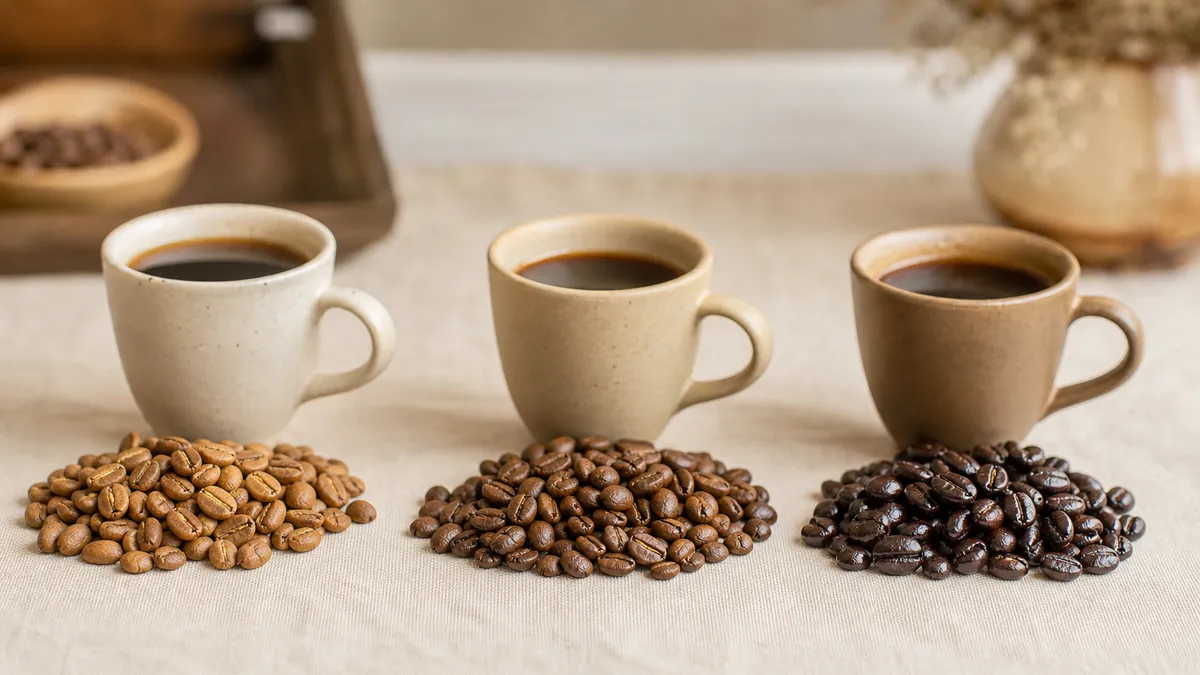
| Roast level | Typical appearance | Common flavour direction | A useful starting point for |
|---|---|---|---|
| Light | Lighter brown, generally with a dry-looking surface | Fruit, flowers and pronounced acidity | Exploring bright, distinctive coffees |
| Medium | Mid-brown, usually without a heavy oily sheen | Caramel-like, nutty or chocolatey notes, with some fruit | A rounded introduction to different brewing methods |
| Dark | Dark brown, sometimes visibly oily | Bittersweet chocolate, roasted notes and, further along, smoke | People who enjoy a more roast-led cup |
Light roast: brightness and detail
Lighter roasting often makes fruit and floral characteristics easier to notice. A coffee might suggest citrus, berries or blossom rather than the toasted flavours someone expects from a traditional dark roast.
Here, acidity means the tart, lively sensation in the cup. It can be enjoyable, like the freshness of fruit, rather than harsh. Light roast is therefore worth exploring if you want coffee that tastes noticeably different from one origin to another.
Medium roast: a meeting point
Medium roasting brings more roast-developed flavour into the balance without necessarily losing the coffee’s fruit character. Nutty, caramel-like and chocolatey descriptions are common, although those flavours are not exclusive to medium roast.
Our suggested starting point for an undecided beginner is medium roast, particularly with tasting notes that already sound appealing. That is a practical recommendation, not a claim that medium is objectively the best level.
Dark roast: roast character takes the lead
Darker roasting places greater emphasis on flavours created by the roast itself. Bittersweet chocolate can give way to increasingly smoky, charred or ashy characteristics as roasting progresses.
Do not assume darker always means a thicker drink. At very advanced roast levels, the resulting cup can become thinner even while its burnt flavour becomes more forceful. “Dark” describes the roast, not every aspect of the finished coffee.
Which roast levels suit different brewing methods?
Start with the flavour you want, then consider the brewer. Roast recommendations are helpful starting points, not restrictions.
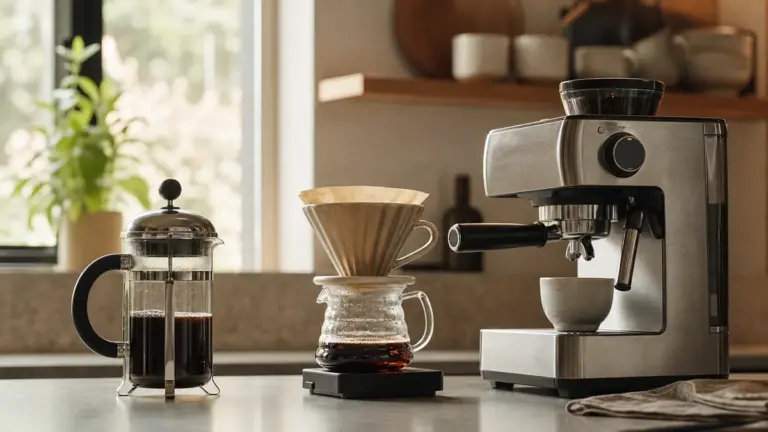
Filter and pour-over: light and medium roasts are sensible places to begin if you want to explore fruit, floral notes and differences between coffees. Union Coffee, for example, recommends its lighter roasting style for filter brewing.
Cafetière: our suggested starting point is medium roast. From there, move lighter if you want more brightness or darker if you prefer a more roasted flavour. There is no need to regard the cafetière as reserved for dark coffee.
Espresso: medium and darker roasts are useful starting points for a roast-led style, but espresso can also be light roasted. Pact Coffee explicitly offers light, medium and dark espresso roasts, demonstrating why “espresso” and “dark” are not interchangeable.
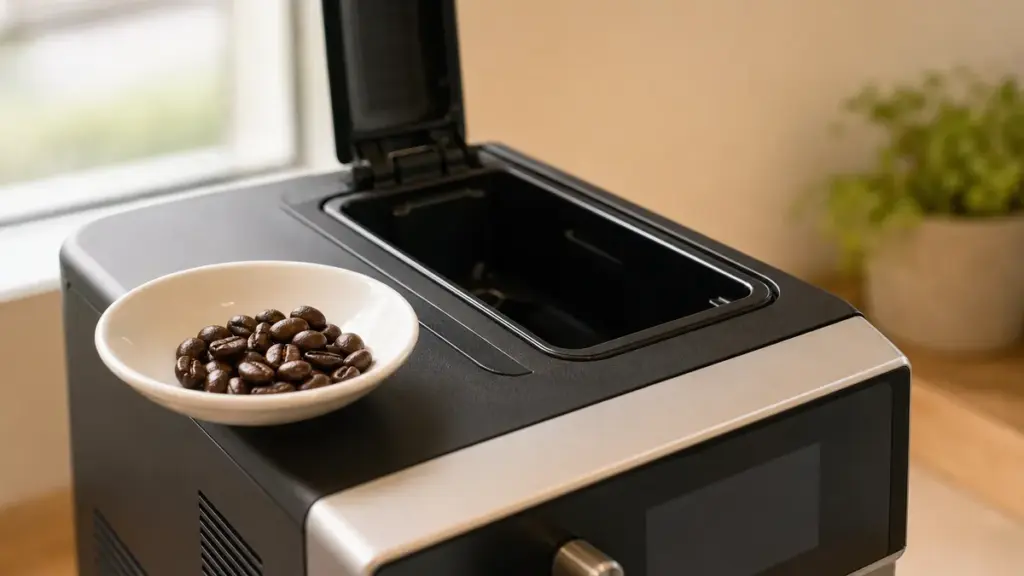
Bean-to-cup machines: begin with beans that meet the machine manufacturer’s requirements. A medium roast without a pronounced oily surface is a sensible first trial, but machine compatibility takes priority over a general roast recommendation.
When changing roast, use the roaster’s brewing guidance rather than assuming your existing settings will transfer unchanged. For the practical brewing decisions, use making good coffee at home.
How to read roast words on a coffee label
The most useful label combines a roast description, tasting notes and a suggested brewing method. Any one of those on its own gives only part of the picture.
Common terms include:
- City and City+: roast-stage names commonly used towards the lighter part of the roasted-coffee progression.
- Full City and Full City+: later stages around the approach to second crack and its beginning, in Sweet Maria’s terminology.
- Vienna, French and Italian: names generally associated with darker roasting, rather than proof of where the beans were grown.
- Filter roast: the roaster’s suggestion for filter-style brewing.
- Espresso roast: a roast intended for espresso, which may still be light, medium or dark.
Treat named roast styles as approximate descriptions. A term used precisely within one roaster’s system may be interpreted differently elsewhere.
Nor should you translate “intense”, “bold” or “strong” directly into caffeine content. Ask what the seller means: a flavour description is not a laboratory measurement of the finished drink.
When comparing unfamiliar coffees, a useful question is: “Is this more fruit-led or roast-led?” That often gets you closer to the cup you want than debating whether its brown colour qualifies as medium-dark.
Does dark roast contain more caffeine?
Dark roast does not reliably mean more caffeine. A powerful roasted flavour is not evidence of a larger caffeine dose, and roasting does not turn ordinary coffee into decaffeinated coffee.
The research is more nuanced than the familiar claim that light or dark always wins. A laboratory study published in Molecules in 2021 found no statistically significant difference in caffeine concentration between its roast groups.
A controlled brewing study published in Scientific Reports in 2024 generally found less caffeine in dark-roast brews than in light- and medium-roast brews under identical brewing conditions. However, when the researchers compared brews at the same extraction yield, the darker roasts generally had higher caffeine concentrations. Extraction yield means the proportion of the dry coffee that dissolves during brewing.
Those findings answer different experimental questions, which helps explain apparently contradictory advice. Measuring coffee by scoop rather than weight adds another complication because roasting changes bean size and density.
The practical lesson is straightforward: do not choose a roast label as your caffeine control. The coffee used, the amount brewed and the extraction conditions all need consideration.
Why oily beans matter in bean-to-cup machines
Darker beans can have a visible oily sheen. This is a surface characteristic, not a quality score, and some beans show oil before the very darkest roast stages.
For automatic machines, the important issue is reliable feeding and grinding. Miele’s troubleshooting guidance explains that oils can cling to the bean container and hinder the flow of beans into the grinder. A machine may then report an empty container even when beans remain inside.
That is more precise than saying every oily bean will inevitably “clog the grinder”. Problems can begin in the hopper, before the beans reach the grinding mechanism.
Follow your own machine’s manual. If it permits darker beans but feeding becomes unreliable, Miele’s advice includes cleaning the bean container more frequently and trying a less oily coffee. Do not assume that cleaning or bean advice for one manufacturer applies to every machine.
A simple way to find your preferred roast
Use roast level as a starting hypothesis, then let your tasting notes do the work.
- Choose a flavour direction. Try light for fruit and brightness, medium for a rounded introduction, or dark for more roast-led flavour.
- Check the intended brewing use and machine requirements. These matter more than matching a fashionable roast word.
- Keep a short record. Write down whether you wanted more fruit, less bitterness or a different roasted character.
- Use that description next time. “Less smoky than this coffee” is a useful request to give a roaster.
For the next purchasing decision, choosing your first beans brings roast level together with the other information on the bag.
FAQ
Is light roast the same as under-roasted coffee?
No. Light roast is a roasting style; underdevelopment describes an unsuccessful result rather than simply a pale colour. Roasting educator Chris Kornman notes that roasts ended too early can show bready or cereal-like flavours. A light roast should be judged by its intended flavour and execution, not dismissed because it is light.
Can two coffees with the same roast level taste different?
Yes, because roast level is only one influence on flavour. The original coffee and the roaster’s choices both matter. Even within a broad category such as medium, one coffee may lean towards fruit while another suggests nuts or chocolate. Read the tasting notes rather than expecting the category to specify an exact taste.
Can I identify roast level accurately from an online photograph?
Not reliably. Lighting, background colour and the angle of illumination affect how brown beans appear, while photographs introduce further uncertainty. The SCA identifies visual judgement as a limitation in communicating roast colour. Use a photograph as an illustration, not as a substitute for the roaster’s description or measured colour information.
Where to go next
Read How to Choose Your First Coffee Beans to turn your understanding of roast levels into a practical choice, then How to Make Good Coffee at Home to work on the brewing. How Coffee Is Made: From Seed to Cup explains what happens before roasting, while Coffee for Beginners provides the wider learning path.
Sources
- S1. Specialty Coffee Association, What Color is Your Coffee?, 25, issue 21, publication year not displayed. Primary account of UC Davis roast-colour research and the limitations of roast terminology.
https://sca.coffee/sca-news/25/issue-21/what-color-is-your-coffee-37lk7 - S2. Specialty Coffee Association, Peter Giuliano, Coffee Decoded: Flavor from the Fires: Why Roast Color Matters, 2026. Roasting chemistry and colour.
https://sca.coffee/sca-news/coffee-decoded-4-roast-color - S3. Specialty Coffee Association, Peter Giuliano, Coffee Decoded: What Makes Coffee Bitter?, 2026. Sources of bitterness, including roasting and brewing.
https://sca.coffee/sca-news/coffee-decoded-18-bitterness-in-coffee - S4. Scientific Reports, Lindsey and colleagues, Caffeine content in filter coffee brews as a function of degree of roast and extraction yield, 2024, volume 14, article 29126. Author-hosted copy of the experimental paper.
https://pages.uoregon.edu/chendon/coffee_literature/coffee_lit_rev/2024_ep20_caffeine.pdf - S5. Molecules, Awwad and colleagues, Quantification of Caffeine and Chlorogenic Acid in Green and Roasted Coffee Samples Using HPLC-DAD and Evaluation of the Effect of Degree of Roasting on Their Levels, 2021, volume 26, article 7502. Laboratory analysis of roast groups.
https://pmc.ncbi.nlm.nih.gov/articles/PMC8705492/ - S6. Miele Great Britain, Fill bean container, undated support guidance, accessed November 2026. Oily beans and interrupted feeding into the grinder.
https://www.miele.co.uk/support/customer-assistance/coffee-1238/all/fill_bean_container-92062007051 - S7. Sweet Maria’s, Thompson Owen, First Crack FAQ: What is First Crack? What is Second Crack?, 2022. First-hand roasting explanations and audible cues.
https://library.sweetmarias.com/first-crack-faq-what-is-first-crack-what-is-second-crack/ - S8. Sweet Maria’s, Thompson Owen, Using Sight to Determine Degree of Roast, 2022. Roast-stage names, appearance and advanced dark roasting.
https://library.sweetmarias.com/using-sight-to-determine-degree-of-roast/ - S9. Union Coffee, Roast Profiles, undated, accessed November 2026. The roaster’s flavour descriptions and brewing recommendations.
https://unionroasted.com/pages/roast-profiles - S10. Pact Coffee, Espresso Coffees, undated, accessed November 2026. Manufacturer’s description of light, medium and dark espresso roasts.
https://www.pactcoffee.com/coffees/espresso - S11. Royal Coffee, Chris Kornman, Roasting for Creation or Destruction, 2023. First-hand roasting education on flavour development, underdevelopment and darker roasting.
https://royalcoffee.com/blogs/blog/roasting-for-creation-or-destruction
This article was researched using retrieved SCA material, primary experimental papers, first-hand roasting education and manufacturer support guidance; practical starting points are identified as editorial recommendations, not universal brewing rules.
Last checked: November 2026