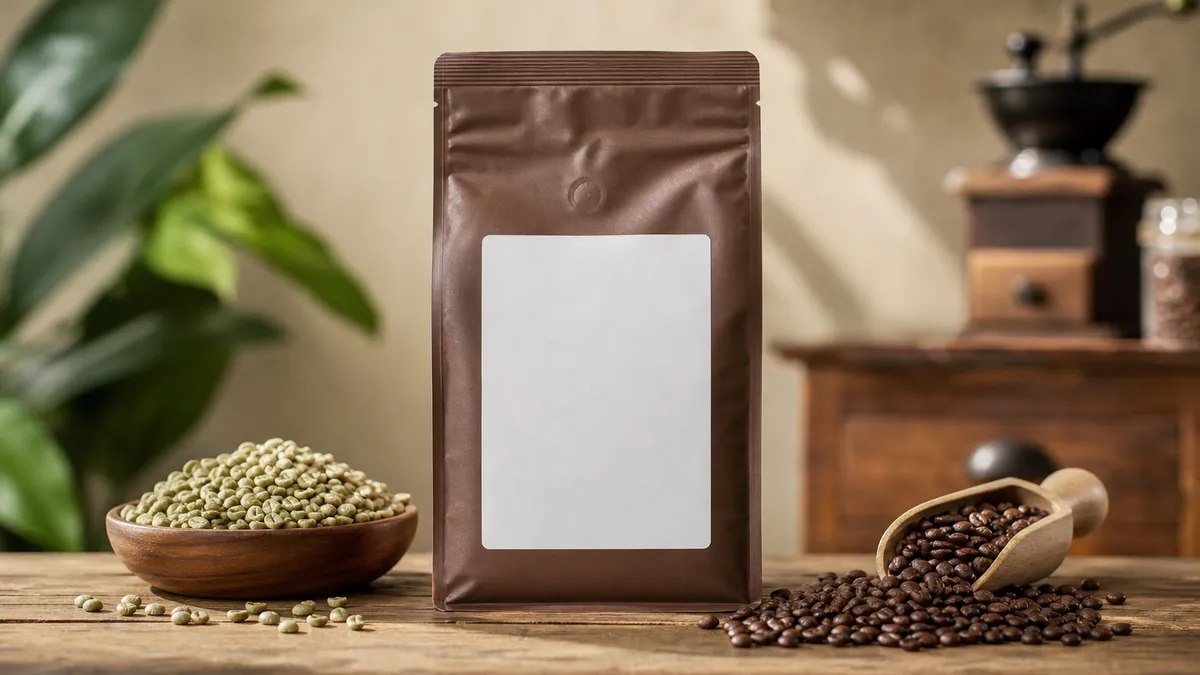
To read a coffee bag, start with the coffee’s form, roast description, dates and net weight, then use origin, producer, variety and processing details to narrow your choice. Separate information required on ordinary UK prepacked food from optional coffee details: an altitude figure or elaborate tasting note is not a legal requirement or a guarantee of quality.
In short
- Check whether you are buying whole beans or ground coffee before studying the flavour description.
- A roast date records roasting; a best-before date concerns quality. Do not calculate one from the other.
- Origin identifies a place, variety identifies the plant, and process describes how the harvested coffee was handled.
- Treat tasting notes as sensory comparisons, not an ingredients list.
- Read certification marks against their own standards, and check the net weight rather than judging quantity by bag size.
How to read a coffee bag in a useful order
Read the practical information first, then the details that help explain flavour. This keeps an impressive farm story from distracting you from the wrong grind or an unsuitable roast.
- Identify the product. Look for whole beans, ground coffee and any stated brewing method. If buying ground coffee, check that its intended use matches your equipment.
- Read the roast description and tasting notes together. Choose a flavour direction you enjoy rather than assuming the darkest roast or most unusual description is best.
- Find both dates. Distinguish “roasted on” from “best before”, and ask the retailer if an unexplained date is ambiguous.
- Check net weight. Divide the bag’s stated grams by your usual dose to estimate how many brews it contains.
- Read the traceability information. Look for country, region, producer or producer group, variety and process. Ask what a name represents if the label does not say.
- Examine claims and certification marks. Look for supporting information rather than accepting “premium” or “ethical” as a complete explanation.
For example, an illustrative 250 g bag, used at 15 g per brew, provides 16 complete doses, with 10 g remaining. That is arithmetic, not a freshness recommendation: choose a quantity that fits your actual use.
For the broader buying decision, start with buying and storing coffee.
What a UK coffee bag must tell you
For an ordinary retail bag of prepacked roasted coffee, expect the food’s name, net quantity, best-before information, the responsible food business’s name and address, and batch identification, subject to the rules allowing suitable date marking to identify a batch. Necessary storage instructions and other applicable information must also appear. A separate ingredients list is generally unnecessary for a clearly identified single-ingredient food. [S1]
Roast date, altitude, producer name, variety, processing method, roast level and tasting notes are not general mandatory particulars for plain roasted coffee. They are additional information that can help you choose. Missing altitude does not make a bag unlawful; missing required food information is a different matter. [S1]
Country of origin is not automatically compulsory on every coffee bag, but it must be given where omission would mislead. “Roasted in Britain” describes roasting, not where the coffee was grown. Check for a separate growing origin rather than treating a roaster’s address as one. [S1]
The address rules differ within the UK. Food sold in Great Britain requires an appropriate UK food business or importer address; Northern Ireland generally requires an appropriate Northern Ireland or EU address. These labelling points were checked in November 2026. [S1]
Origin, producer and variety: three different identities
Origin tells you where
Read origin from broad to specific: country, region, then any named farm, producer group or processing station. More detail gives you more information to investigate, but does not itself prove that the coffee tastes better.
Do not assume a prominent name belongs to an individual farmer. A washing station processes harvested coffee and can receive fruit from many growers. A roaster’s published example describes a coffee company working with smallholders through several washing stations, illustrating why a station name is not necessarily a single-farm identity. [S10]
When you see “single-origin”, ask how narrowly the seller defines that origin. Is it one country, one region, one farm or a particular lot? The useful information is the stated boundary, not just the phrase.
Producer tells you who
Look for an explanation of the producer’s role: farmer, estate, cooperative or another organisation. If several names appear, distinguish the people growing the coffee from those processing, exporting and roasting it.
A useful question for the seller is: “Who produced this lot, and is it kept separate or combined with other growers’ coffee?” This is more revealing than counting the names on the label.
Variety tells you about the plant
A variety is a named type within a coffee species. Bourbon and Caturra are arabica variety names, whereas “arabica” identifies the species rather than one particular variety. World Coffee Research records differences between varieties in characteristics including quality potential, disease resistance and adaptation. [S4]
Use variety as a detail for comparing coffees you enjoy, not a promise of a fixed flavour. Growing conditions and management also affect the result. [S4]
Process and altitude: useful clues, not rankings
Processing describes what happens between harvesting coffee fruit and obtaining dried green coffee. The bean is the seed inside that fruit. [S6]
| Label detail | What it tells you | What it does not establish |
|---|---|---|
| Washed | Skin, pulp and mucilage are removed before drying, using washing and/or mechanical removal | A guaranteed flavour |
| Natural | Coffee is dried in the fruit before the dried outer material is removed | Superior quality |
| Honey or pulped natural | Fruit skin and pulp are removed, with some or all mucilage retained during drying | That honey has been added |
| Altitude, often “masl” | Height in metres above sea level | A universal quality ranking |
The processing descriptions follow the International Coffee Organization’s overview; the honey terminology is also explained by a producer using that method. [S6]
Mucilage means the sticky layer surrounding the seed. “Honey” refers to that material, not an added sweetener. “Anaerobic” describes oxygen-limited processing conditions, so ask for the fuller method rather than treating it as a complete replacement for washed, natural or honey. [S6]
An altitude range gives growing context, but it is not a score. World Coffee Research explicitly cautions that environment, altitude, soil nutrition, weather and farm management affect performance and quality. Compare altitude alongside the other details, rather than choosing whichever bag prints the highest number. [S4]
Roast dates, roast levels and tasting notes
Read the date wording
A roast date tells you when roasting occurred. A best-before date indicates the period associated with expected quality, provided storage instructions are followed; it is not the same as a use-by safety deadline. [S1, S3]
A distant best-before date does not reveal the roast date. Do not subtract an assumed shelf life, because that assumption has not been supplied by the label.
For interpreting the dates in more depth, see roast and best-before dates. For deciding what to buy now, use buying fresh coffee.
Read roast level as a broad flavour guide
Light, medium and dark are useful starting descriptions, but do not assume that different roasters use them identically. The Specialty Coffee Association has documented inconsistent roast terminology and work towards clearer measurement. [S7]
As a broad guide, lighter roasts can emphasise fruity and floral characteristics, while darker roasts tend towards more roast-led, bittersweet flavours. These are tendencies, not guarantees for every coffee. [S7]
A printed strength number is not a caffeine measurement. Where a seller uses it for roast intensity, it describes something different from the concentration you produce by changing the coffee-to-water ratio. Check the seller’s explanation of its scale. [S8, S12]
Translate tasting notes into familiar comparisons
“Apple”, “almond” and “floral” can describe sensory attributes found in coffee. World Coffee Research’s Sensory Lexicon provides defined references for describing and measuring such attributes. [S5]
Read a tasting note as “this reminded the taster of…” rather than “this ingredient was added”. If a product is explicitly flavoured, inspect its ingredients and allergen information instead of relying on the tasting description. A sensory reference to almond is not evidence that almonds are an ingredient. [S1, S5]
Start with broad impressions: fruity or roast-led, delicate or heavy, pleasantly bright or more bitter. You do not need to identify every named fruit to decide whether you enjoy the cup.
Certifications and marketing terms to examine
Certification marks answer particular questions. They should not be treated as interchangeable endorsements.
- Fairtrade: look for the recognised mark and the scheme’s explanation. Its coffee standard governs specified production and trading requirements. It is not a roast-level or flavour description. [S9]
- Organic: this is regulated terminology, not simply a synonym for natural. Organic claims require compliance with production and certification rules; look for the relevant control-body details. [S9]
- Rainforest Alliance: its certification covers environmental and social requirements, with independent auditing. It is distinct from organic certification. [S9]
Choose the scheme relevant to your priorities, then assess the coffee’s flavour separately. Do not infer that an uncertified bag necessarily fails a particular practice merely because it lacks that mark.
Treat these marketing descriptions as prompts for questions:
- Premium, gourmet or artisan: what concrete information supports the description? Prefer an explained roast, identifiable coffee and helpful brewing guidance.
- Direct trade: ask who bought from whom, how the relationship works and what evidence is published.
- Ethical or sustainable: ask which practice is being claimed, who checks it and what the claim covers.
- Single-origin or microlot: ask for the geographical boundary and what makes the lot distinct.
These questions do not mean the claims are worthless. They prevent an attractive phrase from doing more work than the evidence behind it.
Check the label against a simple brew
A repeatable brew helps you turn label language into your own reference points. This cafetière comparison exercise adapts Coffee Collective’s published method, using a suggested starting temperature within the SCA’s published filter-brewing temperature range. It is not a formal cupping protocol. [S11, S12]
- Record the label. Note origin, process, roast description, date and tasting notes before opening.
- Weigh the ingredients. Use 19.5 g coffee and 300 g water, approximately 300 ml. This is coffee to water by weight, about 1:15.4, equivalent to the source method’s 65 g per litre. Grind coarsely. [S11]
- Add water at 93 degrees Celsius. Start a timer and wet all the grounds. This temperature is a practical starting suggestion, not a requirement printed on the bag. [S12]
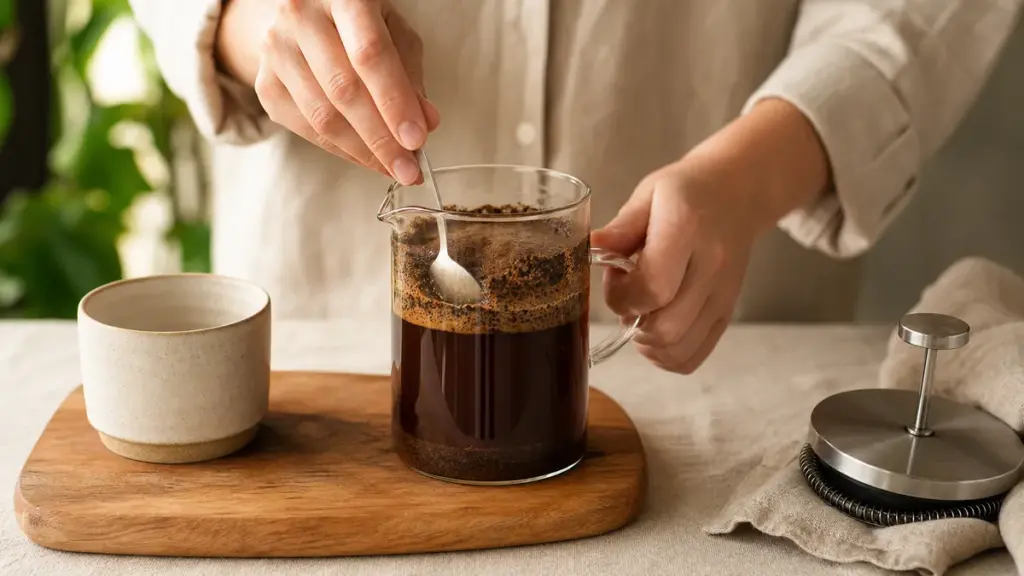
- Wait 4 minutes. Break the floating crust gently with a spoon and remove the foam and large floating particles. [S11]
- Wait another 30 seconds, fit the lid, press gently and pour. Let the coffee cool enough to taste comfortably. [S11]
- Write your own description first. Then compare it with the bag. Repeat with the same recipe before deciding that a flavour difference comes from the coffee.
| Symptom | Likely cause | Fix |
|---|---|---|
| You cannot identify the named fruit | The descriptor is more specific than your own reference | Start with “fruity” or “not fruity” |
| Two “medium” roasts seem very different | Sellers may use roast terms differently | Compare their fuller descriptions |
| You cannot judge one bag against another | Your brewing recipe changed | Repeat with the same dose, water and method |
| A bold “strength” rating disappoints | You expected a caffeine or brewed-concentration measure | Ask what the scale measures |
The table offers diagnostic starting points, not proof of a particular cause. Record what you actually enjoy, then use that record when choosing your next bag.
FAQ
Why is there no nutrition panel on my coffee bag?
Plain whole or milled coffee beans, including decaffeinated beans, are generally exempt from mandatory nutrition declarations. Exceptions can apply, including where nutrition or health claims are made. The absence of a panel on an ordinary bag of plain coffee is therefore not, by itself, a sign of incomplete labelling. [S2]
Can a familiar blend contain different coffees next time?
Yes, a roaster can change a blend’s components, so check the current information rather than relying only on its name. Square Mile’s published blend notes provide an example of changing seasonal components. If you particularly enjoyed one bag, record its origins and process as well as the blend name. [S10]
What should I keep from the label after finishing the bag?
Keep a photograph and a short brewing note. Record the product name, origin, producer information, process, roast date and your recipe, then add whether you would buy it again. Learning how to read a coffee bag becomes more useful when the printed description is connected to your own experience.
Where to go next
Read Buying Fresh Coffee for choosing your next purchase, and Finding Specialty Coffee Retailers for assessing sellers and their information. Roast Dates and Best-Before Dates explains the two date systems, while Coffee Storage Tips covers what to do after opening.
Sources
Source identifiers connect the article to the editorial evidence log.
-
S1. GOV.UK, Food labelling and packaging: Food labelling, what you must show; and Food labelling: giving food information to consumers, current guidance retrieved November 2026.
https://www.gov.uk/food-labelling-and-packaging/food-labelling-what-you-must-show
https://www.gov.uk/guidance/food-labelling-giving-food-information-to-consumers
These explain mandatory particulars, conditional origin information, ingredients and territorial address requirements. -
S2. Food Standards Agency, Q and A document: nutritional requirements of Regulation 1169/2011, undated retrieved edition, Annex V exemptions.
https://www.gov.uk/government/publications/nutrition-labelling
It identifies whole and milled coffee beans among nutrition-labelling exemptions, subject to exceptions. -
S3. Food Standards Scotland, Use-by and best-before dates, undated current guidance retrieved November 2026.
https://www.foodstandards.gov.scot/consumer-advice/food-labels/use-by-and-best-before-dates
It distinguishes quality-related best-before dates from safety-related use-by dates. -
S4. World Coffee Research, Arabica Coffee Varieties, living catalogue, retrieved November 2026.
https://varieties.worldcoffeeresearch.org/arabica
https://cdn2.assets-servd.host/worldcoffee-research/production/pdf/catalogEnglish/Combined/arabica-1769602235.pdf?dm=1769602235
The catalogue distinguishes varieties and explains environmental limits on quality predictions. -
S5. World Coffee Research, Sensory Lexicon, version 2.0, October 2017.
https://worldcoffeeresearch.org/resources/sensory-lexicon
It provides sensory attributes and references for describing coffee. -
S6. International Coffee Organization, Coffee Development Report 2022/23: Beyond Coffee, Figure B.8; Café Monteverde, Coffee Processing Explained: Washed, Honey, Natural and Anaerobic, 2026.
https://ico.org/documents/cy2024-25/coffee-development-report-2022-23.pdf
https://cafedemonteverde.com/2026/10/08/natural-honey-washed-anaerobic-coffee-difference/
These support the processing definitions and the producer’s explanation of honey processing. -
S7. Specialty Coffee Association, What Color is Your Coffee?; and Coffee Decoded: Why is Roast Level so Important to Consumers?, current articles retrieved November 2026.
https://sca.coffee/sca-news/25/issue-21/what-color-is-your-coffee-37lk7
https://sca.coffee/sca-news/coffee-decoded-3-roast-level-consumers
These discuss inconsistent roast terminology and broad roast-related flavour tendencies. -
S8. Contact Coffee Company, Coffee Strength Scale Explained, 2026, retailer’s explanation of packaging terminology.
https://www.contactcoffee.com/blogs/news/coffee-strength-scale-explained
Used only for the distinction between a packaging strength scale and caffeine measurement. -
S9. Fairtrade International, Fairtrade Standard for Coffee, current standards page; DEFRA, Organic food: labelling and advertising rules, updated 2025; Rainforest Alliance, What Does Rainforest Alliance Certified Mean?, updated 2025.
https://www.fairtrade.net/en/why-fairtrade/how-we-do-it/standards/who-we-have-standards-for/standards-for-small-scale-producer-organisations/coffee.html
https://www.gov.uk/guidance/organic-food-labelling-rules
https://www.rainforest-alliance.org/sas/
These define the respective schemes rather than treating their marks as interchangeable. -
S10. Square Mile Coffee Roasters, Our Pick Espresso, week 44 coffee information, 2025.
Used as a published example of seasonal blend changes and washing-station sourcing.
-
S11. Coffee Collective, French Press, undated published brewing guide, retrieved November 2026.
https://coffeecollective.dk/cdn/shop/files/French_press_guide.pdf?v=16904010372972159496
It supplies the dosing rate, grind description and brewing sequence adapted here. -
S12. Specialty Coffee Association, Certified Home Brewer Program: Minimum Certification Requirements, 2017 edition.
https://sca.coffee/research/coffee-standards
Used for a temperature reference and the distinction between beverage concentration and other meanings of strength, not as a cafetière standard.
Researched through live retrieval of official food-labelling guidance, coffee research resources, certification organisations and published producer and roaster documents; the tasting exercise is an explicitly identified adaptation, not first-hand testing.
Last checked: November 2026