Australian coffee culture combines espresso, independent neighbourhood cafés and a strong connection between coffee and eating out. Melbourne is its best-known expression, shaped by migration, longstanding espresso bars and a lively brunch scene. Australia also helped popularise the flat white internationally, although its origins are disputed with New Zealand.
In short
- Post-war Italian migration helped bring espresso into everyday café life, alongside a distinct and older Greek café tradition.
- Melbourne’s reputation rests on its café history and contemporary coffee scene, not an objectively established claim to the world’s best coffee.
- A flat white combines espresso with steamed milk and a thin layer of foam; a long black combines espresso with hot water.
- Melbourne’s magic is generally a double ristretto with textured milk in a small cup, commonly around 150 ml.
- Australian and New Zealand café businesses helped spread this approach to London, including Flat White, Kaffeine, Caravan and Ozone.
How migration shaped Australian coffee culture
Australia’s espresso culture did not arrive in an empty cup. Melbourne already had coffee stalls, coffee lounges and places where writers and artists gathered before the post-war espresso boom.
Italian migration after the Second World War nevertheless helped change the place of coffee in daily life. Migrant-run businesses brought espresso into neighbourhoods such as Carlton, Brunswick and Fitzroy, making the café a meeting place as well as somewhere to buy a drink. In Sydney, Italian-run bars and restaurants likewise served espresso and continental cakes.
Greek migration belongs in this history too, but the Greek café and Italian espresso bar should not be treated as identical institutions. The National Museum of Australia documents Greek-owned cafés serving familiar Australian meals and American-style ice-cream sodas, often rather than recognisably Greek food. This tradition predated the post-war migration that further enlarged Greek communities in Melbourne and Sydney.
That distinction matters. Australian café culture developed through different migrant businesses adapting to local customers, not through a single national tradition being transplanted intact.
Pellegrini’s and the early espresso-bar legends
Pellegrini’s Espresso Bar opened in Melbourne in 1954. Public Record Office Victoria preserves building plans connected with the business, giving its history firmer foundations than café folklore alone.
Calling it Melbourne’s first espresso bar is less secure. State Library Victoria identifies the Bancrofts’ café, opened in May 1954, as an early commercial espresso pioneer, while Museums Victoria records espresso machines in earlier restaurant kitchens and Italian grocery shops. “First machine”, “first espresso café” and “first widely influential espresso bar” are different claims.
A short timeline helps separate the developments:
- Before the post-war boom: coffee stalls and continental-style lounges were already part of Melbourne life.
- 1954: Pellegrini’s opened, during the emergence of the city’s influential espresso bars.
- 1980s: youth-oriented cafés added new combinations of music, décor, food and coffee to the older café tradition.
Why Melbourne has such a strong coffee reputation
Melbourne’s reputation is partly historical and partly about how many different things a café can be. The older espresso bar, neighbourhood breakfast spot and contemporary coffee specialist coexist rather than forming a neat sequence in which each replaces the last.
Museums Victoria records how inner-city cafés became associated with younger customers, music and distinctive interiors. It also describes café culture’s role in urban renewal, including the gentrification that accompanied it. Coffee was not simply a drink becoming more fashionable; cafés were helping change how parts of the city were used.
Independent businesses are central to the national picture. Tourism Australia highlights independently owned cafés as a defining feature of Australian coffee culture. Independence does not guarantee an excellent cup, but it allows different menus, service styles and identities rather than a single prescribed experience.
For a visitor, this makes the neighbourhood café as relevant as the celebrated destination. A small espresso bar and a busy brunch restaurant can express different sides of the same culture.
The “coffee capital” description is best understood as a reputation, not a measured championship. Tourism Australia uses it for Melbourne, but that does not establish that every Melbourne café outperforms every café in Sydney or elsewhere.
Our coffee culture guide puts these local identities into their wider context.
Flat white, long black and Melbourne magic
Australian menus can seem familiar to UK readers until the details start to shift. The useful distinctions concern the coffee base, the quantity of milk or water, and the finished texture.
The table compares those features rather than prescribing universal recipes.
| Drink | What it contains | Main distinction | Who it suits |
|---|---|---|---|
| Flat white | Espresso, steamed milk and a thin layer of foam | A milk coffee without a large, dry foam cap | Someone wanting coffee flavour with a smooth milk texture |
| Long black | Espresso poured into hot water | A black espresso-based drink, not filter coffee | Someone wanting a longer drink without milk |
| Short black | Espresso | The concentrated coffee without added milk or water | Someone wanting a small, direct coffee |
| Magic | Double ristretto with textured milk in a small cup | A restricted espresso base and relatively little milk | Someone who finds a larger milk drink too milky |
What makes a flat white different?
The defining idea is espresso combined with steamed milk and a thin foam layer. Microfoam means the fine bubbles that give properly textured milk its glossy appearance, rather than a mound of stiff froth.
Avoid treating “double shot” as a universal definition. Tourism Australia describes a single-shot flat white, while other café interpretations use a double espresso or ristretto. The name alone therefore does not tell you the dose or the proportion of coffee to milk.
Ask about the café’s recipe if strength matters to you. A familiar drink name is not a technical specification.
What is a long black?
A long black is made by pouring espresso into hot water. Tourism Australia describes it using two shots.
For a UK visitor accustomed to an americano, it is a useful starting point, but do not assume identical proportions. Asking for less water is clearer than asking for something vaguely “stronger”.
What is Melbourne’s magic?
A magic generally combines a double ristretto with textured milk in a small cup. Ristretto means a restricted espresso extraction, using less water than the corresponding espresso preparation.
Australian roaster Di Stefano describes a cup of around 150 ml. Treat that as a published interpretation, not an enforceable city-wide standard. The useful ordering description is “double ristretto with a small amount of flat-white-style milk”, followed by a question about how that particular café serves it.
For the wider movement towards coffee-focused preparation, see modern specialty coffee.
Who invented the flat white?
There is no single agreed origin story. Australia and New Zealand both have claims, and naming a drink, developing its preparation and making it internationally familiar are separate achievements.
The prominent Australian account centres on Alan Preston at Moors Espresso Bar in Sydney in 1985. A website presenting his case includes photographs of menus and describes his adaptation of an earlier Queensland expression, “white coffee, flat”. It is valuable claimant evidence, but not a neutral ruling on every competing account.
The well-known Wellington account concerns Fraser McInnes at Café Bodega in 1989. In his reported recollection, milk would not froth properly for a cappuccino, producing the drink he called a flat white. New Zealand Story presents the Wellington episode as one popular story while acknowledging earlier developments and Australian claims.
The defensible conclusion is not that both stories prove equal priority. It is that the available accounts do not justify presenting an uncontested inventor. Both countries helped develop and spread the modern flat white, and Melbourne’s wider reputation does not make it the drink’s established birthplace.
Why brunch belongs in the story
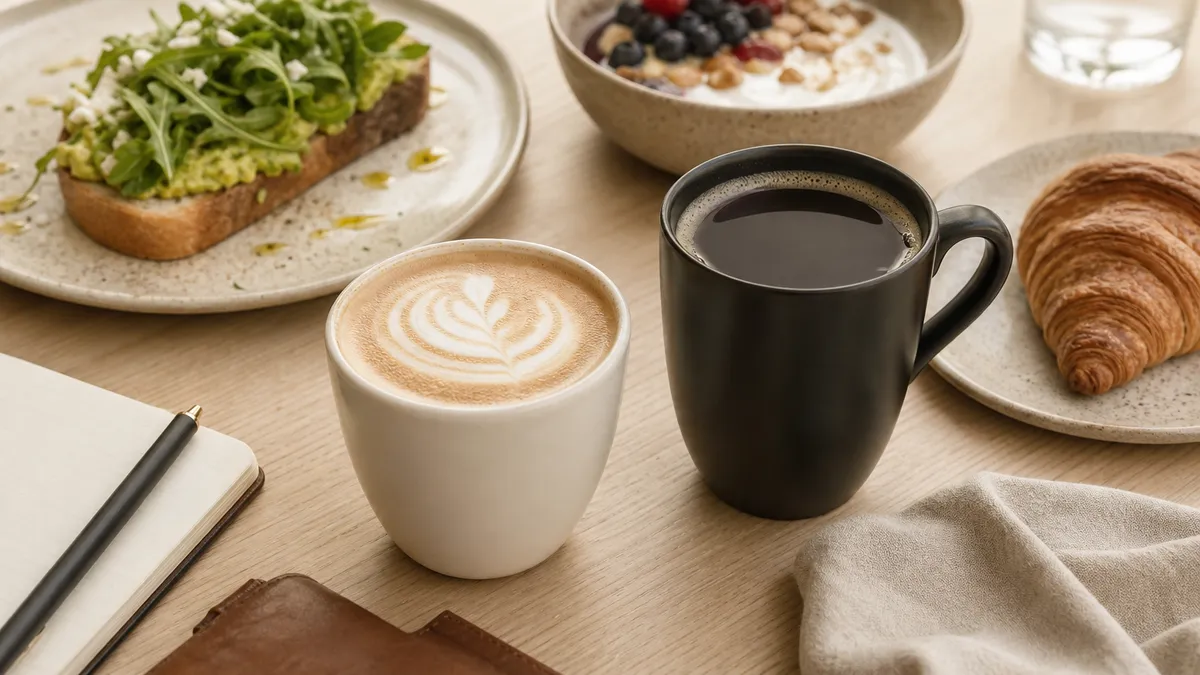
Coffee and food are closely connected in Melbourne’s contemporary café identity. The City of Melbourne’s brunch guide brings together coffee with dishes ranging from baked eggs and smashed avocado to French toast, hotcakes and sandwiches.
That breadth is more revealing than any single supposedly national dish. Brunch gives the café a role beyond supplying a quick drink: it becomes somewhere to sit, eat and spend time with other people.
For a visitor, distinguish between a coffee-led espresso bar and a food-led café before choosing where to stop. One may be exactly right for a short black; the other may suit a leisurely meal. Neither format needs to impersonate the other.
A useful way to understand the culture is to experience both. Have a coffee without a meal on one occasion, then make room for a proper café breakfast on another. The contrast tells you more than ordering the same drink everywhere.
How Australian and New Zealand cafés influenced the UK
The influence on Britain is better described as Antipodean, meaning Australian and New Zealand, than exclusively Australian. The histories of individual businesses show how the movement travelled through people, workplaces and hospitality ideas.
Flat White opened on London’s Berwick Street in 2005. Kaffeine founder Peter Dore-Smith identifies it as a direct inspiration for his own business, which opened in 2009. That is a particularly useful connection because it comes from a participant describing what influenced him, rather than a later claim that one café transformed an entire city.
Caravan followed on Exmouth Market in 2010. Its founders had met working in restaurants in New Zealand and wanted to combine freshly roasted coffee with relaxed, all-day dining.
Ozone, which began in New Zealand, opened its London roastery and eatery on Leonard Street in March 2012. Its account of that opening places coffee and food together rather than treating brunch as an unrelated addition.
These examples suggest an export larger than a drink recipe: a café could take coffee seriously while also being an approachable place to eat. They do not mean Australia or New Zealand invented British independent coffee. Their influence was a contribution to a developing scene, not its sole origin.
For another comparison, explore European café traditions.
How to approach an Australian café
You do not need specialist vocabulary to participate. A little precision is more useful than trying to sound local.
- Choose the experience: a quick coffee, a seated drink or a meal.
- Name the drink: flat white, long black or another recognised order, rather than simply “coffee”.
- Specify your milk: say so when you want an alternative to the café’s usual choice.
- Ask about the recipe: particularly for a magic or when the number of shots matters.
- Describe the adjustment: less milk or less water communicates more than “make it strong”.
Treat those questions as ordinary ordering, not a test of expertise. Australian and Melbourne coffee culture is easier to appreciate when the conversation stays focused on what you actually enjoy drinking.
FAQ
Can I order plant-based milk in an Australian café?
Yes, plant-based alternatives are widely available. Tourism Australia lists soya, almond and oat among the alternatives commonly offered, although each café’s selection differs. Name the milk when ordering rather than assuming a flat white will use it, and ask what is available if your preferred option is not shown.
Does an Australian iced coffee always mean coffee over ice?
No, an Australian iced coffee may include ice cream. Tourism Australia distinguishes it from an iced latte, which it describes as espresso, milk and ice cubes. If you want a straightforward chilled coffee without ice cream, check the menu description or explain the ingredients you would like.
Do I need to visit a famous café to understand the culture?
No, a famous venue is only one way into the subject. A useful approach is to compare an established espresso bar, a neighbourhood café and a contemporary specialist, without expecting them to provide identical experiences. Pay attention to the relationship between the drink, the food and the way the place is used.
Where to go next
Read Coffee Culture for the broader framework, then Modern Specialty Coffee Culture for the ideas behind contemporary coffee-focused cafés. Viennese and French Café Culture offers a European comparison, while Japanese and Korean Coffee Culture explores other distinctive relationships between coffee, service and café design.
Sources
-
Museums Victoria, Cafe Culture, undated.
https://collections.museumsvictoria.com.au/articles/2933
Museum account of Melbourne’s cafés, migration, espresso and later urban change. -
NSW Migration Heritage Centre, Journey to a New Life: Italian Migration in NSW, Work, undated.
https://www.migrationheritage.nsw.gov.au/exhibition/journey/work/index.html
Documents Italian-run businesses serving espresso and continental cakes. -
Museums Victoria, Immigration History from Greece to Victoria, undated.
https://origins.museumsvictoria.com.au/countries/greece
Historical account of Greek settlement and post-war migration. -
National Museum of Australia, Busy Bee Greek cafe collection, undated.
https://www.nma.gov.au/explore/collection/highlights/busy-bee-greek-cafe
Collection-based history distinguishing Greek café ownership from the food served. -
Public Record Office Victoria, Pellegrini’s original Espresso Bar building plan, 2018.
https://prov.vic.gov.au/about-us/our-blog/pellegrinis-original-espresso-bar-building-plan
Archival account confirming the café’s 1954 opening. -
State Library Victoria, Sarah Matthews, A Melbourne love affair, 2015.
https://blogs.slv.vic.gov.au/such-was-life/a-melbourne-love-affair/
Historical account of coffee stalls, social life and early espresso cafés. -
Tourism Australia, Australian coffee cheat sheet, undated.
https://www.australia.com/en/things-to-do/food-and-drinks/australian-coffee-cheat-sheet.html
Contemporary ordering terminology, drink descriptions and café context. -
Di Stefano Coffee, Nicolas Di Stefano, Melbourne’s Magic Coffee: What Is It?, 2026.
https://distefano.com.au/blogs/drinks/what-is-a-magic-coffee-melbourne
A roaster’s published interpretation of the magic, not a universal standard. -
Flat White History, S. J. Will, Origin of the Flat White, 2015.
https://www.flatwhitehistory.com.au/
Claimant account presenting Alan Preston’s history and photographs. -
New Zealand Story, Eyes on New Zealand, Who invented the flat white?, 2026.
https://www.eyesonnewzealand.com/stories/who-invented-the-flat-white
Explicitly acknowledges competing accounts and no agreed origin. -
NZEDGE, Trans-Tasman Flat White War of Origins Heats Up, 2015.
Reports Fraser McInnes’s recollection, attributing the original reporting to James Robertson, Good Food, 27 September 2015.
-
City of Melbourne, The best brunches in Melbourne, updated 20 August 2026.
https://whatson.melbourne.vic.gov.au/article/the-best-brunches-in-melbourne
Examples of contemporary café food and coffee served together. -
Kaffeine, Peter Dore-Smith, Remembering 30 years in Hospitality: A Career Indeed, 2015.
https://kaffeine.co.uk/week-beginning-october-26th-remembering-30-years-in-hospitality/
Founder’s account of Flat White’s influence and Kaffeine’s opening. -
Caravan, About Caravan Restaurants and Caravan Coffee Roasters, undated.
https://caravanandco.com/pages/about
Company account of its New Zealand connections and 2010 opening. -
Ozone Coffee, It’s Ozone UK’s 10th birthday, 2022.
https://ozonecoffee.co.uk/blogs/journal/ozone-uk-10th-birthday
Company retrospective confirming its March 2012 London opening.
This article was researched using museum and archival histories, official tourism and city guidance, attributed origin accounts and café founders’ published histories, distinguishing recollection from established chronology.
Last checked: November 2026