Japanese and Korean coffee cultures combine careful brewing with distinctive ideas about what a café should be. Japan’s kissaten, traditional coffee houses, sit alongside canned coffee and modern roasters; South Korea’s café boom brings iced Americanos, themed spaces and architecture into everyday coffee drinking. These are overlapping traditions, not a simple contrast between Japanese precision and Korean fashion.
In short
- A Japanese kissaten is a coffee house with its own character, often shaped by its owner’s brewing, music and food.
- Hand drip, flannel-filter brewing and siphon coffee are useful ways into Japan’s coffee traditions.
- UCC introduced canned coffee with milk in 1969, but an earlier canned coffee, Mira, appeared in 1965.
- South Korea recorded 106,452 coffee-specialist establishments in 2023. This is a dated statistical count, not a live total.
- In South Korea, eoljuk-a describes choosing an iced Americano even in freezing weather; concept cafés make the setting another reason to visit.
Understanding Japanese and Korean coffee culture
Start with the individual café rather than a national stereotype. A listening-focused kissaten, a Tokyo specialty roaster and a Korean birthday café offer different experiences, even though coffee connects them.
Here, Korean coffee culture means South Korea. The evidence and examples below should not be extended to North Korea.
For a beginner, the most useful distinction is between coffee as the main attraction and coffee as part of a wider experience. Look at the brewing equipment, menu, seating and house rules. These tell you more about what to expect than a photograph of the interior alone.
The wider coffee culture guide provides the international context. This article concentrates on the institutions, drinks and design choices that make Japan and South Korea particularly interesting.
Japan’s kissaten: history, hospitality and individual character
Kissaten originally referred to a place for drinking tea, but became closely associated with coffee. These establishments have roots before the Second World War, although much of their familiar character developed during the post-war decades of the Showa era, which lasted from 1926 to 1989.
That history was not uninterrupted. The All Japan Coffee Association describes wartime disruption to imports and restrained consumption during post-war reconstruction, followed by the liberalisation of coffee imports in 1961. The kissaten story is therefore one of recovery and expansion as well as patient craftsmanship.
A traditional kissaten might have wood-lined seating, carefully chosen cups and a menu of coffee and light meals. Its identity often comes from the proprietor’s preferences rather than a repeatable chain format. Some roast their own beans; others make music central to the visit.
Jun-kissa, meaning a “pure” coffee house, distinguishes establishments that do not serve alcohol. It does not mean that every other kissaten serves it, nor does it certify a particular standard of brewing.
Listening can matter as much as drinking
In a jazz kissa, recorded music may be the reason people come. These listening cafés helped give customers access to records and audio equipment that were beyond many individuals’ reach.
Do not assume that the music is background sound. Some listening-focused establishments discourage conversation, so a lively catch-up may be better suited to another café. The attraction is the opportunity to give both the recording and the cup your attention.
Hand drip, nel and siphon: precision in practice
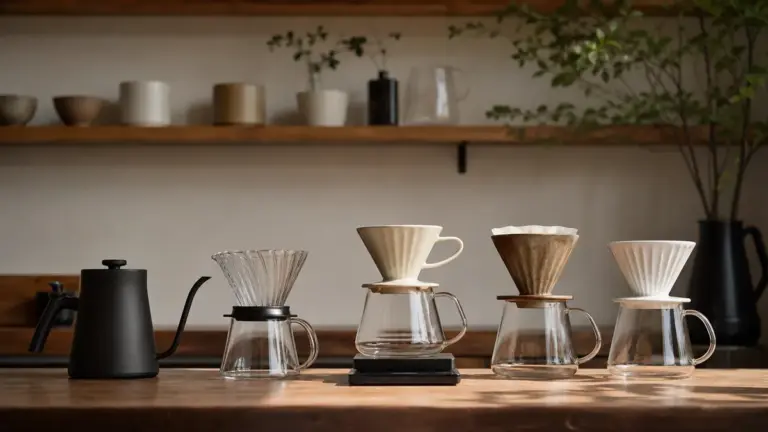
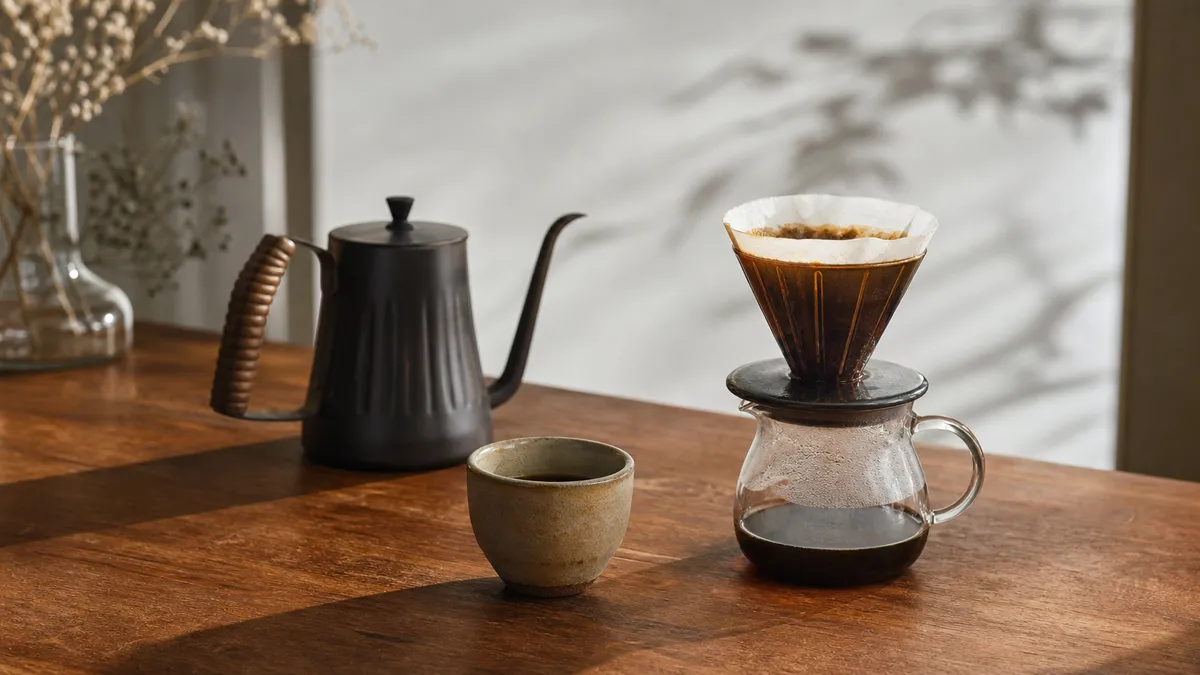
Hand drip, another name for manually poured filter coffee, is strongly associated with kissaten brewing. Japan National Tourism Organization identifies pour-over and siphon as characteristic methods, alongside a general preference for darker roasts.
The important point is not that every Japanese coffee follows one exact recipe. It is that the preparation itself can become a visible part of hospitality: the customer watches someone make a cup deliberately, rather than simply receiving a finished drink.
Nel: coffee through flannel
Nel refers to the flannel cloth used as a filter. Instead of pouring through disposable paper, the brewer pours water over ground coffee held in a reusable cloth filter.
Hario’s published description of its Woodneck brewer identifies the material as cotton flannel. That gives the term a practical meaning: nel is a filter-based brewing approach, not a bean variety, roast level or synonym for all Japanese coffee.
For the curious drinker, ask which coffee the shop recommends with its chosen method. Comparing two drinks made with different beans tells you about the whole preparation, but does not isolate the effect of the filter.
Siphon: a different mechanism
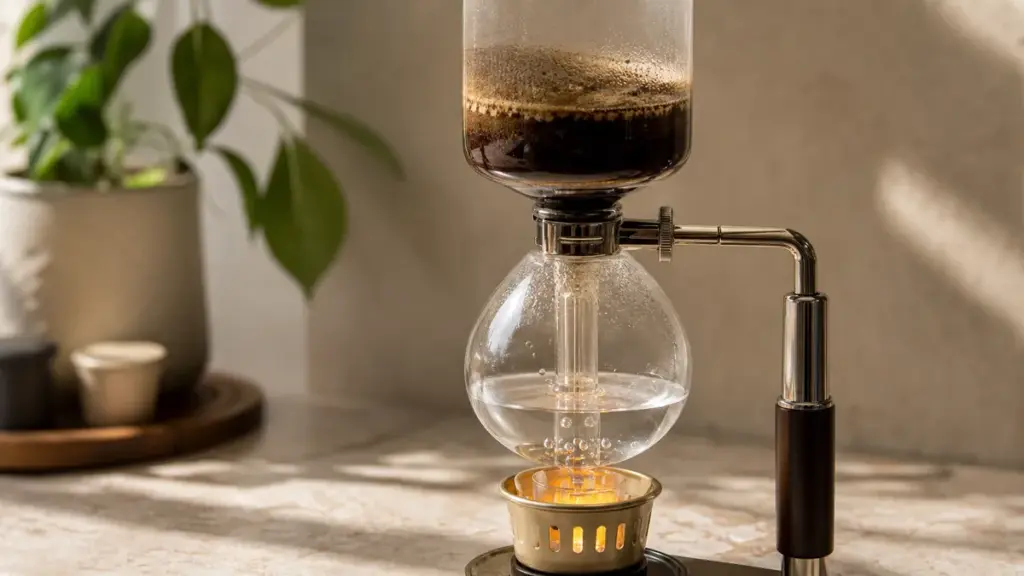
A siphon brewer uses two connected chambers. Heating the lower chamber builds pressure and pushes water upwards; coffee brews in the upper chamber, then filters back down after the heat is removed.
The rising water and glass apparatus make it compelling to watch, but the movement has a brewing function. It is not espresso, and the appearance of the equipment alone cannot tell you how the drink will taste.
Treat the method as one useful question among several. Bean choice, roast and the café’s intended style still deserve attention.
Canned coffee and Tokyo’s modern roasters
Japan’s coffee culture also includes the opposite of a slowly prepared sit-down cup: ready-to-drink coffee.
The familiar claim that UCC invented canned coffee in 1969 needs qualification. UCC’s museum describes its founder Tadao Ueshima’s achievement as the world’s first canned coffee with milk, introduced in 1969. Shimane Prefecture identifies an earlier product, Yoshitake Miura’s Mira coffee, launched in September 1965.
These sources use different scopes for the “first” claim. This article follows the distinction between the earlier canned coffee and UCC’s milk-containing product, rather than attributing the entire category to UCC.
The All Japan Coffee Association links the expansion of canned coffee and vending machines with the growth of coffee consumption. Convenience and craftsmanship belong in the same account of Japanese coffee, not in competing accounts of what is authentic.
Tokyo’s modern independent roasting scene adds another strand. Glitch Coffee & Roasters, which opened in Jimbocho in 2015, explicitly describes its approach in terms of light roasting and individual origins. It is a useful counterexample to the idea that Japanese coffee necessarily means a dark kissaten blend.
The broader specialty coffee movement helps explain this attention to origin. It should not be mistaken for a replacement for older coffee-house traditions.
South Korea’s café boom and everyday iced Americano
South Korea’s contemporary café boom has a useful landmark in Starbucks’ first Korean shop, opened near Ewha Womans University in Seoul on 27 July 1999. That is a milestone in chain expansion, not the beginning of Korean coffee drinking.
The scale of the subsequent café sector is clearer when the figures are dated and defined. A government-published foodservice report, drawing on Statistics Korea, records 100,729 coffee-specialist establishments in 2022 and 106,452 in 2023.
Using the 2023 count and the census population of 51.77 million gives approximately 2.06 establishments per 1,000 residents, or one for every 486 people. The calculation is 106,452 ÷ 51,770,000 × 1,000. This is an indicative national density, not a claim that cafés are evenly distributed or that South Korea holds a world record.
These are historical figures checked in November 2026, not a current shop register.
Eoljuk-a: iced Americano despite the cold
An iced Americano combines espresso, water and ice. In South Korea, its winter popularity has acquired a name: eoljuk-a, also written eoljukah, roughly expressing “iced Americano even if I freeze to death”.
The phrase is playful, not literal advice. It captures a recognisable preference without implying that everyone drinks the same thing.
There is no need to turn that preference into a single national personality trait. Reporting on the phenomenon discusses convenience and the ability to drink without waiting for cooling, but these are proposed explanations, not proof of one universal motive.
Themed cafés and design culture
South Korea’s café culture makes the room itself worth examining. Seoul Metropolitan Government documents cafés in converted private homes, themed establishments in Yeonnam-dong and coffee spaces within hanok, traditional Korean houses.
These examples show different ways of creating an architectural concept. A converted home offers a domestic setting; a hanok café brings an existing building tradition into contemporary use. Neither needs an elaborate novelty theme to give the visit a distinct character.
Themed cafés can also centre on participation rather than architecture. South Korea’s Ministry of Culture, Sports and Tourism describes birthday cafés organised by fans to celebrate musicians and other celebrities. Decorations, special menus and collectibles turn the café into a temporary meeting place for a shared interest.
Design culture therefore deserves more careful treatment than “a place to take photographs”. Ask what the space invites people to do: listen, meet, celebrate, examine the building or concentrate on the coffee.
The comparison with Japan is useful precisely because it is not absolute. A kissaten organised around music is also a concept-led space. A Korean café in a renovated house need not be visually extravagant. In both countries, the relationship between drink, room and customer is more revealing than a national style label.
A short timeline
| Date | Development | Why it matters |
|---|---|---|
| 1961 | Japan liberalised coffee imports | Context for subsequent growth in consumption |
| September 1965 | Mira canned coffee appeared in Shimane | Qualifies the familiar UCC invention story |
| 1969 | UCC introduced canned coffee with milk | A distinct milestone in ready-to-drink coffee |
| 27 July 1999 | Starbucks opened its first South Korean shop | A landmark in the modern chain-café era |
| 2015 | Glitch opened in Tokyo’s Jimbocho | An example of contemporary light-roast coffee |
What to notice on a café visit
Use this checklist to explore Japanese and Korean coffee culture without reducing either country to a single drink:
- Identify the focus. Is the attraction brewing, music, architecture, food or a shared interest?
- Ask about preparation. Find out whether the coffee is hand-dripped, cloth-filtered, siphon-brewed or espresso-based.
- Compare like with like where possible. Ask whether the same coffee is available through different methods.
- Read the room. Check photography and conversation rules, especially in listening-focused kissaten.
- Record the useful details. Note the bean, roast, method and what you liked, rather than treating “Japanese” or “Korean” as a flavour description.
My suggested approach is to choose contrasting experiences: a brewing-focused café and a space-led café. That comparison asks a better question than which country does coffee best: what makes you want to stay for another cup?
FAQ
Does kissaten mean a café that serves only coffee?
No. Kissaten can serve light meals and sweets as well as coffee, and some serve alcohol. The narrower term jun-kissa identifies a coffee house without alcohol service. Treat these terms as clues to the establishment’s character, not guarantees of a particular menu, brewing method or quality level.
Is Korean iced Americano the same as cold brew?
No. An iced Americano is made with espresso, water and ice. It is therefore defined by how it is assembled, not simply by being cold black coffee. If you want to experience the drink associated with eoljuk-a, order an iced Americano rather than assuming that any chilled coffee is equivalent.
Should I ask before photographing a Japanese kissaten?
Yes. GO TOKYO’s kissaten guidance notes that some establishments prohibit photography or publish their own rules. Ask before photographing the room or brewing process, and avoid including other customers without permission. The equipment may be interesting, but the café remains someone’s workplace and other people’s place to relax.
Where to go next
Read Coffee Culture to place Japanese and Korean coffee culture in a wider context, then Modern Specialty Coffee Culture for the origin-focused approach found in contemporary roasters. For contrasting café traditions, Swedish Fika and Nordic Coffee Culture explores the coffee break, while Viennese and French Café Culture offers another perspective on the coffee house as a place to spend time.
Sources
-
Japan National Tourism Organization, Kissaten: Japan’s Old-School Coffee Shops, 2021. History, brewing preferences and listening cafés.
https://www.japan.travel/en/blog/kissaten-japans-old-school-coffee-shops/ -
Japan National Tourism Organization, Take Your Cup Of Coffee With Something Quirky At A Kissaten, undated. Post-war development and proprietor-led character.
https://www.japan.travel/en/ph/story/coffee-culture-in-japan-kissaten/ -
All Japan Coffee Association, Coffee Market in Japan, undated historical overview. Import history and ready-to-drink coffee.
-
Hario USA, Drip Pot Woodneck and “Next” Coffee Syphon, undated manufacturer descriptions. Filter material and brewing mechanism only.
https://www.hario-usa.com/products/drip-pot-woodneck
https://www.hario-usa.com/products/coffee-syphon-next -
UCC Coffee Museum, The world’s first canned coffee, undated; Shimane Prefecture, Shimane ga Ichiban, undated. Differently scoped canned-coffee priority claims.
https://www.ucc.co.jp/museum/sp/en/001.html
https://www1.pref.shimane.lg.jp/admin/seisaku/koho/ichiban/ -
Glitch Coffee & Roasters, Concept, undated. Company’s stated opening year and roasting approach.
https://glitchcoffee.com/ -
SCK Company, Shinsegae Group Newsroom, Starbucks first store, 20th-anniversary renewal, 2019, Korean-language release.
https://www.shinsegaegroupnewsroom.com/starbucks-1st-store-20th-anniversary/ -
Republic of Korea Ministry of Agriculture, Food and Rural Affairs, 2025 Domestic and International Foodservice Trends, 2025, p. 100. Establishment counts attributed to Statistics Korea.
https://www.mafra.go.kr/bbs/home/798/593021/download.do -
Statistics Korea, 2023 Population and Housing Census (Register-based Census), 29 July 2024. Population denominator for the density calculation.
https://mods.go.kr/board.es?act=view&bid=11739&list_no=432396&mid=a20101000000 -
Korea JoongAng Daily, [WHY] It’s cold in Korea. Why is everyone drinking iced americanos?, 15 March 2025. Definition and reported explanations of eoljukah.
https://www.koreajoongangdaily.com/kjd-special/why-its-cold-in-korea-why-is-everyone-drinking-iced-americanos/12049349 -
Seoul Metropolitan Government, Café Culture in Seoul, Korea, 2016. Converted homes, concept cafés and hanok settings, used as documented examples rather than current venue recommendations.
https://english.seoul.go.kr/cafe-culture-seoul-korea-2/ -
Republic of Korea Ministry of Culture, Sports and Tourism, Celebrating Idols: The vibrant world of K-pop birthday cafes, 18 June 2024.
https://www.mcst.go.kr/english/policy/kocis/newsView.jsp?pSeq=234 -
Tokyo Convention & Visitors Bureau, GO TOKYO Gourmet, Tokyo’s Kissaten Culture: A Time Capsule of Coffee and Comfort Food, undated. Café types, listening culture and photography etiquette.
https://www.gourmet.gotokyo.org/article/33.html
Researched using official tourism and government publications, an industry history, manufacturer documentation, company records and attributed cultural reporting; statistical calculations were checked separately.
Last checked: November 2026