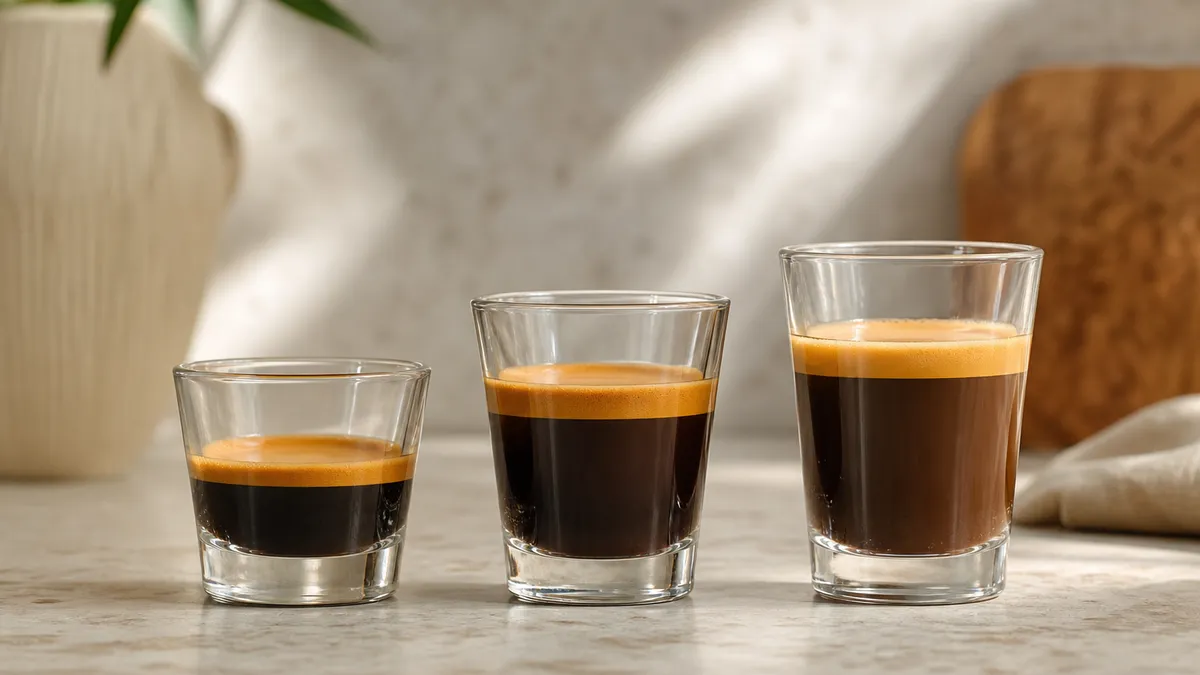
The difference between ristretto, espresso and lungo is chiefly the amount of brewed coffee collected from a given dose of grounds. Using an 18 g dose, useful starting points are 18 to 27 g out for ristretto, 36 to 45 g for espresso, and 54 to 72 g for lungo: shorter shots generally feel more concentrated, while longer shots extract further but taste less concentrated.
In short
- Compare dry coffee dose with finished drink weight, not the water entering the machine.
- The ratio bands are working conventions, not universally agreed definitions.
- A short shot can be concentrated yet under-extracted; a long shot can be lighter yet more fully extracted.
- Stop at your target beverage weight, then use taste and recorded shot time to guide adjustments.
- Caffeine depends on the coffee, dose and extraction. Neither cup size nor flavour intensity reliably tells you the amount.
Ristretto vs espresso vs lungo: the comparison
All three belong to the espresso family. Ristretto means “restricted” and lungo means “long”; espresso, sometimes called normale in this comparison, sits between them.
The table compares beverage-weight ratio, output from the same dose, likely texture and drinking preference. The suggestions describe who might enjoy each style, not which is objectively better.
| Shot style | Coffee dose to beverage weight | Output from 18 g of grounds | Typical texture and flavour tendency | Who it suits |
|---|---|---|---|---|
| Ristretto | 1:1 to 1:1.5 | 18 to 27 g | Dense and concentrated; can become sharply sour if insufficiently extracted | Someone who enjoys a small, intense drink |
| Espresso | 1:2 to 1:2.5 | 36 to 45 g | A middle ground between concentration, body and flavour development | Someone wanting a reference point for comparison |
| Lungo | 1:3 to 1:4 | 54 to 72 g | Lighter body; can become bitter or drying if poorly adjusted | Someone who prefers a longer, less concentrated shot |
These boundaries are deliberately approximate. Lavazza describes ristretto as 1:1 to 1:1.5 and lungo as 1:3 to 1:4, whereas La Marzocco’s 2022 guide allows broader ristretto and normale bands. The SCA’s published survey of barista practice found an average espresso ratio of 1:2, but that was a survey, not a rule defining every shot.
For the underlying method and equipment, see espresso brewing. Here, the useful question is what changes when you alter shot length.
Measure the drink in grams, not millilitres
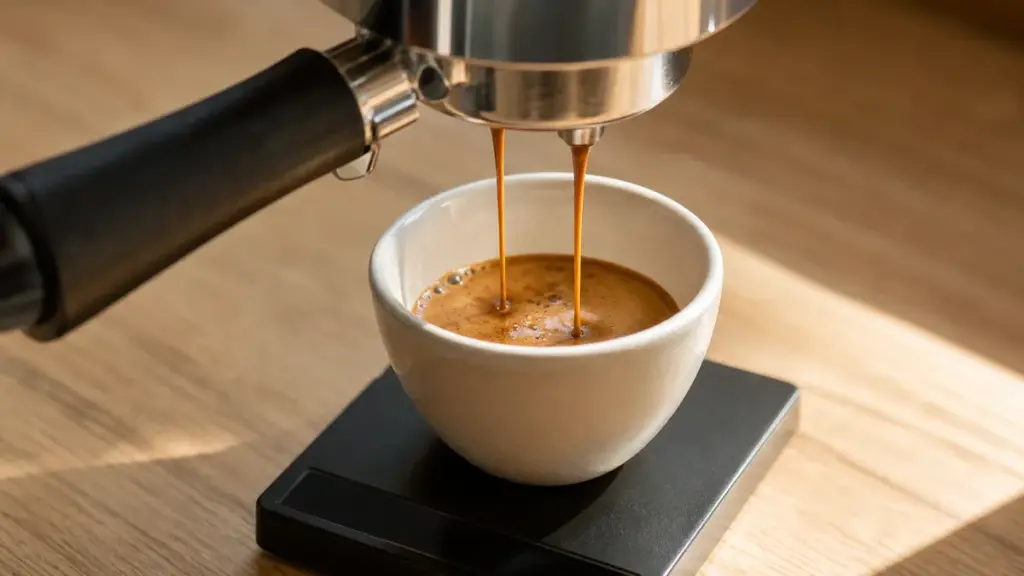
Dose means the dry ground coffee placed in the basket. Beverage yield means the weight of espresso collected in the cup.
An 18 g dose producing 36 g of drink has a 1:2 ratio. The same dose producing 54 g has a 1:3 ratio. To calculate your own target, multiply the dose by the second number in the ratio.
These are beverage-weight ratios, not “volumes by weight”. Grams measure mass; millilitres measure volume. There is no need to convert the recipes into millilitres: weighing the finished drink gives you a direct, repeatable comparison.
Also distinguish espresso ratios from the coffee-to-brewing-water ratios used for filter and immersion methods. The brewing methods guide explains that wider distinction.
Keep dose constant when comparing shot lengths. Otherwise, changing both the amount of coffee and the amount of drink makes it harder to identify what caused the difference.
How extraction changes flavour
Extraction is the transfer of material from the grounds into the drink. Concentration describes how much of that material is present relative to the amount of liquid.
Those are separate ideas. With the same dose and grind setting, collecting more espresso generally increases extraction while reducing concentration. Stopping earlier does the reverse.
Ristretto: concentrated does not automatically mean balanced
A ristretto has less liquid carrying the extracted coffee, which usually gives it a heavier, more concentrated impression. That can be enjoyable, but stopping a successful espresso recipe early does not guarantee a successful ristretto.
Taste for the distinction between lively acidity and an unfinished, sharply sour flavour. If the shorter drink loses sweetness or feels aggressively sharp, its intensity is not evidence that extraction is sufficient.
Espresso: a useful reference point
A middle-length shot is a sensible place to begin because it gives you room to move in either direction. Establish a drink you enjoy before deciding whether a shorter or longer version improves it.
Do not treat the middle ratio as a promise of balance. Coffee choice, grind, preparation and flow still matter.
Lungo: lighter does not mean less extracted
A lungo passes more water through the grounds rather than merely adding water to a completed espresso. It can therefore taste different, not simply weaker.
A well-adjusted longer shot need not be harsh. However, extending a recipe without reconsidering its grind or endpoint can produce a thin drink with an unpleasant bitter or drying finish. Evaluate texture and aftertaste together rather than assuming that more liquid means gentler flavour.
How to pull and compare each shot
This is a focused comparison exercise, not a replacement for espresso dialling in. Use a basket suitable for your chosen dose, a scale, a timer and the same coffee throughout.
Start with a reference espresso
- Prepare the machine according to its instructions. If temperature is adjustable, 93°C is a manufacturer-supported starting point. Keep it unchanged during this comparison.
- Weigh 18 g of grounds, provided that dose suits the basket. Distribute them evenly and tamp level.
- Place the cup on the scale and tare it. Start brewing and timing together.
- Collect 36 g of espresso, giving a 1:2 ratio. A conventional starting window is about 25 to 35 seconds, but the number is diagnostic, not a pass mark.
- Taste and record the result. Note sweetness, acidity, bitterness, body and any drying finish.
If this reference shot is unpleasant, improve it before drawing conclusions about the other styles.
Pull a ristretto
For the first comparison, keep the preparation unchanged and stop at 27 g, a 1:1.5 ratio. This is an editorial tasting exercise: it lets you experience the effect of shortening the beverage before changing another variable.
If you want to develop that into a regular ristretto recipe, try a slightly finer grind in small steps. This can slow the flow and support extraction at the smaller output. Taste after each change rather than forcing the shot to match a particular number of seconds.
Pull a lungo
For the corresponding longer comparison, collect 54 g, a 1:3 ratio. Keep a record of how long it takes and whether the extra liquid improves flavour or merely adds a drying finish.
When developing a separate lungo recipe, a slightly coarser grind can help reach the larger output without simply prolonging the original extraction. Change one variable at a time. If the longer style still tastes worse, you do not have to keep it merely because the ratio is conventional.
Keep the comparison manageable
Begin with those three endpoints rather than testing every possible ratio. Write a brief preference note for each, then refine the style you actually want to drink.
The aim is not to make all three taste identical. It is to discover which balance of concentration, texture and flavour works best with your coffee.
Which has more caffeine?
Shot length alone cannot provide a dependable caffeine figure. Coffee composition, dose, grind and the amount extracted all matter.
A controlled laboratory study by Schmieder and colleagues used a 20 g arabica dose and calculated caffeine in three beverage sizes from analysed extraction fractions. Across its experimental settings, the approximate ranges were:
- Ristretto, 20 g drink: 120 to 140 mg.
- Espresso, 40 g drink: 172 to 195 mg.
- Lungo, 60 g drink: 190 to 217 mg.
These are study-specific ranges, not estimates for every café serving or for this article’s 18 g examples. They also show why “ristretto contains only slightly less caffeine” is too confident as a general rule.
EFSA’s 2015 evidence assessment found no safety concerns for healthy non-pregnant adults at single doses up to 200 mg or habitual intakes up to 400 mg across the day. These are population benchmarks, not targets; sensitivity varies. The NHS advises no more than 200 mg daily from all sources during pregnancy. Speak to a GP, pharmacist or midwife about individual concerns.
Choosing a shot length beyond the basic ratios
Once you understand the three styles, consider the coffee rather than defending a particular label.
La Marzocco suggests shorter ratios for more developed roasts and longer ratios for lighter roasts. Treat that as a starting hypothesis, not an instruction that every dark roast must become ristretto or every light roast must become lungo.
Extraction evenness matters too. Grinding progressively finer does not indefinitely improve extraction or flavour. Barista Hustle’s practical guidance emphasises that a more even extraction gives a wider useful range, whereas uneven extraction can leave a drink tasting sour and bitter together.
This is why a disappointing ristretto should not automatically trigger another finer adjustment. Check whether your preparation and flow are repeatable before chasing the ratio.
There is also a useful alternative when your preferred espresso tastes good but feels too concentrated: add hot water after brewing. That makes an Americano-style drink, not a lungo, because the added water does not pass through the grounds.
For ristretto vs espresso vs lungo, choose your endpoint by the result you enjoy. Keep the recipe as a record of that result, not a substitute for tasting it.
FAQ
Is a double ristretto the same as a single espresso?
No. “Double” describes the dose or serving convention, while “ristretto” describes a shorter beverage relative to its dose. A double-dose ristretto can occupy a similar amount of space in a cup to a smaller-dose espresso without having the same recipe or caffeine content. Ask about the dose and output rather than relying on the name.
Can I make these styles on a capsule machine?
You can vary the output if the machine allows it, but you cannot usually adjust the coffee dose or grind inside the capsule. Its ristretto, espresso and lungo programmes therefore should not be assumed to match the weight ratios in this article. Follow the capsule maker’s brewing guidance and weigh the result if you want to compare outputs.
Can a lungo replace coffee made in a cafetière or AeroPress?
It can replace it as your chosen drink, but it is not the same brewing process. Lungo remains an espresso-style extraction through a compact bed of grounds. If you are choosing a method rather than adjusting a shot, read the separate French Press and AeroPress guides instead of using beverage size as the deciding factor.
Where to go next
Read Espresso for the underlying method, then Espresso Dialling In: Dose, Yield and Time for systematic recipe adjustments. For alternatives to espresso-style brewing, French Press and AeroPress explain two different approaches worth comparing.
Sources
-
Specialty Coffee Association, “Defining the Ever-Changing Espresso”, 25 Magazine, Issue 3, 2017. Survey evidence for weight-based measurement and espresso ratios, not a universal shot-length standard.
https://sca.coffee/sca-news/25-magazine/issue-3/defining-ever-changing-espresso-25-magazine-issue-3-zyx36. -
Specialty Coffee Association, “Water and Coffee Acidity: How to Adapt Your Water for Different Extraction Methods”, 25 Magazine, Issue 9, 2019. Explanation of beverage ratio versus brewing-water ratio.
https://sca.coffee/sca-news/25/issue-9/english/water-and-coffee-acidity-how-to-adapt-your-water-for-different-extraction-methods-25-magazine-issue-9-pxjby. -
La Marzocco Home, “Using Espresso Brew Ratios”, 2022. Manufacturer guidance on ratio conventions, timing and temperature.
https://home.lamarzoccousa.com/using-espresso-brew-ratios/. -
La Marzocco Home, “The Essential Guide to Mastering Espresso at Home”, 2025. Manufacturer guidance on preparation and roast-related ratio choices.
https://home.lamarzoccousa.com/the-essential-guide-to-mastering-espresso-at-home/. -
Lavazza, “Ristretto vs. Lungo: The Espresso Ratio Guide”, undated. Manufacturer guidance on shot styles, grind adjustments, capsules and the distinction from an Americano.
https://www.lavazzausa.com/en/recipes-and-coffee-hacks/ristretto-vs-lungo-guide. -
Barista Hustle, “The Espresso Compass”, 2017. Practitioner guidance on concentration, extraction and evenness.
https://www.baristahustle.com/the-espresso-compass/. -
Schmieder, B. K. L. and colleagues, “Influence of Flow Rate, Particle Size, and Temperature on Espresso Extraction Kinetics”, Foods, volume 12, article 2871, 2023. Controlled laboratory extraction research, particularly methods section 2.8.2 and Table 2.
https://pmc.ncbi.nlm.nih.gov/articles/PMC10418593/. -
European Food Safety Authority, “Caffeine”, current topic page summarising the 2015 Scientific Opinion on the safety of caffeine. Population-level safety assessment.
https://www.efsa.europa.eu/en/topics/topic/caffeine. -
NHS, “Foods to avoid in pregnancy”, current guidance retrieved November 2026. UK pregnancy caffeine guidance.
https://www.nhs.uk/pregnancy/keeping-well/foods-to-avoid/.
Researched using SCA publications, manufacturer brewing guidance, controlled extraction research and current NHS and EFSA guidance; the suggested tasting exercise is editorial guidance, not a claim of first-hand testing.
Last checked: November 2026