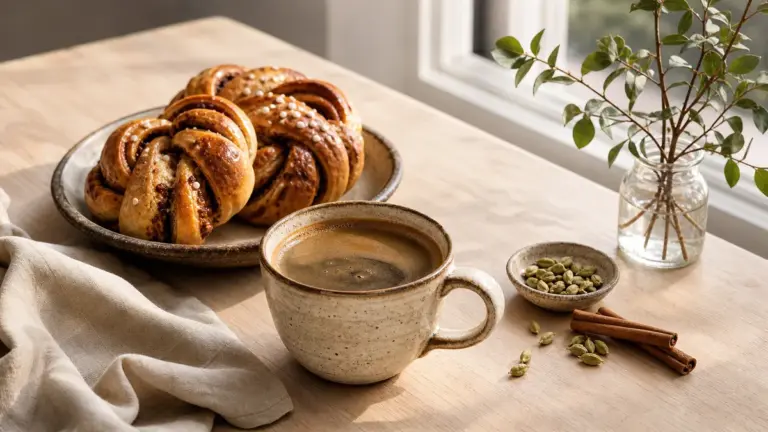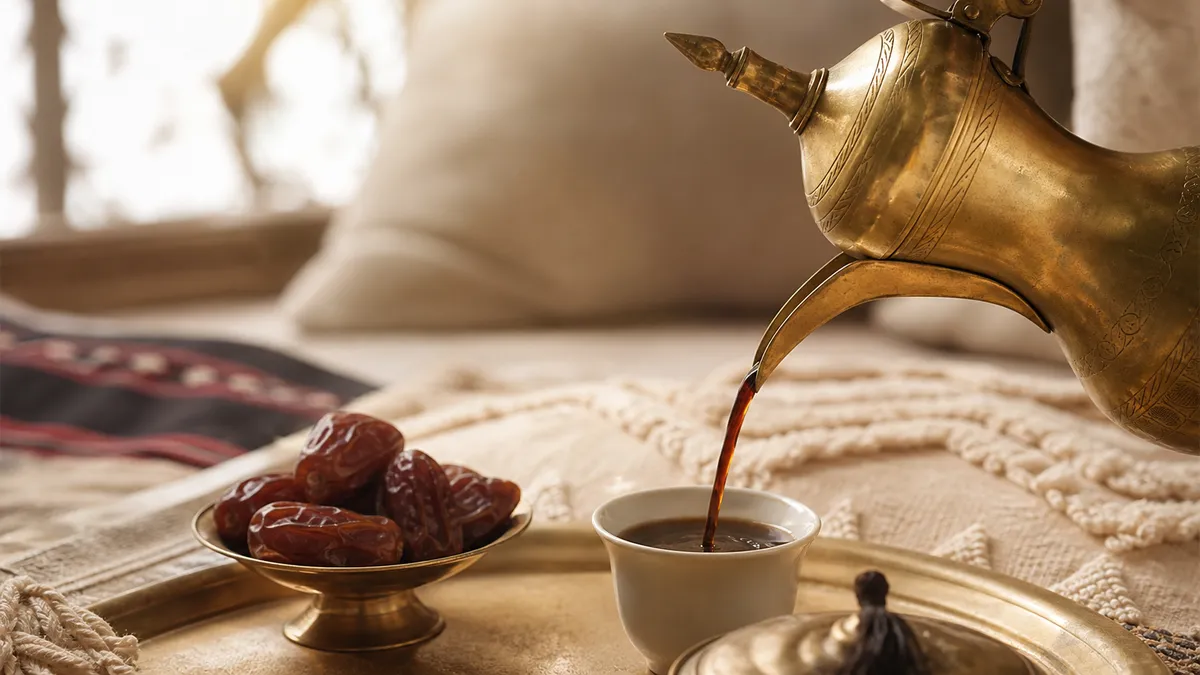
Arabic coffee traditions centre on welcoming guests: preparing fragrant coffee, offering small servings and attending carefully to refills. Often called qahwa or gahwa, the drink varies between regions and households, so the lightly roasted, cardamom-scented coffee associated with the Arabian Peninsula is a family of traditions, not one universal Arab recipe.
In short
- A dallah is the traditional coffee pot; a finjan is the small cup from which the coffee is drunk.
- Light roasts, cardamom and saffron are characteristic of some preparations, but darker roasts and different spice combinations also belong.
- In documented Emirati practice, the server holds the dallah in the left hand and offers the cup with the right.
- Small servings allow repeated offers of hospitality. Gently shaking the cup commonly signals that no refill is wanted.
- UNESCO first recognised the shared tradition in 2015. An extended inscription in 2024 added Jordan to the original four participating countries.
Arabian Coffee Rituals
The central act is not simply making a drink. It is receiving someone properly. UNESCO describes Arabic coffee as a daily hospitality practice as well as part of weddings and gatherings concerned with reconciliation and resolving disputes.
Coffee can therefore accompany an ordinary visit or an occasion carrying considerable social weight. Preparing it, deciding whom to serve first and noticing when someone wants more are all ways of showing attention.
A majlis is a sitting place or gathering in which people meet and converse. Coffee belongs naturally in this setting, alongside conversation, shared memories and, at some gatherings, poetry. The wider relationship between drinks and social life is explored in coffee and society.
Preparation as part of the welcome
Traditional preparation can make the work visible to guests. Abu Dhabi’s Department of Culture and Tourism describes a sequence of roasting beans, cooling and grinding them, boiling the grounds and transferring the coffee into a smaller serving pot.
Its Bait Al Gahwa initiative teaches both coffee-making and the hosting of a majlis. This is a useful reminder that the skill includes looking after people, not merely producing the right liquid.
Visit Qatar describes a comparable journey from roasting and grinding to simmering coffee with cardamom and other traditional ingredients. It also emphasises that families preserve their own recipes and rituals.
There is consequently no need to look for a single ceremonial script that makes every other version incorrect. Ask how a particular household prepares its coffee, rather than whether it follows the supposedly definitive recipe.
Dates and other accompaniments
Dates are a traditional accompaniment in Qatar and Saudi Arabia, providing sweetness beside the coffee’s bitterness. Oman’s official tourism guidance also places coffee alongside dates and halwa, a sweet confection.
For a first encounter, taste the coffee before reaching for anything else. Then try it with the accompaniment offered by your host. This is a more useful introduction than expecting it to behave like an espresso or a milky coffee.
Qahwa and Gahwa Varieties
Qahwa and gahwa are not two distinct coffee recipes. They are forms of the Arabic name encountered in different pronunciations and English spellings. Abu Dhabi Culture identifies gahwa as the Emirati Arabic term, while Qatar’s official tourism material uses both forms.
Neither spelling tells you the roast, spice mixture or strength. Those details require a little more explanation.
Light roasts, cardamom and saffron
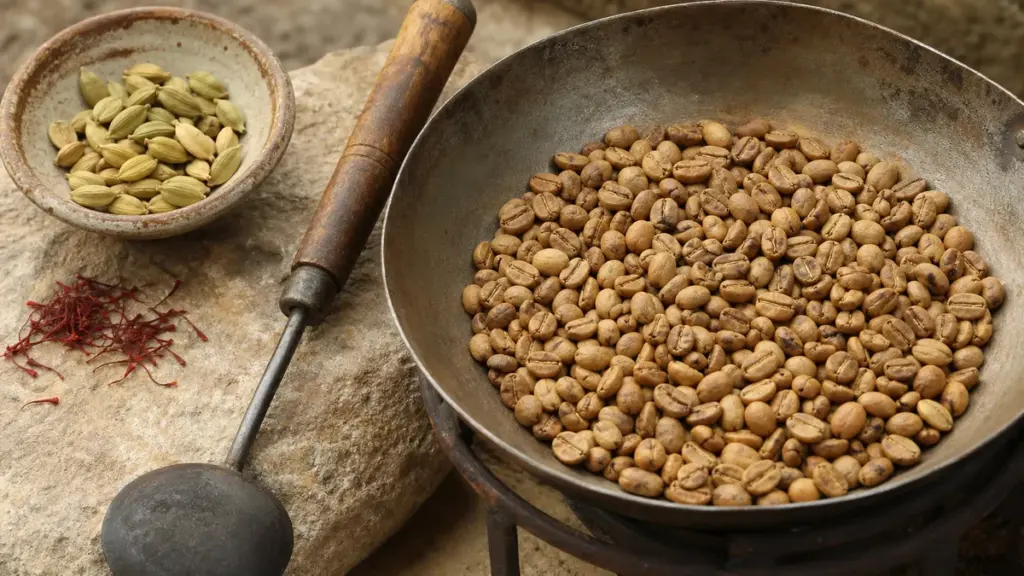
The pale, golden coffee familiar from many Arabian hospitality settings is an important expression of the tradition, but not its complete definition. Qatar Tourism describes coffee whose strength and colour vary, usually prepared with cardamom and sometimes with saffron, cloves or cinnamon.
Saudi Arabia’s Culinary Arts Commission documents light-roasted southern preparations with cardamom and saffron among their ingredients. Its regional overview also includes cinnamon, fennel, cloves and ginger in the south.
These are documented combinations, not an instruction to put every spice into every pot. When choosing coffee or asking about a serving, enquire about the actual ingredients rather than assuming that “Arabic coffee” always means cardamom and saffron.
Regional differences at a glance
The following examples describe published regional practices, not boundaries that every household observes.
| Place or tradition | Documented preparation or accompaniment | What to avoid assuming |
|---|---|---|
| Southern Saudi Arabia | Light roast with cardamom, saffron and other possible spices | That every southern recipe contains the same mixture |
| Northern Saudi Arabia | Dark roast with cardamom in the Culinary Arts Commission’s overview | That Arabic coffee must be pale |
| Central and eastern Saudi Arabia | Medium-roasted preparations featuring cardamom and saffron | That roast colour alone identifies a recipe |
| Qatar | Variable strength and colour; cardamom is usual, with other spices sometimes added | That every family makes identical golden coffee |
| Oman | Cardamom-flavoured black coffee, accompanied by dates or halwa | That the accompaniments are the same throughout the peninsula |
Jordan adds another important dimension: coffee’s role in receiving visitors and maintaining social relationships. Its Ministry of Tourism and Antiquities specifically explains the gestures for requesting another serving or declining a refill.
The useful distinction is between a shared language of hospitality and local ways of expressing it. For the broader context, the coffee culture guide provides a route into other traditions without treating them as interchangeable.
The Dallah and Finjan
The dallah is the traditional coffee pot used in preparation and service. The finjan is a small coffee cup, commonly handleless; English spellings also include finjal and finyal in the Emirati sources.
Although the serving pot attracts attention, traditional equipment can be more extensive. Abu Dhabi Culture describes separate dallahs for boiling, filtering and serving, alongside a roasting pan and a stirring tool.
That distinction matters when watching a demonstration. The coffee reaching the guest may have passed through more than one vessel. A beautiful serving dallah does not necessarily tell you how the coffee was roasted or brewed.
Why the cup is only partly filled
A small pour is deliberate, not a short measure. Abu Dhabi Culture describes filling the cup a quarter full; Visit Qatar describes a third.
The shared principle is a modest serving followed by attentive refills, rather than filling the cup to the brim. The precise fraction is less useful to a visitor than recognising the repeated offer.
The same caution applies to hand movements. UNESCO’s current summary refers to pouring with the right hand, whereas Abu Dhabi’s detailed account specifies the pot in the left hand and the cup in the right. For practical Emirati service, follow that locally documented description rather than turning a multinational summary into a universal pouring manual.
Serving Etiquette: A Visitor’s Checklist
You do not need to memorise an elaborate code before accepting coffee. Observe the host, respond appreciatively and ask quietly if you are unsure.
The following checklist draws on official Emirati, Qatari and Jordanian descriptions:
- Let the host establish the serving order. Older or honoured guests commonly receive priority. Do not assume that the person nearest the pot should be served first.
- Receive the cup with your right hand where practical. Emirati guidance also describes returning it with the right hand.
- Expect a small serving. Do not interpret a partly filled cup as an oversight or ask the server to fill it like a mug.
- Allow the host to offer a refill. In Jordan’s visitor guidance, holding the cup out signals that you would like more.
- Gently shake the cup when finished. A small side-to-side movement is a documented way to decline another serving, including in Jordan and Qatar.
- Follow your own needs. If you do not drink coffee, explain politely. Hospitality should not become a reason to consume something you do not want.
Published guidance sometimes mentions three cups. Qatar Tourism calls three the favoured number, while Abu Dhabi Culture describes a customary range from one to three. Treat these as descriptions of particular customs, not a compulsory drinking target.
For hosts, the practical lesson is attentiveness: recognise a refusal and do not keep pouring. For guests, appreciation matters more than performing every gesture perfectly. The wider mechanics of welcoming people are covered in coffee at social gatherings.
UNESCO Recognition: What Was Inscribed?
UNESCO recognition concerns living knowledge and social practices, not approval of one recipe or ownership of coffee by a single country.
The distinction is especially useful here because the current inscription builds on an earlier multinational one.
A short recognition timeline
- 2015: Arabic coffee, a symbol of generosity entered UNESCO’s Representative List of the Intangible Cultural Heritage of Humanity through the United Arab Emirates, Saudi Arabia, Oman and Qatar. The original reference was 01074.
- 2022: Saudi Arabia’s Knowledge and practices related to cultivating Khawlani coffee beans was inscribed separately, under reference 01863.
- 2024: The Arabic coffee inscription was extended to include Jordan. Reference 02111 incorporates and replaces the original 2015 entry.
The Khawlani inscription should not be confused with the hospitality inscription. It concerns cultivation and associated knowledge, including planting, maintaining agricultural terraces, harvesting and processing coffee.
Read together, the entries recognise different parts of coffee culture: growing and processing the crop, and preparing and sharing the drink. They are related, but they are not the same heritage element.
The extension also explains why older descriptions list four countries while the current entry lists five. Both can accurately describe their respective dates; a present-day account should include Jordan.
Appreciating Arabic Coffee Traditions at Home
For a UK reader, a useful starting point is to ask what a packet or menu means by “Arabic coffee”. Look for a stated roast and ingredient list, and ask whether spices are already included before adding your own.
When sharing it, explain the particular preparation you have chosen rather than presenting it as the coffee of every Arab country. Offer small servings and an easy opportunity to decline another.
A dallah and finjan can help introduce the objects associated with the tradition, but equipment alone is not the whole practice. The most worthwhile lesson from Arabic coffee traditions is the attention given to a guest: noticing, offering and knowing when to stop.
FAQ
Must I finish my coffee before discussing the purpose of a visit?
Do not assume that this is a universal rule. UNESCO documents coffee’s place in reconciliation and other significant gatherings, but that does not establish one conversational sequence for every visit. In an unfamiliar formal setting, let your host lead rather than applying etiquette advice gathered from a different country or occasion.
Can traditional gahwa and modern speciality coffee coexist?
Yes. Visit Qatar explicitly describes younger Qataris embracing different coffee styles alongside traditional gahwa, including iced interpretations. A preference for espresso or filter coffee need not mean abandoning a family hospitality tradition. The drink chosen for a café visit and the coffee offered when receiving guests can serve different purposes.
What is a useful question to ask someone serving Arabic coffee?
Ask, “How does your family prepare it?” Official Qatari guidance emphasises family recipes, while Saudi sources document regional differences in roast and spices. This question invites an explanation without suggesting that one version must be more authentic than another. You can then ask about the ingredients, serving pot or accompaniments.
Where to go next
Read Coffee Culture for the wider guide, and The Role of Coffee in Social Gatherings to explore how offering a drink helps structure a welcome. Asian Coffee Traditions broadens the comparison, while Turkish coffee rituals is the next read for a distinct preparation and serving tradition.
Sources
-
UNESCO, Arabic coffee, a symbol of generosity, nomination 02111, 2024. Current description of the shared practice and participating countries.
https://ich.unesco.org/en/RL/arabic-coffee-a-symbol-of-generosity-02111 -
UNESCO Intergovernmental Committee, Decision 19.COM 7.B.55, 2024. Confirms the 2015 inscription, original participating countries, extension to Jordan and replacement of reference 01074 by 02111.
https://f5vip11.unesco.org/en/decisions/19.COM/7.B.55 -
UNESCO, Knowledge and practices related to cultivating Khawlani coffee beans, nomination 01863, 2022.
https://ich.unesco.org/en/RL/knowledge-and-practices-related-to-cultivating-khawlani-coffee-beans-01863 -
Abu Dhabi Culture, Department of Culture and Tourism, Gahwa-Arabic coffee, undated. Equipment, Emirati terminology and serving etiquette.
https://abudhabiculture.ae/en/cultural-resources/publications/gahwa-arabic-coffee -
Department of Culture and Tourism Abu Dhabi, Bait Al Gahwa, undated. Traditional preparation sequence and heritage training.
https://dct.gov.ae/en/what.we.do/culture/projects/bait.al.gahwa.aspx -
Department of Culture and Tourism Abu Dhabi, The history and origin of coffee, undated. Description of the handleless finjan and traditional equipment.
-
Visit Qatar, The Art of Making Arabic Coffee, undated. Family traditions, preparation and dates.
https://visitqatar.com/intl-en/about-qatar/traditions/art-of-making-arabic-coffee -
Qatar Tourism, Qatar National Tourism Council reveals 10 surprising facts about Arabic coffee, undated. Ingredients, accompaniments and serving customs.
https://www.qatartourism.com/en/news-and-media/press-releases/qntc-reveals-10-surprising-facts-about-arabic-coffee -
Visit Qatar, The culture of coffee in the Arab world, undated. Small pours, terminology and contemporary coffee culture.
https://visitqatar.com/intl-en/things-to-do/get-inspired/culture-of-coffee -
Saudi Culinary Arts Commission, Renaissance and Trends in Culinary Arts in the Kingdom, undated. Regional roast and ingredient overview.
https://culinary.moc.gov.sa/-/media/Project/Ministries/Commission/culinaryarts/Culinary-Arts-Books/Sector-Reports/RT-in-the-Kingdom-Eng.pdf -
Experience Oman, Heritage and Culture Activities, undated. Omani coffee, dates, halwa and hospitality.
https://experienceoman.om/things-to-do-categories/heritage-and-culture-activities -
Jordan Ministry of Tourism and Antiquities, Local customs, undated. Gestures for requesting and declining refills.
https://www.mota.gov.jo/EN/Pages/local_customs
This article was researched using UNESCO records and official cultural and tourism sources, distinguishing locally documented customs from broader descriptions.
Last checked: November 2026