Coffee around the world is drunk as a quick espresso, a slowly filtered glass, a sweet iced drink or a succession of small cups shared with guests. Understanding the local habit means noticing not just the recipe, but how it is served, when people drink it and what accepting a cup means.
In short
- In Italy, ordering un caffè normally means an espresso, not a large black coffee.
- Turkish coffee is served with its fine grounds still in the cup; let them settle before drinking.
- In Singapore, kopi, kopi-O and kopi-C describe different combinations of coffee, milk and sugar.
- In some Arabic coffee traditions, gently shaking your cup signals that you have finished.
- Finland, Sweden, Denmark and Norway are heavy coffee-consuming countries, but consumption figures need a year and a clear measurement basis.
A quick guide to coffee around the world
Start with the serving style. A small cup might contain concentrated espresso, coffee brewed with its grounds, or a modest serving intended to be repeatedly replenished. Its size alone tells you little about the occasion.
These examples are starting points, not national rules. Read the wider coffee culture guide for the context behind the drinks.
| Place or tradition | What to expect | Useful first step |
|---|---|---|
| Italy | Espresso in a small cup, often enjoyed standing at the bar | Ask for un caffè |
| Türkiye | Powder-fine coffee brewed in a small pot | Specify sweetness before preparation |
| Qatar and neighbouring Arabic coffee traditions | Coffee poured from a dallah, often with dates | Watch the host’s serving gestures |
| Vietnam | A phin filter dripping into a cup or glass | Check whether milk and ice are included |
| Singapore | Kopi customised with milk, sugar and other additions | Learn the order rather than asking simply for coffee |
| Sweden | Coffee and often something sweet during fika | Make time for the company |

Ethiopia: preparation is part of the invitation
In the Ethiopian coffee ceremony, the making of the drink is something guests experience together. Beans are roasted, their aroma is appreciated, and the coffee is ground before brewing in a rounded clay pot called a jebena, also written dj ebena in some accounts.
The coffee is poured into small handleless cups. Incense, fresh greenery and accompaniments such as popcorn or toasted seeds may be part of the setting. These details make the ceremony a shared sensory occasion, rather than simply a way of producing a drink.
A traditional sequence has three successive services, commonly called abol, tona and baraka. Water is added to the grounds again between services. If invited, ask your host what the occasion involves rather than assuming every household follows an identical sequence.
The Ethiopian coffee ceremony deserves a separate explanation of its preparation, meanings and regional variations.
Arabic and Turkish coffee: different drinks, shared hospitality
Arabic coffee
In Qatar, qahwa is a fragrant coffee commonly prepared with cardamom and served alongside dates. A dallah is the distinctive serving pot. The combination of coffee, spice and a sweet accompaniment is quite different from a milky café drink.
UNESCO’s account of the shared Arabic coffee tradition describes older people and guests being served first. It also records pouring with the right hand and the drinker shaking the cup to indicate that they have finished.
Treat these as customs associated with particular communities and occasions, not instructions for every café across the Arabic-speaking world. The safest approach in someone’s home is to watch the host and ask quietly if you are unsure. Our guide to Arabic coffee traditions explores those distinctions.
Turkish coffee
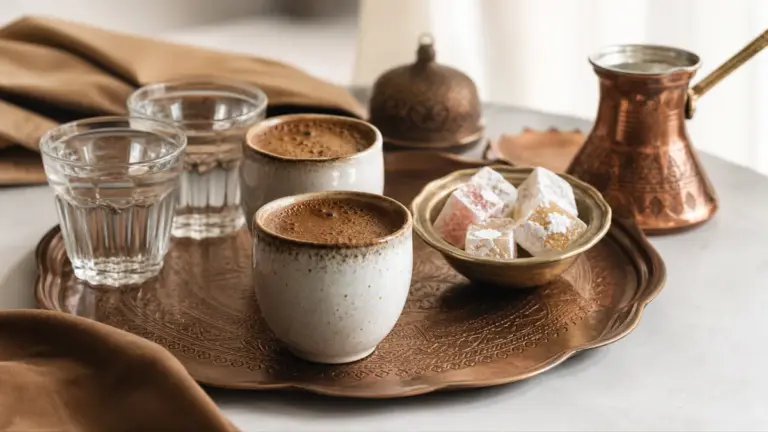
Turkish coffee uses coffee ground to a fine powder, slowly heated with water in a long-handled pot called a cezve. Sugar, if wanted, is normally added during preparation, so decide on sweetness when ordering.
The drink arrives in a small cup, usually accompanied by water and sometimes Turkish delight. It is not paper-filtered: the fine grounds remain and settle at the bottom. Sip the liquid above them rather than trying to finish every last drop.
Hospitality and conversation are central to the tradition, while reading the remaining grounds is a familiar cultural practice, not a prediction to treat as fact. Read Turkish coffee rituals for the customs beyond the cup.
Europe: espresso at the bar and coffee with company
Italy’s small, concentrated pause
In an Italian bar, un caffè generally means espresso. It is often drunk standing al banco, at the counter, and may punctuate an afternoon or follow a meal.
Cappuccino belongs especially to breakfast customs, frequently alongside a pastry. That is useful cultural context, not a reason to turn someone else’s drink preference into a test of manners. Also remember that latte means milk: say caffè latte if you want coffee with it.
The fuller guide to Italian espresso culture explains the vocabulary and regional habits without reducing Italy to a list of prohibitions.
Sweden’s fika
Swedish fika is a pause for coffee, often with something sweet, and usually with an emphasis on company. A cinnamon bun is a familiar accompaniment, but the social break matters more than assembling a particular plate.
Visit Sweden describes fika as an established part of daily life, including many workplaces. For a visitor, the useful lesson is simple: accept the pause as well as the drink. Do not assume the invitation is merely an opportunity to collect a takeaway.
Asia: slow drips, precise orders and listening cafés
Vietnam’s phin and sweet iced coffee
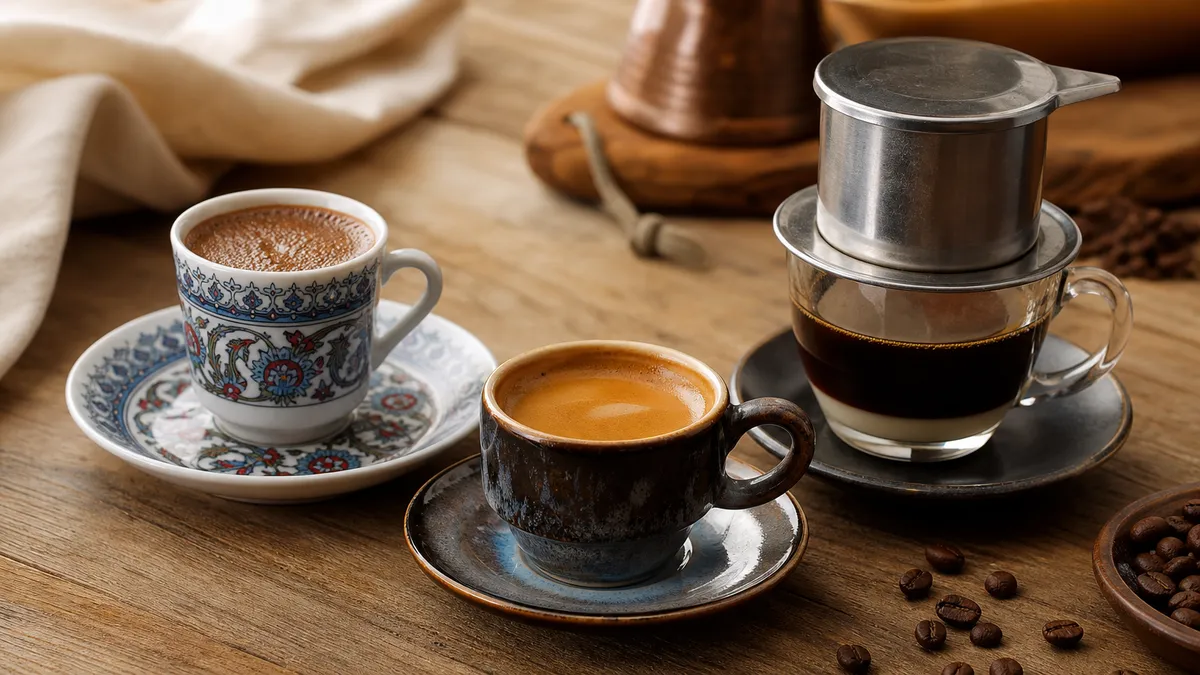
A phin is a small metal filter that sits above the cup or glass, allowing coffee to drip through under gravity. Watching it work is part of the experience.
Cà phê sữa đá combines coffee, sweetened condensed milk and ice. Stirring blends the dark coffee with the thick, sweet milk underneath. Hanoi’s cà phê trứng, or egg coffee, takes a different direction, with a whipped egg-based topping over coffee.
These are distinct drinks, not interchangeable versions of one national recipe.
Singapore’s kopi vocabulary
Singapore’s traditional kopi is strained through a cloth filter, then customised. The ordering vocabulary tells the stallholder what to add:
- Kopi: coffee with condensed milk.
- Kopi-O: black coffee with sugar.
- Kopi-C: coffee with evaporated milk and sugar.
- Kopi-O kosong: black coffee without sugar.
- Kopi-C kosong: coffee with evaporated milk and no added sugar.
Condensed milk and evaporated milk are not interchangeable here. Learning the distinction is more useful than memorising a supposedly universal translation of “white coffee”.
Japan’s kissaten
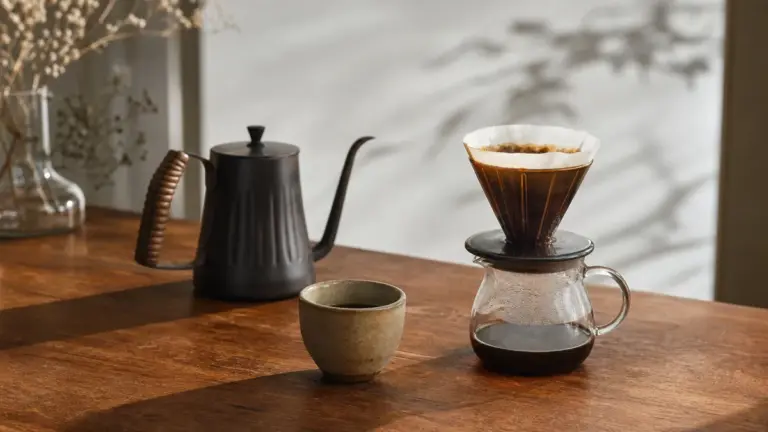
A kissaten is a traditional Japanese coffee shop. Japan’s national tourism organisation highlights pour-over and syphon brewing in these establishments, often alongside a preference for darker roasts. A syphon brewer uses connected chambers and pressure changes to move water during brewing.
Some music-focused cafés, including jazz and classical listening cafés, discourage conversation. Look at the room before treating every coffee shop as a place for a lively catch-up.
Our guide to Asian coffee traditions expands these examples without treating a vast region as one coffee culture.
The Americas: familiar words, different cups
In Colombia, tinto means black coffee, not red wine. Tintico is an affectionate diminutive. A pintadito adds a little milk, while perico can mean coffee with milk, particularly in Bogotá. Local vocabulary can therefore be as useful as knowing the brewing equipment.
Mexico’s café de olla offers another approach. A traditional recipe documented in Así se come en Tlaxcala combines coffee with cinnamon and piloncillo, an unrefined cane sugar, in an earthenware pot. Sweetness and spice are built into that preparation rather than added afterwards.
In New Orleans, Café du Monde provides a specific example of a regional serving style: its coffee-and-chicory blend is traditionally served au lait, mixed half-and-half with hot milk. That is the establishment’s stated preparation, not a formula for every American milk coffee.
Australia: order the drink, not just “coffee”
Tourism Australia’s ordering guide distinguishes flat whites, long blacks, short blacks and other espresso-based drinks. Its flat white description pairs espresso with steamed milk and a thin layer of foam; a long black has espresso poured into hot water.
The practical lesson is to specify the drink and whether you are staying or taking it away. For cold drinks, ask what is included: Tourism Australia notes that an “iced coffee” may contain ice cream, whereas an iced latte is described as espresso, milk and ice.
A familiar name is useful, but the ingredients still deserve a quick check.
Which countries drink the most coffee per person?
Nordic countries feature prominently in coffee-consumption comparisons. The European Coffee Federation’s European Coffee Report 2024/2025 reports the following figures for 2023, using kilograms of green coffee equivalent per person per year.
| Country | Annual consumption per person |
|---|---|
| Finland | 10.5 kg |
| Sweden | 9.0 kg |
| Denmark | 7.4 kg |
| Italy | 5.5 kg |
| United States | 4.8 kg |
The same report’s UK chart indicates approximately 3.4 kg per person. This is an approximate chart reading because the UK bar has no printed numerical label. Norway’s national coffee information body also identifies Norway as a very high-consuming country, although its separate national series should not be silently inserted into this table.
What those figures actually measure
“Green coffee equivalent” expresses different coffee products as an equivalent weight of unroasted coffee. It is not the weight of roasted beans someone buys, nor the volume of liquid they drink.
The International Coffee Organization defines per-capita consumption as total consumption divided by the whole population. That includes people who do not drink coffee. Its importing-country statistics also use “disappearance”, a supply-based measure involving net imports and visible inventory changes, rather than counting swallowed cups.
There is another dating detail: the ECF comparison combines 2023 consumption with 2022 population figures. Its publication title does not make these 2024 or 2025 consumption data.
Use the figures to understand scale, not to award a definitive world championship. Different years, population bases, product conversions and country groupings can change a ranking. National consumption also says nothing by itself about coffee quality or the importance of a particular ritual.
A practical etiquette checklist
Before joining a coffee occasion, ask yourself:
- Is this a café order or an invitation from a host? Follow the host’s lead in a ceremonial setting.
- Is sweetness decided before brewing? Turkish coffee is the clearest example here.
- What does the local drink name include? Check milk, sugar, ice and other additions.
- Does returning an empty cup invite another serving? Watch for local finishing signals.
- Is the room intended for conversation or listening? A music-focused kissaten may call for quiet.
Use these as prompts, not rigid rules. A polite question is better than performing a custom you have only half understood.
FAQ
Can I join a coffee ceremony without drinking coffee?
Ask the host whether you can join without drinking. Explain your preference before serving begins, rather than accepting repeated cups you do not want. You can show interest in the preparation, conversation and hospitality without pretending to enjoy or tolerate the drink. Do not assume declining requires a detailed personal explanation.
Which tradition is simplest to explore at home?
Fika is a straightforward starting point because you can focus on making time for coffee and company rather than reproducing a ceremonial procedure. For a drink-led comparison, try a plain espresso beside a longer black coffee. Describe the experience honestly as inspired by a tradition, not an authentic reconstruction of someone else’s ceremony.
How can I organise a respectful workplace coffee tasting?
Present each drink as an example, not as what everyone in a country drinks. Name the ingredients, offer small optional servings and provide alternatives. Keep recipes separate from explanations of hospitality or ritual. A workplace tasting can introduce coffee around the world without turning living traditions into costumes or compulsory participation.
Where to go next
Read Coffee in Different Cultures for a closer comparison of the meanings attached to coffee, and Coffee and Society for its wider social role. The Role of Coffee in Social Gatherings focuses on why sharing a drink can matter as much as its preparation.
Sources
-
UNESCO, Éloi Ficquet, “Ethiopia, the home of coffee”, 2023, updated 26 June 2023.
https://www.unesco.org/en/articles/ethiopia-home-coffee
Used for preparation, serving, accompaniments and successive services. -
UNESCO, “Arabic coffee, a symbol of generosity”, 2024 inscription record, nomination file 02111.
https://ich.unesco.org/en/RL/arabic-coffee-a-symbol-of-generosity-02111
Used for hospitality and serving etiquette. -
Qatar Tourism, “The Art of Making Arabic Coffee”, undated, current online edition retrieved November 2026.
https://visitqatar.com/intl-en/about-qatar/traditions/art-of-making-arabic-coffee
Used for qahwa, cardamom, the dallah and dates. -
Türkiye Tourism Promotion and Development Agency, Go Türkiye, “Turkish Coffee in Istanbul Guide”, undated, current online edition retrieved November 2026; Türkiye Ministry of Culture and Tourism, “Turkish Coffee”, 2016.
https://goturkiye.com/istanbul/turkish-coffee
https://webtv.ktb.gov.tr/Video/3204
Used for the cezve, sweetness, accompaniments and settling grounds. -
Eataly, “A Guide to Italian Coffee Culture”, undated, current online edition retrieved November 2026.
https://www.eataly.com/us_en/magazine/culture-and-tradition/italian-coffee-culture
Used as a practitioner source for ordering vocabulary and customary serving occasions, not as evidence of universal rules. -
Visit Sweden, “Fika like a Swede”, 2026, updated 11 September 2026.
https://visitsweden.com/what-to-do/food-drink/swedish-kitchen/all-about-swedish-fika/
Used for fika, company, sweet accompaniments and workplace practice. -
Vietnam National Authority of Tourism, “A taste of Vietnam: The story behind its beloved coffee culture”, undated, current online edition retrieved November 2026.
https://vietnam.travel/things-to-do/taste-vietnam-story-behind-its-beloved-coffee-culture/
Used for phin brewing, iced condensed-milk coffee and egg coffee. -
Singapore Tourism Board, “Order Coffee Like A Local”, undated, current online edition retrieved November 2026.
https://www.visitsingapore.com/things-to-do/dining/local-food-and-drinks/order-coffee-like-a-local/
Used for cloth filtration and kopi ordering terms. -
Japan National Tourism Organization, James Hadfield, “Kissaten: Japan’s Old-School Coffee Shops”, 2021, published 27 August 2021.
https://www.japan.travel/en/blog/kissaten-japans-old-school-coffee-shops/
Used for brewing styles, roast preferences and listening-café etiquette. -
ProColombia, Colombia Travel, “An unforgettable journey through the Colombian coffee route”, undated, current online edition retrieved November 2026.
https://colombia.travel/en/blog/unforgettable-journey-through-colombian-coffee-route
Used for tinto, tintico, pintadito and perico. -
CONACULTA, Yolanda Ramos Galicia, Así se come en Tlaxcala, 2014, first edition in the Cocina Indígena y Popular series, recipe on printed page 250.
Used for the documented café de olla preparation.
-
Café du Monde, “Coffee Black or Au Lait”, undated, current online edition retrieved November 2026.
https://shop.cafedumonde.com/coffee/
Used only for the establishment’s stated coffee-and-chicory serving style. -
Tourism Australia, “Australian coffee cheat sheet”, undated, current online edition retrieved November 2026.
https://www.australia.com/en/things-to-do/food-and-drinks/australian-coffee-cheat-sheet.html
Used for drink descriptions and ordering distinctions. -
European Coffee Federation, European Coffee Report 2024/2025, 2025, section 10.1, printed page 56.
https://www.ecf-coffee.org/wp-content/uploads/2025/05/European_Coffee_Report_2024-2025_v1.pdf
Used for the explicitly dated consumption comparison and its methodology. -
International Coffee Organization, Data concepts and variables used in the statistics of the Organization, SC 105/21, 11 March 2021.
https://ico.org/documents/cy2020-21/sc-105e-data-concepts.pdf
Used for green bean equivalent, per-capita consumption and disappearance definitions. -
Norsk Kaffeinformasjon, Bjørn Grydeland, “Forbruket av kaffe i Norge”, 2026, published 21 May 2026.
https://kaffe.no/forbruket-av-kaffe-i-norge-2/
Used for Norway’s high consumption and the basis of its national series.
Research combined UNESCO cultural accounts, official tourism guidance, documented regional recipes, practitioner descriptions and coffee-statistics methodology; no first-hand visits or testing are claimed.
Last checked: November 2026