Swedish fika is a pause for coffee, something to eat and, above all, time with other people. It belongs to a wider Nordic attachment to coffee, but it is a specifically Swedish social custom, not a name for every coffee break across northern Europe.
In short
- Fika is both a noun and a verb, and the company matters more than an elaborate drink.
- Sweden’s national living heritage inventory includes fika; national inventory recognition is not the same as inscription on an international UNESCO list.
- The European Coffee Federation reports annual consumption for 2023 of 10.5 kg per person in Finland, 9 kg in Sweden and 7.4 kg in Denmark. These are population averages, not individual drinking targets.
- Light-roast filter coffee is an important part of the story, but northern boiled coffee and darker roasts belong in it too.
- Kaffeost, cheese served in coffee, is a regional northern tradition, particularly associated with northern Sweden and Finland, rather than a universal Nordic habit.
What Swedish fika actually means
The simplest translation is “coffee break”, but that misses the deliberate social pause. Sweden’s living heritage inventory describes people stopping to talk, drink coffee or another drink, and eat together. Fika is therefore an activity, not a recipe: buying a cinnamon bun does not, by itself, capture the whole idea.
Visit Sweden describes fika as a chance to pause, connect and recharge. It can happen at different times of day, at home, in a café or outside; coffee and something sweet are typical rather than an admission requirement. The word works as both a noun and a verb.
Calling fika a protected social institution makes sense as a description of time people value and make room for. It needs qualification if “protected” suggests a special legal status, however. Fika appears in Sweden’s national inventory of intangible cultural heritage, which forms part of the country’s work under UNESCO’s safeguarding convention; the inventory explains that national inclusion and nomination to international lists are separate stages.
For readers exploring coffee culture, the useful distinction is between the drink and the occasion. With fika, the occasion deserves as much attention as what is in the cup.
Nordic coffee culture is broader than fika
The Nordic countries are Denmark, Finland, Iceland, Norway and Sweden, with Greenland, the Faroe Islands and Åland also belonging to the wider Nordic region. Swedish fika is one identifiable tradition within that larger area, not a shared label that should replace local customs.
Finland illustrates the wider attachment to everyday coffee. Finnpartnership’s November 2025 market report describes coffee at home, in offices, during breaks, at celebrations and in cafés. It identifies ground coffee brewed in a filter machine as the dominant preparation method, alongside growing interest in espresso drinks and speciality coffee.
That distinction helps avoid a polished but misleading picture in which everyone drinks unusually pale speciality coffee beside a perfectly shaped bun. Everyday filter coffee, contemporary roasting businesses and regional pot-coffee traditions coexist. Northern Sweden’s continuing kokkaffe culture is a particularly clear counterexample to the idea that Nordic coffee must mean light-roast pour-over.
A useful way to explore the subject is to ask three separate questions: how is the coffee prepared, what accompanies it, and what social purpose does the pause serve? They reveal more than treating “Nordic” as a single flavour or lifestyle.
How much coffee do Nordic countries drink?
High consumption is real, but a figure needs its year and measurement attached. The European Coffee Federation’s European Coffee Report 2023/2024 combines International Coffee Organization consumption data for 2023 with World Bank population information for 2022. Its selected comparisons include the following annual amounts.
| Country or grouping | Coffee consumption per person, 2023 |
|---|---|
| Finland | 10.5 kg |
| Sweden | 9 kg |
| Denmark | 7.4 kg |
| EU27 average | 5.7 kg |
Source: European Coffee Federation, European Coffee Report 2023/2024, section 10.1. Figures describe the report’s consumption estimates, not measured intake by every resident.
These figures support the description of strong coffee-drinking cultures without requiring a permanent “world champion” ranking. They also should not be converted into cups per day without stating an assumed coffee dose, serving size and measurement basis.
For this guide, the dated comparison is more useful than a seemingly precise daily cup count. It shows the scale of the habit while leaving room for differences between households, workplaces and individual drinkers.
Light roasts, filter coffee and the older coffee pot
What the light-roast connection means
Finnpartnership describes a longstanding Finnish preference for lighter-roasted filter coffee, while also reporting increased interest in darker roasts. Light roast is therefore an important tradition, not evidence that everyone shares the same preference.
Contemporary Norwegian roaster Tim Wendelboe provides a clear first-party explanation of the speciality approach. The business says its roasting aims to retain each coffee’s distinctive flavour without covering it with darker roast aromas, while avoiding grassy flavours and sourness from insufficient development. Its stated goal is clarity, brightness and sweetness, with little ashy roast character. This is the roaster’s description of its own approach, not an independent assessment of every Nordic coffee.
For a reader choosing beans, that suggests looking beyond the word “light”. Ask what the roaster intends the coffee to taste like and which brewing method it recommends. A useful comparison is to taste two coffees through the same brewer rather than changing beans, equipment and recipe together.
Kokkaffe: coffee brewed in the pot
Kokkaffe is the Swedish term for boiled or pot-brewed coffee. Swedish Lapland’s regional tourism organisation describes coarse grounds brewed in a coffee pot, over a fire or on a stove, with the grounds allowed to sink before serving. Its account of the continuing tradition includes dark-roasted coffee.
The important distinction is the method. The grounds meet the water directly in the pot, rather than sitting in a paper filter through which water passes. Calling it boiled coffee should not imply that every household follows one identical boiling and settling procedure: the regional sources themselves describe different approaches.
Light-roast filter and coarse-ground kokkaffe are not competing definitions of authenticity. They are different parts of the coffee culture worth understanding on their own terms.
The bakes: cinnamon, cardamom and choice
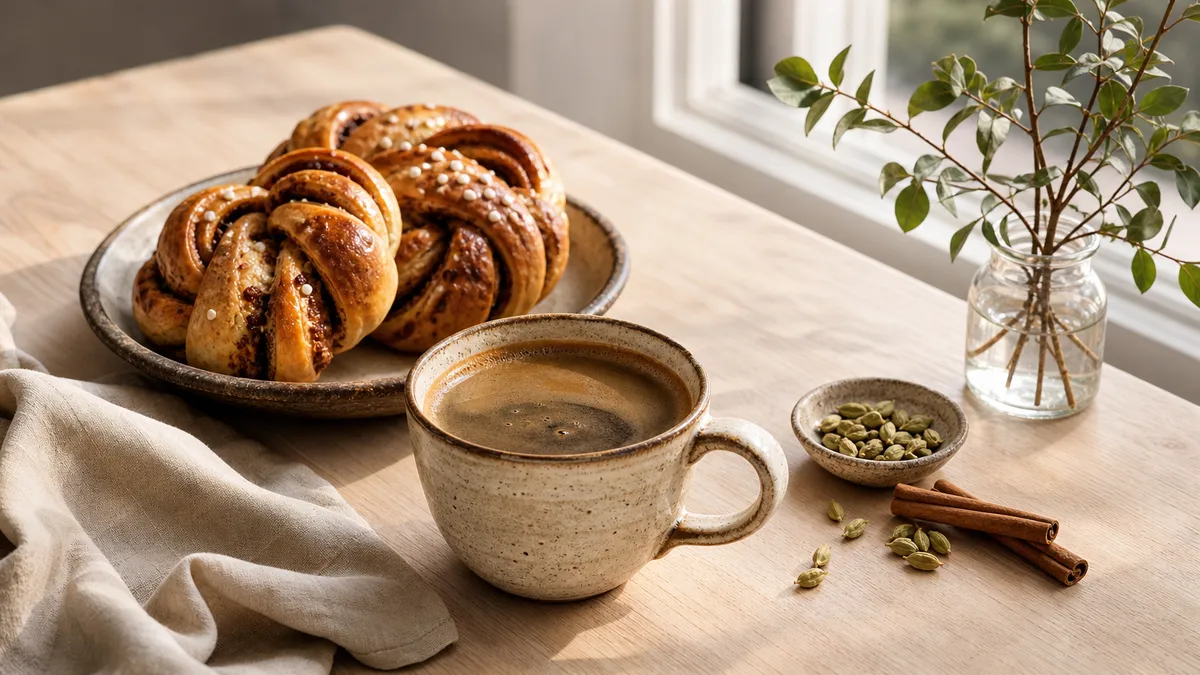
Kanelbullar are cinnamon buns, with kanelbulle the singular. Visit Sweden describes the familiar version as a wheat-flour bun filled with cinnamon, sugar and butter, commonly finished with pearl sugar. They are a classic fika accompaniment, rather than a compulsory component of every break.
Kardemummabullar are cardamom buns. Arla’s Swedish recipe uses cardamom in the dough, butter-and-sugar filling and topping, showing how thoroughly the spice can shape the bake. These are not simply cinnamon buns under a different name: cardamom is the central flavour.
The wider fika table also includes sponge cake, biscuits, chocolate balls and prinsesstårta, the marzipan-covered celebration cake. Sweden’s heritage inventory records this variety rather than defining fika through one signature pastry.
For hosting, choose something enjoyable and manageable rather than assembling a display. A shared plate is enough. If you want to explore how baked goods and coffee shape other occasions, Viennese and French café traditions provide a useful next comparison.
A short historical perspective
- 19th century: Visit Sweden connects the development of patisseries with the establishment of coffee-and-cake gatherings.
- From the 1980s: Sweden’s heritage inventory describes cafés becoming more popular meeting places as elaborate coffee parties at home became less common.
The setting has changed without removing the central invitation to stop and spend time together.
Kaffeost: a regional northern tradition
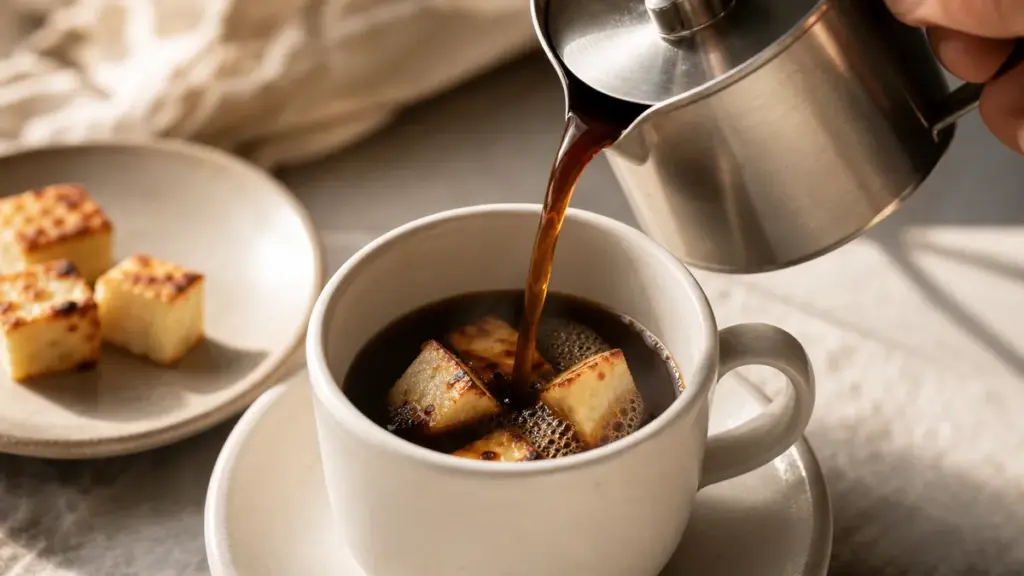
Kaffeost means coffee cheese. In northern Sweden and Finland, small pieces of mild cheese may be placed in a cup and covered with coffee. Swedish Lapland’s account notes both fresh and baked forms, and identifies kahvijuusto as a name used in Tornedalen.
The Finnish baked cheese leipäjuusto, often translated as bread cheese, is a familiar example. Visit Finland describes it as mild, usually made from cow’s milk, with a browned, spotted exterior and a characteristic squeaky texture. It identifies dipping the cheese into hot black coffee as a traditional Sámi way of eating it; serving it with cloudberry jam is another presentation.
This belongs to the regional northern Scandinavian and Finnish story, not to an imagined standard Nordic breakfast. It also should not be presented as something every Swedish café serves. To explore it, ask specifically for coffee cheese and how the producer recommends serving it, rather than assuming any cheese will reproduce the tradition.
Fika at work, and how to borrow the idea
Sweden’s heritage inventory records morning and afternoon fika breaks in many workplaces, with colleagues gathering in a common space. A 2023 academic discussion paper similarly describes fika as an informal, usually mid-morning or mid-afternoon occasion without an agenda, rather than another meeting with refreshments. Neither source establishes a universal schedule for every employer.
The paper suggests that repeated informal conversation can help people get to know each other, but it is a discussion piece proposing further research, not a controlled trial proving a productivity benefit. The Swedish Work Environment Authority separately explains that working-time rules cover breaks and can be affected by collective agreements. Cultural custom and employment entitlement should not be confused.
For a UK workplace or a gathering at home, try this practical adaptation:
- Make the invitation clear. Invite people to stop and sit together, not simply collect a drink.
- Keep preparation straightforward. Use the brewer you already have; save an equipment demonstration for another occasion.
- Offer alternatives. Include a non-coffee drink and ask about dietary requirements before choosing food.
- Leave out the agenda. Avoid turning the pause into a progress report or compulsory networking exercise.
- Allow people to decline. Make the occasion welcoming without demanding participation.
- Judge it by the experience. Ask whether people enjoyed the pause, not whether they followed an imagined set of Swedish rules.
This is an editorial hosting checklist, not a claim about a nationally prescribed ceremony. The most useful lesson from Swedish fika and Nordic coffee culture is to give the occasion proper space, without making the coffee or the company a performance.
FAQ
Can you have fika without drinking coffee?
Yes, fika can include another drink. Sweden’s living heritage inventory explicitly allows for coffee or another beverage in its description of the custom. If you are hosting, offer something your guests actually want to drink rather than treating caffeine as essential. The shared pause is a better guide than policing the contents of the cup.
Is there a fixed time or duration for fika?
No single fixed time or duration defines fika. Visit Sweden says it can happen at any time of day, while workplace accounts commonly describe morning and afternoon occasions. Follow the host’s invitation or the workplace’s arrangements rather than assuming there is a national timetable that every gathering must observe.
Do you need special equipment to host a Nordic-style coffee break?
No special equipment is needed for the hosting approach suggested here. Start with the coffee-making equipment you already use and concentrate on a comfortable place to sit, suitable drinks and an uncomplicated invitation. If you later want to explore light-roast filter coffee or kokkaffe, treat that as a separate brewing project rather than a condition of joining in.
Where to go next
Start with Coffee Culture for the wider subject, then read Italian Espresso Culture for another focused national tradition. Ethiopian Coffee Ceremony offers a further study of a named coffee occasion, while Viennese and French Café Culture develops the connection between coffee, food and gathering places.
Sources
-
Living Heritage, Institute for Language and Folklore and partner agencies, Fika, updated 7 March 2023.
https://levandekulturarv.se/in-english/the-inventory/submissions/fika -
Living Heritage, About the inventory, updated 7 March 2023.
https://levandekulturarv.se/in-english/the-inventory/about-the-inventory -
Visit Sweden, Fika like a Swede, updated 11 September 2026.
https://visitsweden.com/what-to-do/food-drink/swedish-kitchen/all-about-swedish-fika/ -
Nordic Council and Nordic Council of Ministers, Facts about the Nordic countries, undated live page, checked 2026.
https://www.norden.org/en/information/facts-about-nordic-countries -
European Coffee Federation, European Coffee Report 2023/2024, finalised May 2024, section 10.1.
https://www.ecf-coffee.org/wp-content/uploads/2024/07/European-Coffee-Report-2023-2024.pdf -
Finnpartnership, Market report: Coffee, November 2025.
https://finnpartnership.fi/wp-content/uploads/2026/01/Finnpartnership_Market-report_Coffee-2025.pdf -
Tim Wendelboe, FAQ: Our Roasting Style, undated live page, checked 2026. Used as a first-party statement of roasting aims.
https://timwendelboe.no/pages/faq -
Swedish Lapland, The way we eat, undated live page, checked 2026.
https://www.swedishlapland.com/stories/the-way-we-eat/ -
Swedish Lapland, Lämlarna och kaffebönorna, undated live page, checked 2026.
https://www.swedishlapland.com/sv/stories/lemmelkaffe/ -
Visit Finland, What to eat in Finland: guide to iconic Finnish foods, undated live page, checked 2026.
https://www.visitfinland.com/en/articles/finlands-traditional-and-iconic-foods/ -
Arla Sweden, Kardemummabullar, undated live recipe, checked 2026.
https://www.arla.se/recept/kardemummabullar/ -
Yngve, A., Scander, H. and Almroth, S., Taking a closer look at the Swedish coffee break, “fika”, International Journal of Gastronomy and Food Science, volume 33, 2023, article 100775.
https://uu.diva-portal.org/smash/get/diva2%3A1794669/FULLTEXT01.pdf -
Swedish Work Environment Authority, About the Working Hours Act, updated 26 October 2026.
https://www.av.se/en/work-environment-work-and-inspections/acts-and-regulations-about-work-environment/about-the-working-hours-act/
This article was researched using Sweden’s living heritage inventory, official tourism and Nordic cooperation sources, industry consumption data, academic commentary and first-party descriptions of food and roasting practices.
Last checked: November 2026