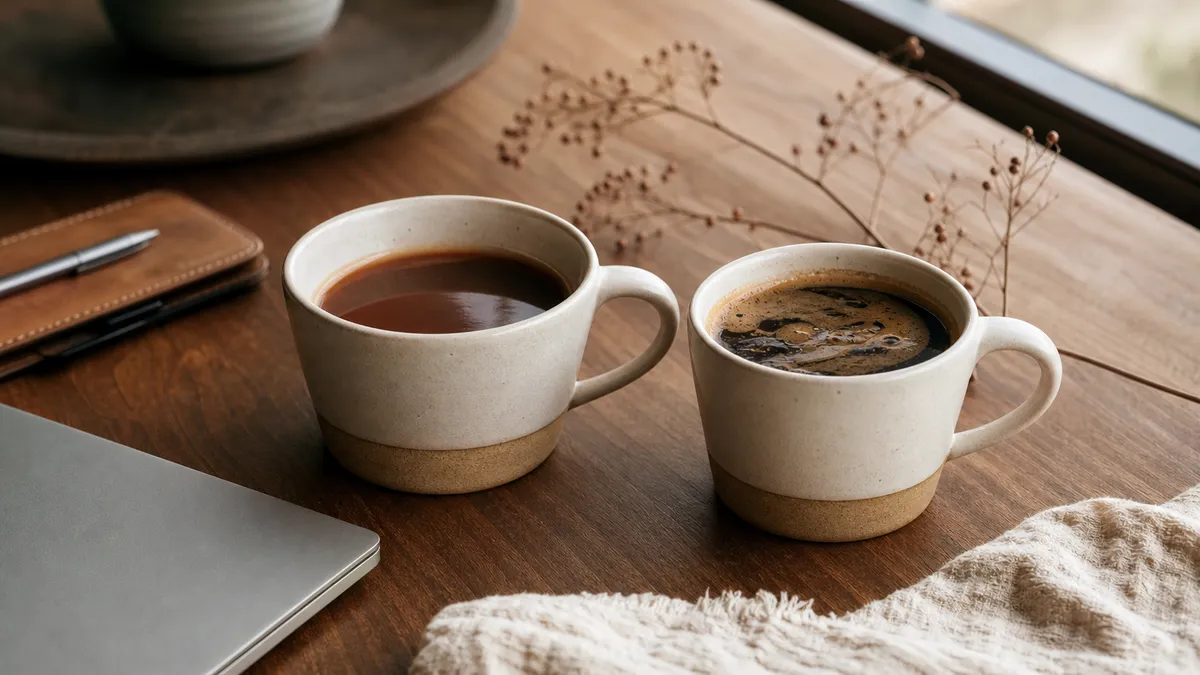
An Americano and a long black both combine espresso with hot water. The common distinction is espresso first for an Americano and water first for a long black, which helps preserve the crema, but this is a convention rather than a universal rule: the amount of water and the café’s own recipe also matter.
In short
- Ask about the espresso dose and added water, not just the drink’s name.
- For the recipes below, start with 18 g of coffee yielding 36 g of espresso, a 1:2 dose-to-yield ratio.
- Add 108 ml of water for our long black or 180 ml for our Americano. These are starting recipes, not official definitions.
- Water first generally leaves more crema visible; pouring water onto espresso disturbs the surface foam.
- With identical espresso, extra water reduces concentration but does not reduce the total caffeine.
Americano and long black: what actually differs?
The usual explanation is useful when learning the drinks, provided it is not treated as a test that every café must pass.
| Feature | Americano, common convention | Long black, common convention |
|---|---|---|
| Order | Espresso, then hot water | Hot water, then espresso |
| Dilution | Often a longer, more diluted drink | Often a shorter, more concentrated drink |
| Surface | Crema may be more broken up | More crema usually remains visible |
| Best starting choice | A longer black coffee to sip | A shorter drink with more espresso intensity |
Published recipes demonstrate the overlap. Breville describes a long black as the reverse of an Americano, with water first. Starbucks, however, also instructs readers to put water first in its Americano recipe, specifically to preserve crema.
Ratios vary too. Breville suggests equal quantities of water and espresso for its long black, while Nespresso describes a version with three parts water to one part espresso. Neither drink therefore has a universally agreed dilution.
For ordering, “a double espresso over a little hot water” communicates more than the name alone. For other drinks to make with the same equipment, browse coffee recipes.
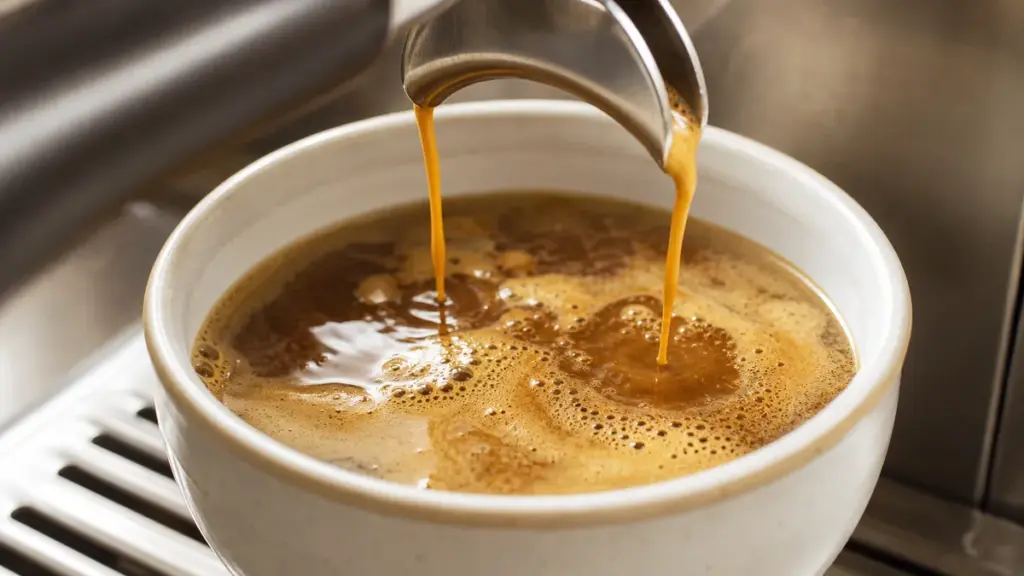
Recipe card: make either drink
These paired recipes deliberately use the same espresso but different amounts of added water. They illustrate a shorter long black and a longer Americano, rather than claiming to reproduce every café’s version.
Serves: 1 per recipe
Preparation time: approximately 3 minutes once the machine is ready
Equipment: espresso machine, suitable double basket, grinder, tamper, scales, kettle or dedicated hot-water outlet, thermometer and cup
Ingredients
For either espresso base:
- 18 g coffee beans, ground for espresso
- Brewing water sufficient to produce 36 g espresso
For a long black:
- 108 ml fresh drinking water, heated to approximately 80°C
For an Americano:
- 180 ml fresh drinking water, heated to approximately 80°C
The added-water temperature is an editorial starting point, not a recognised drink standard. Adjust it to your preference, remembering that the finished drink will still be hot.
Approximate caffeine: allow an illustrative estimate of about 150 mg per drink when using an arabica double espresso. The basis is laboratory research by Ludwig and colleagues, which measured approximately 152 to 174 mg in shorter espresso extractions from roughly 18 to 20 g of arabica coffee. Their extraction differed from this recipe, so this is not a measurement or reliable prediction for your beans.
The same study found 48 to 317 mg across purchased espresso servings, showing why shot count alone cannot establish caffeine content. Adding water does not remove caffeine. In pregnancy, the NHS advises no more than 200 mg daily from all sources; sensitivity varies, and anyone needing personal advice should speak to a GP, pharmacist or midwife.
Method
- Prepare the equipment. Warm the machine according to its instructions. Rinse the cup with hot water, then empty it.
- Prepare the coffee. Grind 18 g into a basket designed for that dose. Distribute the grounds evenly and tamp level.
- Set the espresso starting point. If adjustable, use approximately 93°C brewing water. Aim for 36 g espresso in roughly 25 to 35 seconds, then adjust according to taste rather than chasing time alone.
- For an Americano, brew first. Extract the espresso into the empty cup. Measure 180 ml hot water and pour it gently into the espresso.
- For a long black, add water first. Put 108 ml hot water into the cup. Brew the espresso directly onto it if the cup fits beneath the group head, or transfer the freshly brewed shot gently from a small vessel.
- Taste before changing anything. Let the drink cool enough to sip comfortably. Next time, alter the added water while keeping the espresso recipe unchanged.
The espresso ratio is 18 g in, 36 g out, or 1:2. Separately, these recipes use approximately 1:3 espresso to added water for the long black and 1:5 for the Americano, treating each millilitre of water as approximately one gram. Neither dilution ratio describes the dry coffee dose.
Crema, temperature and taste
Crema is espresso’s surface foam, not milk. A peer-reviewed review by Illy and Navarini describes the role of carbon dioxide generated during roasting, together with coffee compounds that help form and stabilise the bubbles.
Pouring espresso gently onto water generally preserves more visible foam than pouring water through an existing crema layer. Nevertheless, a thick golden surface is not proof that the coffee underneath tastes balanced.
Dilution is the more straightforward explanation for a stronger-tasting long black. With the same espresso, using less water leaves more coffee material in each mouthful. Changing the pouring order does not create more extracted coffee or more caffeine.
Brewing temperature and dilution-water temperature are separate controls. Brewing water passes through the grounds and affects extraction, the process of dissolving material from coffee. Water added afterwards mainly changes concentration and the drink’s temperature.
To explore pouring order fairly, make both drinks with the same espresso yield, water quantity, water temperature and cup type. Compare them before and after gentle stirring. This separates the surface presentation from the much larger recipe change involved in making one drink shorter.
Troubleshooting
| Symptom | Likely cause | Fix |
|---|---|---|
| Thin and watery | Too much added water for your preference | Keep the espresso unchanged and reduce dilution |
| Sharp and sour, with unusually fast espresso flow | Espresso recipe needs adjustment | Try a finer grind, keeping dose and yield fixed |
| Little crema after assembly | Pouring turbulence or little crema on the original shot | Pour gently; judge the drink by taste too |
| Uncomfortably hot | Dilution water hotter than you prefer | Use cooler added water and allow more cooling time |
If you prefer a little milk rather than extra water, macchiato is a useful comparison. For more milk-led options, see cortado and piccolo.
Where the names reportedly came from
Americano means “American” in Italian, with caffè americano meaning “American coffee”. Lavazza reports the familiar account that American soldiers in Italy during the Second World War diluted espresso to resemble coffee from home, but labels it a popular belief. It should be presented as an origin story, not a documented invention with an established creator and date.
Long black is associated with Australia and New Zealand. Nespresso explains the name as an espresso-based black coffee lengthened with water, and reports a story connecting its development with American travellers requesting black coffee. That account likewise does not establish a single inventor or birthplace.
The useful distinction between an Americano and a long black remains practical: agree on the espresso, water quantity and pouring order, rather than expecting the name to specify all three.
FAQ
Is a long black the same as a lungo?
No: a long black combines espresso with separately added water, while a lungo is a longer espresso extraction through the grounds. That changes the brewing process, not merely the dilution afterwards. Do not make a long black by letting the espresso machine keep running until the cup is full.
Can I make either drink with a capsule machine?
Yes, provided you prepare espresso and add water separately. Use the capsule’s espresso setting as your base, then adjust the dilution to taste. Do not assume that a capsule contains the same dose or caffeine as the ground-coffee recipe above; use information for the particular capsule where available.
Should I stir a long black?
You can stir a long black if you prefer a more evenly mixed drink. Stirring changes its crema presentation, but preserving an untouched surface is not a requirement for enjoying it. Try an initial sip, stir gently and compare: the choice is about your preferred drinking experience, not correctness.
Where to go next
Return to Coffee Recipes for other drinks organised around what you want to make. Read Macchiato for a small milk addition, Cortado and Piccolo for shorter milk drinks, or Specialty Coffee Recipes for further variations.
Sources
-
Breville, “Long Black”, undated. Manufacturer recipe documenting water-first assembly and its suggested dilution.
https://www.breville.com/us/en/coffee-journey/recipes/long-black.html -
Starbucks Coffee at Home, “Caffè Americano Recipe”, undated. Published example of an Americano made water first.
https://athome.starbucks.com/recipe/caffe-americano -
Nespresso New Zealand, “Long Black”, 2024. Published dilution, regional association, name explanation and reported origin account.
https://www.nespresso.com/nz/en/coffee-recipes/long-black -
La Marzocco Home, “Basic Espresso Theory”, 2019. Dose-to-yield ratios, shot timing, brewing temperature and grind adjustments.
https://home.lamarzoccousa.com/basic-espresso-theory/ -
Illy, E. and Navarini, L., “Neglected Food Bubbles: The Espresso Coffee Foam”, Food Biophysics, 2011. Peer-reviewed review of crema formation and stability.
https://pubmed.ncbi.nlm.nih.gov/21892345/ -
Ludwig and colleagues, “Variations in caffeine and chlorogenic acid contents of coffees: what are we drinking?”, Food & Function, 2014. Laboratory measurements and a survey of purchased espresso servings.
https://pubs.rsc.org/en/content/articlepdf/2014/fo/c4fo00290c -
NHS, “Foods to avoid in pregnancy”, current online guidance retrieved November 2026. Pregnancy caffeine guidance.
https://www.nhs.uk/pregnancy/keeping-well/foods-to-avoid/ -
Lavazza, “Americano Coffee Definition: Vocabulary and Curiosities”, undated. Name translation and explicitly qualified soldiers’ origin story.
https://www.lavazza.co.uk/en/coffee-secrets/americano-coffee-definition-vocabulary-curiosities
This piece was researched by comparing published manufacturer recipes with peer-reviewed coffee research and current NHS guidance; the paired recipes are editorial starting points, not first-hand test results.
Last checked: November 2026