Coffee in different cultures varies not just in how it tastes, but in what sharing it means: welcoming a guest, taking a proper break, maintaining a friendship or expressing belonging. The most useful question is therefore not simply “What do people drink here?” but “What does this moment ask of the people taking part?”
In short
- Look beyond the recipe: who prepares, serves and shares coffee can matter as much as the brewing method.
- Hospitality has local signals. In the Arabic coffee traditions described by UNESCO, guests and older people are served first.
- Coffee can mark a pause rather than a push towards more work, as Sweden’s fika illustrates.
- Coffee spaces have not always welcomed everyone equally. Gender, status and access belong in the story.
- Treat traditions as living practices, not rules followed identically by everyone in a country.
How to understand coffee in different cultures
A useful starting point is to separate the drink, the occasion and the social setting. A coffee recipe tells you what goes into the cup. A cultural practice tells you why someone offers it, how long you might stay and what accepting the invitation means.
Consider the contrast between an espresso enjoyed standing at an Italian bar and coffee prepared during an Ethiopian gathering. Both can create connection, but they offer different rhythms: a brief encounter woven into the day, or an occasion in which preparation and company receive more time.
Neither is a better or more authentic way to drink coffee. The interesting difference is what people make possible around it.
Our coffee culture guide introduces the wider subject. For a geographical survey of drinks and customs, rather than this guide’s focus on their social meaning, see coffee around the world.
The examples below describe particular documented practices. They should not become predictions about every household, café or individual within a national border.

Hospitality: when offering coffee means offering welcome
In the Arabic coffee traditions documented by UNESCO, serving coffee expresses generosity, respect and hospitality. The order and gestures of service carry meaning: older people and guests receive coffee first, the server pours with the right hand, and a guest can gently shake the cup to indicate they have finished.
These details make hospitality visible. Rather than leaving welcome as an unspoken feeling, the host demonstrates attention through the act of serving.
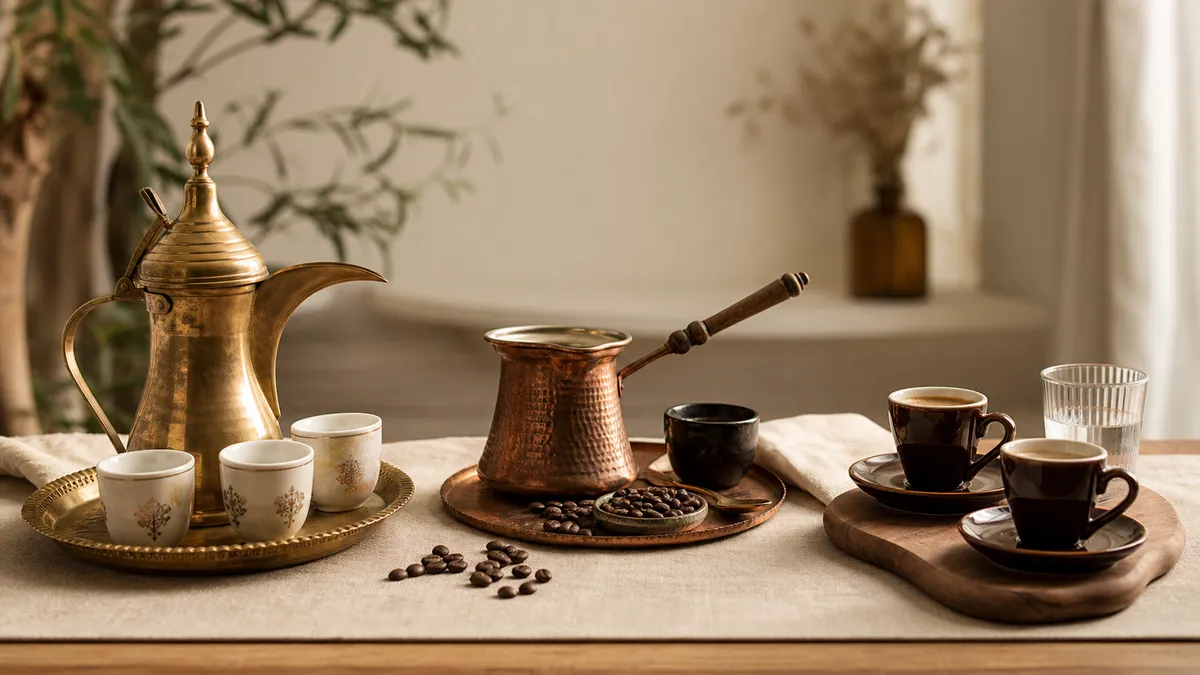
Qatar’s majlis offers a related example. A majlis is a place for sitting and receiving guests, where coffee poured from a dallah, the distinctive serving pot, accompanies conversation and dates. The room and the drink work together: the coffee belongs to a setting designed for receiving people.
In Ethiopia, the anthropologist Éloi Ficquet describes coffee preparation as an occasion for relatives, friends and neighbours to gather. Home-roasted coffee, incense and welcoming arrangements of herbs or flowers can make preparation itself part of receiving visitors.
The useful comparison is not between supposedly “formal” and “relaxed” cultures. It is between different ways of showing attention. One host may demonstrate care through serving order, another through preparation, and another through making time to sit with you.
Ritual: more than an elaborate brewing method
A ritual is a repeated practice with shared meaning. It need not be religious, unusually old or complicated.
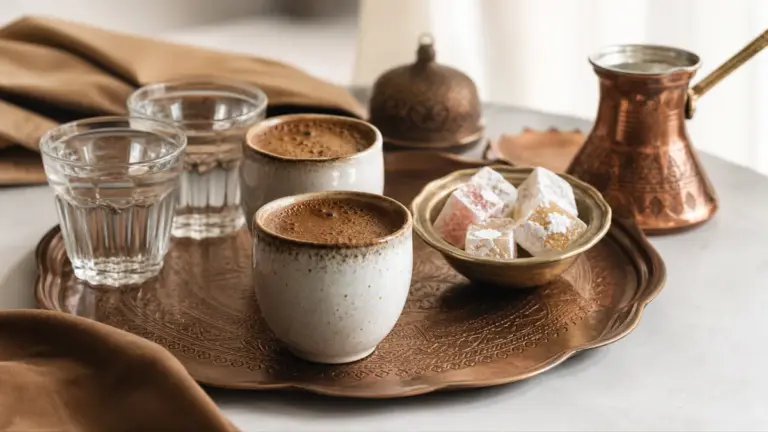
Turkish coffee illustrates how a drink can carry several meanings at once. UNESCO describes it as a symbol of hospitality and friendship, associated with conversation, engagement ceremonies and holidays. Knowledge passes through watching and participating within families, not just through written instructions.
Reading the grounds left in a Turkish coffee cup is another documented social practice. It should be understood as a custom, not evidence that the grounds predict the future. The cultural interest lies in the conversation and shared attention it can create.
Here are several settings compared by their social purpose, rather than their recipes:
| Documented setting | What coffee helps express | What to notice |
|---|---|---|
| Arabic coffee hospitality | Generosity and respect | Serving order and gestures |
| Ethiopian coffee gathering | Welcome and connection | Preparation as part of the occasion |
| Turkish coffee invitation | Friendship and shared concerns | Conversation around the cup |
| Swedish fika | A deliberate social pause | Attention given to company |
| Italian espresso at a bar | A brief everyday encounter | The rhythm of a short visit |
These are examples, not national personality types. A useful habit is to ask what a particular gathering means to its participants before deciding what it represents.
Work and rest: a drink that can mark either
Swedish fika is commonly described as a coffee break, but that translation misses some of its purpose. Visit Sweden presents it as a pause for company and conversation, often with something sweet, and notes that many workplaces schedule fika into the day.
The distinction is between obtaining a drink and taking a break. Carrying coffee back to a screen does not necessarily reproduce the social occasion that fika describes.
An Italian espresso enjoyed standing at a bar offers a different rhythm. As a coffee-sector account by Andrés Montenegro describes, the encounter may last only a few minutes. Brevity does not make it socially empty: it shows that connection need not always require an extended ceremony.
For a UK workplace, the useful lesson is practical rather than decorative. If you want coffee to support a shared pause, make space for the pause. Provide alternatives, avoid compulsory participation, and do not assume everyone wants conversation whenever they make a drink.
The wider subject of how invitations and shared breaks bring people together belongs in coffee and social gatherings. Here, the distinction is simply that coffee can accompany work or create a boundary around rest.
Gender and coffee spaces: who gets to belong?
A coffeehouse can encourage conversation while still excluding people. Describing it as a meeting place is not the same as establishing that everyone could enter on equal terms.
The British Museum describes seventeenth-century London coffeehouses as spaces from which women were excluded, with those unwritten restrictions relaxing during the nineteenth century. This is a reminder that historical claims about open debate need a further question: open to whom?
Separate spaces also require careful interpretation. Visit Qatar describes traditionally male majlis gatherings alongside women’s private majlis within the home. Looking only at the more publicly visible gathering would therefore miss part of the social picture.
Preparation deserves attention too. Ficquet’s account of Ethiopian coffee describes women demonstrating their skill in household hospitality. That skill is part of the occasion, but appreciation should not obscure the work involved in producing it.
A useful way to read any coffee setting is to ask who sits, who serves, who speaks and who is absent. These questions prevent a pleasing image of conviviality from becoming the whole account.
For the broader relationship between coffee, public life and social power, read coffee and society.
Religion and coffee history: devotion, debate and authority
Coffee’s religious history is more complicated than a story of religious authorities opposing a new drink. Religious practice also helped coffee spread.
The British Museum connects early coffee drinking in Yemen with Sufi Muslim communities, whose members used it during devotional remembrance rituals. Coffee subsequently travelled through commercial and pilgrimage networks into wider social life.
As coffeehouses developed, religious and political authorities debated both the drink and the activities surrounding it. The museum records repeated sixteenth-century prohibitions and reversals. Questions about permissibility overlapped with questions about public gathering and authority.
A short chronology helps keep these developments separate:
- Early sixteenth century: coffee reached Istanbul through expanding networks of consumption and exchange.
- Sixteenth century: prohibitions and reversals accompanied disputes about coffee and coffeehouses.
- Early eighteenth century: European colonial powers established coffee plantations in territories they controlled.
This history cautions against treating coffee as inherently sacred, secular, rebellious or respectable. Different communities and authorities have assigned it different meanings.
Nor should an origin legend be treated as a dated historical record. A memorable discovery story and a documented account of coffee’s spread do different kinds of work.
Globalisation: shared equipment, different meanings
Coffee’s international movement did not begin with modern chains. Trade, pilgrimage and European colonial plantation expansion were already connecting its consumption to distant places.
Modern globalisation adds another question: does the spread of familiar café formats erase local practices, or provide another setting in which they develop?
Vietnam offers evidence against a simple replacement story. Its national tourism authority describes contemporary cafés using newer brewing approaches alongside traditional phin filters. A phin is a small metal filter that lets water pass through ground coffee into the cup below. The same account presents pavement coffee drinking as a setting for lingering and conversation.
The sensible inference is that new equipment does not automatically replace an older social purpose. A community can adopt another brewing method without abandoning its reasons for gathering.
Coffee culture also extends beyond places where people drink it. UNESCO’s account of Colombia’s coffee-growing cultural landscape connects coffee with family farming, inherited knowledge, settlement patterns and architecture. Here, coffee helps organise home and working life, not merely the café visit.
These examples suggest a better test of cultural continuity than whether a familiar pot remains on the table: who continues the practice, who can participate, and what meaning do they give it?
A practical checklist for joining respectfully
You do not need to memorise a country’s supposed coffee rules. A few considerate habits are more useful:
- Identify the occasion. Ask whether this is an everyday drink, a hosted gathering or a ceremonial event.
- Watch before acting. Let your host guide seating, serving and the pace of the occasion.
- Ask small, specific questions. “Shall I wait?” is more helpful than requesting a complete explanation while someone is serving.
- Express preferences politely. You can appreciate the invitation without accepting a drink you do not want.
- Ask before photographing. Seek permission from the people involved, particularly in a home or devotional setting.
- Avoid declaring authenticity. An unfamiliar adaptation is a reason to ask about its meaning, not to dismiss it.
Understanding coffee in different cultures begins with noticing the people around the cup. Let their explanation carry more weight than your expectations.
FAQ
Can I take part without drinking coffee?
Yes, you can express interest in the occasion without drinking coffee. Thank your host, explain your preference briefly and ask whether another drink would be convenient. Avoid inventing an elaborate excuse or treating acceptance as a test of respect. The aim is to acknowledge the welcome while remaining clear about what you want.
How can I explore a coffee tradition at home respectfully?
Start with a reliable account from people who practise it, and distinguish learning a brewing method from recreating an entire cultural occasion. Describe what you are doing accurately, such as trying Turkish-style preparation, rather than claiming to reproduce every aspect of a tradition. If someone shares their knowledge, credit that contribution.
What should I ask before photographing a coffee gathering?
Ask whether photography is welcome and whether the people present are comfortable appearing in the picture. Permission from a venue does not replace permission from an individual. In a home, ask before photographing household details as well as people. If the answer is hesitant, put the camera away and enjoy the invitation.
Where to go next
Read Coffee Around the World for the geographical view, then Coffee and Society for a closer examination of coffee’s place in public life. The Role of Coffee in Social Gatherings explores invitations and shared occasions, while Coffee Culture connects the wider subject.
Sources
-
UNESCO, Arabic coffee, a symbol of generosity, current inscription, 2024.
https://ich.unesco.org/en/RL/arabic-coffee-a-symbol-of-generosity-02111 -
Qatar Tourism, Visit Qatar, Majlis culture in Qatar, undated.
https://visitqatar.com/intl-en/about-qatar/traditions/majlis -
UNESCO Courier, Ethiopia, the home of coffee, Éloi Ficquet, 2023, in Cafés: A rich blend of cultures, April to June 2023, pages 19 to 21. Retrieved through the Austrian Commission for UNESCO.
https://www.unesco.at/fileadmin/user_upload/385026eng.pdf -
UNESCO, Turkish coffee culture and tradition, 2013.
https://ich.unesco.org/en/RL/turkish-coffee-culture-and-tradition-00645 -
Visit Sweden, Fika like a Swede, updated 11 September 2026.
https://visitsweden.com/what-to-do/food-drink/swedish-kitchen/all-about-swedish-fika/ -
British Museum, Life in a cup: coffee culture in the Islamic world, large-print exhibition guide, 2021.
https://www.britishmuseum.org/sites/default/files/2021-10/Life_in_a_cup_coffee_culture_in_the_Islamic_world_large_print_guide_1021.pdf -
British Museum, Egypt and Sudan newsletter, issue 9, 2022, “Life in a cup: coffee culture in the Islamic world”.
https://www.britishmuseum.org/sites/default/files/2022-10/egypt_sudan_newsletter_issue_9_2022.pdf -
UN Today, A world in a cup: coffee, culture, and a global ritual, Andrés Montenegro, 1 October 2026.
https://untoday.org/a-world-in-a-cup-coffee-culture-and-a-global-ritual/ -
Viet Nam National Authority of Tourism, A taste of Vietnam: The story behind its beloved coffee culture, undated.
https://vietnam.travel/things-to-do/taste-vietnam-story-behind-its-beloved-coffee-culture/ -
UNESCO World Heritage Centre, Coffee Cultural Landscape of Colombia, inscription 2011, current property description.
https://whc.unesco.org/en/list/1121
This article was researched using retrieved UNESCO heritage records, museum histories, an anthropologist’s cultural account, official tourism resources and a named coffee-sector commentary, distinguishing documented practices from interpretation and practical advice.
Last checked: November 2026