Asian coffee traditions range from Vietnamese phin coffee and South Indian filter kaapi to Singaporean kopi and Japan’s old-style coffee houses. The most useful way to understand them is through their brewing methods, ingredients and settings, rather than looking for a single “Asian” style. This guide concentrates on South, Southeast and East Asia, where familiar ingredients produce remarkably different cups.
In short
- Learn the drink name before ordering: cà phê sữa đá means Vietnamese iced coffee with condensed milk; cà phê trứng is egg coffee.
- Black does not necessarily mean unsweetened: Singaporean kopi O normally contains sugar; kopi O kosong does not.
- Do not stir every cup throughout drinking: Indonesian kopi tubruk retains its grounds, so let the sediment settle.
- Distinguish the brewer from the serving vessels: South Indian kaapi is brewed in a filter, then served separately, sometimes in a tumbler and davara.
- Look beyond the newest cafés: Japanese kissaten and Korean dabang reveal coffee cultures that predate contemporary speciality shops.
Start with the method, not the stereotype
A useful first question is: what happens between the grounds and the cup? Vietnamese phin coffee drips through a perforated filter; Indonesian tubruk leaves the grounds in the drinking vessel; Singaporean kopi passes through a cloth filter. These are different approaches, not interchangeable versions of strong coffee.
For a beginner, the next questions are simpler still: is it hot or iced, does it contain milk, and is sugar already included? Answer those before judging a drink against your usual flat white or black filter coffee.
Our coffee culture guide provides the wider context. Here, the focus is on recognising regional classics and understanding what makes each distinctive.
Vietnam: phin coffee, condensed milk and egg foam
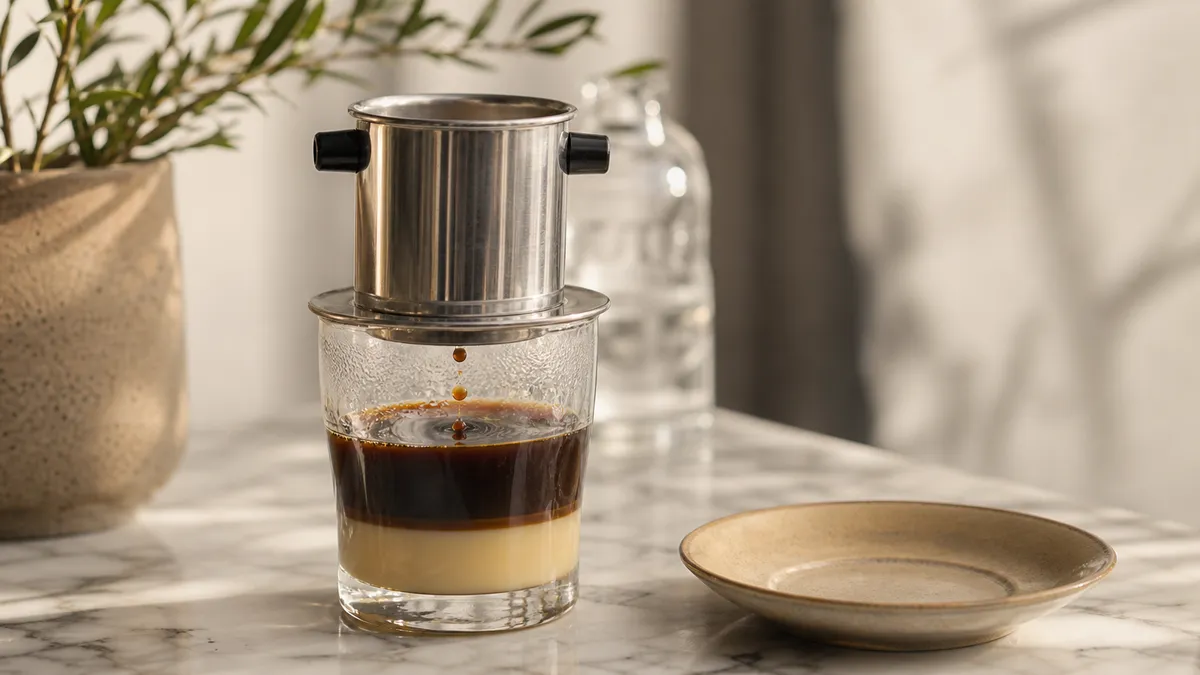
The phin is a small filter that sits above the cup or glass. Water moves through the coffee and perforated base under gravity, rather than being forced through under espresso pressure. Dark-roasted robusta is closely associated with this style, although Vietnamese coffee culture is not limited to one bean or preparation.
Cà phê sữa đá combines coffee, sweetened condensed milk and ice. The contrast is central to its appeal: dark, bitter coffee against thick sweetness, with ice making the finished drink cold and refreshing. Stir before drinking if you want the milk distributed rather than left as a sweet layer at the bottom.
Hanoi’s cà phê trứng, or egg coffee, is a different experience. A whipped mixture containing egg yolk, sugar and condensed milk forms a creamy cap over the coffee. It is closer to a small dessert than an ordinary milk coffee, with a soft, custard-like topping meeting the darker liquid beneath.
Treat these as distinct drinks, not variations distinguished only by sweetness. If you are exploring a menu, try the familiar iced milk coffee first, then egg coffee on another occasion: their textures deserve separate attention.
Indonesia: kopi tubruk and Aceh’s sanger
Kopi tubruk is coffee brewed directly with hot water in the cup, commonly with sugar, without filtering out the grounds. Its defining feature is therefore sediment, not a particular machine or serving glass. Let the grounds settle, sip from above them and leave the muddy final mouthful behind.
That makes tubruk a useful introduction to an unfiltered cup. Do not mistake the residue for a preparation fault, or keep stirring it back into suspension because you expect the drink to dissolve like instant coffee.
Aceh’s kopi sanger combines coffee with sweetened condensed milk. Banda Aceh’s tourism department describes a preparation using less condensed milk than an ordinary local milk coffee, with the mixture poured back and forth between vessels to produce a fine foam. This “pulling” is part of the preparation, rather than milk steaming in the espresso-bar sense.
The same department describes coffee shops as places for gathering and discussion. That social setting matters alongside the recipe: a sanger is not simply a list of ingredients detached from the shop serving it. For the broader subject, see coffee and social gatherings.
India: South Indian filter kaapi
South Indian filter kaapi begins with a concentrated brew commonly called decoction. Grounds and hot water go into the upper chamber of a filter; the liquid collects below and is then mixed with hot milk, with sugar adjusted to preference. Here, “decoction” is the customary name for the collected coffee, not an instruction to boil the finished drink.
Coffee-chicory blends are an established part of Indian coffee consumption, but chicory should not be treated as compulsory in every kaapi. The Coffee Board of India’s consumption study distinguishes chicory-mixed coffee from pure coffee and describes chicory’s earthy flavour contribution. Check the blend rather than assuming that “filter coffee” specifies its ingredients.
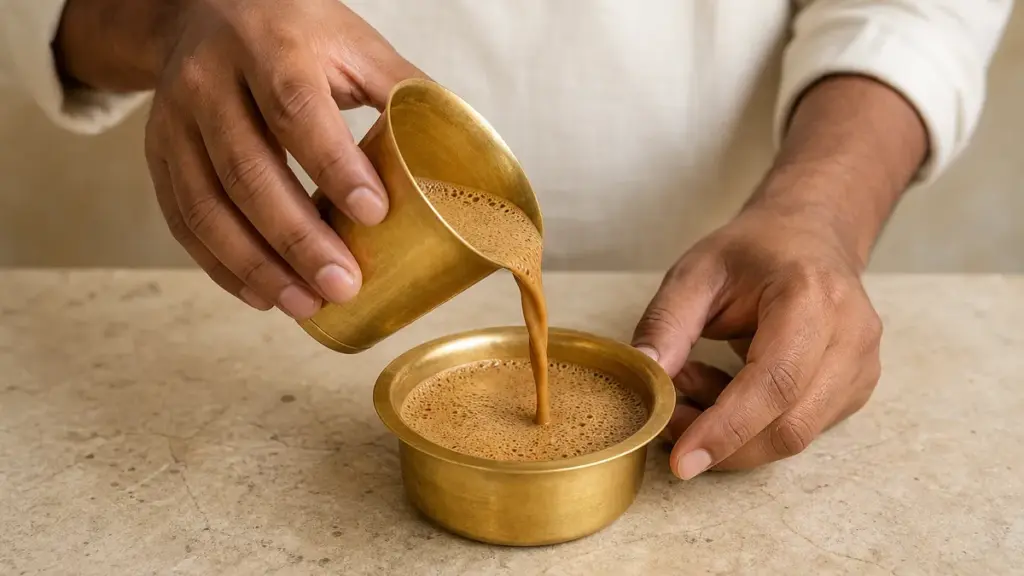
The serving set is separate from the brewer. A davara, also written dabara or dawara, is the bowl paired with the tumbler; brass sets are documented in Kumbakonam coffee stalls. Coffee may be transferred between vessels to create foam. Do not confuse this froth with espresso crema: it is produced during pouring.
For a first taste, order the house preparation before requesting changes. Then decide whether you prefer a stronger coffee-to-milk balance or less sugar, rather than assuming every serving follows one fixed formula.
Malaysia and Singapore: understanding Nanyang kopi
Kopitiam combines the Malay word for coffee with the Hokkien word for shop. Singapore’s National Heritage Board connects the Nanyang breakfast tradition particularly with Hainanese operators, while recognising that both the trade and its customers have become more diverse. Malaysia’s tourism board likewise identifies coffee, kaya toast and soft-boiled eggs as a classic kopitiam breakfast.
Traditional kopi differs from an ordinary dark roast. Singapore Tourism Board describes robusta roasted with margarine and sugar, then strained through a cloth “sock”. Heritage records also document butter in roasting. Recipes differ between businesses, so neither the fat used nor the blend should be assumed universal.
The ordering language is worth learning. This table uses documented Singaporean meanings; confirm local usage when ordering in Malaysia.
| Order | What to expect | Choose it when |
|---|---|---|
| Kopi | Coffee with condensed milk | You want the familiar sweet, milky preparation |
| Kopi O | Black coffee with sugar | You want no milk, but still want sweetness |
| Kopi C | Coffee with evaporated milk and sugar | You prefer evaporated milk to condensed milk |
| Kopi peng | Coffee with condensed milk and ice | You want the standard milky drink cold |
| Kopi O kosong | Black coffee without added sugar | You want neither milk nor added sugar |
These definitions follow Singapore Tourism Board and Mount Alvernia Hospital’s ordering guides. Peng indicates ice, not the removal of milk; kopi O peng is the sweet black iced version.
Condensed and evaporated milk are not equivalent menu terms. Most importantly, kopi C still normally includes sugar: changing the milk does not automatically make the drink unsweetened.
Thailand: oliang and a changing café culture
Oliang, also written o-liang, is a traditional Thai iced black coffee. Angsana’s Baan Talay restaurant places it within the country’s shophouse, market-stall and coffee-cart culture. Its own version includes cardamom and tamarind seed, illustrating why one venue’s blend should not be presented as the universal recipe.
For the newcomer, the useful distinction is between iced black coffee and a milk coffee, not simply between “Thai” and “Western” coffee. Ask what the house preparation contains before ordering, particularly if you are trying to avoid a specific ingredient.
Traditional and contemporary offerings can sit on the same menu. Baan Talay, for example, lists oliang alongside Thai arabica coffees from Doi Tung and Doi Chang. That is a useful reminder to explore both the prepared drink tradition and coffee identified by its growing area.
Japan and South Korea: coffee houses with older roots
Japan’s kissaten
A kissaten is an old-style Japanese coffee shop, although individual establishments vary considerably. Japan National Tourism Organization describes a preference for darker roasts and hand-poured or syphon coffee. A syphon is a brewer using connected chambers, rather than an espresso machine.
Some kissaten are neighbourhood gathering places; others centre on careful brewing or recorded music. In dedicated jazz and classical-music cafés, conversation may be discouraged. Observe the room before assuming that every coffee house is intended for a lively catch-up.
South Korea’s dabang
South Korea’s café history includes the dabang, an older coffee-house setting associated with meeting, music and conversation. Korea Tourism Organization describes these as important social spaces before franchise cafés expanded, and identifies Hakrim in Seoul as a surviving example.
The useful comparison is not “traditional Asia” against “modern coffee”. Both kissaten and dabang show that contemporary café culture has local predecessors, each with its own atmosphere and expectations.
How Asian coffee traditions meet modern cafés
The growth of café culture is not one uniform story. Vietnam’s tourism authority describes heritage cafés alongside speciality shops, while the Coffee Board of India’s 2024 consumption report identifies rising urban café culture. Japan’s tourism organisation also records renewed interest in kissaten among younger customers and coffee enthusiasts.
Taken together, these examples suggest coexistence rather than a straightforward replacement of older drinks. A useful tasting approach is to compare a regional preparation with a café’s contemporary coffee, without treating one as the authentic cup and the other as an imitation.
A short historical perspective
- 1920s to 1950s: Hainanese operators helped popularise Singapore’s kopitiam culture and Nanyang breakfast.
- 1932: Smart Coffee opened in Kyoto, one documented example of Japan’s established kissaten tradition.
- 1956: Hakrim opened in Seoul, well before the contemporary franchise café era.
When exploring Asian coffee traditions, learn one regional drink properly, then ask what else the establishment makes. That approach leaves room for both continuity and invention.
FAQ
Can I use my usual coffee beans in a Vietnamese phin?
Yes, you can explore the phin method with your usual coffee, but do not assume the result represents a particular Vietnamese café’s drink. Vietnam’s tourism authority associates traditional phin preparations closely with dark-roasted robusta. Separate the brewing experiment from the cultural claim, and check what coffee a recipe or venue actually specifies.
Is kopi O the same as an Americano?
No, kopi O names a sweetened black kopi preparation, whereas the traditional kopi method uses roasted coffee brewed through a cloth filter. It is therefore not simply an espresso drink with a different name. If your priority is avoiding added sugar, ask specifically for kopi O kosong rather than relying on the word “black”.
How can I explore these traditions without travelling?
Choose one named preparation, find an establishment or recipe that explains its ingredients, and avoid changing everything on the first attempt. You might begin with phin coffee, filter kaapi or a clearly described kopi order. Treat this as learning a particular drink, not recreating an entire country’s coffee culture in one cup.
Where to go next
Read Coffee Culture for the wider framework, and The Role of Coffee in Social Gatherings to explore the setting around the cup. Continue with Arabic Coffee Traditions and Turkish Coffee Rituals for traditions outside this guide’s main regional focus.
Sources
Publication dates are given where displayed; “undated” means the retrieved page did not provide a clear publication year.
-
Vietnam Tourism, “Vietnam’s Coffee Culture Brews a Global Buzz”, undated.
https://vietnam.travel/things-to-do/vietnam%E2%80%99s-coffee-culture-brews-global-buzz/ -
Vietnam Tourism, “A taste of Vietnam: The story behind its beloved coffee culture”, undated.
https://vietnam.travel/things-to-do/taste-vietnam-story-behind-its-beloved-coffee-culture/ -
Visit Indonesia, Indonesia Culinary Treasures, undated, “Thirst Quenchers”, p. 50; retrieved from the Indonesian education ministry repository.
https://repositori.kemendikdasmen.go.id/8333/1/INDONESIA%20CULINARY%20TREASURES.pdf -
Banda Aceh City Tourism Department, “Sanger: Kopi Khas Aceh yang Menggoda”, 30 July 2024.
https://dispar.bandaacehkota.go.id/2024/07/30/sanger-kopi-khas-aceh-yang-menggoda/ -
Karnataka Tourism, “Brewed in Tradition: The Filter Coffee Culture of Karnataka”, June 2025.
https://karnatakatourism.org/en/blogs/filter-coffee-culture-of-karnataka -
Coffee Board of India, India Coffee, volume LXXXIII, number 9, September 2019, “The mini coffee shop in our home”, reproduced from the New Indian Express.
https://coffeeboard.gov.in/Publications/September%202019%20final.pdf -
Coffee Board of India and CRISIL, Coffee consumption trends in India, 2023, April 2024.
https://coffeeboard.gov.in/Publications/Coffee_Consumption_2023.pdf -
Coffee Board of India, India Coffee E-Magazine, October to December 2025, “Beyond the Dabara”.
https://coffeeboard.gov.in/Publications/OctDec2025/India_Coffee_E-Magazine%28Oct-Dec2025%29.pdf -
Singapore Tourism Board, “Order Coffee Like A Local”, undated.
https://www.visitsingapore.com/things-to-do/dining/local-food-and-drinks/order-coffee-like-a-local/ -
National Heritage Board, Singapore, “Traditional Breakfast of Kaya and Kopi”, undated.
https://www.roots.gov.sg/ich-landing/ich/traditional-breakfast-of-kaya-and-kopi -
National Heritage Board, Singapore, “Kopitiam cup and saucer with leaf green ‘888’ motif”, undated collection record.
https://www.roots.gov.sg/Collection-Landing/listing/1102422 -
Mount Alvernia Hospital, “Know Your Kopi”, undated, reproduced from My Alvernia, issue 36.
https://mtalvernia.sg/education/know-your-kopi/ -
Tourism Malaysia, “20 Awesome and True Malaysian Breakfast”, undated.
https://www.malaysia.travel/explore/20-awesome-and-true-malaysian-breakfast -
Angsana, Baan Talay, “Roasted in Thailand”, undated restaurant menu and explanatory notes.
https://www.taste.angsana.com/baan-talay-roasted-in-thailand -
Japan National Tourism Organization, James Hadfield, “Kissaten: Japan’s Old-School Coffee Shops”, 27 August 2021.
https://www.japan.travel/en/blog/kissaten-japans-old-school-coffee-shops/ -
Korea Tourism Organization, “Curious About the Retro Settings in Korean Dramas? K-Time Travel Back to the Past”, 26 November 2025.
https://english.visitkorea.or.kr/svc/sp/HallyuNew/contentsView.do?dataSetId=70&vcontsId=250745
This guide was researched through official tourism and heritage resources, Coffee Board publications and a verified restaurant menu, distinguishing regional practices from individual house preparations.
Last checked: November 2026