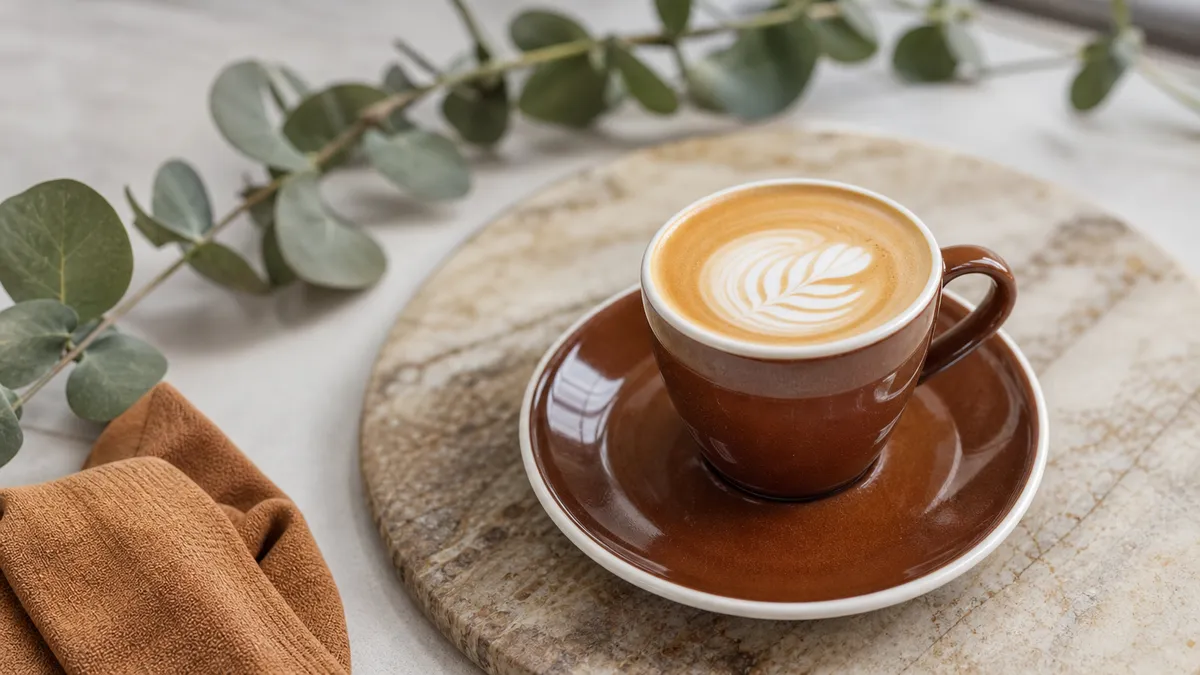
A flat white is espresso with steamed milk and a thin layer of velvety microfoam, the tiny bubbles that give the milk its glossy texture. To make one at home, use a small cup of about 150 to 160 ml, prepare a double espresso and add lightly textured milk without building a thick foam cap.
In short
- Aim for a thin, flowing milk texture, with roughly 5 mm of microfoam on the finished drink.
- Espresso or a double ristretto can form the base, depending on the café and regional convention.
- Measure espresso by weight: a 1:2 recipe means, for example, 20 g of ground coffee producing 40 g of espresso.
- For dairy milk, a steaming target of 60 to 65°C is a useful starting point.
- Compared with a latte made with the same espresso, the smaller milk portion leaves the coffee more prominent.
What makes a flat white different?
A flat white should feel smooth and integrated: coffee and milk arriving together, rather than liquid coffee beneath a separate mound of foam. “Flat” does not mean completely unfoamed. The defining texture is fine microfoam that pours readily and leaves a shallow, glossy surface.
A 150 to 160 ml cup is a useful small-cup convention, supported by La Cimbali’s published recipe. It is not a universal definition: cafés and manufacturers use different recipes, so the drink’s name alone cannot guarantee its size or strength.
The clearest comparison with a latte is how much milk surrounds the espresso. With the same coffee base, a larger milk portion gives a gentler coffee flavour. A cappuccino generally has a more substantial foam layer, although contemporary café versions can overlap.
For other drinks built around the same ingredients, start with our coffee recipes.
Espresso or double ristretto?
Both are valid flat white bases. Sage and La Cimbali publish recipes using double espresso, while Australian roaster and trainer Black Market describes double ristretto as an alternative used by cafés. There is no sound basis for treating double ristretto as the compulsory Australian or UK recipe.
A ristretto is a shorter espresso extraction: less liquid is collected from the same ground-coffee dose. For a clear comparison, you could use:
| Coffee base | Ground coffee | Espresso yield | Dose-to-yield ratio |
|---|---|---|---|
| Double espresso starting point | 20 g | 40 g | 1:2 |
| Short ristretto comparison | 20 g | 20 g | 1:1 |
These are starting recipes, not protected definitions. “Double” refers to the coffee dose and serving convention, not necessarily two separately brewed shots.
Keep espresso yield separate from milk quantity. Espresso ratios describe dry coffee to liquid espresso by weight, not coffee to milk. Nor should you treat espresso grams and millilitres as interchangeable: crema makes its apparent volume variable.
For your first attempt, use an espresso recipe that already tastes balanced with your beans. Changing the shot and the milk technique together makes troubleshooting unnecessarily difficult.
Flat white recipe
Recipe card
Serves: 1
Time: allow about 5 minutes once the machine is ready, depending on its brewing and steaming workflow
Cup: approximately 160 ml
Coffee base: double espresso, 1:2 dose-to-yield ratio
Ingredients
- 20 g coffee beans, using a basket designed to accommodate that dose
- Water suitable for your espresso machine, following its manufacturer’s guidance
- 120 ml cold pasteurised whole milk
You may need a little more milk if your jug or automatic steaming system has a minimum fill requirement. Steam only what the equipment needs and pour only enough to fill the cup.
Equipment
- Espresso machine with a steam wand
- Espresso grinder
- Suitable double basket, portafilter and tamper
- Coffee scales and timer
- Milk jug and milk thermometer
- Small serving cup
Approximate caffeine: about 180 mg, using a controlled laboratory study of arabica espresso as a reference. That study calculated an average of 182.6 mg for 20 g of coffee producing 40 g of espresso. This is an estimate, not a measurement of your drink; different beans and extraction conditions can produce substantially different amounts.
Pregnancy and sensitivity note: the NHS advises no more than 200 mg of caffeine daily from all sources during pregnancy. Individual sensitivity varies, so do not use this recipe estimate as a guaranteed caffeine allowance. Speak to a midwife, GP or pharmacist for personal advice.
Method
-
Prepare the machine and cup. Follow the machine’s warm-up instructions. Have the cup, scales, milk and clean jug ready before brewing.
-
Prepare the coffee. Grind 20 g into a clean, dry basket of suitable capacity. Distribute the grounds evenly and tamp level.
-
Extract by weight. Brew into the cup on the scales and stop at 40 g of espresso. Around 30 seconds is a useful initial reference, not a rule that overrides taste or your roaster’s recipe.
-
Start the milk. Pour 120 ml of cold milk into the jug, provided this meets the equipment’s minimum fill requirement. Purge the steam wand into the drip tray, following the machine’s instructions.
-
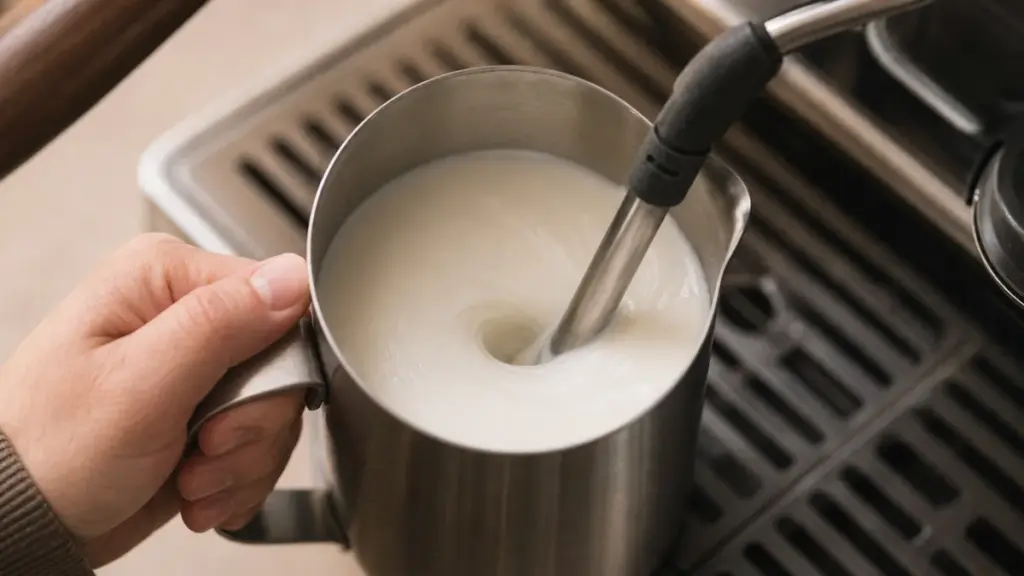
Introduce a little air. Position the steam tip just beneath the milk’s surface. Let it draw in a small amount of air, then lift the jug slightly so the tip sits deeper while the milk continues swirling. You want flowing milk, not a jug full of stiff foam.
-
Finish at 60 to 65°C. Use the thermometer rather than judging temperature solely by touch. Switch off the steam and wait for it to stop before removing the wand. Wipe and purge the wand immediately, following the manufacturer’s procedure.
-
Swirl and pour. Gently tap the jug if there are large surface bubbles, then swirl until the milk looks glossy. Pour a thin stream into the espresso, bringing the spout closer as the cup fills. Stop before overflowing; do not force all the milk into the cup.
Aim for a shallow microfoam layer of roughly 5 mm. Latte art is optional: a plain, glossy surface is perfectly acceptable.
Keep milk refrigerated according to its label, ideally in a fridge operating between 0 and 5°C, and return the carton promptly after pouring.
Getting thin, velvety milk
The trick is to separate adding air from finishing the texture. Air enters near the surface; the subsequent swirling motion helps combine the foam and liquid milk into a more uniform texture.
Use the milk’s appearance as your guide. Large bubbles and a dry mound suggest too much aeration. Milk that looks glossy and flows as one continuous liquid is closer to the target.
| Symptom | Likely cause | Fix |
|---|---|---|
| Thick, spoonable foam cap | Too much air introduced | Shorten the aeration stage |
| Large, visible bubbles | Wand tip breaking the surface too aggressively | Keep the tip just beneath the surface and maintain a controlled swirl |
| Thin milk followed by a foam blob | Milk and foam have separated | Swirl immediately before pouring |
| Coffee flavour disappears | Too much milk for the espresso | Use the smaller cup and stop pouring sooner |
Practise with the same milk and jug before changing ingredients. Consistency makes it easier to recognise what a small adjustment to wand position actually does.
Australia or New Zealand: where did the flat white begin?
Both countries claim the flat white, and the available accounts do not establish a single uncontested inventor. It is best understood as a drink shaped by their closely connected espresso cultures, rather than a recipe with an agreed birthplace.
A short timeline shows why the argument persists:
- 1985: Alan Preston’s account places the name on the menu at Moors Espresso Bar in Sydney. His history website includes menu photographs and his recollections, so it is evidence for his claim, not a neutral verdict on every competing account.
- 1989: a well-known Wellington story describes a cappuccino whose milk would not froth properly, served instead as a flat white. New Zealand Story presents this as one popular origin account, alongside earlier developments in New Zealand cafés.
A dated menu can document use of a name without proving who first made the drink. Equally, an appealing recollection is not proof that no similar drink existed elsewhere.
FAQ
Can I make a flat white without a steam wand?
You can make a similar small milk coffee, although the texture will differ. Origin suggests gently heating milk and using a cafetière, whisk or separate frother as alternatives. Aim for fine, flowing foam rather than a stiff topping, and keep the milk portion small enough that the coffee remains distinct.
Can I use oat milk?
Yes, a plant-based alternative can be used in a flat white. Start with the milk maker’s steaming instructions and your machine’s recommended settings, rather than assuming the dairy-milk temperature and technique will suit every product. Keep the target unchanged: a small drink with glossy milk and a thin foam layer.
Does a flat white contain more caffeine than a latte?
Not necessarily: the espresso recipe determines that comparison, not the drink’s name. If both drinks contain the same espresso, adding more milk does not add more coffee caffeine. A flat white may taste more coffee-forward because it contains less milk, but stronger flavour is not a reliable caffeine measurement.
Where to go next
Read Latte to compare milk proportions, then Cappuccino for a different foam texture. For smaller milk drinks after mastering the flat white, explore cortado and piccolo, or macchiato for coffee with a much smaller milk addition.
Sources
Publication years are given where available; undated pages were retrieved in November 2026.
- La Cimbali, “Flat White”, undated. Cup capacity, double espresso base and thin foam convention.
https://www.cimbali.com/recipes/coffee-tutorial/flat-white - Sage, “Essential Flat White”, undated. Manufacturer recipe using double espresso and a thin microfoam layer.
https://www.sageappliances.com/inspiration/en-gb/recipes/coffee-espresso/essential-flat-white - Origin Coffee, “How To Make a Flat White”, undated. Milk portion, texture, temperature, comparisons and alternative equipment.
https://www.origincoffee.co.uk/blogs/journal/how-to-make-a-flat-white - Pact Coffee, “How to make a flat white”, undated. Weighed espresso recipe, preparation and pouring method.
https://blog.pactcoffee.com/brew-guides/flat-white - Breville, “the Bambino Instruction Book”, revision M26, 2026. Manual milk-texturing technique, temperature and steam-wand safety.
https://assets.breville.com/BES450/BES450_USCM_IB_M26_LR.pdf - Black Market Coffee, “Where Did the Flat White Originate?”, 2015. Australian training convention and double ristretto alternative.
https://blackmarketcoffee.com.au/blogs/bmr-posts/flat-white - Schmieder and colleagues, “Influence of Flow Rate, Particle Size, and Temperature on Espresso Extraction Kinetics”, Foods 12, article 2871, 2023. Dose-to-yield ratios and laboratory caffeine reference, particularly Table 2.
https://mdpi-res.com/d_attachment/foods/foods-12-02871/article_deploy/foods-12-02871-v5.pdf - S. J. Will, “The Sydney History of the Flat White”, Flat White History, 2015. Preston’s account and photographic material.
https://flatwhitehistory.com.au/ - New Zealand Story, “Who invented the flat white?”, 1 October 2026. New Zealand origin accounts and acknowledgement of the unresolved debate.
https://www.eyesonnewzealand.com/stories/who-invented-the-flat-white - Food Standards Agency, “How to chill, freeze and defrost food safely”, 2017. Refrigeration and dairy storage guidance.
https://www.gov.uk/government/publications/how-to-chill-freeze-and-defrost-food-safely/how-to-chill-freeze-and-defrost-food-safely - NHS, “Foods to avoid in pregnancy”, current online guidance, retrieved 2026. Pregnancy caffeine advice.
https://www.nhs.uk/pregnancy/keeping-well/foods-to-avoid/
This article was researched from published roaster and manufacturer instructions, competing origin accounts, controlled laboratory extraction research and official food safety and pregnancy guidance; the recipe is an editorial adaptation, not a claim of first-hand testing.
Last checked: November 2026