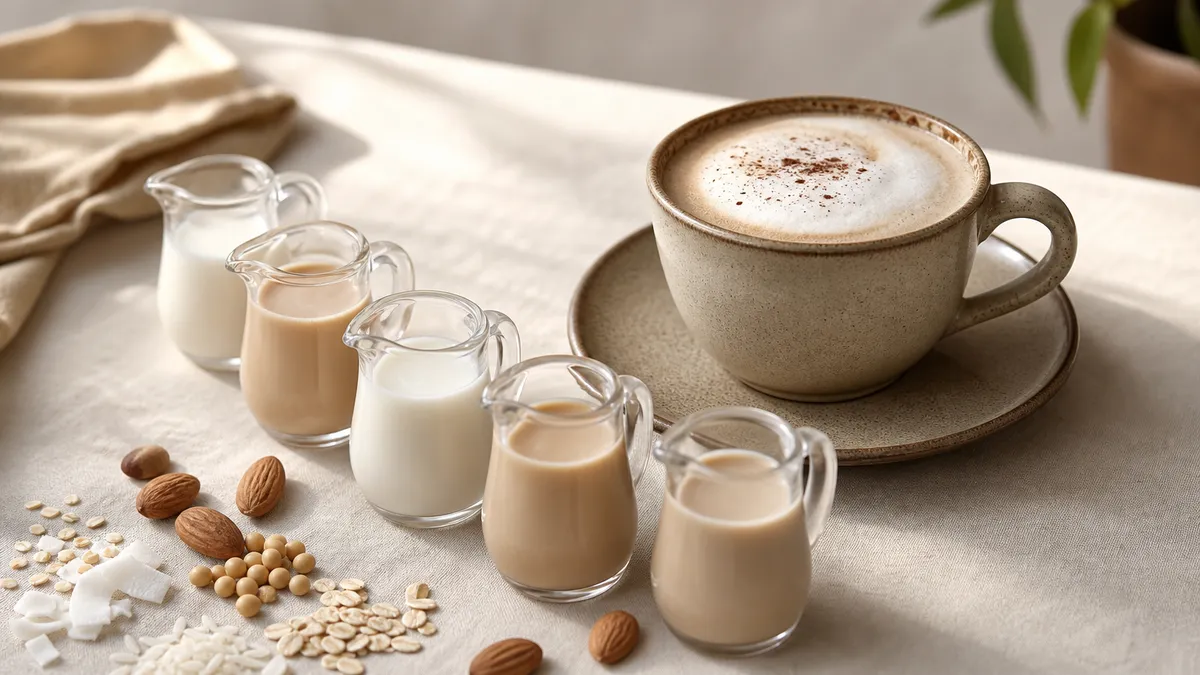
Whole dairy milk is a good starting point for rich, creamy coffee; barista oat is a practical plant-based alternative, while soya and pea drinks are worth trying when foam and protein matter. The best milk for coffee depends on flavour, texture, dietary needs and the particular formulation, not simply the plant named on the carton.
In short
- Whole, semi-skimmed and skimmed dairy milk can all foam. Less fat does not mean less ability to hold bubbles.
- For plant drinks, compare the actual carton: protein, added oils, stabilisers and acidity regulators affect performance.
- Start dairy steaming at 60 to 65 degrees Celsius. Follow the manufacturer’s guidance for plant drinks rather than assuming one temperature suits everything.
- Unsweetened and fortified describe different things. Check sugars, protein, calcium, vitamin B12, vitamin D and iodine separately.
- Plant-based does not mean allergen-free. Shared jugs, steam wands and automatic milk systems need particular attention.
Which milk and plant milk suit your coffee?
Choose using four criteria: the flavour you want, whether you need foam, dietary suitability and how well the drink stays mixed with your coffee.
The table is a starting shortlist, not a ranking of every product. Taste descriptions are broad expectations; formulations and personal preferences vary.
| Milk or drink | Flavour and body | Foam and mixing considerations | Who it suits |
|---|---|---|---|
| Dairy | Whole milk is rich and creamy; lower-fat versions feel lighter | All main fat levels can foam; fat changes texture as well as bubble behaviour | Readers wanting a familiar dairy flavour |
| Oat | Often cereal-like and gently sweet, with rounded body | Barista formulations are useful candidates for fine foam; ordinary versions vary | A first plant-based option to compare with dairy |
| Soya | Can be mild, beany or slightly earthy | Often protein-rich and capable of good foam; some formulations separate in hot coffee | Readers prioritising protein and foam |
| Almond | Nutty, often with a lighter body | Foam and stability vary considerably between products | Readers who actively enjoy almond flavour |
| Coconut drink | Distinct coconut flavour, depending on the blend | Choose a beverage formulated for coffee; do not assume all coconut products behave alike | Readers wanting coconut to be part of the drink’s flavour |
| Pea | Formulation-dependent, from fairly neutral to a noticeable pulse flavour | Pea-based drinks can foam well, but protein alone does not predict performance | Another option to assess alongside oat and soya |
Our coffee recipes hub covers what to make with your chosen milk. Here, the useful question is what that milk contributes, rather than the proportions that distinguish individual coffee drinks.
Dairy fat levels: whole, semi-skimmed or skimmed?
Standardised whole milk contains about 3.5% fat, semi-skimmed about 1.8%, and skimmed roughly 0.1% to 0.3%. Check the bottle because individual products differ. Removing fat leaves broadly similar amounts of protein and calcium, so skimmed milk is not simply diluted whole milk.
For flavour and mouthfeel, my starting recommendation is whole milk when richness matters and semi-skimmed when you prefer something lighter. Skimmed can produce substantial foam, but its texture is less creamy. More foam and better drinking texture are not necessarily the same result.
How proteins and fats make milk foam
Steaming introduces air while heating and circulating the milk. Microfoam means a fine, integrated foam of small bubbles, rather than a stiff cap sitting above watery milk.
Proteins help stabilise the boundary between air and liquid. Dairy contains caseins and whey proteins, both of which can contribute to this structure. Heating changes protein behaviour, but the explanation is not simply that steam “activates” protein at one magic temperature.
Fat adds richness and changes how foam forms and breaks down. Its effect depends on temperature, the condition of the fat droplets and processing. More fat therefore does not automatically produce more foam, and less fat does not automatically produce worse foam.
Plant drinks are more complicated than their protein figures suggest. Added thickeners can slow liquid draining out of foam, while emulsifiers help manage interfaces between ingredients. Processing also changes the final result.
Controlled laboratory comparisons have found substantial differences even between drinks made from the same plant. A 2024 study found that the tested oat drink produced the longest-lasting foam, but the ranking changed with temperature and foaming method. That supports testing individual products, not declaring every oat drink superior to every soya or pea drink.
What “barista edition” actually changes
A barista edition is a formulation intended for coffee, not a guarantee that every product will steam identically.
Depending on the recipe, manufacturers may use:
- Added oil for body and mouthfeel.
- Acidity regulators, including dipotassium phosphate, to help the drink tolerate coffee.
- Stabilisers, such as gellan gum, to help keep components dispersed.
- Emulsifiers, such as lecithin, to help maintain a mixture of oil and water.
These ingredients have different jobs. An acidity regulator is not the same thing as an emulsifier, and a long ingredient list does not by itself tell you whether the foam will be good.
For a concrete example, Oatly’s published UK Barista Edition ingredient list includes rapeseed oil and dipotassium phosphate. The manufacturer describes the acidity regulator as helping the product perform in coffee. This is a formulation example, not an independently tested recommendation.
Sweetened versus unsweetened
Sweetened drinks change the balance of the finished coffee. If you want to judge the beans and milk without an extra sweetening ingredient, start with an unsweetened product.
However, “no added sugar” does not necessarily mean sugar-free. Processing oats can break starch into smaller sugars, so read both the ingredients and the nutrition panel. Compare the “of which sugars” figure on the same volume basis across cartons.
Fortified versus unfortified
Fortification means adding nutrients. It does not tell you whether a drink will steam well.
If plant drinks regularly replace dairy in your diet, compare calcium, vitamin B12, vitamin D and iodine, as well as protein. Products differ: some contain several added nutrients, some calcium alone, and others none. NHS advice favours unsweetened, calcium-fortified alternatives.
For personalised advice about replacing dairy, particularly where allergies or restricted diets are involved, speak to a GP or registered dietitian.
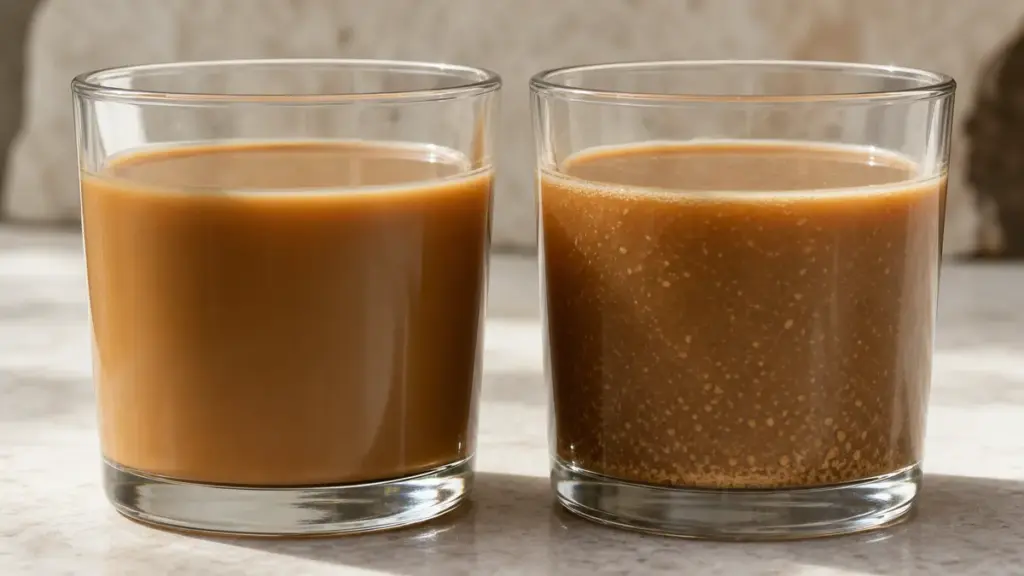
Why plant milk separates in hot coffee
Coffee changes the acidity and composition of the mixture. Together with heat, this can destabilise proteins and other suspended components, producing flecks, clumps or sediment.
It is tempting to blame only the temperature difference between cold milk and hot coffee. Controlled research on soya milk shows a more complicated picture involving temperature, coffee concentration and the proportion of soya drink. In that experiment, some separation was reversible, so it was not simply irreversible protein damage from overheating.
Start by trying a formulation intended for coffee. If it still separates, lower the serving temperature and compare another product using the same coffee. Change one variable at a time.
Do not assume that every separated drink is spoiled, but do not assume separation proves it is safe either. Storage instructions and use-by dates still apply.
A practical steaming and comparison method
Use this as a repeatable comparison, not a fixed recipe for every machine.
- Check suitability first. Read ingredients, allergen warnings, storage instructions and any recommended steaming temperature.
- Start cold. Use freshly refrigerated milk or plant drink. Shake the carton if its instructions require it.
- Use a consistent amount. Choose a volume within your jug or frother’s marked operating limits and repeat it for each comparison.
- Introduce air, then integrate it. With a steam wand, admit air near the surface, then position the tip slightly deeper to maintain circulation without continually adding large bubbles.
- Measure temperature. For dairy, begin with a finishing target of 60 to 65 degrees Celsius. For plant drinks, follow the product’s guidance first.
- Swirl and pour promptly. Look for a glossy, flowing texture rather than the largest possible foam volume.
- Clean immediately. Follow the machine’s instructions for wiping and purging the wand, and wash the jug before another milk is used.
Record the volume, finishing temperature, steaming time and result. There is no universal steaming time because steam power and starting volume differ.
For cold drinks, assess performance separately rather than assuming a hot-foam result transfers unchanged. Our nitro cold brew article covers a different way of building a creamy-feeling coffee drink.
Troubleshooting taste, foam and separation
| Symptom | Likely cause | What to try |
|---|---|---|
| Large, visible bubbles | Too much air or poor circulation | Reduce aeration and maintain a rolling motion |
| Thick foam above thin liquid | Foam has not integrated well, or has drained while standing | Swirl and pour promptly; compare another formulation |
| Little foam | Technique, equipment or formulation is unsuitable | Check wand operation, then try a coffee-focused product |
| Flecks after adding coffee | Heat and mixture composition have destabilised the drink | Try a barista formulation and a lower temperature |
| Coffee tastes unexpectedly sweet | Sweetened drink or sugars present after processing | Compare ingredients and sugars on the nutrition panel |
Allergies, intolerance and shared equipment
Lactose intolerance and milk allergy are different. Lactose is milk sugar; milk allergy involves a reaction to milk proteins. Lactose-free dairy still contains milk proteins and is not a substitute for someone who needs to avoid them.
Milk, soya and almonds are relevant allergens, and oats fall within the cereals containing gluten category used in allergen labelling. For someone with coeliac disease, choose an oat drink specifically labelled gluten-free rather than assuming any oat product is suitable.
Pea can also cause allergic reactions, despite not being one of the 14 allergens requiring special declaration under UK food law. Read the complete ingredient list, including blends, rather than relying only on highlighted words.
A vegan label is not a guarantee against milk cross-contact. At a shared coffee point, consider jugs, cloths, steam wands and internal milk tubing. A routine purge should not be treated as proof that equipment is allergen-free; follow an appropriate cleaning and separation procedure and explain any remaining uncertainty.
Keep refrigerated products and opened cartons as directed. FSA consumer guidance recommends a fridge temperature between 0 and 5 degrees Celsius.
Environmental comparisons: compare the same measure
For a coffee decision, comparing an equal volume of milk is useful, provided it is not mistaken for nutritional equivalence.
Poore and Nemecek’s 2018 Science study provides the foundation for widely used food footprint comparisons. There is an attribution detail worth keeping: dairy and soya milk were included in the published analysis; the familiar oat and almond comparisons use additional calculations supplied afterwards using the same methodology.
In that comparison:
- Greenhouse gas emissions: dairy has a higher footprint than oat, soya and almond drinks.
- Land use: dairy uses more land per litre than those alternatives.
- Freshwater use: almond drink has a substantially greater footprint than oat or soya, although dairy is higher in this dataset.
Water demand also needs geographical context. Irrigation in a water-stressed growing region matters differently from water used where supplies are plentiful. A freshwater volume is not, by itself, a complete measure of local harm.
These are life-cycle estimates, not controlled trials or measurements of every carton sold in Britain. They support oat and soya as sensible options when reducing emissions, land use and freshwater demand are priorities. They do not establish a universal winner, or justify extending the same ranking to coconut and pea without comparable evidence.
FAQ
Can I use homemade plant milk in coffee?
Yes, but do not expect it to behave like a formulated barista drink. Its concentration and processing will differ, and it may lack the ingredients used to stabilise commercial products in coffee. Treat it as a separate experiment, checking both mixing and foam rather than assuming the base ingredient predicts the result.
Does adding milk remove caffeine?
No. Adding milk to a prepared coffee dilutes its caffeine concentration but does not remove the caffeine already present. A larger, milkier drink is therefore not automatically a lower-caffeine drink. For ways to change the coffee component itself, see decaf recipes.
Do I need a barista edition if I never steam milk?
Not necessarily. If an ordinary drink tastes good and stays mixed in your coffee, there is no technical reason to replace it solely for the word “barista”. Coffee-focused formulations can still be useful without steaming because stability in hot coffee is a separate requirement from producing foam.
Where to go next
Use Coffee Recipes to put your choice of milk and plant milk for coffee into practice, and Decaf and Low-Caffeine Coffee Recipes when caffeine is the next variable to change. For contrasting textures and milk-free directions, read Nitro Cold Brew and Espresso Tonic.
Sources
-
Dairy Council for Northern Ireland, Types of milk, undated. Fat levels and differences between dairy milk types.
URL: https://www.dairycouncil.co.uk/what-we-do/nutrition/types-of-milk -
Arla Foods, Milk and Coffee, undated. Manufacturer guidance on dairy texture and steaming.
URL: https://www.arla.com/milk-and-coffee/ -
Kamath, Webb and Deeth, Journal of Dairy Science, The composition of interfacial material from skim milk foams, 2011. Experimental research on proteins at milk-foam interfaces.
URL: https://pubmed.ncbi.nlm.nih.gov/21605740/ -
Kopf-Bolanz and colleagues, Agroscope and Bern University of Applied Sciences, Comparison of physicochemical properties of commercial UHT-treated plant-based beverages and cow’s milk, 2023.
URL: https://www.agrarforschungschweiz.ch/wp-content/uploads/2023/03/043-056_Guggisberg_Food_Milk_EN.pdf -
Hassan and colleagues, Soft Matter, The bubbly life and death of animal and plant milk foams, 2024. Controlled comparisons of hot and cold foam.
URL: https://pubmed.ncbi.nlm.nih.gov/39370983/ -
Gorman and colleagues, Beverages, Consumer Perception of Milk and Plant-Based Alternatives Added to Coffee, 2021. Consumer sensory research.
URL: https://www.mdpi.com/2306-5710/7/4/80 -
Oatly, Oat Drink Barista Edition, current UK product page, undated. Published ingredients and formulation claims, checked November 2026.
URL: https://www.oatly.com/en-gb/products/oat-drink/oat-drink-barista-edition-1l -
Scientific Advisory Committee on Nutrition and Committee on Toxicity, Assessing the health benefits and risks of consuming plant-based drinks, 2025.
URL: https://assets.publishing.service.gov.uk/media/68765a24cfc3756455bb6a61/plant-based-drinks-health-benefits-and-risks_main-report.pdf -
Brown and colleagues, University of Strathclyde, “Curdling” of Soymilk in Coffee: A Study of the Phase Behaviour of Soymilk Coffee Mixtures, 2019. Experimental research.
URL: https://pure.strath.ac.uk/ws/portalfiles/portal/87516330/Brown_etal_FH_2019_Curdling_of_soymilk_in_coffee_a_study_of_the_phase_behaviour.pdf -
Breville, The Bambino BES450 Instruction Book, document code M26. Manufacturer’s manual milk-texturing instructions.
URL: https://assets.breville.com/BES450/BES450_USCM_IB_M26_LR.pdf -
NHS, Dairy and alternatives in your diet, current guidance, undated.
URL: https://www.nhs.uk/live-well/eat-well/food-types/milk-and-dairy-nutrition/ -
Food Standards Agency, Allergen guidance for food businesses, current guidance, 2026. Applies to England, Northern Ireland and Wales.
URL: https://www.gov.uk/government/publications/allergen-guidance-for-food-businesses/allergen-guidance-for-food-businesses -
Allergy UK, Your quick guide to: Pea Allergy, July 2025, version 1.2.
URL: https://www.allergyuk.org/wp-content/uploads/2025/07/Reactions-to-Pea-Protein-v1.2-1.pdf -
Food Standards Agency, Food safety in a heatwave: advice for consumers, 2024. Refrigeration guidance.
URL: https://www.gov.uk/government/publications/food-safety-in-a-heatwave-advice-for-consumers/food-safety-in-a-heatwave-advice-for-consumers -
Poore and Nemecek, Science, Reducing food’s environmental impacts through producers and consumers, 2018, corrected 2019. Life-cycle evidence synthesis.
URL: https://josephpoore.com/data/science-2018/Poore%20and%20Nemecek%20%282018%29%20Reducing%20foods%20environmental%20impacts%20through%20producers%20and%20consumers.pdf -
Our World in Data, Dairy vs. plant-based milk: what are the environmental impacts?, 2022, and FAQs on the environmental impacts of food, 2022. Presentation and methodology notes for the extended milk comparison.
URLs: https://ourworldindata.org/environmental-impact-milks and https://ourworldindata.org/faqs-environmental-impacts-food
Research combined retrieved experimental papers, UK public-health and food-safety guidance, environmental life-cycle evidence and manufacturers’ published formulation and operating instructions; no first-hand product testing is claimed.
Last checked: November 2026