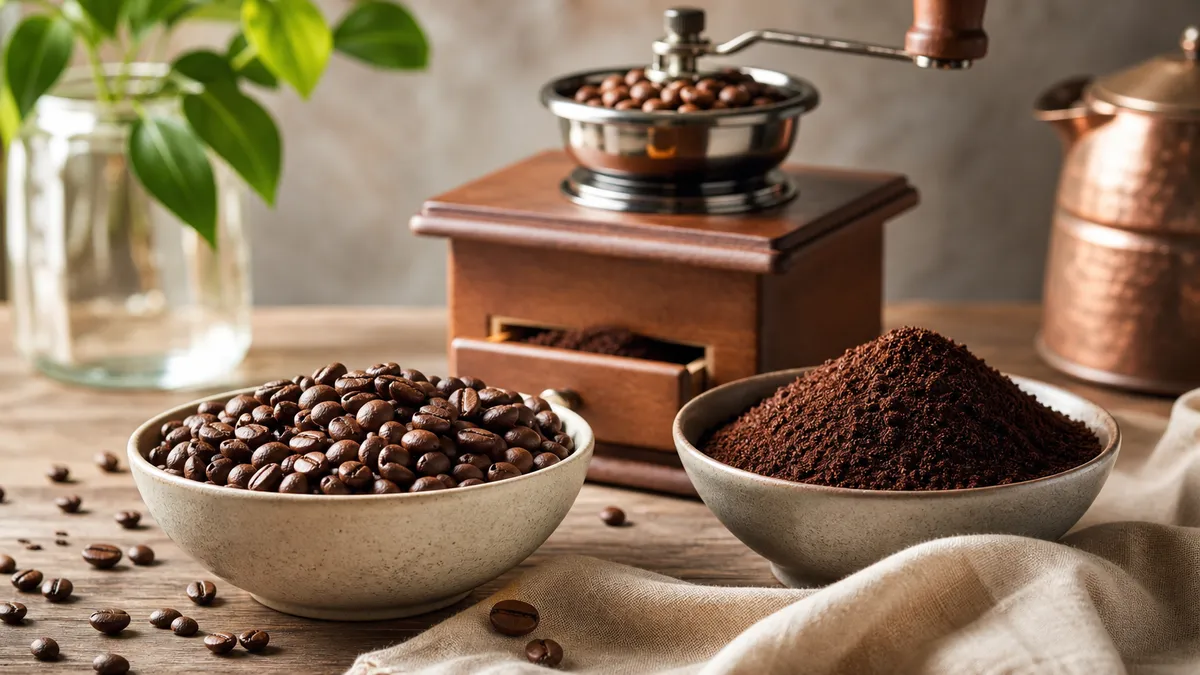
Buy whole beans if you want to preserve aroma and adjust the grind to your brewer; buy ground coffee if removing a preparation step matters more. In the whole beans vs ground coffee comparison, beans have the freshness advantage, but correctly ground coffee remains a sensible, convenient choice.
In short
- Grind only what you need just before brewing to make the most of whole beans.
- Match the grind to the brewer: cafetière, filter and espresso do not all need the same particle size.
- Ground coffee loses freshness faster, but there is no universal deadline after which it suddenly tastes stale. Storage and packaging matter.
- A grinder adds equipment, preparation and cleaning. Decide whether you want that routine before choosing beans.
- Buying ground coffee is reasonable if you like the results, use an appropriate grind and keep the opened supply well protected.
Whole beans vs ground coffee at a glance
The criteria here are aroma retention, control over brewing, convenience and equipment requirements. The recommendations assume you are comparing the same coffee, rather than different origins, roasts or blends.
| Criterion | Whole beans | Ground coffee |
|---|---|---|
| Freshness after grinding | Grinding happens shortly before brewing | More time can pass between grinding and brewing |
| Aroma retention | Better starting point for preserving aroma until preparation | Aroma changes more quickly after grinding |
| Grind control | Adjustable with a suitable grinder | Fixed when purchased |
| Preparation | Adds a grinding step | Ready to measure and brew |
| Equipment | Needs a separate or integrated grinder | No grinder needed |
| Best suited to | People who want control and enjoy adjusting their coffee | People who prioritise a simpler routine |
The freshness and grind-control distinctions follow coffee research and brewer guidance; the suitability judgements are practical editorial recommendations, not product test results.
Neither format should be an automatic badge of quality. Start with the coffee you enjoy, then decide how much control and preparation you want. Our wider buying and storing coffee guide puts this choice alongside the other buying decisions.
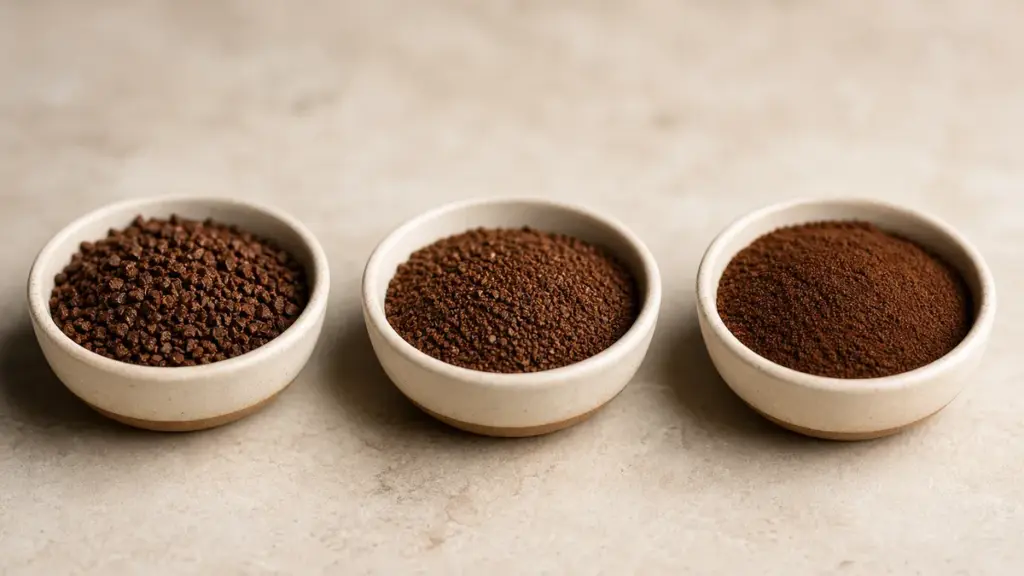
Freshness: why ground coffee changes faster
Grinding breaks the bean into many smaller particles, increasing the surface exposed to the surrounding air. It also releases trapped gas and aroma compounds. That makes coffee easier to extract with water, but less protected while it waits to be brewed.
Two processes matter here. Desirable volatile compounds, the substances that contribute to aroma, escape or change; oxygen also reacts with coffee constituents, contributing to unwanted flavours. Whole beans slow these changes compared with ground coffee, rather than stopping them altogether.
It is tempting to turn this into a stopwatch rule: beans last a certain number of weeks and grounds a certain number of minutes. That is too simple. Gas loss, chemical change and a noticeable difference in the cup are related measurements, not interchangeable definitions of freshness.
A controlled sensory study published in 2006 found that freshly ground coffee had stronger coffee aroma and was preferred to grounds stored at room temperature for one or two weeks. Those results support grinding close to brewing, but they do not establish a universal shelf life for every coffee and package.
The useful rule is to shorten the time between grinding and brewing where practical. If you buy ground coffee, choose a pack size that fits your actual consumption rather than leaving a large opened supply sitting around. Keep both formats protected from air, moisture, heat and light.
Flavour: what difference should you expect?
The clearest reason to choose beans is the chance to retain more aroma until preparation. In the controlled storage study above, freshly ground samples also tasted less bitter than the stored samples under the room-temperature conditions tested. That is evidence for a freshness benefit, not a promise that every freshly ground cup will beat every pre-ground one.
Grinding correctly matters alongside grinding recently. Extraction means the transfer of soluble substances from coffee into water. Particle size affects how quickly that happens and, in brewers where water passes through a bed of grounds, how readily the water flows.
This creates an important distinction:
- Freshness control: deciding when the coffee is ground.
- Brewing control: deciding how finely it is ground.
Whole beans give you access to both controls, provided your grinder is suitable. Pre-ground coffee fixes the second decision in advance, so getting the right grind when you buy becomes especially important.
Our recommendation is to judge the brewed cup, not just the smell from the bag. If you are happy with your ground coffee, there is no need to replace your routine simply to satisfy someone else’s preference.
Match the grind to your brewer
A bag labelled “ground coffee” does not tell you enough on its own. Look for the intended brewing method, or ask the retailer to grind specifically for your equipment.
These are starting points, not fixed specifications. Follow your brewer’s instructions before making adjustments.
| Brewer | Usual starting point | What to ask for when buying ground |
|---|---|---|
| Cafetière | Coarse | Cafetière or French press grind |
| Drip filter machine | Medium | Grind suitable for your filter machine |
| Pour-over | Medium to medium-fine, depending on the brewer | Grind for the particular brewer and recipe |
| AeroPress | Medium-fine for the manufacturer’s general guidance | AeroPress grind, with your recipe specified |
| Espresso machine | Fine, with adjustment for the equipment | Espresso grind and confirmation of basket compatibility |
These broad distinctions come from manufacturer brewing guidance. They are not interchangeable settings across grinders.
For espresso, check the filter basket as well as the bag. A pressurised or dual-wall basket adds resistance through its construction. Sage, for example, specifies dual-wall baskets for pre-ground coffee and single-wall baskets for freshly ground coffee in its Duo-Temp Pro instructions. That is guidance for that equipment, not a universal rule for every espresso machine.
If you use several brewing methods, whole beans become more attractive because you can grind each portion differently. If you always use the same brewer, buying the appropriate ground coffee may remove a decision you do not particularly want to make.
Convenience and the grinder commitment
Ground coffee removes grinding from your routine. That can be the deciding benefit when you want a straightforward morning drink, are travelling with a brewer or share a kitchen where another appliance would be unwelcome.
Whole beans mean choosing and maintaining a grinder, unless your machine already incorporates one. Before buying, consider where it will live, how you will measure coffee and whether you are willing to clean it according to the manufacturer’s instructions.
What the extra equipment involves
The grinder purchase is the additional equipment commitment behind whole beans. Compare suitability for your brewer, adjustment range, cleaning access, replacement parts and warranty terms, rather than assuming that every coffee grinder performs the same job.
A burr grinder passes coffee between grinding surfaces and provides adjustable particle sizes. AeroPress recommends a burr grinder over a blade grinder, particularly because very fine particles can obstruct flow. Espresso also benefits from equipment designed for precise adjustment, a requirement Baratza highlights in its espresso grinder guidance.
Ask whether you want manual or electric operation, and try the workflow if possible. For a shared workplace, request an itemised written quotation covering equipment and any maintenance commitments before deciding.
My recommendation is not to buy a grinder merely because beans are theoretically preferable. Buy one when the extra control is useful enough that you will actually use it.
When ground coffee is perfectly reasonable
Ground coffee is a sensible choice when convenience is your priority, your brewer has a suitable pre-ground option and you already enjoy the results. It is also a reasonable starting point while learning to use a new brewer.
Make the choice deliberately:
- Name your brewer. Ask for the appropriate grind rather than accepting an unspecified general-purpose option.
- Choose a manageable pack. Match the opened supply to how often you brew.
- Reseal promptly. Keep the coffee cool, dry and away from light.
- Assess the cup. Decide whether the aroma and flavour remain satisfying through the pack.
Do not assume you must transfer every bag into a separate canister. Packaging design matters: a controlled whole-bean study found that an integrated screw-cap package retained its measured freshness indicators better than the alternative storage arrangements tested. That does not prove all bags outperform all canisters. See our coffee storage tips for the fuller storage decision.
If your supply lasts much longer than expected, read freezing coffee before changing your storage routine.
A useful test before switching
Try a controlled comparison rather than changing coffee, brewer and grind simultaneously. Ask a retailer whether the same coffee is available as beans and ground for your equipment, then keep your brewing recipe consistent.
Taste the drinks without knowing which is which if someone can prepare them for you. Record which you prefer and whether that preference remains noticeable as you work through the opened coffee.
This is a personal decision exercise, not a laboratory test. It cannot completely separate freshness from grinder differences, but it can answer the question that matters at home: does the whole-bean routine improve your drink enough to justify the extra preparation?
For whole beans vs ground coffee, choose the routine you can maintain and the cup you genuinely prefer.
FAQ
Should I grind my beans the night before?
Grinding immediately before brewing is the better choice for retaining freshness, but preparing the night before is a convenience compromise you can make deliberately. Grind only the amount needed and keep it in a small, tightly closed container. Avoid leaving the grounds exposed overnight, and compare the result with your usual freshly ground brew.
Can I use one bag of ground coffee in different brewers?
You can try it, but expect compromises because brewing methods call for different particle sizes. A medium grind intended for drip coffee is not the same starting point as coarse cafetière coffee or fine espresso coffee. If you regularly switch methods, buying beans gives you the option to grind separately for each one.
Will buying beans fix sour or bitter coffee?
Not necessarily, because freshness is only part of the result. Grind size affects extraction and flow, while the coffee and brewing method also matter. Before changing format, check that your grind suits the brewer and follow a consistent recipe. Treat a flavour problem as something to investigate, rather than proof that pre-ground coffee is responsible.
Where to go next
Read Buying and Storing Coffee for the broader buying decisions, then Coffee Storage Tips to protect whichever format you choose. If you need to keep a reserve beyond your everyday supply, Freezing Coffee explains that separate storage option.
Sources
-
Specialty Coffee Association, Coffee Decoded: What is “freshly roasted” coffee?, undated web article, drawing on research published in 2018.
https://sca.coffee/sca-news/coffee-decoded-9-fresh-coffee -
Ross, C. F., Pecka, K. and Weller, K., Journal of Food Quality, Effect of Storage Conditions on the Sensory Quality of Ground Arabica Coffee, 2006.
https://onlinelibrary.wiley.com/doi/abs/10.1111/j.1745-4557.2006.00093.x -
National Coffee Association, Storage and shelf life, undated web guidance.
https://www.aboutcoffee.org/beans/storage-and-shelf-life/ -
KitchenAid, Coffee grind size and settings guide, 2026.
https://www.kitchenaid.com/countertop-appliances/pinch-of-help/coffee-grind-size -
AeroPress, What grind size should I use?, live support guidance, retrieved November 2026.
https://help.aeropress.com/en-US/what-grind-size-should-i-use-123199 -
Sage Appliances, Duo-Temp Pro Instruction Book, document SES810_EU_UG8_F23, 2023 revision.
https://assets.sageappliances.com/BES810/SES810_EU_UG8_F23_FA_Online.pdf -
Baratza, Shop by Brew Method, undated manufacturer guidance.
https://www.baratza.com/en-us/landing/shop-by-brew-method -
Journal of Food Research International, Effects of different coffee storage methods on coffee freshness after opening of packages, 2022, author paper hosted by the University of Oregon.
https://pages.uoregon.edu/chendon/coffee_literature/coffee_lit_rev/2024_ep16_coffee_packing_tonx_konecny.pdf
This comparison was researched using retrieved sensory and packaging studies, coffee-industry guidance and manufacturers’ brewing instructions; no first-hand equipment testing is claimed.
Last checked: November 2026