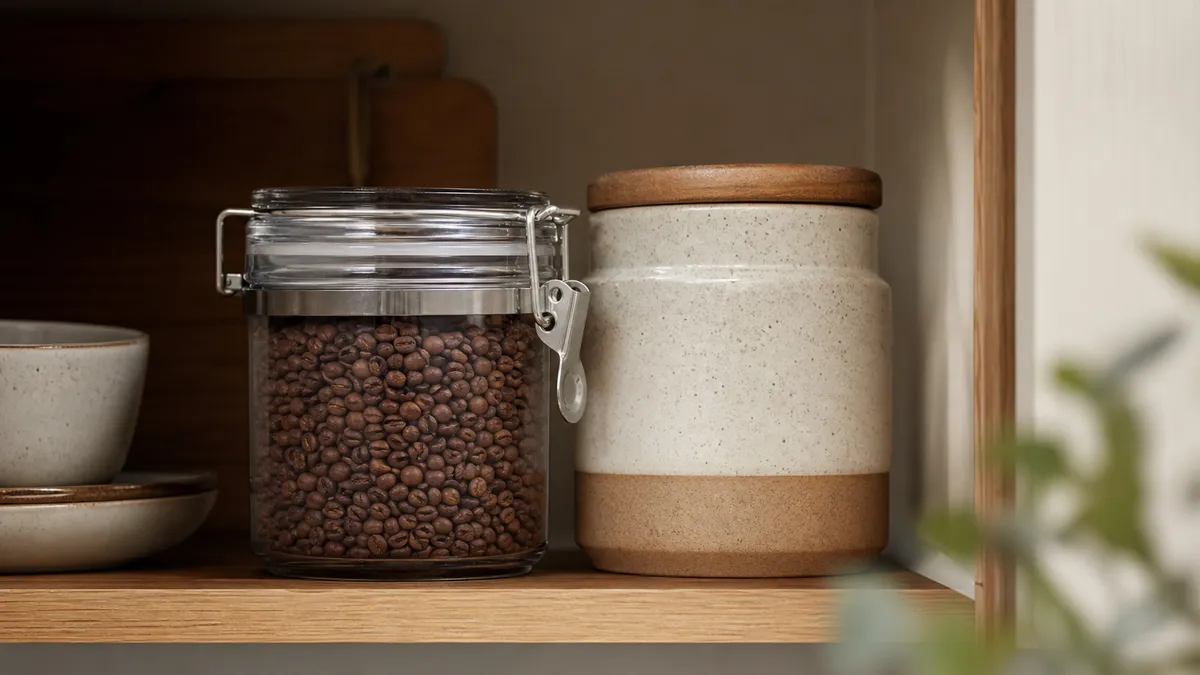
Store coffee in a tightly sealed container or a well-resealed barrier bag, in a cool, dry cupboard away from light and heat. The most useful coffee storage tips are simple: keep your working supply small, close it promptly after use and grind whole beans only when you are ready to brew.
In short
- Buy quantities you expect to use in roughly one to two weeks, rather than treating that period as an expiry deadline.
- Protect coffee from oxygen, light, heat and moisture.
- Judge containers by their seal, light protection and suitability for your coffee, not their appearance alone.
- Vacuum containers remove some air, but cannot restore lost aroma or guarantee a particular freshness window.
- Keep ground coffee tightly closed, and check that any vacuum mechanism is suitable for fine particles.
How to Keep Coffee Fresh
Freshness is about retaining coffee’s desirable aroma and flavour, not simply whether the beans remain usable. Roasted coffee changes during storage even in protective packaging, so good storage slows deterioration rather than stopping it.
The broader buying and storing coffee guide connects these storage decisions with choosing suitable quantities and understanding what you buy.
The four enemies of freshness
Oxygen contributes to oxidation, chemical reactions that change coffee’s oils and aroma compounds. Over time, the cup can lose its lively fragrance and develop stale or rancid notes.
Light is another reason to avoid displaying your daily supply in a clear jar on a sunny worktop. An opaque container provides protection wherever it stands; clear glass needs a dark storage location.
Heat makes a warm kitchen shelf a poor default. Avoid cupboards beside an oven or dishwasher, and places that receive strong afternoon sunshine.
Moisture matters because coffee absorbs water from its surroundings. Keep steam, splashes and damp utensils away from the storage container, and let washed containers dry completely before refilling them.
These protections work together. A strong seal does not compensate for a hot location, and an opaque jar is little help if its lid fits loosely.
Where should coffee live?
Choose a dry pantry shelf or cupboard away from cooking appliances. At an office tea point, put the main supply away from the kettle and dishwasher rather than immediately beside them.
For everyday use, our practical preference is a cupboard rather than a refrigerator. Refrigeration introduces additional moisture-management concerns, especially when containers move between cold storage and a warm room. Follow any specific storage instructions on the pack.
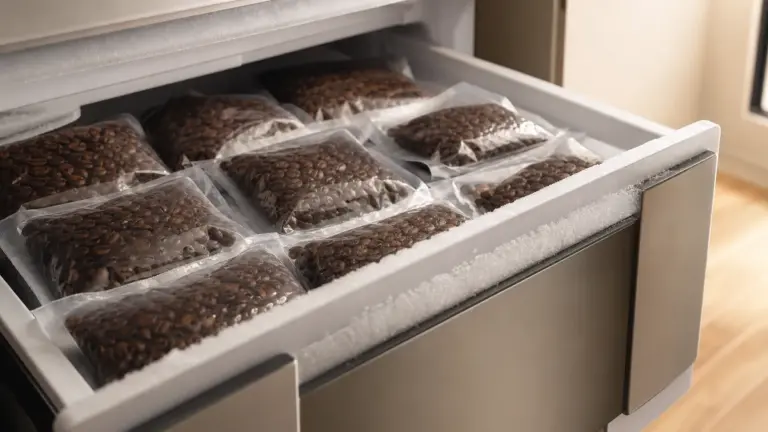
Freezing is a separate option for a reserve supply, not a reason to keep moving the daily container between different temperatures. See freezing coffee for the dedicated method and its precautions.
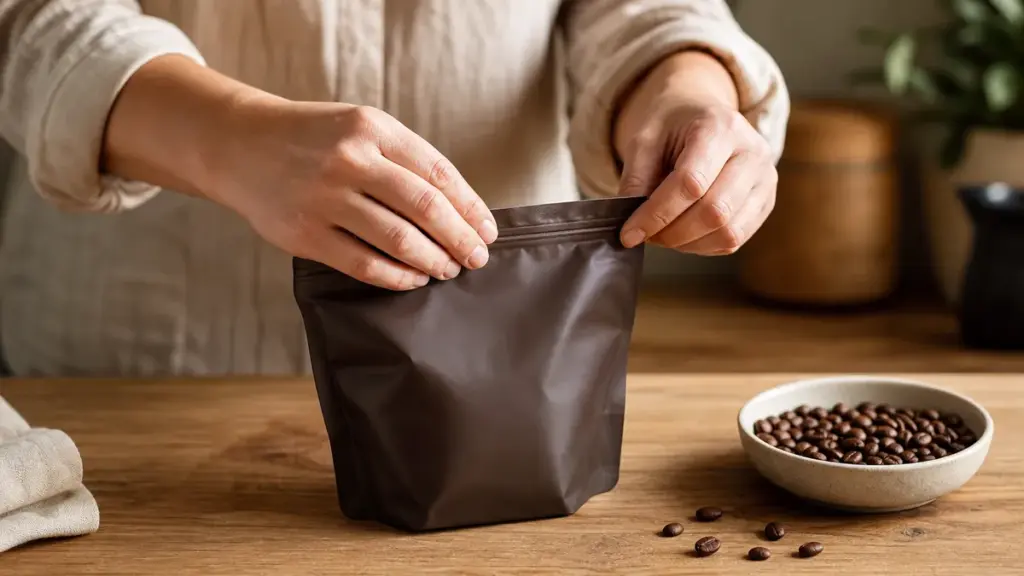
Coffee Bean Storage Tips
The best routine is one that matches how quickly you actually drink coffee. Start by measuring consumption rather than assuming a large bag will disappear.
A numbered storage routine
The quantities below are an illustrative household example, not a prescribed storage standard.
- Work out your daily use. Suppose you brew twice daily with 15 g each time. That is 30 g per day, so a 250 g bag supplies approximately 8.3 days: 250 g ÷ 30 g per day.
- Choose a suitable home before opening. Use the bag’s effective resealing closure or a clean, completely dry food-storage container. A capacity such as 750 ml describes container volume, not a guaranteed bean weight; check the fit without crushing beans or obstructing the lid.
- Choose a cool cupboard. A cupboard measuring 20°C, for example, may be a suitable everyday location if it stays dry and away from heat. This is an example, not an optimum temperature established for every coffee.
- Record when you opened the bag. Keep the original packaging or its details, including any after-opening instructions. This makes later comparisons more useful than relying on memory.
- Remove only what you need and reseal immediately. Grind your 15 g portion just before brewing rather than grinding the remaining bag in advance.
- Review after seven days. Check whether your purchase size suits your routine and whether you still enjoy the aroma and cup. Seven days is a convenient review interval, not a freshness or safety deadline.
If several people share the supply, agree on one closing routine. A container that everybody reliably seals is preferable to a more complicated system that is regularly left open.
How long will coffee keep its flavour?
There is no universal number of days that separates fresh coffee from stale coffee. Packaging, storage conditions and the coffee itself affect the rate of change, while personal acceptance also varies.
The National Coffee Association recommends buying enough for one or two weeks. Use that as a purchasing guide, not a claim that all beans peak or expire within that period. Ask the roaster about the particular coffee rather than treating a general rule as a guarantee.
Also distinguish time since roasting from time since opening. An unopened protective pack and a repeatedly opened container do not expose coffee to the same conditions.
A best-before date concerns quality rather than safety; it is not a promise of unchanged flavour after opening. Our guide to roast dates and best-before dates explains that distinction without turning this storage routine into a dating guide.
Storing ground coffee
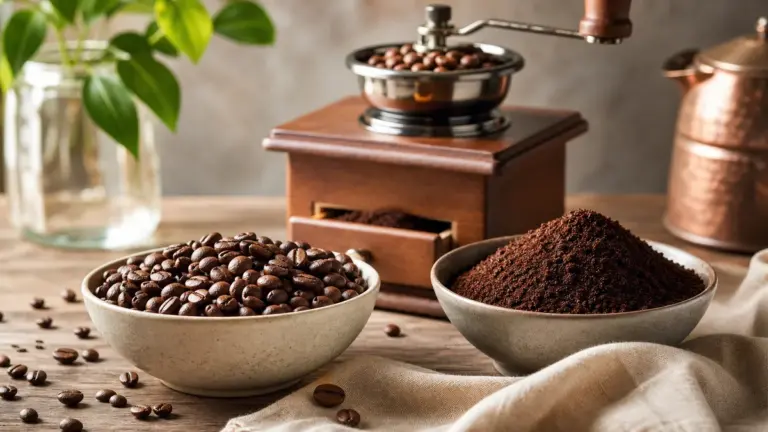
Ground coffee needs the same protection as beans, with particular attention to prompt closure. Grinding greatly accelerates the release of carbon dioxide and associated aroma changes, so storage cannot fully reproduce grinding immediately before brewing.
If you buy pre-ground coffee, choose a quantity that fits your consumption and follow its after-opening instructions. Keep it in an effective resealable pack or a suitable airtight container, using a clean, dry spoon.
Do not interpret rapid aroma loss as an instruction to discard ground coffee after a few minutes. It describes changing quality, not a universal safety limit. For the wider practical trade-off, read whole beans versus ground coffee.
Coffee Storage Containers
Compare containers using four criteria: closure, protection from light, practical size and ease of cleaning. The material alone does not establish whether a container will preserve coffee well.
| Storage option | Main advantage | Limitation | Best suited to |
|---|---|---|---|
| Original barrier bag with effective closure | Retains protective packaging without unnecessary transfer | Closure and bag condition vary | Everyday use when the pack reseals securely |
| Opaque airtight canister | Combines light protection with a reusable container | Traps ordinary air when closed | A straightforward daily routine |
| Clear airtight jar | Contents are visible | Requires a dark cupboard | Readers who already have suitable jars |
| Air-displacement container | A moving lid reduces the space above the coffee | Not the same mechanism as a pumped vacuum | Readers wanting adjustable internal volume |
| Vacuum canister | Removes some air before sealing | Requires correct operation and maintenance | Readers willing to maintain its mechanism |
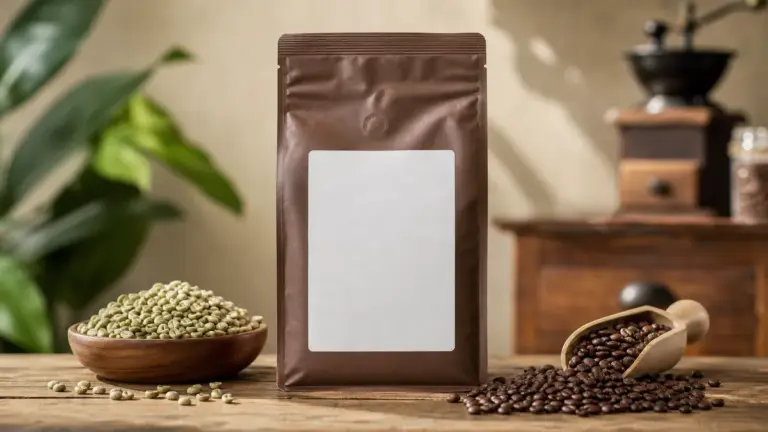
A one-way valve is not a replacement for closing the bag. Its purpose is to let gas released by roasted coffee escape while limiting air entering through the valve. An open bag top still needs an effective closure.
Research also cautions against assuming that decanting always improves storage. A controlled study comparing several after-opening methods found differences in chemical freshness markers, with an integrated screw-cap pack performing well. It did not establish a universal sensory expiry point or prove that every bag outperforms every canister.
Our recommendation is therefore to keep good packaging when its closure works, rather than transfer coffee merely because a jar looks more substantial.
Troubleshooting storage problems
| Symptom | Likely cause | Fix |
|---|---|---|
| Aroma becomes muted during storage | Ageing, including aroma loss and oxidation | Buy a smaller working supply and check closure |
| Coffee smells of nearby foods | Exposure to surrounding odours | Use a tightly sealed container in a different location |
| Beans are stored in direct sun | Inadequate light and heat protection | Move them to a cool cupboard |
| Vacuum indicator repeatedly changes | Gas release, leakage or a mechanism issue | Follow the maker’s resealing and cleaning instructions |
Treat these as checks, not diagnoses. A disappointing brew alone does not identify a storage fault.
Vacuum-Sealed Containers
A vacuum canister uses a pump or other mechanism to lower the pressure inside a sealed vessel by removing some air. An ordinary airtight jar closes around the air already present; it does not actively remove it.
Reducing oxygen exposure is a sensible storage aim, but “vacuum-sealed” does not mean oxygen-free or permanently fresh. Opening the container admits air again, and the result depends on the seal, mechanism and how it is used.
What vacuum storage can and cannot tell you
Manufacturer claims about extended freshness should be read as product claims, not universal findings. Do not translate a promised percentage improvement into a guaranteed number of extra days for your own beans.
Coffee also releases carbon dioxide after roasting, a process called degassing. Gas release can affect the pressure inside a vacuum container, so a changing indicator does not automatically prove that outside air has leaked in. Follow the manufacturer’s instructions rather than assuming every pressure change has the same cause.
Check ground-coffee compatibility before filling any pumped canister. Fellow, for example, explicitly advises against ground coffee in its Atmos because fine particles may clog the intake valve. That is a product-specific restriction, not a rule that ground coffee cannot be vacuum-packed by other suitable systems.
For most everyday routines, start with sound sealing, a cool location and an appropriate quantity. Consider vacuum storage as an additional measure, not a substitute for those habits.
FAQ
Can I mix a new bag with the beans already in my container?
Our practical recommendation is to finish the existing batch first. Keeping batches separate makes their opening dates and flavour changes easier to track. Before refilling, inspect the container and clean it according to its instructions, allowing every washed part to dry completely before adding coffee.
Should I open an unopened bag to put it in a canister?
Not simply because you own a canister. Protective packaging can provide an effective barrier before opening, and opening changes the atmosphere around the beans. Leave an intact pack closed until needed, unless its instructions say otherwise; then assess whether its closure is suitable for everyday use.
Does a weak bloom prove that coffee has gone stale?
No, a weak bloom alone does not prove staleness. The bloom, the bubbling when water first wets grounds, reflects carbon dioxide release, which changes as coffee ages. Use it as one observation alongside aroma and flavour, not as a pass-or-fail test for whether to keep the bag.
Where to go next
Read How to Read a Coffee Bag to identify the storage instructions worth retaining, and Roast Dates and Best-Before Dates to understand the dates alongside them. For a reserve supply, continue with Freezing Coffee; for deciding when to grind, choose Whole Beans vs Ground Coffee. Together, these extend the coffee storage tips here without complicating the daily routine.
Sources
-
National Coffee Association, Storage and shelf life, undated, accessed November 2026.
https://www.aboutcoffee.org/beans/storage-and-shelf-life/ -
Specialty Coffee Association, Coffee Decoded: What is “freshly roasted” coffee?, undated year, accessed November 2026.
https://sca.coffee/sca-news/coffee-decoded-9-fresh-coffee -
Zurich University of Applied Sciences and Tchibo, Smrke and colleagues, Effects of different coffee storage methods on coffee freshness after opening of packages, Food Packaging and Shelf Life, volume 33, article 100893, 2022.
https://digitalcollection.zhaw.ch/bitstream/11475/26687/3/2022_Smrke-etal_Effects-of-different-coffee-storage-methods-on-coffee-freshness_FPSL.pdf -
Zurich University of Applied Sciences and collaborators, Glöss and colleagues, Freshness indices of roasted coffee: monitoring the loss of freshness for single serve capsules and roasted whole beans in different packaging, Chimia, volume 68, 2014. Retrieved abstract and bibliographic record.
https://pubmed.ncbi.nlm.nih.gov/24801853/ -
Lavazza, How to store ground coffee, all the tips, undated, accessed November 2026. Used for everyday ground-coffee handling, not its extended shelf-life claims.
https://www.lavazza.co.uk/en/coffee-secrets/how-to-store-ground-coffee-tips -
Fellow, How Vacuums Prevent Coffee Staling, undated, accessed November 2026. Manufacturer explanation, not independent performance evidence.
https://fellowproducts.com/blogs/learn/how-vacuums-prevent-coffee-staling/ -
Fellow, Should I store ground coffee in the Atmos Vacuum Canister?, updated October 2026.
https://help.fellowproducts.com/hc/en-us/articles/360016559911-Should-I-store-ground-coffee-in-the-Atmos-Vacuum-Canister -
GOV.UK, Understanding food labelling: Best before and use-by dates, current online guidance accessed November 2026.
https://www.gov.uk/understanding-food-labelling/best-before-and-use-by-dates
Research combined coffee-industry guidance, primary packaging research and manufacturer operating advice, with illustrative quantities clearly separated from measured findings.
Last checked: November 2026