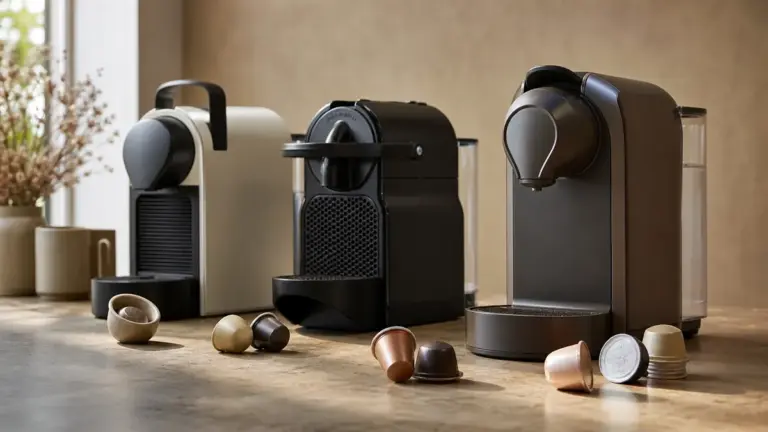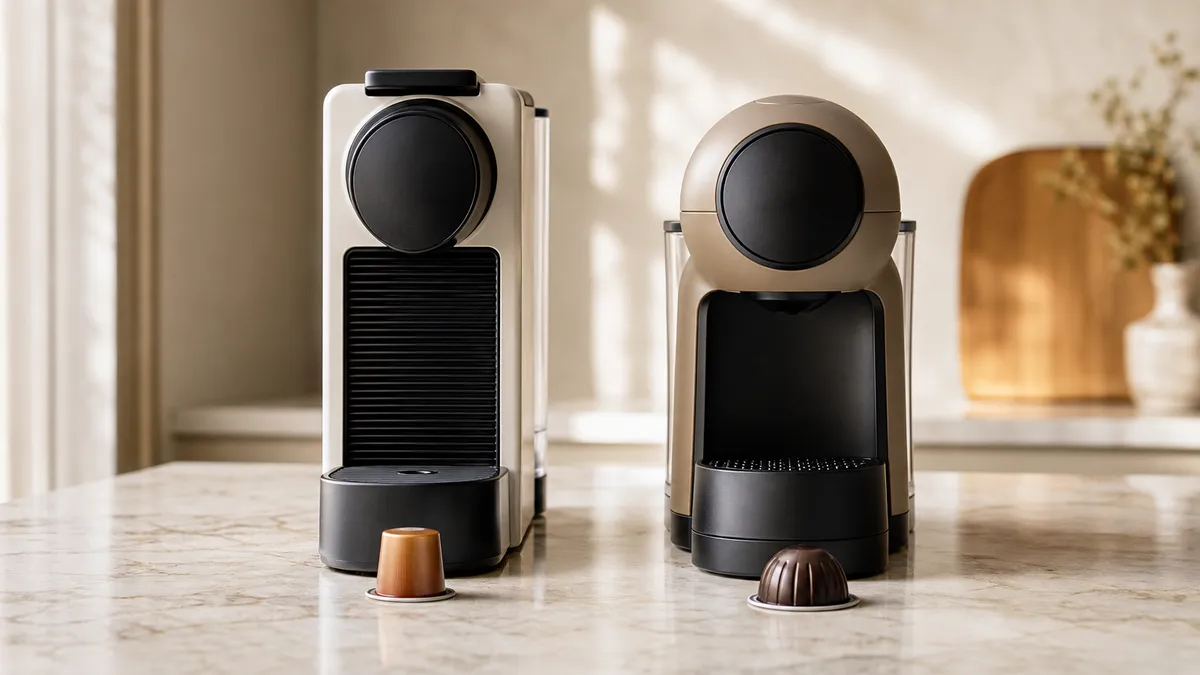
Nespresso Original and Vertuo are two incompatible capsule systems: Original uses pump-driven pressure extraction for short coffees, while Vertuo spins barcode-labelled capsules to make drinks from espresso to larger mugs. Choose Original for espresso-focused drinking and wider capsule-brand choice; choose Vertuo if several black-coffee sizes matter more than buying independently made compatible capsules.
In short
- Original’s standard coffee sizes are 25 ml ristretto, 40 ml espresso and 110 ml lungo, although machine buttons vary.
- Vertuo’s advertised sizes extend from 25 ml to 535 ml, but not every machine accepts every capsule format.
- Original-compatible capsules are available from independent coffee brands; Vertuo remains a controlled, patent-protected system.
- Starbucks by Nespresso Vertuo capsules are available in the UK, but they are not evidence of an open third-party capsule market.
- Both systems have capsule-recycling routes. Check the collection arrangements for your address, capsule brand and, where relevant, workplace.
Nespresso Original vs Vertuo at a glance
The useful comparison criteria are extraction method, drink size, capsule choice, milk preparation and recycling arrangements. Neither system wins every category: the better choice depends on what you actually want in the cup.
| Criterion | Original | Vertuo |
|---|---|---|
| Extraction | Pump-driven pressure extraction; Nespresso advertises a 19 bar system | Barcode-controlled Centrifusion, which spins the capsule during brewing |
| Standard coffee formats | Ristretto, espresso and lungo | Ristretto through to mug, XL and carafe formats, subject to machine compatibility |
| Capsule choice | Nespresso and independently made Original-compatible capsules | Vertuo-format capsules, including the official Starbucks by Nespresso range |
| Coffee surface | Pressure-produced crema | A generous coffee-foam layer marketed as crema |
| Milk drinks | Separate frother, integrated milk system or steam wand, depending on model | Separate frother, integrated milk system or steam wand, depending on model |
| Recycling | Follow the capsule brand’s accepted scheme | Nespresso’s dedicated routes, with local options varying |
| Best suited to | Short-coffee drinkers who value capsule-brand choice | Drinkers wanting several black-coffee sizes from one system |
These are system-level differences, not evidence that one particular machine is more reliable or produces better-tasting coffee. For the wider equipment decision, start with coffee machines; for the general advantages and limitations of capsules, see pod and capsule machines.
How each system extracts coffee
Original: pump-driven pressure
Original machines force heated water through a capsule of ground coffee using a pump. Nespresso advertises a 19 bar high-pressure extraction system, but that headline should not be presented as a measured, constant pressure throughout the coffee bed.
In particular, the often-repeated claim that Original operates at approximately 9 bar inside the capsule is not established by the manufacturer specifications retrieved for this comparison. The defensible distinction is pump-driven pressure extraction versus rotational extraction, not a supposedly precise pressure comparison.
The capsule supplies the prepared coffee portion, so the drinker chooses the coffee and beverage setting rather than adjusting a grinder or tamping loose grounds. Original therefore suits someone who wants a short coffee without managing those preparation variables.
Vertuo: barcode-controlled Centrifusion
Vertuo reads a barcode on the capsule rim and selects brewing parameters for that coffee. Nespresso says these include temperature, flow, rotation speed and water-contact time.
Its Centrifusion process combines water and ground coffee while rotating the capsule. Published manufacturer descriptions differ by model: Breville’s Vertuo specification states up to 7,000 revolutions per minute, while Nespresso’s Swedish support page describes approximately 4,000 revolutions per minute for Vertuo Next compared with 7,000 for Vertuo Plus.
Those figures describe different implementations, not a universal speed for every Vertuo brew. A faster rotation figure is not, by itself, a reason to prefer a machine.
Cup sizes: espresso, lungo and larger mugs
Original concentrates on short coffees. A ristretto is the smallest listed serving, an espresso is the standard short serving, and a lungo is a longer extraction through the capsule.
Vertuo offers more intended beverage volumes, with capsules portioned for their designated sizes.
| Coffee format | Original nominal volume | Vertuo nominal volume |
|---|---|---|
| Ristretto | 25 ml | 25 ml |
| Espresso | 40 ml | 40 ml |
| Double espresso | Not a standard single-capsule format | 80 ml |
| Lungo or Gran Lungo | 110 ml lungo | 150 ml Gran Lungo |
| Mug | Not a standard capsule format | 230 ml |
| XL | Not a standard capsule format | 355 ml |
| Carafe | Not a standard capsule format | 535 ml |
These are manufacturer-stated beverage volumes, not coffee-to-water ratios or measurements of extracted coffee solids. Original machines also differ in their available buttons and programmed recipes.
Check the exact Vertuo model before buying larger capsules. Nespresso’s UK support information lists XL and Carafe compatibility for Vertuo Creatista, Lattissima, Next, Pop and Pop+. Do not assume an older Vertuo Plus accepts those formats simply because it accepts smaller Vertuo capsules.
A long drink also needs defining before you choose. If you want espresso diluted with separately added hot water, assess that recipe rather than assuming you need a larger capsule format. If you want a pot of paper-filtered coffee, read about drip and filter machines: Vertuo’s larger servings do not make its extraction method equivalent to filter brewing.
Capsule range and compatibility
Original and Vertuo capsules cannot be interchanged. Check the system name on both the machine and the capsule packaging, rather than relying on the word “Nespresso” alone.
Original’s principal advantage is its independent compatible-capsule market. Lavazza, for example, explicitly sells capsules for Nespresso Original and states that they do not fit Vertuo. Look for an explicit compatibility statement covering your machine, including any exclusions, before ordering.
Both Nespresso ranges include decaffeinated and flavoured coffees. Original adds the possibility of choosing among independently produced compatible ranges, rather than restricting the decision to Nespresso’s own catalogue.
Vertuo remains different. In its 23 July 2026 half-year results discussion, Nestlé confirmed that the system was still patent protected and referred to several patents. That supports describing Vertuo as a controlled system, but not publishing a single definitive date when all compatible capsules will become possible.
Starbucks by Nespresso Vertuo is now a permanent UK range, according to Nespresso’s UK information. It is sold through Nespresso’s website, app and Boutiques rather than supermarkets. This official collaboration should not be confused with independently made Original-compatible capsules.
For other incompatible capsule families, see other capsule systems.
Crema and taste: what actually differs?
Crema is coffee foam, not cream or milk. Scientific literature on espresso describes the importance of carbon dioxide generated during roasting, pressure during brewing and coffee compounds that help stabilise the bubbles.
Original produces crema through pressure extraction. Calling it simply an “emulsion” misses the distinction between gas bubbles in the crema and dispersed oils in the liquid coffee beneath it.
Vertuo produces its surface layer through a different brewing process. Breville describes the result as foam formed from coffee and air during Centrifusion; Nespresso markets it as crema. “Coffee foam” is therefore a useful plain-language description, without pretending that the two systems form identical surface layers.
Do not choose solely by the height of that layer. The meaningful buying question is whether you enjoy the liquid coffee and its texture after stirring, not whether the surface looks impressive immediately after brewing.
Taste also depends on the selected capsule and serving size. Nespresso acknowledges that even matching Starbucks blends can taste slightly different between systems because extraction differs. A comparison between a short Original espresso and a large Vertuo mug cannot isolate the brewing system from the coffee recipe.
Our recommendation: taste the beverage you intend to drink, at its intended volume and with your usual milk addition. Judge aroma, bitterness, acidity and texture rather than treating either system name as a flavour guarantee.
Machines, milk and day-to-day use
Choose the capsule system first, then compare machines within it. Nespresso’s listed Original families include Essenza Mini, Pixie, CitiZ, Lattissima and Creatista; its Vertuo range includes Pop, Pop+, Next, Up, Lattissima and Creatista.
Those names do not make the capsule systems interchangeable. “Creatista” and “Lattissima” appear in both families, so check the full product description.
Milk preparation deserves a separate decision. Nespresso lists Original models with separate frothers, integrated milk systems and steam wands. Vertuo also offers separate-frother arrangements, a Lattissima milk system and a Creatista steam wand.
Compare the full preparation routine, not just the coffee button. Ask to see milk preparation, rinsing, capsule-bin emptying and water-tank access before committing to a machine.
For a workplace, request written confirmation that the proposed model and support arrangements suit the intended use. Include peak-time demand, responsibility for cleaning and the recycling route in that discussion rather than choosing solely by staff headcount.
How to compare ongoing use without a headline capsule figure
Compare a finished drink, not merely one capsule. A recipe using several capsules needs a different calculation from a drink made with a single capsule.
For your own comparison:
- Record the drinks actually required, including their sizes and milk additions.
- Count capsules per finished drink and estimate how many drinks will be prepared.
- Include capsules, milk, cleaning materials, descaler, electricity and any delivery or recycling arrangements.
- Include the machine, milk equipment and applicable servicing over your chosen ownership period.
- Divide the total expenditure over that period by the number of finished drinks.
Keep the assumptions and VAT basis consistent between systems. For workplace purchasing, obtain itemised written quotations and ask suppliers to identify what is included, excluded and dependent on a continuing capsule order.
This method also exposes a practical difference: Original lets you compare independently made compatible coffees, while Vertuo ties capsule selection more closely to its controlled range.
Recycling: check the route, not just the material
Nespresso offers dedicated recycling routes for its aluminium capsules, including collection, drop-off and Boutique returns. Podback provides additional options for participating brands, with availability depending on location.
Nespresso says returned capsules are processed to separate the aluminium from the spent coffee. Recycling therefore requires an accepted collection route, not simply recognition that aluminium is recyclable.
For independently made Original-compatible capsules, follow that brand’s instructions. Machine compatibility does not automatically establish acceptance by a particular recycling scheme.
At work, confirm business arrangements directly rather than assuming a household route applies. Nespresso publishes a separate business recycling service and provides a route for requesting a waste transfer note.
Who should choose each system?
Choose Original if your priority is short coffees, milk recipes based on short coffees, and freedom to choose independently made compatible capsules. Its limitation is that larger black-coffee formats are not its central purpose.
Choose Vertuo if you want several intended coffee volumes from one capsule system and are comfortable with its controlled capsule range. Its limitations are restricted independent capsule choice and model-specific compatibility for larger formats.
For Nespresso Original vs Vertuo, our buying judgement is straightforward: decide what drink you want first, then check capsule availability, exact machine compatibility and the complete preparation routine. A feature you will not use is not a reason to choose the system.
FAQ
Can I keep my Original capsules if I switch to Vertuo?
No, Original capsules will not work in a Vertuo machine. Switching systems means changing capsule format as well as the machine. If you already hold a substantial supply, plan to use it with your existing compatible machine rather than assuming the capsules can transfer to the replacement.
Does buying a Creatista mean I am buying Original?
No, the Creatista name appears in both Original and Vertuo ranges. It describes a machine family with milk-preparation features, not a universal capsule format. Check whether the full product name and specification say Original or Vertuo before ordering either the machine or replacement coffee.
Will the same Starbucks blend taste identical in both systems?
Not necessarily, even when the blend name and intended serving size match. Nespresso says the different extraction technologies can produce slight taste differences. Treat the shared blend name as a starting point for comparison, not a promise that the finished drinks will have identical texture or flavour.
Where to go next
Read Pod or Capsule Coffee Machines for the wider capsule decision, then Dolce Gusto, Tassimo and Lavazza A Modo Mio if you are comparing other systems. Drip Coffee Makers and Filter Coffee Machines is the useful next read for larger pots of black coffee, while Coffee Machines puts these choices alongside the other machine categories.
Sources
Manufacturer specifications below are published claims, not independently measured performance. Undated live pages were checked in November 2026.
- Nespresso UK, “Choose Your Nespresso System”, undated live page: system positioning, pressure extraction and barcode-controlled brewing.
- Nespresso UK, “Original Coffee Machines”, undated live page: machine families, beverage settings and milk arrangements.
- Nespresso UK, “Coffee Machines”, Vertuo range and FAQs, undated live page: current families, seven advertised beverage volumes and XL/Carafe compatibility.
- Nespresso UK, “Nespresso Coffee Pods”, Original and Vertuo FAQs, undated live page: capsule incompatibility, serving volumes and coffee ranges.
- Lavazza UK, “Capsules Compatible with Nespresso Original Machines”, undated live page: independently made Original-compatible capsules and Vertuo exclusion.
- Breville, “Vertuo”, model BNV220, undated US manufacturer page: Centrifusion, claimed maximum rotation speed and coffee-and-air foam description. Used for mechanism, not UK model availability.
- Nespresso Sweden, “Frequently Asked Questions”, undated live page: model-specific rotation-speed descriptions for Vertuo Next and Vertuo Plus.
- Nestlé, “2026 Half-year results”, transcript, 23 July 2026: confirmation that Vertuo remained patent protected through several patents.
- Nespresso UK, “Starbucks by Nespresso”, FAQs, undated live page: permanent UK Vertuo range, sales channels and possible taste differences between systems.
- Illy and Navarini, “Neglected Food Bubbles: The Espresso Coffee Foam”, Food Biophysics, 2011: scientific review of espresso foam, carbon dioxide and stabilising coffee compounds.
- Nespresso UK, “How To Recycle Nespresso Coffee Pods”, undated live page: domestic return routes, Podback participation and material separation.
- Nespresso Professional UK, “How to recycle your business coffee pods”, undated live page: business collections and waste transfer note requests.
This comparison was researched from manufacturer specifications, official UK capsule and recycling information, Nestlé’s results transcript and a scientific review; it does not report first-hand machine testing.
Last checked: November 2026