Drip coffee makers heat water and distribute it over ground coffee in a filter, allowing the brewed coffee to drain into a jug or cup. Good filter coffee machines can make excellent coffee with little intervention: choose one that brews your usual quantity well, controls temperature consistently and keeps the finished coffee appropriately.
In short
- Choose capacity by litres and your actual mug size, not the advertised number of “cups”.
- A thermal carafe suits staggered drinking; a glass jug and hot plate suit serving a batch together.
- A timer schedules brewing, but does not necessarily control temperature, flow or strength.
- SCA certification provides evidence of brewing performance, not a guarantee that every setting will suit you.
- Compare minimum batch size, cleaning access, replacement parts and UK support before extra programmes.
How Drip and Filter Coffee Machines Work
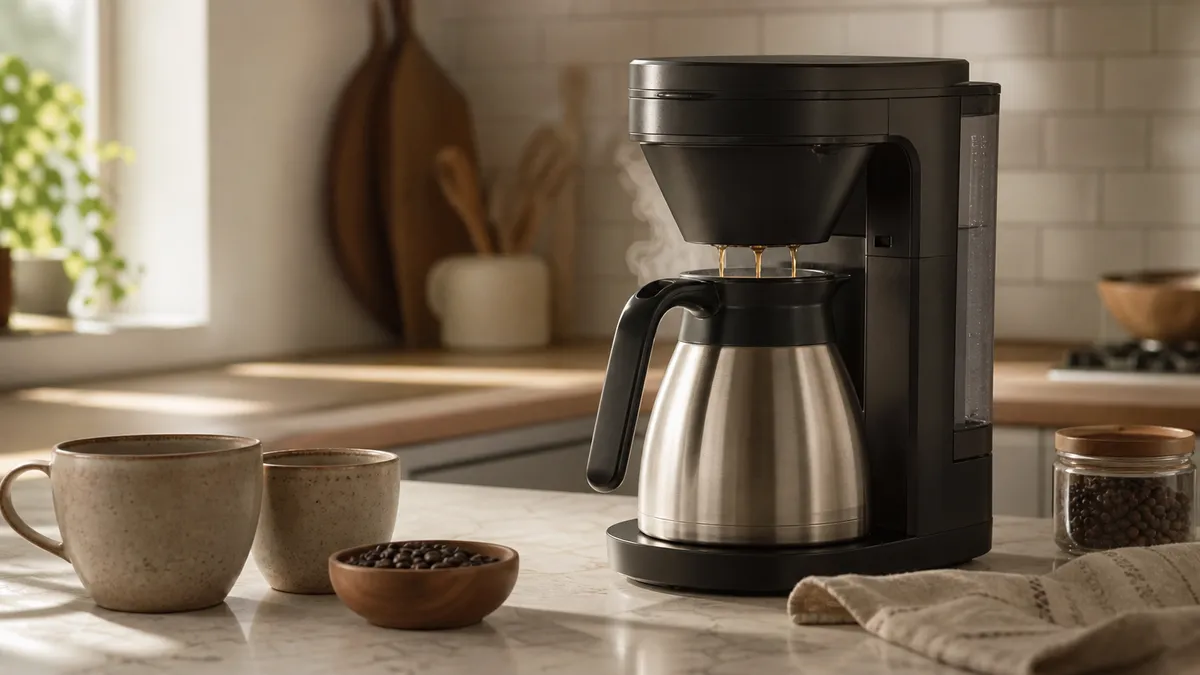
An electric drip machine automates pour-over brewing. Water leaves a reservoir, passes through a heater and reaches an outlet above ground coffee. It flows through the coffee and filter into the vessel below, without espresso’s pressurised extraction.
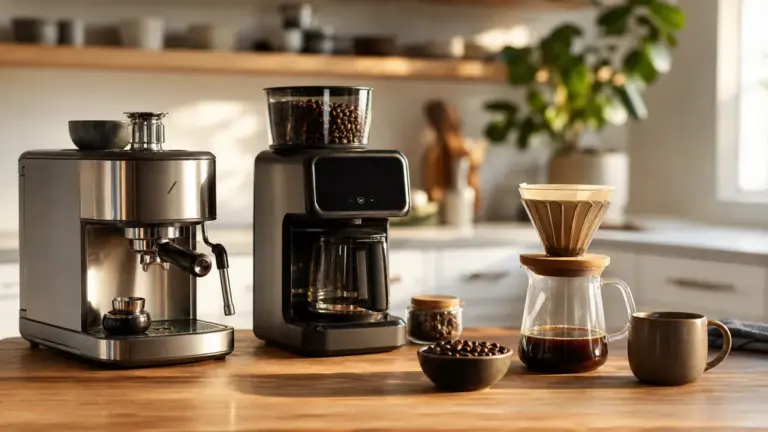
The machine controls water delivery; you usually control the coffee, grind and dose. Some models incorporate a grinder.
Filter suits people who want a shared batch of black coffee without preparing individual drinks. For other equipment categories, start with our coffee machines guide.
What determines the result?
Temperature, water distribution and the relationship between basket size and batch volume matter more than the number of buttons.
The outlet, often called a showerhead, should wet the coffee bed effectively. Extraction means dissolving material from the grounds into water; uneven wetting gives different parts of the bed different treatment.
A capable brewer still needs an appropriate dose, grind and unobstructed filter.
Brew temperature and time
Where temperature adjustment is available, 92 to 96°C is a useful starting point. This is brewing temperature where water meets coffee, not a recommended drinking temperature or hot-plate setting.
Heating time, contact time and final draining are different measurements. Follow the instructions for your batch rather than forcing every brew into one stopwatch target.
Older SCA requirements specified more than 4 minutes but less than 8 minutes of contact time at maximum capacity. As explained below, certification documents have changed: that historical rule is not a universal requirement for every current brewer.
Thermal Carafe Drip Makers
A thermal carafe retains heat through insulation rather than a hot plate. It suits staggered drinking or taking the jug to a breakfast table.
A glass jug on a hot plate receives continuing heat and makes the remaining quantity easy to see. It can suit households drinking together. A hot plate does not automatically mean poor brewing: SCA specifications include temperature-controlled holding.
Our preference is thermal for staggered serving, a practical recommendation rather than a claim that every insulated model tastes better.
Check whether the lid pours comfortably, the interior is accessible for cleaning and replacement jugs are available. Heat-retention claims describe temperature, not freshly brewed flavour throughout the stated period.
Preheat the carafe if instructed, empty the warming water before brewing and check dishwasher suitability.
Programmable Coffee Makers
“Programmable” can mean:
- Delayed start: brewing begins at a selected time.
- Custom brewing: temperature, flow or initial wetting can be adjusted.
- Batch selection: operation changes for smaller quantities.
- Maintenance settings: water hardness is recorded or descaling prompted.
A bloom is an initial wetting stage before the remaining brew water arrives.
Sage’s Luxe Brewer Thermal specifications include delayed start and adjustment of bloom volume, bloom time, temperature and flow. Melitta’s AromaFresh combines a timer with an integrated grinder and adjustable grind. These are manufacturer-described features, not independent performance findings.
Check timer behaviour: Sage’s manual says delayed start requires re-engagement for each use, while unplugging clears the clock. Decide whether you simply want scheduled coffee or want to experiment with brewing variables.
SCA Certified Brewers
The Specialty Coffee Association, or SCA, tests equipment against brewing and performance standards. Its current programme identifies the European Coffee Brewing Centre as its third-party testing centre.
Certification provides stronger evidence than an unsupported flavour claim, but applies to specific equipment and conditions, not an entire brand.
Why published requirements differ
The SCA’s publicly available 2017 Minimum Certification Requirements specified:
- Water reaching 92°C within the first minute, remaining at least that hot afterwards and never exceeding 96°C.
- Full-capacity contact time above 4 minutes and below 8 minutes.
- All grounds wetted within the first minute, plus an extraction-uniformity assessment.
- 1.15% to 1.45% TDS and 18% to 22% extraction yield.
TDS means total dissolved solids, a measure of beverage strength. Extraction yield is the proportion of dry coffee dissolved into the drink. The often-repeated 1.15% to 1.35% TDS range therefore does not match that 2017 certification document.
The publicly retrievable SCA Standard 310-2021 instead specifies slurry temperature of 90 to 96°C by 33% water delivery, maintained thereafter, and 1.15% to 1.55% TDS at its standard test ratio.
These are changes between versions, not figures to combine into one supposed current rule. Current certification standards require member access. Check the exact model’s certification evidence and relevant mode rather than relying on an undated badge.
Certification does not establish long-term reliability, convenient cleaning or your preferred flavour.
Best Home Drip Machines
Choose by normal batch size, serving routine and willingness to adjust settings. This shortlist uses those criteria rather than claiming an overall winner.
Manufacturer features checked in November 2026. These machines were not tested side by side for this article.
| Home requirement | Model to investigate | Published features | Main compromise |
|---|---|---|---|
| Straightforward shared batches | Moccamaster KBG Select | Glass jug, hot plate, full or half-pot selection | No insulated serving jug |
| Staggered drinking and experimentation | Sage Luxe Brewer Thermal | Thermal carafe, delayed start, custom controls | More settings to understand |
| Integrated grinding and scheduled brewing | Melitta AromaFresh | Ceramic grinder, adjustable grind, timer | Another mechanism to maintain |
Before ordering, check minimum batch size, lid-opening clearance, filter availability, cleaning instructions, replacement jugs and UK support for the exact model.
For home purchases, statutory consumer rights are separate from a manufacturer’s guarantee. GOV.UK says faulty or misdescribed goods can attract remedies without a warranty. Workplace purchases should not assume the same consumer protections.
Brands
Moccamaster offers relatively direct operation. Its KBG Select half-pot setting slows water delivery, according to the manufacturer.
Sage provides more programmable control in the Luxe Brewer Thermal, making it worth investigating for adjustable brewing.
Melitta offers integrated grinding in the AromaFresh. Confirm the variant: a family name alone does not establish the jug or programmes supplied.
Brand reputation cannot replace model evidence. Reliability needs more than a feature list; check spare parts for the exact machine.
Getting Good Coffee from a Drip Machine
Adapt this starting method to the manufacturer’s minimum batch and basket instructions.
- Measure fresh, cold water: begin with 1,000 g, approximately 1,000 ml, in a suitably sized machine.
- Weigh 55 g of coffee: the SCA standard test dose per kilogram of water, approximately 1:18.2 coffee to water by weight.
- Use the recommended filter grind: fit the correct filter and distribute grounds evenly without tamping.
- Prepare the carafe: preheat if instructed, discard that water and fit the brewing lid correctly.
- Select the normal or certified mode: where appropriate, start around 92 to 96°C. Record normal cycle time without confusing it with the historical contact-time criterion.
- Taste and change one variable: record dose, water and settings so improvements are repeatable.
Troubleshooting
| Symptom | Likely cause | First fix |
|---|---|---|
| Too strong or weak | Unsuitable coffee-to-water proportion | Weigh both and adjust the dose |
| Basket overflowing | Restricted flow or incorrect assembly | Check filter, outlet and grind guidance |
| Slower brewing or reduced temperature | Possible mineral build-up | Follow the descaling procedure |
| Coffee cools quickly | Cold vessel or lid problem | Preheat if instructed; check assembly |
Water and cleaning
Check your local supplier’s water information, not a supposed UK-wide hardness figure. Thames Water, for example, provides postcode-based reports.
Hardness may be reported in mg/L as calcium carbonate. Check what the figure measures before comparing it with coffee-water guidance: hardness and alkalinity are not interchangeable.
Cleaning coffee-contact parts and descaling the water circuit are separate tasks. Follow the manual for chemicals, rinsing and dishwasher suitability.
Advantages/Benefits & Disadvantages
Advantages
- Batch brewing: one preparation serves several people.
- Repeatable operation: the machine manages water delivery.
- Serving choice: insulated carafes and heated jugs suit different routines.
- Adjustability: dose, grind and sometimes brewing controls remain yours to change.
Disadvantages
- Batch limitations: a large brewer may not suit one mug.
- Preparation: most models still need measured grounds and water.
- Maintenance: baskets, filters, jugs and water circuits need attention.
- Drink limitations: filter brewing does not provide espresso shots or integrated milk steaming.
Compare pod or capsule machines if individual drinks matter more than shared batches. For hands-on espresso, manual lever machines serve a different purpose rather than being a direct upgrade.
FAQ
Can I use pre-ground coffee?
Yes, provided it is ground for filter brewing and suits your machine’s instructions. Espresso-ground coffee may restrict flow in a drip basket. Begin with a measured dose rather than a scoop estimate, then adjust the proportion or grind choice after tasting. An integrated grinder is convenient, but not essential to using a drip machine.
Can I put milk in the water reservoir?
No, use water in the reservoir and add milk separately to the finished coffee. The Sage manual used here explicitly prohibits other liquids in its water tank. If milk-based drinks are your main requirement, choose equipment designed to handle milk rather than adapting a drip brewer.
Can I pause brewing to pour a cup?
Only if the machine’s instructions permit it. A drip-stop valve can temporarily close the basket outlet when the jug is removed, but brewing water may continue entering the basket. Follow the permitted interruption time, if one is specified, and replace the jug promptly rather than treating drip-stop as an indefinite pause.
Where to go next
Read Coffee Machines to compare drip coffee makers and filter coffee machines with other equipment. Commercial Espresso Machines covers workplace espresso service, while Nespresso Original vs Vertuo helps readers considering individual capsule drinks instead of shared batches.
Sources
-
Specialty Coffee Association, Certified Home Equipment, current webpage, retrieved November 2026. Programme scope and third-party testing.
https://sca.coffee/certified-home-brewer -
Specialty Coffee Association, Minimum Certification Requirements for Coffee Brewers, 2017. Historical temperature, contact time, strength, extraction and wetting requirements.
https://sca.coffee/research/coffee-standards -
Specialty Coffee Association, Home Coffee Brewers: Specifications and Test Methods, SCA Standard 310-2021, publicly hosted copy. Brewer definition, test ratio, temperature, strength and holding specifications.
https://sca.coffee/research/coffee-standards -
Specialty Coffee Association, Standards, current webpage, retrieved November 2026. Current access arrangements for certification standards.
https://sca.coffee/research/coffee-standards -
Moccamaster, KBG Select Polished Silver, current product page, retrieved November 2026. Claimed jug, hot-plate and batch-selection features.
https://www.moccamaster.eu/kbg-select-polished-silver-53970 -
Sage, The Luxe Brewer Thermal, current UK product page, retrieved November 2026. Claimed thermal-carafe, timer and custom-brewing features.
https://www.sageappliances.com/en-gb/product/BDC465 -
Sage, The Luxe Brewer, instruction book, file revision B26, 2026. Preparation, delayed start, cleaning, descaling and troubleshooting.
https://assets.sageappliances.com/BDC465/SDC415_465_EU_UG8_B26_LR.pdf -
Melitta, AromaFresh, current UK product page, retrieved November 2026. Claimed grinder, timer and maintenance features.
https://www.melitta.co.uk/filter-coffee-machines/aromafresh -
Moccamaster, Brewing 101, current guidance, retrieved November 2026. Dosing, filter preparation and restricted filter flow.
https://us.moccamaster.com/pages/moccamaster-brewing-101 -
Moccamaster, Instructions for Use, Select and related brewers, undated. Carafe preparation and drip-stop precautions.
https://www.moccamaster.eu/pub/media/handleidingen/talen/Manual_SELECT.pdf -
Thames Water, Check Your Water Quality, current postcode tool, retrieved November 2026. Local water-information route.
https://www.thameswater.co.uk/help/water-and-waste-help/water-quality/check-your-water-quality -
GOV.UK, Accepting Returns and Giving Refunds: The Law, current guidance, retrieved November 2026. Faulty goods and the distinction between guarantees and statutory rights.
https://www.gov.uk/accepting-returns-and-giving-refunds
This guide was researched from SCA documents, manufacturer specifications and instructions, official consumer guidance and a water-supplier information tool; recommendations are specification-based, not first-hand test results.
Last checked: November 2026