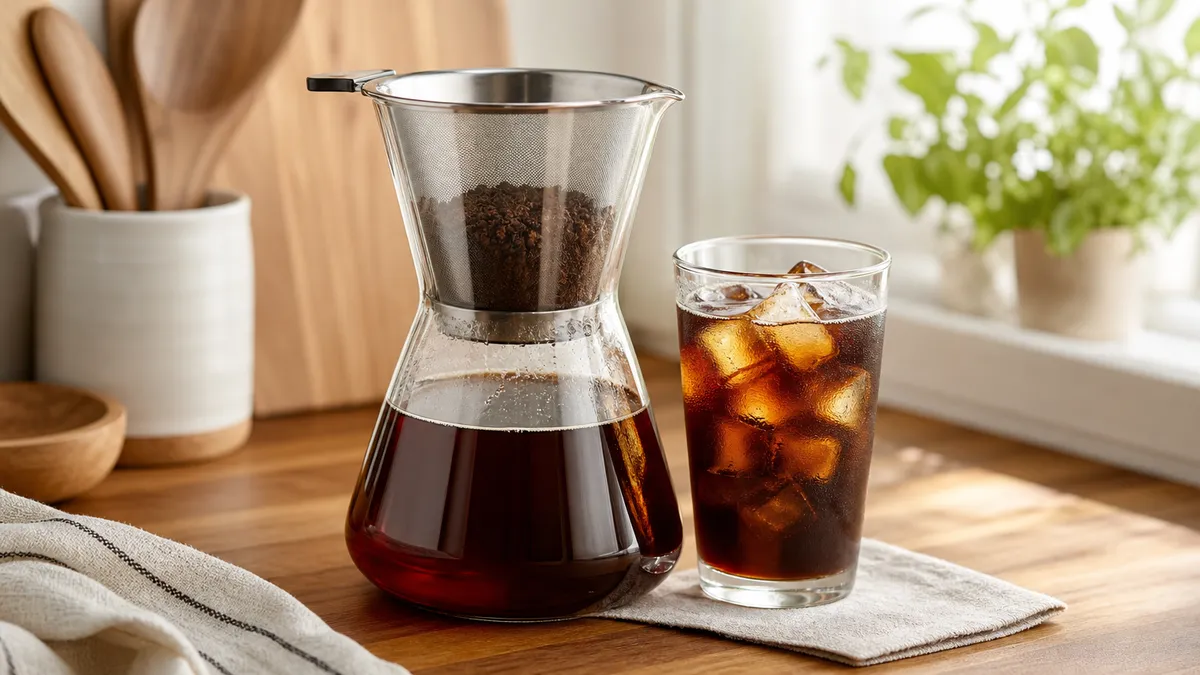
For most homes, the best cold brew coffee maker is a lidded jar or jug with a removable filter that fits comfortably in the fridge. Choose a draining concentrate brewer if you want a stronger base to dilute, or a tower drip device if controlling the brewing process matters more than simplicity.
In short
- Check finished coffee yield, not just the container’s capacity: grounds retain water.
- Decide whether you want ready-to-drink coffee or concentrate before choosing the filter size.
- Concentrate recipes commonly use coffee-to-water ratios of 1:4 to 1:8 by weight; 1:12 to 1:15 is useful starting territory for lighter, ready-to-drink recipes.
- Brewing times are equipment-specific. OXO specifies 12 to 24 hours at room temperature or 20 to 24 hours refrigerated for its Compact brewer.
- Prioritise a removable filter, accessible seals and a container you can clean thoroughly.
Which type of cold brew coffee maker should you choose?
Cold brew equipment falls into two main families: immersion, where coffee grounds soak in water, and slow drip, where water gradually passes through a bed of grounds.
The first decision is therefore about workflow, not brand. Do you want to fill a container and leave it in the fridge, or adjust a drip device on the worktop? For the wider equipment picture, start with our coffee machine guide.
The comparison below uses brewing method, handling, cleaning and intended use as its criteria.
| Maker type | How it works | Main limitation | Best suited to |
|---|---|---|---|
| Jar with separate filtration | Grounds steep freely, then the liquid is strained | Transferring and filtering require extra handling | Trying cold brew before choosing dedicated equipment |
| Jug with filter basket | Grounds sit inside a removable basket | Basket capacity can restrict stronger recipes | Straightforward refrigerated brewing |
| Draining immersion brewer | Coffee steeps above a filter, then drains into a separate vessel | Seals, outlets and filters need attention | Making concentrate for dilution |
| Tower drip device | An adjustable outlet feeds water through the grounds | More components and a less hands-off workflow | Readers who enjoy controlling the process |
Jar and filter makers
A suitable food-safe jar, lid and separate filter are enough to make immersion cold brew. A dedicated maker earns its place by making separation, pouring or cleaning easier, rather than by making cold extraction possible.
Basket-style jugs keep the grounds contained, so you can lift out the filter when brewing finishes. Before buying, check whether the basket opens at both ends or has a removable base. A narrow filter that traps grounds in an inaccessible corner is an inconvenience repeated after every batch.
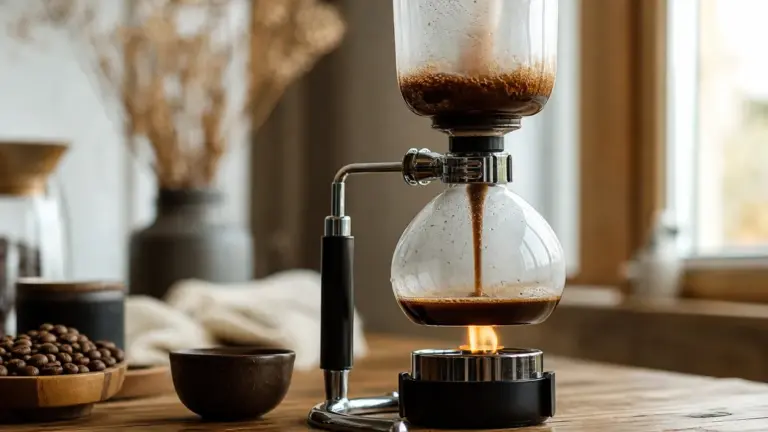
Tower drip devices
A tower separates the water reservoir, coffee chamber and receiving vessel. Hario’s Water Dripper Clear, for example, uses an adjustable spout and a stainless steel filter.
Choose this style because you want to manage slow percolation, meaning water moving through the coffee bed. Do not assume that an elaborate tower automatically produces better coffee than an immersion jug. Our pour-over brewer guide provides useful background on a different form of percolation, without treating the methods as interchangeable.
Capacity: measure the coffee you will actually drink
“Capacity” may mean water input, total container volume or finished beverage. These are not equivalent.
OXO’s Compact instructions specify 175 g of coffee and 700 ml of water, with a lower concentrate yield after draining. Hario, by contrast, describes the Mizudashi’s 600 ml and 1,000 ml figures as brewed volume. Read the definition beside the number.
Work backwards from your household’s consumption:
- Choose your normal serving volume.
- Multiply it by the number of servings required.
- For concentrate, calculate the concentrate needed separately from dilution water.
- Check the manufacturer’s recipe, expected yield and maximum coffee dose.
- Measure the assembled brewer against your fridge shelf, including clearance to lift it out.
As an illustrative planning assumption, two people drinking 250 ml each per day need 1,000 ml over two days. That is finished drinking volume, not necessarily the required brewing-container capacity.
Also check whether the lid is designed to prevent leaks or merely cover the opening. Do not assume a pouring jug can be stored on its side.
Filters: choose for handling as well as clarity
Filter material matters, but so does access for cleaning.
Reusable mesh avoids a disposable paper filter at each brew. Mesh is not always metal: Hario specifies polyester resin mesh for the Mizudashi, while OXO describes stainless steel mesh in its Compact brewer.
Paper filters add a disposable component and can simplify removing the grounds. Toddy’s Home system offers a paper-bag method alongside its reusable felt filter.
Felt filters have their own maintenance routine. Toddy instructs users to rinse its felt filter without soap and freeze it damp in a resealable bag between uses. That is a product-specific instruction, not a rule for every reusable filter.
If the drink feels gritty, filtration deserves attention before you extend the steep. Fine particles passing through the filter are not necessarily a sign that the coffee needs more brewing time.
For readers also comparing small manual brewers, our aeropress guide covers that separate equipment choice.
Brands
The following are examples selected for their different brewing arrangements and published instructions, not a ranking based on hands-on testing. Specifications are manufacturer claims, checked in November 2026; confirm the exact version before ordering.
Hario: removable-filter jugs and slow-drip equipment
The Mizudashi Cold Brew Coffee Pot is a direct example of the basket-in-jug approach. Hario lists brewed volumes of 600 ml and 1,000 ml, with a heatproof glass pot and polyester resin filter mesh. Its product guidance specifies approximately eight hours refrigerated.
This is my preferred starting format for someone who values straightforward preparation and serving. The limitation to investigate is basket capacity, particularly if you intend to make concentrate.
Hario also makes the Water Dripper Clear. Its published height is 455 mm, illustrating why tower buyers should measure the space beneath kitchen cupboards rather than considering footprint alone.
OXO: compact concentrate brewing
The OXO Brew Compact Cold Brew Coffee Maker combines an immersion container, removable mesh filter and separate glass carafe. Placing the brewer on the carafe starts drainage automatically.
Its appeal is controlled transfer without pouring the whole slurry, meaning the mixture of water and grounds, through another filter. The trade-off is additional assembly: the manual requires correct gasket placement and alignment to prevent leaks.
Toddy: larger-batch concentrate
The Toddy Cold Brew System, Home Model uses a separate brewing container and decanter. Its published paper-filter recipe takes 340 g of coffee and 1.9 litres of water.
Consider it if concentrate is your intended routine and you have room for the components. Its reusable felt filter requires more specific care than simply rinsing a mesh basket.
For any brand, check UK access to replacement filters, seals and glass vessels before committing.
Advantages/Benefits & Disadvantages
The main advantage of an immersion maker is low active effort: preparation and filtration surround a long unattended steep. A removable basket or draining outlet can also make separating the grounds more convenient than using an ordinary jar.
Concentrate provides flexibility because you dilute individual servings. A plain black batch can remain separate from milk until each drink is prepared.
The disadvantages are planning and cleaning. These are not on-demand brewers, and a large batch occupies fridge space while brewing or awaiting use. Draining systems add seals and outlets; towers add separate chambers and a drip-control mechanism.
My recommendation is to choose the simplest design that solves a real inconvenience. For most beginners, that means an accessible filter and comfortable pouring, not a more elaborate brewing mechanism.
Ratios and steeping: match the recipe to the maker
Ratios here mean dry coffee to brewing water by weight, not coffee to finished drink.
Published recipes differ. Kaldi’s describes concentrate ratios of 1:4 to 1:8, while Counter Culture uses 1:8 before dilution. Ready-to-drink examples include Holybean’s 1:12 and Fables’ approximately 1:15.
These are recipe choices, not strict boundaries. At 1:4, 100 g of coffee takes 400 g of water; at 1:15, it takes 1,500 g. A filter basket must accommodate the dose while allowing the grounds to become properly wet.
Dilution is a separate ratio. For example, 60 ml of concentrate plus 120 ml of water produces 180 ml of drink at one part concentrate to two parts water by volume.
Room temperature or fridge?
Follow the instructions for your equipment rather than applying one universal overnight steep. OXO specifies 12 to 24 hours on the counter or 20 to 24 hours in the fridge, whereas Hario’s Mizudashi guidance specifies approximately eight refrigerated hours.
For a home routine, I favour refrigerated immersion because it combines brewing and chilled storage. Do not assume a manufacturer’s room-temperature recipe authorises leaving the finished drink unrefrigerated.
A first batch to check your maker
This is a commissioning method for a removable-basket immersion maker, not a replacement for its manual.
- Wash and assemble it according to the manufacturer’s instructions.
- Check recipe compatibility. If its dose and water limits permit, try 50 g coffee with 600 g cold drinking water, approximately 600 ml, for a 1:12 starting ratio.
- Use the specified grind and wet all the grounds. Do not overfill or tightly pack the basket.
- Cover and refrigerate, keeping the fridge between 0 and 5 degrees Celsius.
- Use the maker’s refrigerated steeping time, then remove the basket and allow it to drain.
- Record the finished yield and taste. Change one variable at a time on the next batch.
Cleaning and chilled storage
Empty the grounds after brewing and dismantle the parts the manual identifies as removable. Clean the vessel, lid and accessible seals; do not treat a quick rinse as a substitute for the specified washing routine.
Dishwasher permissions vary by component. OXO permits its Compact glass carafe in the dishwasher but instructs users to hand-wash the cork lid and other parts.
| Symptom | Likely cause | Fix |
|---|---|---|
| Gritty coffee | Fine particles passing through the filter | Check filter condition and use the specified grind |
| Weak, thin drink | Excessive dilution or incompletely wetted grounds | Check the recipe and saturation before extending time |
| Slow drainage | Fine grounds clogging the filter | Clean it and follow the maker’s grind guidance |
| Leaking base | Misplaced seal or incorrect assembly | Empty safely, inspect and reassemble as instructed |
How long does homemade cold brew keep?
Do not treat seven to ten days as a universally verified shelf life. OXO claims up to 14 refrigerated days for its concentrate, while Peoria’s public-health guidance uses a seven-day limit for specified refrigerated retail preparation.
The evidence differs in scope. An industry-funded laboratory challenge study summarised by the National Coffee Association found no pathogen growth under its tested conditions, but explicitly limits those findings to the products and processes examined.
For home planning, I recommend small batches for the next two days, stored black in a clean, covered container. This is a cautious editorial approach informed by the Food Standards Agency’s general leftovers guidance, not a cold-brew-specific validated expiry.
Add milk when serving rather than assigning the mixed drink the black coffee’s claimed storage period. Follow the milk’s storage and use-by instructions.
FAQ
Do I need a dedicated cold brew maker?
No, a suitable lidded food-safe vessel and a way to filter the grounds can work. A dedicated maker is useful when its basket, drainage arrangement or pouring lid improves your routine. Try the basic process first, then identify which handling step you actually want better equipment to solve.
Can I use ordinary pre-ground coffee?
Yes, provided its grind suits your maker’s instructions. Do not assume every brewer needs identical grounds: filter construction and drainage arrangements differ. Toddy specifically recommends coarse grinding to reduce clogging. If your coffee drains poorly or leaves grit, check grind compatibility before deciding that the brewer itself is unsuitable.
Should I choose a jug or a tower as my first cold brew maker?
Choose a jug unless you specifically want to manage slow drip. That is a workflow recommendation, not a claim that immersion always tastes better. A covered immersion jug suits refrigerated preparation, while a tower makes the adjustable drip arrangement part of the brewing experience and requires suitable worktop clearance.
Where to go next
Read Coffee Machines for the broader equipment map, then Pour-Over Brewers: V60, Chemex, Kalita Wave and Melitta Cone if you want to investigate manual percolation. Aeropress and Moka Pots are useful next reads when comparing other home brewing routines; our moka pot guide covers the latter before you decide whether cold brew coffee makers should be your next purchase.
Sources
-
Hario Europe, Mizudashi Cold Brew Coffee Pot, undated product specification and brewing guidance.
https://www.hario-europe.com/collections/coffee/products/hario-cold-brew-coffee-pot-glass-mizudashi-chocolate-brown -
Hario Europe, Water Dripper Clear, undated product specification.
https://www.hario-europe.com/products/hario-water-dripper-clear -
OXO, Compact Cold Brew Coffee Maker: Instruction Manual, undated.
https://www.oxo.com/media/wysiwyg/BL_Brew_11237500_Compact_Cold_Brew_Instruction_Booklet_M_H.pdf -
OXO, How to Use the OXO Compact Cold Brew Coffee Maker, 2022.
https://www.oxo.com/blog/coffee-and-beverages/how-to-make-cold-brew-coffee
OXO, Compact Cold Brew Coffee Maker, undated product specification.
https://www.oxo.com/shop/coffee-beverage/coffee-tea/coffee-makers-grinders/compact-cold-brew.html -
Toddy, Cold Brew System Brewing Guide, 2022.
https://toddycafe.com/cold-brew/instruction-manual -
Kaldi’s Coffee, 5 Things to Know About Cold Brew Coffee, updated 2023.
https://kaldiscoffee.com/blogs/news/5-things-you-should-know-about-cold-brew -
Counter Culture Coffee, Guide To Cold Brew, undated.
https://counterculturecoffee.com/blogs/counter-culture-coffee/guide-to-cold-brew -
Holybean, Cold Brew, undated brewing guide.
https://holybean.dk/en/brew-guide/cold-brew-2/
Fables Specialty Coffee, Cold Brew, undated recipe.
https://fablescoffee.com/pages/cold-brew -
Food Standards Agency, How to chill, freeze and defrost food safely, 2017, GOV.UK guidance applying to England, Northern Ireland and Wales.
https://www.gov.uk/government/publications/how-to-chill-freeze-and-defrost-food-safely/how-to-chill-freeze-and-defrost-food-safely -
Peoria City/County Health Department, Cold Brew Coffee Safety, September 2022. US retail guidance, not UK domestic law.
https://www.pcchd.org/DocumentCenter/View/2439/Cold-Brew-Coffee-Safety-HACCP-2022 -
National Coffee Association, Cold Brew Challenge Study, undated public summary of industry-funded Eurofins laboratory research.
https://www.ncausa.org/Industry-Resources/Cold-Brew-Resources/Cold-Brew-White-Paper
Research used manufacturer specifications and manuals, published roaster recipes and food-safety guidance; no first-hand equipment testing was undertaken.
Last checked: November 2026