The right coffee machine for your home is the one that makes your favourite drinks with a routine you will actually enjoy. Start with what you drink, then choose how much preparation, milk handling and cleaning you want to do before comparing individual machines.
In short
- For mugs of black coffee or several servings together, start by considering a filter machine.
- For espresso and steamed-milk drinks, compare a hands-on espresso setup with a bean-to-cup machine.
- For capsules, choose the coffee system before the appliance: drink sizes and compatibility differ.
- Treat the grinder, milk equipment, water treatment and cleaning supplies as part of the complete setup.
- Read the manual and UK warranty terms before ordering, and measure access space as well as the machine itself.
Choose coffee machines by what you drink
Write down the drinks your household makes most often, including their approximate size. “Coffee every morning” is less useful than “a large black mug each, followed by a cappuccino at the weekend”.
Mostly black coffee
If you enjoy a pot of black coffee shared over breakfast, put an automatic filter machine on your shortlist. It passes hot water through ground coffee held in a filter, collecting the drink in a jug.
An Americano takes a different route: espresso diluted with hot water. Do not assume that a machine’s “long coffee” setting makes filter coffee, or that a larger drink button reproduces the flavour you already like. Ask how the drink is prepared and, where possible, taste it.
Mostly espresso, cappuccino or flat white
Consider either a portafilter espresso machine or a bean-to-cup machine. A portafilter is the handled holder containing the coffee basket: with a hands-on machine, you prepare and fit it yourself.
Choose the hands-on route if adjusting coffee and learning milk technique appeal to you. Start with bean-to-cup if you would rather select a drink than prepare each coffee puck. Our guide to bean-to-cup machines explains that option in more detail.
Mostly quick individual drinks
Capsules deserve consideration when portioned coffee and a straightforward preparation routine matter most. Check the system carefully: Nespresso’s own comparison, for example, distinguishes Original’s espresso-focused range from Vertuo’s broader serving sizes and different brewing technology.
Taste the specific drinks you expect to buy. A familiar drink name on the packaging is not enough to establish that you will enjoy the result.
Compare machine types against your routine
The criteria below are drink style, preparation involvement, grinder requirements and the main compromise. These are starting points for choosing a category, not performance rankings or recommendations of particular models.
| Machine type | Best starting point for | Coffee and grinder needs | Main compromise |
|---|---|---|---|
| Automatic filter | Black coffee and shared jugs | Suitable ground coffee, or beans and a separate grinder | Does not prepare espresso or steam milk |
| Portafilter espresso | Espresso and hands-on milk drinks | Espresso-suitable grounds; a capable grinder for fresh-bean adjustment | You prepare the coffee and clean the basket |
| Bean-to-cup | Fresh-bean drinks with automated preparation | Integrated grinder; check any pre-ground option | Automation still involves cleaning and emptying |
| Capsule | Portioned individual drinks | Compatible capsules; no separate grinder | Coffee choice depends on the capsule system |
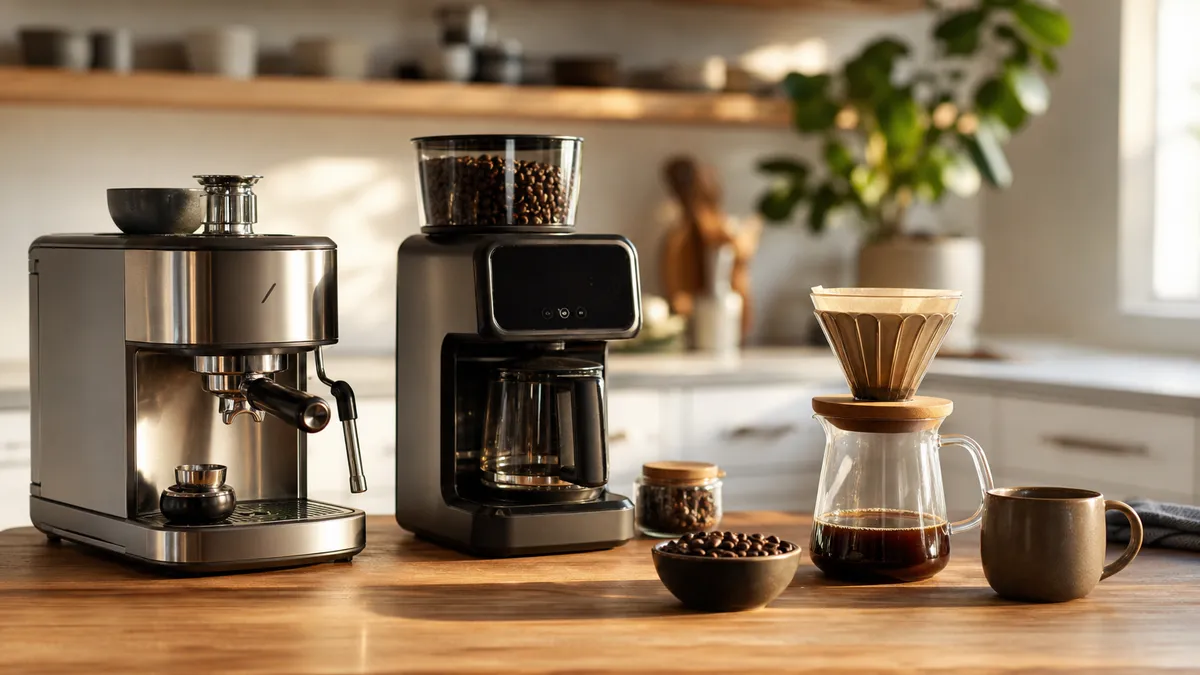
A pour-over dripper or cafetière also makes a useful comparison before committing to an electrical appliance. If you already enjoy that style of coffee, ask what you want a machine to improve: unattended brewing, a shared batch or a different drink altogether.
For a fuller explanation of the categories, read machine types explained. Keep this buying decision focused on your own routine rather than collecting features.
Choose the complete setup, not just the appliance
Instead of treating entry, middle and premium tiers as quality grades, compare what each complete setup lets you do.
- A focused setup: choose equipment for your main drink, without adding milk systems or controls you do not expect to use.
- A learning setup: prioritise accessible adjustments, a suitable grinder and a workflow you want to practise.
- An automated setup: assess drink preparation and cleaning together, rather than judging convenience by the drink button alone.
To work out the full commitment, list the machine, grinder where needed, milk equipment, scales, filters, cleaning products and replacement water cartridges. Add coffee consumption, milk use, electricity and any servicing requirements over the same ownership period for each candidate.
Request itemised written quotations for packages, servicing or extended cover. Check what is included, the VAT basis and whether ongoing supplies must come from a particular supplier. Compare equivalent packages rather than a bare machine against a complete bundle.
Decide what you need from a grinder
For a hands-on fresh-bean espresso setup, treat the grinder as part of the purchase. You need adjustment that suits espresso, not simply a product labelled “coffee grinder”.
Grinding changes the resistance water encounters as it passes through the coffee. Sage’s espresso guidance links an excessively fine grind with restricted flow, and an excessively coarse grind with rapid extraction. Adjustment therefore has a practical job, rather than being an enthusiast’s extra.
Ask these questions:
- Is the grinder intended for espresso, filter brewing or both?
- Can you make small, repeatable adjustments?
- Can you clean it without an awkward dismantling routine?
- If you alternate regular and decaffeinated coffee, how will you change between them?
Do not assume every burr grinder covers every method. Moccamaster, for example, describes its KM5 as less suitable for fine espresso grinding.
Pre-ground coffee remains an option where the machine and basket permit it. Check the instructions before buying: basket requirements differ, and the convenience of pre-ground coffee should be assessed against the adjustment you want.
Choose the milk routine you can live with
Compare milk texture, preparation and washing up as separate requirements.
A steam wand gives you direct involvement in texturing milk. Some machines also offer automatic wand operation: Sage’s Bambino Plus manual, for example, describes both automatic and manual milk texturing. “Automatic milk” therefore does not always mean an attached milk container.
An automatic carafe or tube system is worth investigating if dispensing milk into the cup is your priority. Read its disassembly instructions before deciding that it is convenient. De’Longhi’s Rivelia manual separates the after-use cleaning function from thorough cleaning of the milk carafe.
A standalone frother is another arrangement to consider, particularly if you want to keep milk preparation separate from coffee brewing. Ask to see its finished texture rather than assuming it will match a steam wand.
If you use a plant-based drink, seek a demonstration with that product. De’Longhi notes that frothing results vary with the type, brand and ingredients of the milk or alternative. If someone has a milk allergy, do not assume a rinse programme establishes adequate allergen removal: ask for specific guidance before sharing milk equipment.
Check space, water and cleaning before ordering
Measure the working space
Measure width, depth and height in centimetres, then check how you will:
- refill or remove the water tank;
- open the bean hopper beneath a cupboard;
- remove the drip tray and grounds container;
- move a steam wand and position a jug;
- fit your usual cup beneath the outlet.
Use the manufacturer’s published dimensions as the starting point, not the complete installation requirement. Read any ventilation and placement instructions. A cardboard footprint on the worktop is a useful way to test whether the proposed position still leaves preparation space.
Check your local water
Look up your own water supplier’s hardness information rather than using a national average. Thames Water, for example, provides postcode-based water-quality information and explains the relationship between minerals, hardness and limescale.
When comparing the report with machine instructions, match the units. “mg/L as calcium carbonate” expresses hardness on a calcium-carbonate-equivalent basis; do not substitute a calcium-only result.
Use the machine’s hardness test where supplied, and follow its instructions for filters and descaling. Ask the manufacturer if your water treatment arrangement is not covered by the manual.
Read the cleaning instructions first
Cleaning is part of choosing the machine, not a problem to solve afterwards. Find the instructions for the coffee path, milk equipment, drip tray, grounds container and descaling.
Do not treat a rinse as a substitute for every other maintenance task. The Rivelia manual, for example, has separate procedures for milk-carafe cleaning, infuser cleaning and descaling. Sage instructs Bambino Plus users to wipe the steam wand after milk texturing and allow it to purge.
For a filter machine, check jug and filter-holder care too. Moccamaster explicitly advises against putting its removable parts in a dishwasher. Never generalise one manufacturer’s cleaning method to another appliance.
Look beyond the feature list
For filter machines, check the exact model against the Specialty Coffee Association’s certified home equipment list. SCA certification involves third-party testing against brewing and performance requirements. It is useful evidence about brewing performance, but not a substitute for checking access, cleaning or warranty support.
For espresso machines, ask what a specification changes in use. Can you adjust the coffee preparation? What happens when you make several milk drinks consecutively? Does a claimed rapid start include the preparation you need for your drink?
Treat published specifications as manufacturer claims, not independent proof of reliability. Request the manual for the exact UK model and check that any demonstration uses the same version.
Understand UK warranties and consumer rights
For a household purchase from a trader, the Consumer Rights Act 2015 requires goods to be of satisfactory quality, fit for purpose and as described. Your statutory rights are against the retailer; a manufacturer’s warranty is additional protection, not a replacement.
There is normally a 30-day short-term right to reject faulty goods. After that, repair or replacement is generally the next remedy. For faults appearing within six months, the law generally presumes the fault existed at delivery unless the trader establishes otherwise.
Online purchases generally have a separate change-of-mind cancellation period: notify the retailer within 14 days of receiving the goods, then return them within a further 14 days. Exceptions and permitted deductions can apply, so do not assume you can extensively brew-test a machine and return it unchanged.
Read the UK warranty terms for registration, domestic-use restrictions, maintenance requirements and the repair process. Keep proof of purchase and report faults promptly. A warranty’s expiry does not automatically end statutory rights.
Follow this decision path and build your shortlist
- Name your main drink. Begin with filter for shared black coffee, or investigate espresso equipment for espresso-based drinks.
- Choose your involvement. Decide whether preparing coffee is an enjoyable activity or something you want automated.
- Choose the milk arrangement. Include cleaning and storage, not just dispensing.
- Check the complete setup. Include the grinder, accessories, water requirements and ongoing supplies.
- Eliminate poor practical fits. Reject machines whose access, cleaning or support arrangements do not suit your home.
- Compare the remaining candidates. Use the same drink and routine in each demonstration.
Before ordering, ask the retailer:
- Can it prepare my usual drink in my actual cup?
- What must I do before and after each session?
- What equipment and consumables are not included?
- How do I switch coffee, including decaffeinated coffee?
- Which parts are user-cleanable or replaceable?
- Who handles a fault, and what happens during repair?
The best shortlist is one in which every remaining coffee machine suits your drinks and household. Appearance and extra programmes can then settle the choice, rather than conceal a poor practical match.
FAQ
Can a filter machine make espresso?
No, a filter machine does not make espresso. It brews coffee through a filter into a jug rather than following a portafilter espresso process. If your main aim is cappuccino or flat white, investigate espresso-capable equipment and milk preparation. Choose filter because you enjoy its coffee, not as a route to espresso.
Should I choose a built-in grinder or separate equipment?
Choose according to how you want to operate and maintain the setup. An integrated grinder keeps grinding within the appliance, while separate equipment lets you select the brewer and grinder independently. Before deciding, compare adjustment, cleaning access and the repair arrangements for each component. Neither layout establishes the quality of the finished drink by itself.
Is an app necessary for a good coffee machine?
No, an app need not be a buying requirement. Decide which tasks you want it to perform, then check whether the machine also provides the controls you need on the appliance. Ask what happens without an account, a phone or an internet connection. Treat connectivity as a useful feature only when it solves a problem you actually have.
Where to go next
Start with Coffee Machines to explore the equipment category, then read Types of Coffee Machine Explained if you are still choosing a brewing system. If automated fresh-bean preparation suits your routine, Bean-to-Cup Coffee Machines is the next useful read.
Sources
-
Specialty Coffee Association, SCA Certified Home Equipment, live certification list, checked November 2026.
https://sca.coffee/certified-home-brewer -
Sage Appliances, The Barista Express, BES875/SES875: Quick Guide, document code SES875_EU_UG6_D21_FA_LR, publication year not stated.
https://assets.sageappliances.com/BES875/SES875_EU_UG6_D21_FA_LR.pdf -
Sage Appliances, The Bambino Plus, SES500: Quick Guide, publication year not stated.
-
De’Longhi, Rivelia EXAM44X.5Y / FEB4455: Instructions for Use, document EN-57132C8735, publication year not stated.
https://www.delonghi.com/medias/EXAM44055B-287353 -
Moccamaster, Frequently Asked Questions, live manufacturer guidance, checked November 2026.
https://www.moccamaster.eu/faq -
Nespresso UK, Choose Your Nespresso System, live manufacturer comparison, checked November 2026.
https://www.nespresso.com/uk/en/choose-your-nespresso-system -
Thames Water, Water Quality and Hard Water, live supplier guidance, checked November 2026.
https://www.thameswater.co.uk/help/water-and-waste-help/water-quality
https://www.thameswater.co.uk/help/water-and-waste-help/water-quality/hard-water -
Department for Business, Innovation & Skills, Consumer Rights Act 2015, 2015 guidance.
https://www.gov.uk/government/publications/consumer-rights-act-2015/consumer-rights-act-2015 -
GOV.UK, Accepting Returns and Giving Refunds: The Law, live guidance, checked November 2026.
https://www.gov.uk/accepting-returns-and-giving-refunds
This guide was researched using manufacturer manuals, the SCA certification register, water-supplier information and official UK consumer-rights guidance; no first-hand machine testing is claimed.
Last checked: November 2026