The AeroPress is worth buying if you want a compact, hands-on brewer for one person’s coffee, with control over strength, brewing time and filtration. It steeps ground coffee in water, then uses a hand-operated plunger to push the drink through a filter. Choose it for flexibility and portability, not automatic brewing, large batches or true espresso.
In short
- Choose by capacity, material, packing arrangement and accessory compatibility, rather than expecting a different material alone to improve flavour.
- The maker’s current range includes Original, Clear and Clear Colors, Original XL, Clear XL, Go, Go Plus, Premium, Steel and Premium Walnut.
- XL brewers have a claimed capacity of approximately 600 ml and require XL filters. Standard filters do not fit them.
- Paper filters suit a cleaner cup; reusable metal filters allow more oils through and give a fuller texture.
- Brew upright. AeroPress strongly discourages the inverted method because instability and hot-water spills can cause burns.
What is an AeroPress, and how does it work?
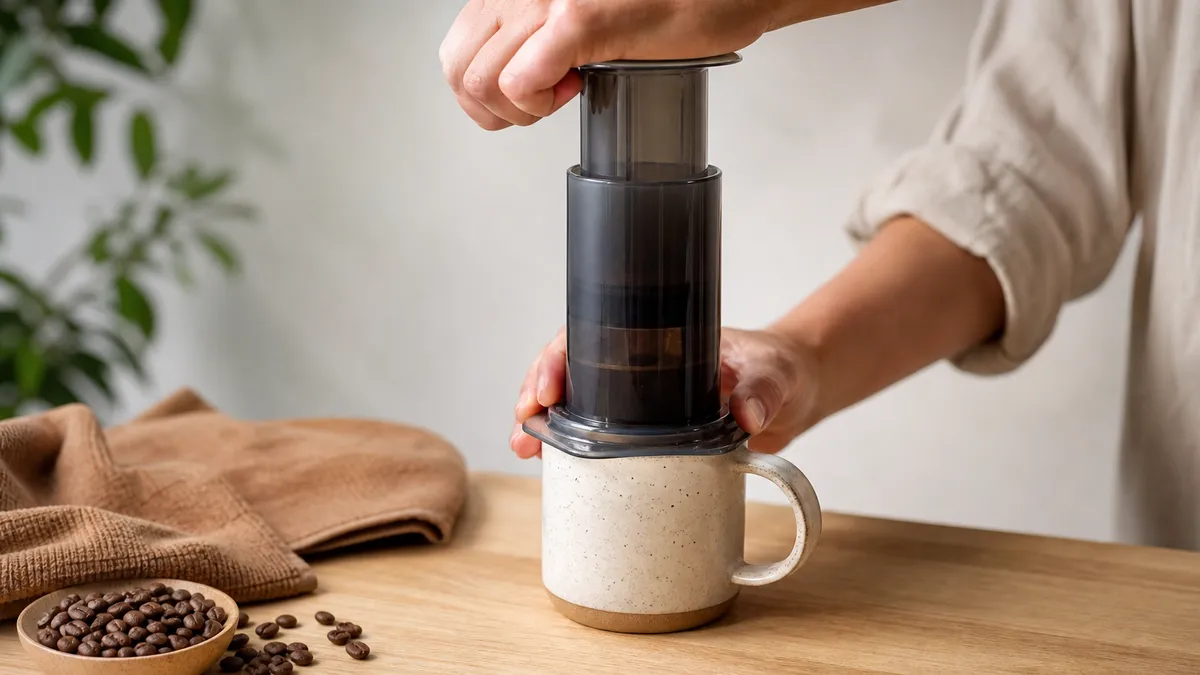
An AeroPress has a brewing chamber, a plunger with a silicone seal, and a removable filter cap. Ground coffee and water mix inside the chamber, a process called immersion brewing, before the plunger pushes the liquid through the filter into a mug or carafe.
That combination explains its appeal. Steeping gives you control over contact time, while filtration separates the drink from the grounds. You can change the coffee dose, water quantity, grind, temperature and steeping time without changing the brewer.
There is no heater, pump or milk steamer. You supply ground coffee, water heated separately and the effort needed to press. It belongs among manual brewers in our coffee machines guide, rather than among automatic office machines.
The resulting drink can be a normal-strength black coffee or a concentrate for dilution with water or milk. AeroPress describes some preparations as “espresso-style”, but the brewer is not a substitute for a conventional espresso machine. A valve attachment does not change that distinction.
Which AeroPress versions are currently sold?
The following range was listed on the manufacturer’s website when checked in November 2026. These are manufacturer-published specifications, not independently measured capacities; a global listing does not guarantee immediate UK stock.
The comparison uses four buying criteria: nominal capacity, principal materials, included travel equipment and practical limitations. Capacities are rounded metric equivalents of the maker’s stated figures, not guaranteed finished-drink volumes.
| Version | Nominal capacity | Principal materials and distinguishing feature | Best suited to |
|---|---|---|---|
| Original | About 300 ml | Polypropylene brewer | A straightforward starting point for home or work |
| Clear and Clear Colors | About 300 ml | Tritan copolyester, a transparent plastic | Seeing the brewing mixture and choosing a preferred finish |
| Original XL | About 600 ml | Polypropylene brewer with Tritan carafe | A larger serving or coffee to share |
| Clear XL | About 600 ml | Tritan brewer with carafe | XL capacity with a visible brewing chamber |
| Go | About 240 ml | Polypropylene brewer; packs into its supplied mug | Compact travel where a smaller brew is sufficient |
| Go Plus | About 300 ml | Tritan brewer; packs into an insulated stainless steel tumbler | Commuting and travel with integrated drinkware |
| Premium | About 300 ml | Borosilicate glass, stainless steel and aluminium, with silicone seal | Home use where glass-and-metal construction matters |
| Steel | 360 ml | Stainless steel components, silicone seal and vacuum-insulated chamber | Buyers wanting a metal brewer, including for travel |
| Premium Walnut | About 300 ml | Glass, metal and walnut components, with silicone seal | Home use where appearance and material finish are priorities |
Original is our default recommendation for someone who simply wants to try this brewing method. Choose Clear for visibility, Go for its compact packing arrangement, or an XL when serving size is the deciding factor.
Steel and Premium Walnut also appear in the current listings, so older comparisons covering only Original, Clear, Go and XL are incomplete. Steel’s vacuum-insulated chamber is a distinct construction feature; it should not be treated as proof of better-tasting coffee.
Premium needs a particular qualification. Although its principal structural materials are glass and metal, it retains a silicone plunger seal. AeroPress specifies hand-washing and does not recommend it for travel because the glass can break. Premium Walnut adds wood-care requirements and must not go in the dishwasher.
Capacity is not the same as servings
The maker’s “cups” are not necessarily your usual mug. Compare millilitres instead, and remember that coffee occupies chamber space and retains some brewing water.
Go Plus illustrates the distinction: its tumbler holds approximately 470 ml, but the brewer’s nominal capacity is approximately 300 ml. A larger receiving vessel does not make the chamber larger.
Brands
AeroPress makes the brewers, replacement components, paper and metal filters, and its own flow-control attachments. Fellow makes Prismo, an alternative valve-equipped filter cap. Able Brewing makes reusable Disk filters, including an XL version.
These accessories solve different problems. A metal filter changes filtration; a valve-equipped cap controls when liquid leaves the chamber. Neither is essential for getting started.
Paper and metal filters
Paper is the sensible first choice if you want a clean cup with little sediment. AeroPress sells white and natural paper filters, as well as reusable metal options.
Metal filters let more coffee oils through. Able describes its Standard Disk as giving fuller body with more fine particles, while its Fine version offers finer filtration. The finer disk is also thinner and needs more careful handling.
Filter size matters:
- Standard size: Original, Clear, Clear Colors, Go, Go Plus, Premium and Steel.
- XL size: Original XL and Clear XL.
Premium Walnut is supplied with paper filters, but check its exact compatibility listing before ordering an aftermarket cap or filter. Do not assume that an accessory advertised simply as “for AeroPress” fits every version.
If you enjoy a heavier texture, a metal filter may suit you. If sediment is what you are trying to avoid, start with paper.
Flow-control caps and Fellow Prismo
AeroPress’s standard Flow Control Filter Cap uses a pressure-operated valve to prevent drip-through before pressing. The maker lists compatibility with Original, Go, Clear, Premium, Steel and Go Plus, but not XL brewers.
The XL Variable Flow Control Cap is different. It uses an adjustable flow-restriction mechanism and fits Original XL and Clear XL only.
Fellow Prismo combines a pressure-actuated valve with a reusable metal filter. Fellow explicitly excludes Go, XL and AeroPress brewers manufactured from 2005 to 2009, and confirms compatibility with Clear. Seek confirmation for other versions rather than extrapolating from similar-looking dimensions. Fellow also specifies hand-washing.
Our advice is to start with the supplied cap and paper filters. Add an accessory when you can name the problem it will solve.
Using an AeroPress safely
Upright brewing means placing the chamber, with its filter cap secured, directly on a suitable receiving vessel. Some liquid passing through before pressing is normal with the standard cap.
The inverted method balances the brewer on its inserted plunger during steeping, then turns the hot assembly over before pressing. People use it to prevent early drainage and extend steeping, but AeroPress strongly discourages it because the arrangement is less stable and can spill hot liquid.
Use the upright method instead. A compatible flow-control cap provides another way to hold the brew without turning the brewer upside down.
A simple upright starting method
This is an editorial starting recipe, using the maker’s published temperature and dose guidance, rather than a universal AeroPress standard. It is intended for a standard-size brewer, not as a scaled recipe for every version.
- Put a correctly sized paper filter in the cap, secure the cap fully, and stand the chamber on a sturdy, compatible mug on a level surface.
- Add 16 g of medium-fine ground coffee.
- Add 200 g of water, approximately 200 ml, at 85°C. This is a coffee-to-water ratio of 1:12.5 by weight.
- Stir gently for approximately 3 seconds, then carefully insert the plunger to limit further drainage.
- Leave for 60 seconds, then press gently and steadily. Do not force a resistant plunger.
- Remove the brewer, allow hot components to cool before handling, eject the grounds and rinse.
This produces a relatively strong starting brew. Adjust dilution to taste, then change one brewing variable at a time rather than changing the dose, grind and steeping time together.
| Symptom | Likely cause | Fix |
|---|---|---|
| Plunger is difficult to move | Grind too fine, excessive fines or pressing too hard | Stop forcing it; use a coarser grind next time and press gently |
| Coffee drains before pressing | Normal flow through the standard cap | Follow the upright instructions; consider a compatible flow-control cap if necessary |
| More sediment than expected | Metal filtration or a misplaced paper filter | Try paper and check that it lies flat before securing the cap |
| Coffee leaks around the assembly | Incorrect assembly, damaged components or unsuitable vessel | Stop brewing, let it cool and inspect the parts and vessel |
Use a sturdy ceramic or metal receiving vessel rather than fragile glass. Fellow specifically warns against pressing Prismo over thin glass.
Travel and workplace use
Go and Go Plus address different packing needs. Go stores its brewer and accessories inside a polypropylene mug. Go Plus packs into a double-wall, vacuum-insulated stainless steel tumbler with built-in filter storage.
The Go Plus wording deserves care: AeroPress describes a magnetic splash-resistant lid and a built-in filter holder. Do not confuse the lid’s magnet with a claim that the filter compartment itself is magnetic, or interpret splash-resistant as leakproof.
For travel, check the whole kit rather than the brewer alone:
- How will you heat water?
- Will you carry pre-ground coffee or a grinder?
- Does everything pack securely after washing and drying?
- Where will you put wet grounds?
- Is there a stable place to brew and press?
For a personal office drink, a manual brewer can be a useful choice. For a shared tea point, remember that every batch requires someone to dose, fill, press and clean it. Our recommendation is not to choose AeroPress as the main brewer for a queue of colleagues.
Advantages/Benefits & Disadvantages
Advantages and benefits
Adjustable brewing: you can vary strength, steeping and filtration in the same device.
Compact options: Original keeps the equipment simple, while Go and Go Plus provide integrated packing systems.
Straightforward grounds removal: removing the cap lets you push out the spent coffee puck, then rinse the parts.
Choice of texture: paper and metal filters offer meaningfully different filtration, without requiring another brewer.
Disadvantages
It remains hands-on. Grinding, water heating, weighing and clean-up are separate tasks, even when the brewing itself is brief.
Capacity needs checking. The small chamber is attractive for personal use, less convenient when several people want coffee together.
It does not steam milk or reproduce machine espresso. If your priority is concentrated stovetop coffee, compare moka pots, while recognising that they are not espresso machines either.
Accessories are not universally compatible. XL has its own filter size, and aftermarket caps have model restrictions.
Materials affect care. Glass needs protection, Premium requires hand-washing, and walnut components need prompt drying and specific cleaning.
For most first-time buyers, our choice remains Original. Move to another AeroPress because its capacity, materials or packing system meets a specific need, not because the name sounds more advanced. If your main interest is brewing with cold water, compare cold brew coffee makers before choosing equipment.
FAQ
Can I use supermarket ground coffee?
Yes, supermarket ground coffee can be a practical starting point. AeroPress’s own instructions include a method using shop-bought medium-ground coffee. You do not need a grinder before trying the brewer, although ready-ground coffee limits your ability to adjust particle size if pressing resistance or the result in the cup needs changing.
Can I put every AeroPress in the dishwasher?
No, cleaning instructions differ by version. The manufacturer specifies hand-washing for Premium and no dishwasher cleaning for Premium Walnut, while Go is listed as top-rack dishwasher-safe. Follow the instructions for your exact brewer and each attachment separately. Fellow Prismo, for example, must be hand-washed even if the brewer itself permits dishwasher cleaning.
Do I need to buy a flow-control cap immediately?
No, the supplied cap is sufficient for the manufacturer’s upright brewing method. Early drip-through is part of that method, not automatically a fault. Consider a flow-control attachment if you specifically want to prevent drainage during steeping, but check compatibility first and do not expect the attachment to turn the brewer into an espresso machine.
Where to go next
Read Coffee Machines for the wider equipment decision and Moka Pots if concentrated stovetop coffee is your priority. Cold Brew Coffee Makers is the useful next read if you want to explore equipment intended for brewing with cold water.
Sources
Manufacturer pages are used for claimed specifications, compatibility and care instructions, not as independent evidence of superior flavour or reliability. Undated pages below were retrieved in November 2026.
-
AeroPress, “Compare AeroPress Coffee Makers”, undated, current listing. Materials, nominal capacities and principal supplied equipment.
https://aeropress.com/pages/compare-aeropress -
AeroPress, current XL, Go and Go Plus product pages, undated. Model-specific capacity, packing, materials and travel features.
https://aeropress.com/products/aeropress-coffee-maker-xl
https://aeropress.com/products/aeropress-coffee-maker-clear-xl
https://aeropress.com/products/aeropress-go-travel-coffee-press
https://aeropress.com/products/aeropress-go-plus -
AeroPress, Premium, Steel and Premium Walnut product pages, undated. Additional current models, construction and model-specific care.
https://aeropress.com/products/aeropress-coffee-maker-premium
https://aeropress.com/products/aeropress-coffee-maker-steel
https://aeropress.com/products/aeropress-coffee-maker-premium-walnut -
AeroPress, “Getting Started With The AeroPress Coffee Maker” and “FAQ”, undated. Operation, brewing guidance, inversion warning and troubleshooting.
https://aeropress.com/pages/how-to-use
https://aeropress.com/pages/faq -
AeroPress, standard paper and stainless steel filter product pages, undated. Filter choices, filtration and fit.
https://aeropress.com/products/aeropress-paper-micro-filters
https://aeropress.com/products/aeropress-stainless-steel-reusable-filter -
AeroPress, standard and XL flow-control cap product pages, undated. Mechanisms and compatibility.
https://aeropress.com/products/aeropress-flow-control-filter-cap
https://aeropress.com/products/aeropress-flow-control-filter-cap-xl -
Fellow, “Prismo AeroPress Attachment”, undated. Valve, supplied filter, compatibility exclusions, vessel warning and cleaning.
https://fellowproducts.com/products/prismo -
Able Brewing, “Disk: Reusable Filter for AeroPress”, undated. Standard, Fine and Fine XL filters, filtration differences and handling.
https://ablebrewing.com/products/disk-coffee-filter
This guide was researched from live manufacturer specifications, instructions and accessory listings; recommendations are editorial judgements, and no first-hand testing is claimed.
Last checked: November 2026