Decaffeinated coffee is real coffee from which most of the caffeine has been removed, usually before the beans are roasted. It is not caffeine-free: the US Food and Drug Administration gives a typical range of 2 to 15 mg in approximately 237 ml of decaf coffee, so “a little caffeine” is more accurate than “none”.
In short
- Decaf describes caffeine reduction, not a particular flavour, roast or brewing method.
- The familiar limits of 0.1% for roasted coffee and 0.3% for coffee extracts need their legal context: they are not one universal UK/EU rule.
- A percentage measured in dry coffee cannot be read directly as milligrams in a finished drink.
- Decaffeination can change flavour, but a process name alone does not tell you whether a coffee will taste good.
- If you need to avoid caffeine strictly, ask for product-specific information rather than relying on the word “decaf”.
What is decaffeinated coffee?
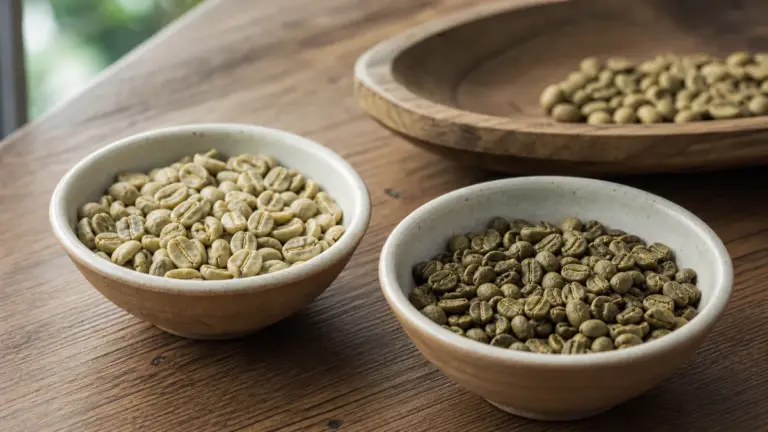
Decaf starts as coffee, not a substitute made from roasted grain or chicory. Most commercial decaffeination treats green coffee, meaning the unroasted beans, to extract caffeine before drying and roasting them.
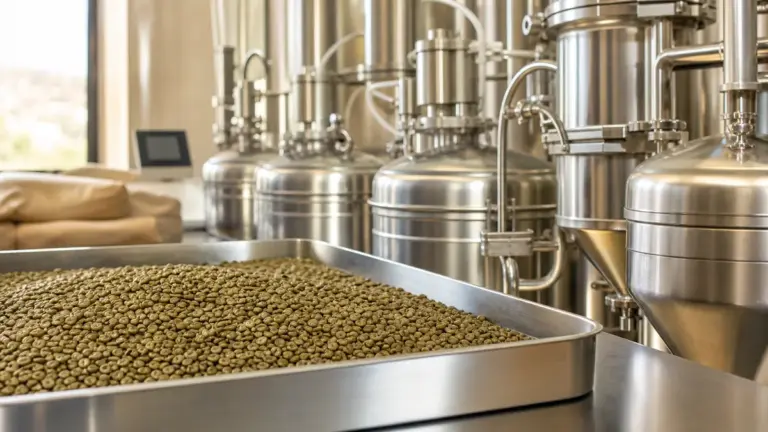
Broadly, processors use water-based systems, carbon dioxide or solvents such as ethyl acetate and dichloromethane. These methods share an awkward task: remove caffeine while retaining as much of the material responsible for coffee’s flavour as possible.
That is enough processing detail to understand the product. Our guide to how decaffeination works explains the individual methods, while caffeine and decaf puts decaf alongside the wider subject of caffeine.
The useful distinction is between decaffeinated and caffeine-free. Decaffeination greatly reduces caffeine; it does not promise its complete absence.
How much caffeine remains?
There is no dependable caffeine figure for every cup of decaf. The FDA’s typical range is 2 to 15 mg per approximately 237 ml, equivalent to its quoted US serving of 8 fluid ounces. Treat this as general guidance, not a measurement of your particular beans, instant coffee or espresso.
The frequently repeated “2 to 5 mg per cup” is therefore too narrow as a universal answer. Some products may fall within it, but neither the decaf label nor a particular processing method guarantees that range.
Serving size matters, as does the quantity of coffee used. A large drink made with several doses is not equivalent to a smaller drink made with one, even when both are decaffeinated.
What the UK, EU and other standards actually say
Two different measurements often become muddled: caffeine remaining in dry coffee and the proportion of the original caffeine removed.
| Product or reference | Threshold or description | What it actually means |
|---|---|---|
| Coffee extracts, including instant coffee, in England | No more than 0.30% residual anhydrous caffeine relative to coffee-based dry matter | Regulation 5 of the Coffee Extracts and Chicory Extracts (England) Regulations 2000 applies to extracts, not roasted beans |
| Coffee extracts in Wales, Scotland and Northern Ireland | Corresponding regulations specify the same 0.30% threshold | These are separate national instruments, not an extension of the English regulations |
| Coffee extracts under EU Directive 1999/4/EC | No more than 0.3% anhydrous caffeine relative to coffee-based dry matter | This harmonised rule concerns extracts, not an EU-wide roasted-bean definition |
| Decaffeinated roasted coffee in Germany | No more than 0.1% caffeine relative to coffee dry matter | This is an example of a national roasted-coffee rule |
| US National Coffee Association description | Decaffeination typically removes around 97% of the original caffeine | This is a trade-body description, not the same measurement as a dry-matter limit |
Legal and industry references checked in November 2026.
“Anhydrous” means without water. “Dry matter” means the coffee material after excluding its moisture, not the weight of the drink after brewing.
The distinction corrects a common attribution error: England’s 2000 extracts regulations do not establish a 0.1% limit for roasted or ground coffee. Nor should Germany’s national roasted-coffee limit be presented as though it came from the EU extracts directive. For UK roasted beans, ask the supplier which residual-caffeine specification its product meets.
Swiss Water separately advertises a manufacturer-guaranteed “99.9% caffeine-free” target. Do not automatically rewrite that as “99.9% of the original caffeine removed”: the wording does not establish the same calculation, and it is not a per-cup caffeine figure.
Does decaf taste different?
It can, but “decaf flavour” is not one fixed taste.
Laboratory research has found differences between regular and decaffeinated coffee in both volatile compounds, which contribute to aroma, and non-volatile compounds, which contribute to taste and other properties. A 2024 study examining different origins and roast conditions found changes in flavour-related chemistry following water decaffeination.
That does not prove every decaf tastes worse. Chemical differences tell us that processing changes the coffee, not which cup an individual will prefer.
A controlled sensory study published in 2026 found differences in bitterness, roasted aroma and acidity between the regular and decaffeinated espresso samples it examined. However, it also investigated sweeteners, and its findings should not be stretched into a verdict on all decaf coffee.
For the sceptic, the sensible test is practical: is the cup aromatic, balanced and enjoyable? Judge sweetness, acidity, bitterness and texture separately rather than treating the missing caffeine as a missing flavour.
What has improved about decaf quality?
The strongest explanation is better control over the things that can damage or preserve flavour, rather than a claim that one process has solved decaf permanently.
For example, Swiss Water describes screening incoming coffee for defects and cup profile, adjusting its process using moisture and density measurements, and monitoring caffeine during treatment. Those are the processor’s published practices, not independent proof that its coffee always tastes better than another method.
Its water-based system uses green coffee extract, water containing dissolved coffee material, together with carbon filtration to remove caffeine. The aim is to reduce the loss of other coffee constituents while caffeine leaves the beans.
These controls help explain how processors approach quality. They do not establish how much better today’s average decaf is than yesterday’s, and there is no reason to promise that every modern bag will be excellent.
The useful buying lesson is to look beyond the process badge. Ask what the coffee is, how it was roasted and how the seller describes its flavour. Our comparison of water-based decaf processes examines those methods without treating their names as tasting scores.
Who might choose decaf?
Decaf is useful when someone wants the drink but less caffeine. That can mean replacing an evening coffee, reducing total intake or following individual advice from a healthcare professional.
For people who experience unwanted effects after caffeine, decaf may reduce exposure substantially, but its remaining caffeine still matters. The FDA advises that people who react strongly may need to avoid decaffeinated drinks too. Our guide to caffeine sensitivity explains why a general population benchmark is not a personal allowance.
During pregnancy, the NHS advises no more than 200 mg of caffeine a day from all sources. Decaf can help reduce the total, but include its residual caffeine alongside tea, chocolate, other drinks and relevant supplements.
EFSA’s 2015 scientific risk assessment concluded that habitual intake up to 400 mg daily, spread across the day, raises no safety concerns for healthy non-pregnant adults. It also found that 100 mg close to bedtime can affect sleep in some adults. These are population guidance figures, not intake targets or guarantees for a particular person.
Speak to a GP, pharmacist or midwife if you have a medical condition, take medicines or have been advised to avoid caffeine.
How to give decaf a fair try
Use this short assessment rather than expecting one process name to choose the coffee for you.
- Set your priority. Are you mainly seeking an enjoyable lower-caffeine drink, or do you need a documented residual-caffeine level? The second requires information from the supplier.
- Choose for flavour. Ask for a decaf matching the style you already enjoy, rather than choosing solely by its processing method.
- Keep your comparison consistent. Compare drinks prepared in the same way, without changing the milk or sweetener at the same time.
- Taste without the label in view. If possible, have someone serve the samples without identifying them. Note what you actually taste before deciding which is decaf.
- Judge the product, not the category. An unappealing cup is a reason to try a different coffee, not evidence that all decaf is disappointing.
This is a suggested tasting exercise, not a claim of first-hand testing.
Reading residual-caffeine figures properly
A dry-coffee percentage describes concentration, not the amount that necessarily reaches the cup.
For an illustrative calculation, assume 10 g of completely dry roasted coffee at 0.1% caffeine:
10 g × 0.001 = 0.01 g caffeine = 10 mg caffeine in the dry coffee.
That is an inventory of caffeine in the assumed dry dose. It is not a measured brewed-drink result, and it does not account for moisture in an actual weighed dose or how much caffeine the brewing process extracts.
Likewise, instant coffee’s 0.3% threshold does not mean a mug necessarily contains three times as much caffeine as a drink brewed from beans meeting 0.1%. The products are used differently and in different quantities.
For a meaningful comparison, ask for caffeine per stated serving, together with the preparation instructions. A product’s laboratory result is more informative than a generic percentage-removal claim.
Common decaf myths
- “Decaf means zero caffeine.” The name encourages that assumption, but residual caffeine remains. Serving size and product-specific information still matter.
- “Every decaf has the same caffeine content.” Percentage limits and broad descriptions are easily mistaken for a recipe. They do not specify one finished-drink dose.
- “Removing caffeine removes all the flavour.” Caffeine reduction can accompany changes in other compounds, but coffee retains flavour after decaffeination. The important question is how the finished cup tastes.
- “A process badge guarantees better coffee.” Processing is easier to recognise on a packet than the many factors behind flavour. A stated method provides useful information, not a universal ranking.
FAQ
Should I switch from regular coffee to decaf overnight?
You do not have to make an abrupt switch. The FDA recommends reducing caffeine gradually because withdrawal can be unpleasant, even though it is not generally considered dangerous. Replace regular drinks progressively if that suits you, while keeping track of other caffeine sources. See caffeine withdrawal for a fuller explanation.
Can I decaffeinate ordinary coffee at home?
There is no reliable household equivalent of the commercial processes described here. Simply changing how you brew ordinary beans does not establish a decaffeinated product or a known residual-caffeine level. If reducing caffeine is the aim, start with coffee that has already been decaffeinated rather than trying to remove caffeine during preparation.
Is a half-regular, half-decaf mixture caffeine-free?
No. It still contains caffeine from the regular coffee as well as the smaller amount remaining in the decaf. An equal-weight mixture also does not establish an exact caffeine figure unless the caffeine content of both components is known. It may be a useful intermediate choice when reducing intake, but it is not equivalent to fully decaffeinated coffee.
Where to go next
Read How Coffee Is Decaffeinated for the processing methods, then Swiss Water and Mountain Water Process for a closer comparison of water-based approaches. If your reason for choosing decaffeinated coffee is how caffeine makes you feel, Caffeine Sensitivity and Caffeine Withdrawal address personal responses and reducing intake.
Sources
-
US Food and Drug Administration, Spilling the Beans: How Much Caffeine is Too Much?, current consumer guidance, retrieved November 2026. Typical decaf caffeine range and gradual reduction advice.
https://www.fda.gov/consumers/consumer-updates/spilling-beans-how-much-caffeine-too-much -
UK legislation, The Coffee Extracts and Chicory Extracts (England) Regulations 2000, SI 2000/3323, particularly regulations 3, 5 and 11.
https://www.legislation.gov.uk/uksi/2000/3323/pdfs/uksi_20003323_en.pdf -
UK legislation, corresponding coffee extracts regulations for Wales, 2001, Scotland, 2001, and Northern Ireland, 2001, particularly regulation 5 in each instrument.
https://www.legislation.gov.uk/wsi/2001/1440/made
https://www.legislation.gov.uk/ssi/2001/38/pdfs/ssi_20010038_en.pdf
https://www.legislation.gov.uk/nisr/2001/45/pdfs/nisr_20010045_en.pdf -
Food Safety Authority of Ireland, Coffee and Chicory, current guidance identifying the scope of Directive 1999/4/EC; Finnish Food Authority, Kahviuutteet ja sikuriuutteet, current guidance specifying its 0.3% extracts threshold.
https://www.fsai.ie/enforcement-and-legislation/legislation/food-legislation/coffee-and-chicory
https://www.ruokavirasto.fi/elintarvikkeet/elintarvikeala/tuote–ja-toimialakohtaiset-vaatimukset/muut-tuotekohtaiset-vaatimukset/kahviuutteet-ja-sikuriuutteet/ -
German Federal Ministry of Justice, Verordnung über Kaffee, Kaffee- und Zichorien-Extrakte, 2001, amended 2017, section 2.
https://www.gesetze-im-internet.de/kaffeev_2001/BJNR310700001.html -
National Coffee Association USA, Does decaf coffee have caffeine?, undated, retrieved November 2026. Trade-body description of typical caffeine removal.
https://www.aboutcoffee.org/health/faq/does-decaf-coffee-have-caffeine/ -
Swiss Water, Work With Us: Green Decaf & Tolling and Our Coffee Decaffeination Process, undated, retrieved November 2026. Manufacturer descriptions, not independent performance verification.
https://www.swisswater.com/pages/work-with-us
https://www.swisswater.com/pages/coffee-decaffeination-process -
Park and colleagues, Analysis of volatile and nonvolatile compounds in decaffeinated and regular coffee prepared under various roasting conditions, Food Chemistry, volume 435, article 137543, 2024.
https://www.sciencedirect.com/science/article/pii/S0308814623021611 -
Cusielo and colleagues, Between Bitterness and Sweetness: How Decaffeination and Sweeteners Shape the Sensory Experience of Espresso Coffee, Journal of Food Science, 2026.
https://pmc.ncbi.nlm.nih.gov/articles/PMC13279845/ -
NHS, Foods to avoid in pregnancy, current guidance, retrieved November 2026.
https://www.nhs.uk/pregnancy/keeping-well/foods-to-avoid/ -
European Food Safety Authority, Caffeine, summarising its Scientific Opinion on the Safety of Caffeine, 2015, current topic page retrieved November 2026.
https://www.efsa.europa.eu/en/topics/topic/caffeine
Research combined retrieved legislation, official food-safety and health guidance, primary laboratory and sensory studies, and clearly identified processor descriptions; no first-hand testing was undertaken.
Last checked: November 2026