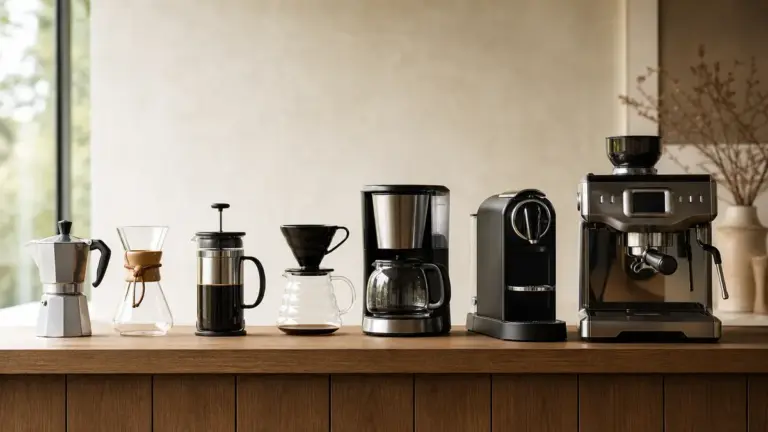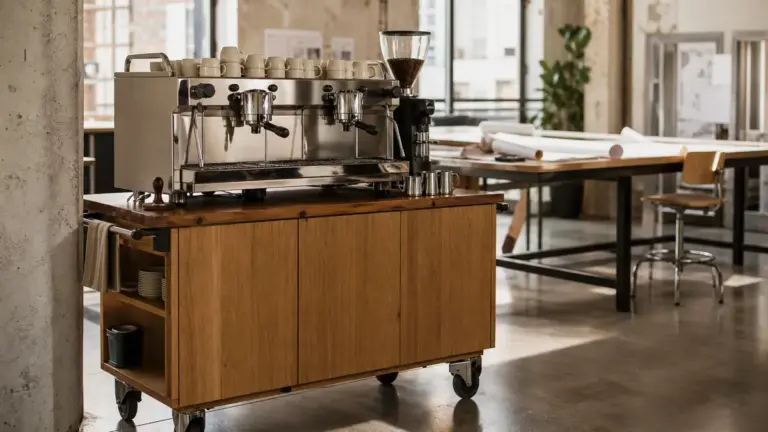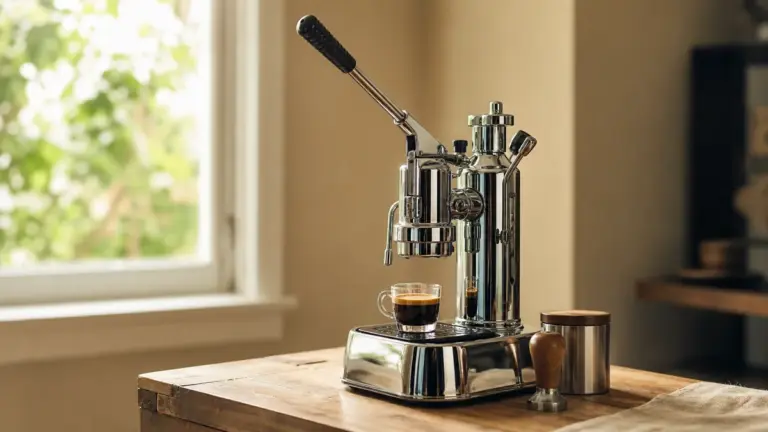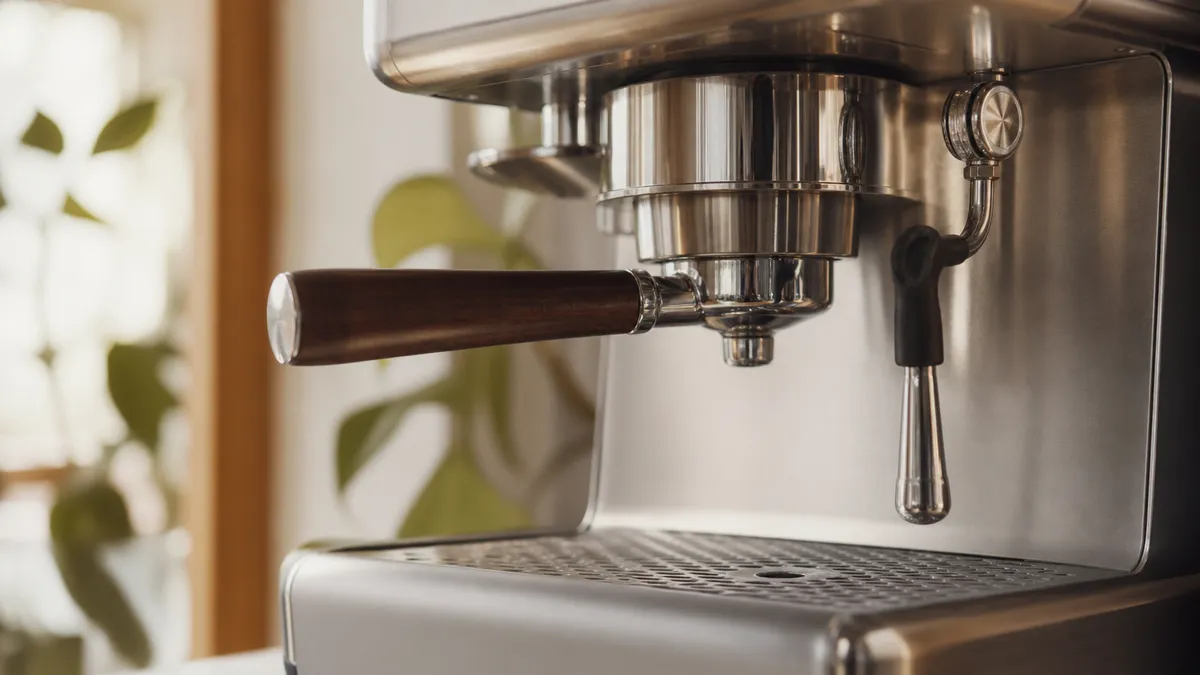
Espresso machines force hot water through finely ground coffee held in a removable handle called a portafilter. Choose a single boiler if you mainly drink espresso and can wait between brewing and steaming; consider a heat exchanger or dual boiler if you regularly prepare several milk drinks together.
In short
- A 9 bar brewing pressure is a conventional reference point, not a reason to prefer a machine advertised with a 15 or 19 bar pump.
- A PID controller helps regulate temperature, but does not by itself prove that water reaches the coffee at a stable temperature.
- Thermoblocks heat flowing water, rather than keeping a boilerful hot. Their performance depends on the complete design.
- Single-wall baskets need accurately ground coffee; pressurised, dual-wall baskets are more forgiving of pre-ground coffee.
- Check the grinder, water requirements, cleaning routine and UK repair arrangements before choosing extra machine features.
Choosing between espresso machines
Begin with your busiest coffee-making session. Preparing one espresso presents a different workflow from making cappuccinos for everyone after lunch.
This guide concentrates on pump-driven portafilter machines. For the wider choice between espresso, filter and other systems, start with our coffee machines guide and machine types explained.
Assess machines against four criteria:
- Drinks: mainly black coffee or repeated milk drinks.
- Control: shot stopping and adjustable brewing temperature.
- Workflow: warm-up, simultaneous brewing and steaming, refilling and cleaning.
- Ownership: grinder, water treatment, spare parts and servicing.
Our buying advice is to prioritise repeatable preparation and a suitable grinder before decorative finishes or elaborate menus.
Single Boiler Espresso Machines
A conventional single-boiler, dual-purpose machine uses the same boiler for brewing water and steam. It heats to a higher temperature for steaming, so brewing and milk texturing happen sequentially.
After making espresso, you switch to steam mode and wait. Before brewing again, the machine must return to its brewing condition, sometimes using a cooling and refilling procedure specified in its manual.
This suits mainly espresso drinkers who occasionally prepare milk. It is less convenient when every drink requires another transition.
Temperature control varies. A thermostat cycles the heater around switching points; a PID-equipped single boiler offers more deliberate regulation. Profitec’s GO product card, for example, specifies a single boiler with PID control.
Buying check: request a demonstration of espresso, steaming and the return to espresso, not just one successful shot.
Dual Boiler Espresso Machines
Dual-boiler machines have separate boilers for brewing and steaming. This separates the temperature requirements and allows simultaneous extraction and milk texturing on machines designed for that operation.
The practical advantage is continuity: prepare a shot while steaming milk, then move to the next drink without changing one boiler between functions.
Independent brew-temperature adjustment also suits experimentation. Sage’s Dual Boiler specifies a PID-controlled brew boiler, separate steam boiler and actively heated group head, the assembly into which the portafilter locks.
However, two boilers do not guarantee better espresso. Group heating, control accuracy and coffee preparation still matter. If you rarely steam milk, the extra system may be unnecessary.
Heat Exchanger Espresso Machines
A heat exchanger, usually shortened to HX, keeps its main boiler at steaming temperature. Brewing water passes through a separate passage inside that boiler, gaining heat without mixing with the boiler water.
This can support brewing and steaming together without a dedicated brew boiler. However, brewing temperature is influenced indirectly by the steam boiler and operating pattern.
On conventional HX designs, standing water can become too hot during an idle period. A cooling flush, running water through the group before brewing, may therefore be required.
Do not apply one flushing routine universally. LELIT describes MaraX’s double-probe control as addressing classical HX overheating.
La Marzocco’s general explanation emphasises cooling flushes, while LELIT describes a design intended to avoid that problem. These concern different implementations: follow the exact model’s manual.
Thermoblock Espresso Machines
A thermoblock heats water flowing through a passage in a heated metal assembly, rather than storing the brewing supply in a conventional boiler. Ascaso describes an aluminium block containing a stainless-steel water tube.
A single thermoblock may serve brewing and steaming, requiring a transition. Separate heating circuits can improve workflow, but check whether the machine permits simultaneous operation.
Sage claims that the Bambino Plus’s proprietary ThermoJet heater reaches extraction temperature in three seconds. That does not establish that a cold portafilter and cup are fully warmed.
Compare complete brewing readiness, not heater claims alone, and check the recommended preheating routine.
Semi Automatic Coffee Machines
On a semi-automatic espresso machine, the pump supplies pressure, but you start and stop the shot. You normally also grind, dose, distribute and tamp the coffee.
An automatic portafilter machine stops extraction at a programmed endpoint, potentially based on time, water volume or beverage weight. Volumetric control measures water passing through the system; gravimetric control uses the weight collected in the cup.
Automatic stopping does not necessarily automate grinding or milk preparation, nor remove grind adjustment.
Ask exactly what happens after pressing brew. Our traditional coffee machines guide explains the hands-on workflow; bean-to-cup machines are the alternative if you want grinding and brewing integrated into an automated routine.
Pressure, temperature stability and PID
Why 9 bar differs from a 15 or 19 bar claim
A pump’s advertised pressure is not necessarily the extraction pressure. Sage describes 9 bar extraction from a 15 bar pump; De’Longhi describes 9 bar extraction from the 19 bar pump in its La Specialista Opera.
The larger number is therefore not a quality ranking. Ask about regulated brewing pressure under operating conditions.
An over-pressure valve, or OPV, limits maximum pressure through a relief or bypass route. It does not make pressure identical throughout every shot. This differs from pressure profiling, which deliberately changes pressure during extraction.
Start with the manufacturer’s settings and correct coffee preparation, rather than treating pressure adjustment as a beginner’s shortcut.
What a PID does, and what it cannot promise
PID stands for proportional, integral and derivative. This feedback-control method adjusts heating using current temperature error, accumulated error and rate of change, helping reduce overshoot and fluctuation.
Sensor location matters. A stable boiler reading is not automatically a measurement of water temperature where it meets the coffee. Group heating and the water path remain part of the thermal system.
Sage’s Dual Boiler manual specifies a default extraction-temperature setting of 93°C. That is a model setting, not a universal recipe.
When comparing temperature claims, ask where measurements were taken, whether the machine was fully warmed and whether testing included repeated shots.
Grinders, portafilters and filter baskets
An espresso-capable grinder is part of the system, not an optional finishing touch. It needs sufficiently fine adjustment to change the resistance of the compacted coffee bed, called the puck, without jumping from a rapid gush to near blockage.
With dose held consistent, finer grinding generally slows flow and coarser grinding speeds it up. A machine upgrade cannot replace that adjustment.
Single-wall or dual-wall baskets?
An unpressurised, single-wall basket relies principally on the coffee bed for resistance. It suits exploring freshly ground coffee with control over grind and dose.
A pressurised, dual-wall basket adds a restricted outlet beneath the filtering surface. This is more forgiving of pre-ground coffee, but cannot restore freshness or compensate for every preparation problem.
Sage’s guidance distinguishes these uses. Check the supplied baskets rather than assuming every machine expects the same grinder.
Does portafilter diameter matter?
58 mm is a familiar commercial format, also used domestically. Domestic designs also include 54 mm, as on the Bambino Plus, and 51 mm, used by specified De’Longhi machines and accessories.
Diameter concerns compatibility, not flavour ranking. Match baskets, tampers and replacement portafilters to the exact model: nominal diameter alone does not establish fit.
Brands
Compare individual machines rather than relying on brand reputation. These manufacturer-described examples, checked in November 2026, are not independently tested performance or reliability rankings.
- Sage: Bambino Plus illustrates rapid on-demand heating and automatic milk texturing; Dual Boiler illustrates separate brewing and steam systems.
- Profitec: GO’s product card specifies a single boiler with PID control. Confirm the exact generation and controls supplied.
- LELIT: MaraX illustrates HX engineering with additional temperature management. Follow its instructions rather than a generic HX flushing routine.
- Ascaso: its documentation describes single and dual thermoblock arrangements. Confirm simultaneous-operation capability and electrical requirements.
Request the UK manual, warranty exclusions and repair process. Specifications establish claimed features, not long-term reliability.
Advantages/Benefits & Disadvantages
Compare heating systems by workflow and control, rather than assuming a simple hierarchy.
| Heating design | Main benefit | Main compromise | Who it suits |
|---|---|---|---|
| Single boiler | Brewing and steaming from one boiler | Waiting between functions | Mainly espresso, with occasional milk |
| Heat exchanger | Brewing and steaming together | Model-dependent temperature management | Milk-drink makers willing to learn the routine |
| Dual boiler | Separate brewing and steam control | Extra equipment that may be unnecessary | Repeated milk drinks and temperature experimentation |
| Thermoblock | On-demand water heating | Capability varies substantially by implementation | Buyers prioritising a suitable fast-start workflow |
Before you buy
- Describe your busiest session. Request a matching demonstration, including the return from steaming to brewing.
- Confirm grinder and baskets. Check that they support your intended preparation.
- Measure the working area. Include portafilter movement, tank access, steam-wand clearance and cleaning space.
- Check local water hardness. Use your supplier’s postcode report and the machine maker’s treatment instructions.
- Read the maintenance routine. Establish which tasks are yours and which require a technician.
- Get an itemised written quotation. Include machine, grinder, accessories, water treatment, consumables and servicing.
Rather than relying on entry, intermediate or premium labels, separate essential extraction control, workflow improvements and experimentation features. Compare complete packages over the same ownership period using your own consumption and maintenance assumptions.
For workplace use, confirm that the machine is intended and warranted for that setting. Our commercial espresso machines guide covers capacity and installation questions.
FAQ
Can I use pre-ground coffee while learning?
Yes, provided the machine has a suitable pressurised basket and its instructions allow it. Sage recommends dual-wall baskets for pre-ground coffee and single-wall baskets for freshly ground beans. This can simplify the first steps, but a suitable grinder gives you the adjustment needed to control flow through a single-wall basket.
Should I modify the OPV on a new machine?
No, not as a first step. Establish a repeatable dose, suitable grind and the manufacturer’s recommended operating routine before considering pressure changes. Sage’s safety guidance reserves procedures outside its instruction booklet for authorised service personnel. Ask the manufacturer or an authorised technician about any proposed modification rather than following instructions for a different machine.
Will using a water filter remove the need for descaling?
Not necessarily. Sage’s Dual Boiler manual still provides descaling instructions and advises descaling when scale builds up despite the supplied filter. Check your local hardness and follow the exact machine’s maintenance requirements. A filter is not permission to ignore scale, and an arbitrary descaling schedule may not suit your water or equipment.
Does the manufacturer’s warranty replace my consumer rights?
No, a manufacturer’s warranty is separate from statutory consumer rights. GOV.UK explains that rights concerning faulty goods can apply regardless of whether a warranty remains valid. Keep proof of purchase and contact the retailer about faults. Workplace purchases need separate consideration because a business purchase is not automatically covered by consumer-purchase protections.
Where to go next
Read Traditional Coffee Machines for the hands-on preparation routine, or Bean-to-Cup Coffee Machines if convenience matters more than handling a portafilter. Commercial Espresso Machines is the next read for workplace capacity and installation, while Types of Coffee Machine Explained helps you reconsider whether espresso machines are the right category at all.
Sources
Undated manufacturer pages below were retrieved in November 2026. Specifications and performance statements are the manufacturers’ claims unless stated otherwise.
-
Gaggia, Classic E24 operating instructions, revision 00, undated. Brewing, steam operation and returning the boiler to brewing temperature.
https://www.gaggia.com/app/uploads/2023/11/6420-010-18421-MANUAL-GAG.-CLASSIC-E24-EU-Rev-00.pdf -
Sage, The Dual Boiler instruction booklet, UK edition, 2021. Heating systems, PID, OPV, temperature settings and maintenance.
https://assets.sageappliances.com/BES920/SES920_UK_IB_2021.pdf -
Sage, The Dual Boiler, GB product specifications, undated. Separate boilers, heated group, portafilter and pump versus extraction pressure.
https://www.sageappliances.com/en-gb/product/bes920 -
La Marzocco USA, Dual boiler espresso machines keep your coffee brewing consistently, 2025. Dual-boiler and conventional HX mechanisms.
https://www.lamarzoccousa.com/news/blog/dual-boiler-espresso-machines-are-consistent/ -
LELIT, MaraX, US technical description, undated. Double-probe HX system and temperature-management claims, not UK electrical specifications.
https://www.lelit.com/en-us/product/marax-pesmx02 -
Ascaso, Thermoblock, technical explanation, undated. Water path and single versus dual heating arrangements.
https://ascaso.com/en/technology/thermoblock/ -
Sage, The Bambino Plus, GB product specifications, undated; Bambino Plus quick guide, BES500/SES500, undated. ThermoJet claims, portafilter, baskets, preparation and safety.
https://www.sageappliances.com/en-gb/product/bes500
https://assets.sageappliances.com/BES500/SES500_EU_UG8_L25_LR.pdf -
Profitec, GO: single boiler with PID controller, product card, undated. Single-boiler configuration and PID specification.
https://www.profitec-espresso.com/en/products/go-2-0 -
La Marzocco USA, Understanding Commercial Espresso Machine Configurations, 2021; Prof. John Blackwell, Coffea Arabica Machina 101: PID, Part 1, 2009; Product catalogue, 2025. Shot-control terminology, PID operation and pressure profiling.
https://www.lamarzoccousa.com/news/blog/understanding-commercial-espresso-machine-configurations/
https://www.lamarzoccousa.com/news/blog/prof-john-blackwell-coffea-arabica-machina-101-pid-part-1/
https://lamarzoccousa.com/wp-content/uploads/2025/03/Productcatalog2025.pdf -
De’Longhi, La Specialista Opera EC9555M, US specifications, undated; Rosewood Bottomless Portafilter DLSC085, US specifications, undated. Pump versus extraction pressure and a documented 51 mm portafilter example.
https://www.delonghi.com/en-us/p/la-specialista-opera-la-specialista-opera-espresso-machine-with-cold-brew/EC9555M.html
https://www.delonghi.com/en-us/p/coffee-accessories-dlsc085-bottomless-portafilter/DLSC085.html -
Thames Water, Water quality, undated. Postcode-based local water information and hardness.
https://www.thameswater.co.uk/help/water-and-waste-help/water-quality -
GOV.UK, Accepting returns and giving refunds: the law, undated; Consumer Rights Act 2015, 2015. Faulty-goods rights and the distinction between warranties and statutory remedies.
https://www.gov.uk/accepting-returns-and-giving-refunds
https://www.gov.uk/government/publications/consumer-rights-act-2015/consumer-rights-act-2015
Research combined retrieved manufacturer manuals and technical descriptions with official UK consumer guidance and water-supplier information; no first-hand machine testing was undertaken.
Last checked: November 2026