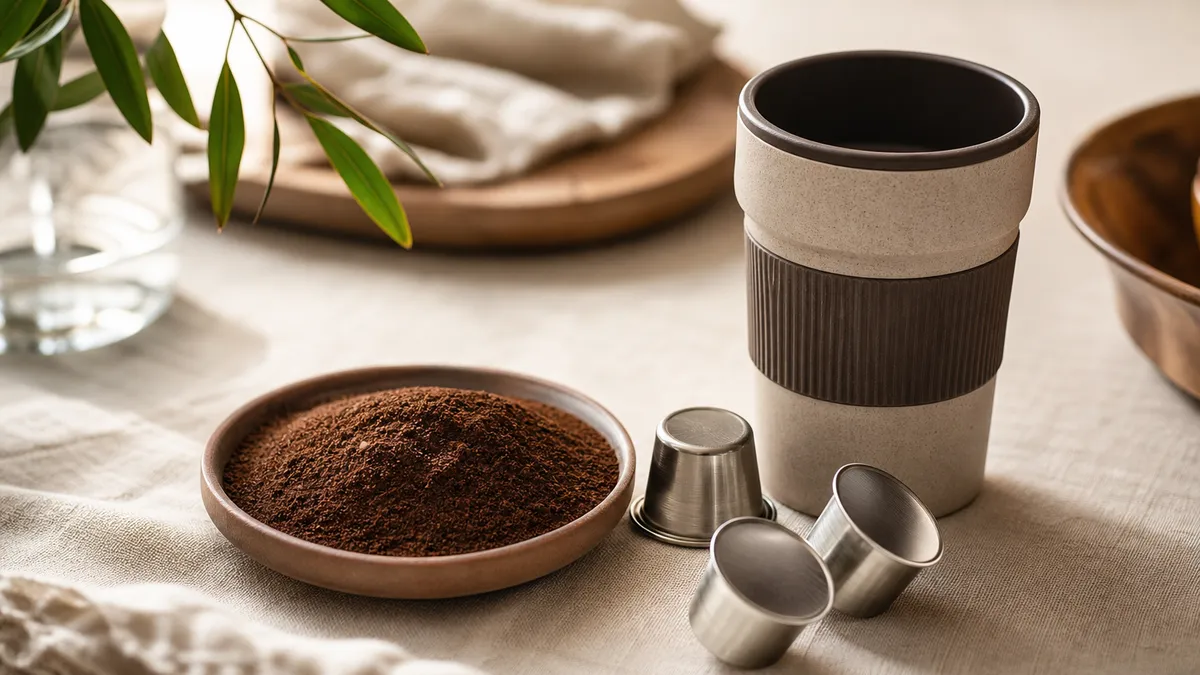
Coffee pods create single-use packaging waste, but they do not automatically have a higher carbon footprint than other brewing methods. Their overall impact depends on how much coffee you use, how efficiently you heat water, what you throw away and whether the used capsules actually reach a suitable recycling or composting process.
In short
- Compare drinks you actually finish, not simply “one pod” against “one pot”.
- Coffee dose, wasted brewed coffee and machine energy can change the environmental ranking.
- Aluminium, plastic and compostable capsules all depend on the right collection and treatment route.
- Podback provides household recycling routes for participating aluminium and plastic pods, with availability varying locally.
- Workplace pods need an explicitly accepted business-waste arrangement, not an assumed household route.
Why the capsule is only part of the picture
The empty capsule is the most visible waste, but visibility is not a measure of total environmental impact. Growing, processing and roasting the coffee, manufacturing packaging and equipment, heating water and handling waste all contribute.
A life-cycle assessment, usually shortened to LCA, estimates impacts across a defined product system. Its boundaries matter: a packaging study cannot, by itself, tell you which complete brewing method is best.
Carbon footprint is also only one measure. It describes greenhouse gas emissions, not every consequence for resources, water, ecosystems or waste. A method can perform relatively well on climate while still producing unnecessary single-use packaging.
Our wider guide to coffee and the environment explains those separate pressures. For pods, the useful question is narrower: what happens when we compare the same useful drink, including the coffee and energy that never make it into a finished cup?
What life-cycle studies actually show
Quantis, Chayer and Kicak, 2015
This North American assessment compared single-serve capsules with bulk drip-filter brewing. Commissioned by PAC, Packaging Consortium, it underwent an external critical review, but it was an industry-commissioned report rather than an independent journal experiment.
Efficient single-serve preparation performed favourably, despite generating more packaging waste. However, the assumptions deserve attention: the model assigned no coffee wastage to capsules, included substantial wastage scenarios for filter coffee and assumed 37 minutes on a hotplate even in its accurate, no-waste filter scenario.
That is not the same comparison as carefully measured pour-over coffee drunk immediately.
Hicks, 2018
Andrea Hicks’s peer-reviewed assessment compared drip filter, cafetière and pod-style brewing. Pods performed best in several environmental impact categories, while cafetière performed best in others.
The major drivers were dry coffee quantity and brewing energy. This supports a conditional conclusion, not a universal winner: changing dose, wastage or equipment energy can change the result.
UQAC researchers, 2023
Researchers at the Université du Québec à Chicoutimi presented a literature-based comparison in The Conversation. This was an explanatory article reporting their analysis, not itself a peer-reviewed journal paper.
For a 280 ml drink, their assumptions included 25 g of coffee for filter, 14 g for capsules and 17 g for cafetière. Capsules benefited particularly when alternative methods used surplus coffee and heated excess water. Those unequal doses are central to the result, not a minor detail.
Moresi and Cimini, 2025
A later assessment focused on brewing and post-consumer impacts across several packaging formats. It found traditional preparation using coffee from bulk bags less impactful than the single-serving systems assessed.
These findings are not necessarily contradictory. The studies ask different questions and use different boundaries, doses, equipment and disposal assumptions. Treat their rankings as results for specified systems, not labels permanently attached to brewing methods.
Comparing pods with other brewing methods fairly
Start with the drink you want: its volume, strength and number of servings. Comparing a small capsule drink with a large, strong cafetière mug does not isolate the effect of packaging.
Use the following criteria before choosing a method: coffee consumed, coffee discarded, electricity used, packaging generated and an available waste route.
| Method | What can work in its favour | What can worsen its impact | Where it may fit |
|---|---|---|---|
| Single-use pods | Fixed portions can avoid unwanted batch coffee | Capsule production, unrecycled packaging and additional pods per drink | Occasional individual drinks with reliable collection |
| Cafetière or manual filter | No individual capsule; preparation can match demand | Excess grounds, surplus kettle water and unfinished coffee | People willing to measure and brew only what is needed |
| Batch filter | Preparation can serve several people together | Unwanted leftovers and prolonged hotplate use | Predictable groups that finish the batch |
| Bean-to-cup or espresso | No individual capsule around each dose | Dose, idle energy, rinsing and discarded drinks need consideration | Workplaces willing to assess actual use |
This is a decision aid, not a numerical league table.
Coffee dosing deserves particular care. A lower dose reduces the coffee attributed to a drink, but only if that drink meets your needs. If you use another capsule to obtain the strength you wanted, include it in the comparison.
Likewise, brewing a larger batch is not automatically efficient. Count what people drink, not what the machine produces. Precision is a useful feature of pods, but measuring loose coffee can provide portion control too.
Aluminium, plastic and compostable pods
There is no sound rule that one capsule material always wins. Material production matters, but so do capsule construction, recycled content, collection, separation and the treatment that actually follows.
| Capsule type | Potential advantage | Main limitation | What to check |
|---|---|---|---|
| Aluminium | Dedicated systems can recover the metal after separating the grounds | Making the capsule still has impacts; recovery depends on collection | Exact product acceptance and a practical return route |
| Conventional plastic | Participating pods can be processed through specialist collection | A plastic recycling symbol does not establish local acceptance | Whether the whole pod, including its components, is accepted |
| Compostable | Suitable treatment can process capsule material alongside its contents | Industrial compostability does not mean home compostability or food-bin acceptance | Certification, instructions and an accepting treatment route |
What the compostable studies assume
Wageningen University & Research’s 2023 assessment favoured composted compostable capsules when considering climate impacts alongside material circularity, meaning how materials remain in useful circulation. Separately collected aluminium also performed well.
Its scenarios were explicitly “what if” comparisons, assuming 100% collection into the selected end-of-life route. That is useful for understanding potential, but it is not evidence that every capsule sold reaches that route.
The practical distinction is between compostable and composted. A material’s ability to break down under suitable conditions does not ensure that your local facility accepts or processes it.
Home and industrial compostability are separate claims. TÜV AUSTRIA distinguishes products suitable for garden composting from those requiring industrial conditions. Look for certification covering the complete capsule and follow its instructions.
For broader packaging questions, including how to interpret disposal claims, see eco-friendly packaging.
Recycling coffee pods in the UK
Household collections
Podback provides collection routes for participating aluminium and plastic beverage pods. These include dedicated kerbside services in participating council areas and drop-off locations, including selected supermarkets and recycling centres.
Check the current arrangements for your postcode and pod brand. A council collection is not automatically available everywhere, and a recycling centre accepting pods in one area says nothing about another.
Follow the instructions for your particular route. Podback’s kerbside arrangements distinguish aluminium from plastic because they go to different reprocessing facilities. Do not assume any bag, mixed container or household recycling bin will do.
According to participating council guidance, specialist processors separate the grounds from the capsule materials. The recovered metal and plastic enter manufacturing routes, while the grounds undergo anaerobic digestion, a process that produces biogas and a material used as a soil improver.
Ordinary recycling and food bins
Do not put used capsules into mixed recycling merely because their material is recyclable. Local acceptance and preparation requirements decide whether that route is suitable.
Compostable pods require equal caution. North London Waste Authority, for example, instructs residents not to put compostable plastic in food or garden waste. Its food-waste process removes packaging rather than distinguishing compostable products from conventional plastics.
A compostability claim is therefore not permission to use a council food caddy. Check the collector’s explicit instructions.
Workplace pods are business waste
An office should arrange an accepted business collection before relying on a pod system’s recycling claims. Household kerbside services, retail drop-offs and household recycling centres should not be assumed to accept workplace waste.
A specific commercial route does exist for some systems. As checked in November 2026, Nespresso Professional publishes a UK business capsule collection service using its recycling bags, with waste transfer notes available on request. That is a supplier-described service, not evidence that every brand or capsule format is covered.
Ask your supplier or waste contractor to confirm in writing:
- Which capsule brands, materials and formats it accepts.
- How pods must be stored, separated and presented.
- Whether the service accepts your workplace’s waste.
- Where the capsules and grounds go.
- What collection records and waste documentation you receive.
In England, Simpler Recycling requirements took effect on 31 March 2025. Micro-firms with fewer than 10 full-time-equivalent employees have until 31 March 2027. The guidance includes coffee grounds as food waste but excludes compostable or biodegradable packaging from ordinary food-waste collection, directing users towards residual waste or a dedicated collection.
These are England’s rules, not a UK-wide timetable. Confirm the relevant requirements and collector arrangements in Scotland, Wales or Northern Ireland.
A practical way to reduce your impact
Start with your habits and available collections rather than buying a different material on the strength of its label.
- Record what you actually use. Note the drinks finished, capsules used, loose coffee dosed and leftovers discarded over a representative working week.
- Match preparation to demand. Brew smaller batches when demand is uncertain. Include every capsule used to make a stronger drink.
- Check energy behaviour. Use energy-saving settings and avoid unnecessary hotplate or ready-to-brew operation, following the machine’s instructions.
- Confirm the destination. Check acceptance for your exact capsules and whether the route covers household or business waste.
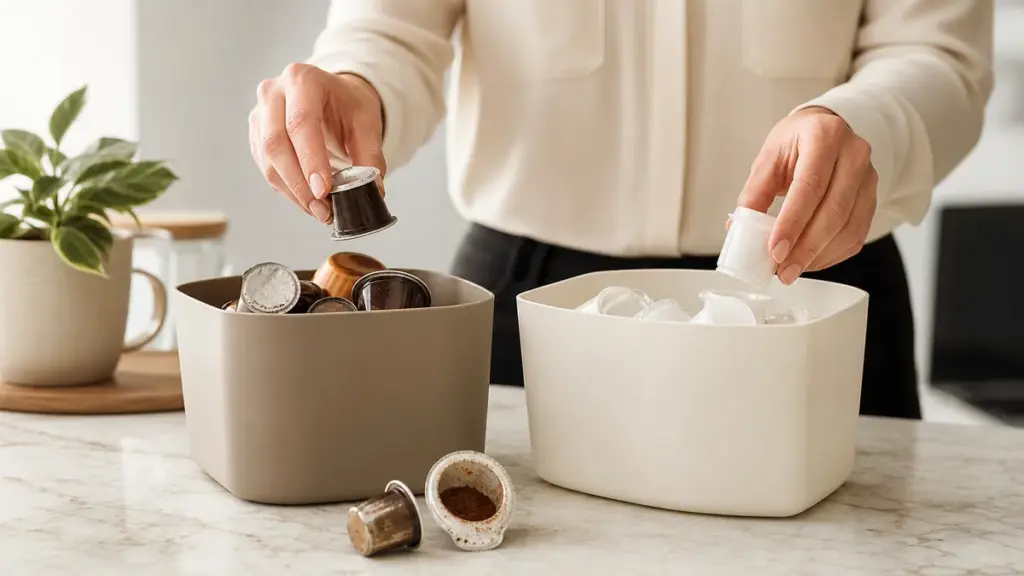
- Make separation easy. Put the correct collection container beside the machine and assign responsibility for returning or collecting it.
- Review what leaves the building. A collection arrangement is only useful if staff use it correctly and the material is actually collected.
For loose grounds, reusing coffee grounds and cascara explains the wider options. Those options do not make the capsule around them recyclable.
How to judge an environmental claim
Before accepting “lower carbon”, ask: lower than what, under which assumptions? A comparison should identify the drink, coffee dose, electricity supply, machine behaviour, wastage and disposal route.
Also distinguish access from results. Being able to return a capsule is not the same as returning it; collecting it is not the same as recovering every component. A model assuming complete collection describes potential performance, not necessarily everyday performance.
The Competition and Markets Authority’s Green Claims Code asks shoppers to consider the whole picture and understand disposal claims. Apply that approach to coffee pods and the environment: assess the coffee, brewing and waste system together, rather than letting the capsule material stand in for the whole answer.
FAQ
Should I replace a working pod machine immediately?
Not solely because a study ranks another method better. Equipment manufacture belongs in a full comparison, and the studies here do not establish a universal replacement threshold. First reduce wasted drinks, check the machine’s energy settings and establish a collection route. When replacement becomes necessary, compare systems against your actual drinking pattern.
Are refillable capsules automatically better?
No, not automatically. They avoid repeatedly discarding a complete single-use capsule, but their manufacture, service life, coffee dose and washing still belong in the assessment. They should also produce a drink you will finish. Check machine compatibility and cleaning instructions rather than assuming that “reusable” settles every environmental question.
Does “recyclable aluminium” mean every used pod becomes another pod?
No. Recyclability describes a potential material route, not a guaranteed outcome or a particular final product. Collection and processing must happen first. UK scheme guidance describes recovered aluminium entering various products, including cans and components, rather than promising that every returned capsule becomes a new coffee capsule.
Where to go next
Read Coffee and the Environment for the wider framework, then Eco-Friendly Packaging to understand material and disposal claims. Reusing Coffee Grounds and Cascara examines the organic material left after brewing and processing, while Deforestation and Coffee explains why attention must also extend back to the farm.
Sources
-
Quantis, Chayer, J.-A. and Kicak, K. Life Cycle Assessment of Coffee Consumption: Comparison of Single-Serve Coffee and Bulk Coffee Brewing. Final report prepared for PAC, Packaging Consortium, 2015.
URL: https://pac.global/wp-content/uploads/2024/10/quantis-lca-2015-3.pdf -
Hicks, A. L., Journal of Industrial Ecology. Environmental Implications of Consumer Convenience: Coffee as a Case Study. Volume 22, issue 1, 2018; first published online in 2017.
URL: https://onlinelibrary.wiley.com/doi/abs/10.1111/jiec.12487 -
Viana, L. R., Marty, C., Boucher, J.-F. and Dessureault, P.-L. Here’s How Your Cup of Coffee Contributes to Climate Change. The Conversation, 2023, retrieved through the authors’ syndicated commentary on CNA.
URL: https://www.channelnewsasia.com/commentary/coffee-capsules-harm-environment-carbon-footprint-filter-brew-3190661 -
Moresi, M. and Cimini, A., Italian Journal of Food Science. Streamlined Life Cycle Assessment of Packaging Waste in Coffee Preparation and Consumption. Volume 37, issue 4, 2025.
URL: https://mail.itjfs.com/index.php/ijfs/en/article/view/3256 -
Wageningen University & Research, Brouwer, M. Sustainability Assessment of Different Types of Coffee Capsules. Research presentation, 12 December 2023.
URL: https://edepot.wur.nl/645120 -
Conwy County Borough Council. Podback Frequently Asked Questions. Undated live guidance, checked November 2026.
URL: https://www.conwy.gov.uk/en/Resident/Recycling-and-Waste/Podback-Frequently-Asked-Questions.aspx -
South Derbyshire District Council. Recycling Advice. Undated live guidance, checked November 2026.
URL: https://www.southderbyshire.gov.uk/our-services/recycling-bins-and-waste/recycling-advice -
North London Waste Authority. Coffee Pods. Undated live guidance, checked November 2026.
URL: https://www.nlwa.gov.uk/whatcanwerecycle/coffee-pods -
Nespresso Professional UK. How to Recycle Your Business Coffee Pods. Undated supplier service information, checked November 2026.
URL: https://www.nespresso.com/pro/uk/en/recycling -
Department for Environment, Food & Rural Affairs. Simpler Recycling: Workplace Recycling in England. Published 2024, updated 3 October 2025.
URL: https://www.gov.uk/guidance/simpler-recycling-workplace-recycling-in-england -
TÜV AUSTRIA. OK Compost HOME. Undated certification guidance, checked November 2026.
URL: https://en.tuv.at/ok-compost-home-en/ -
Competition and Markets Authority. Green Claims Code for Shoppers. 2021.
URL: https://www.gov.uk/government/publications/green-claims-code-for-shoppers/green-claims-code-for-shoppers
This article was researched using retrieved life-cycle studies, university research material, official waste guidance, certification information and supplier collection terms; no first-hand machine testing was undertaken.
Last checked: November 2026