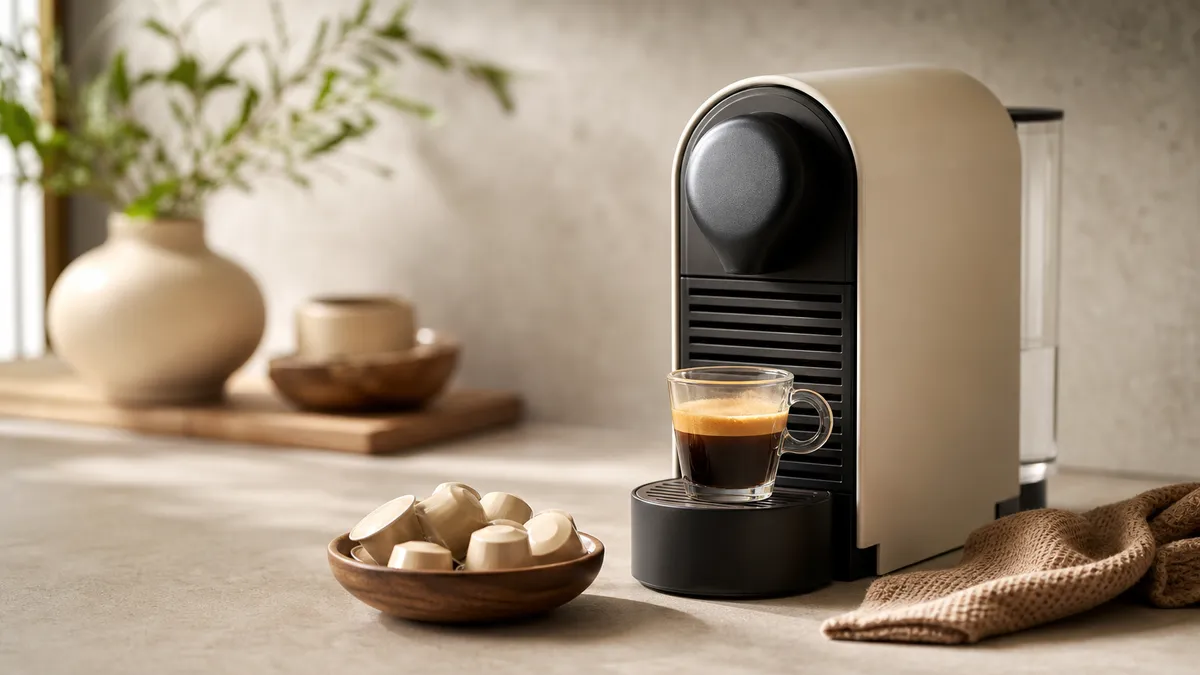
Pod and capsule coffee machines are worth considering if you want repeatable coffee without grinding, weighing or handling loose grounds. Their main compromises are restricted coffee choice, limited control and a used pod to deal with after each drink, so choose the capsule system before choosing the machine.
In short
- Compatibility belongs to the system, not simply the coffee brand: Nespresso Original, Vertuo, Dolce Gusto, Tassimo and A Modo Mio are not interchangeable.
- E.S.E. means Easy Serving Espresso: these 44 mm paper pods need an E.S.E.-compatible machine or a manufacturer-approved pod basket.
- Compare finished drinks, not capsule counts. Some milk drinks require a coffee capsule and a separate milk capsule.
- Podback accepts aluminium and plastic pods from participating brands, with local collection and drop-off arrangements.
- Industrially compostable does not mean home-compostable, or automatically accepted in your food-waste collection.
How pod and capsule coffee machines work
A capsule contains a measured portion of coffee or another drink ingredient inside a container. In a typical pressure-based coffee system, the machine pierces the capsule and sends heated water through the grounds, carrying dissolved coffee into the cup. The capsule takes over the dosing and containment that you would otherwise manage yourself.
Not every system brews in the same way. Nespresso Original uses pressure extraction; Vertuo uses a spinning capsule and barcode-controlled brewing. Tassimo reads a barcode on its T DISC to select water quantity, temperature and brewing time. These are manufacturers’ descriptions of their technologies, not independent guarantees of flavour.
“Pod” is often used loosely for all these formats, but an E.S.E. paper pod is different. It holds pre-portioned ground coffee between filter-paper layers rather than inside a rigid aluminium or plastic capsule. The standard format discussed here is 44 mm, and compatibility must be stated explicitly.
For the wider choice between capsules, beans and loose grounds, start with our coffee machine guide.
Brands
Choose by drink format, milk method, capsule availability and disposal route, rather than by the badge on the machine. The comparison below covers the principal systems relevant to this guide, not every single-serve format sold in the UK.
System information checked in November 2026. Brewing technologies and compatibility statements below come from manufacturers.
| System | Brewing and compatibility | Milk approach | Best fit and main limitation |
|---|---|---|---|
| Nespresso Original | Pressure-based brewing; Original capsules, including explicitly compatible products from other brands | Separate frother or a machine with milk equipment | Short coffees and buyers wanting compatible-brand choice; unsuitable for Vertuo capsules |
| Nespresso Vertuo | Spinning extraction with capsule barcode recognition; separate from Original | Milk equipment depends on the machine or bundle | Buyers wanting different drink sizes; check which capsule sizes the particular machine supports |
| NESCAFÉ Dolce Gusto | Dedicated capsule format with drink-specific preparation instructions | Some drinks use separate coffee and milk capsules | Mixed drink preferences; capsule count does not always equal serving count |
| Tassimo | Barcode-controlled T DISCs | Milk-based T DISCs available | Automated preparation of different drinks; requires the correct T DISC format |
| Lavazza A Modo Mio | Dedicated espresso capsule system | Check the individual machine’s milk equipment | Buyers who enjoy its coffee range; A Modo Mio capsules do not fit Nespresso |
| E.S.E. paper pods | 44 mm paper format for explicitly compatible machines or baskets | Depends on the espresso machine | Pre-portioned espresso without rigid capsules; not compatible with the capsule systems above |
A familiar coffee name on a box is not enough. Lavazza, for example, sells both A Modo Mio capsules and a separate range compatible with Nespresso Original. Read the complete compatibility statement before buying.
Our Nespresso system comparison explores that choice in detail. For the other dedicated systems, see Dolce Gusto, Tassimo and A Modo Mio.
Taste: consistency versus control
The strongest argument for capsules is repeatability. A pre-portioned coffee format removes the need to choose a dose, grind the beans or tamp the grounds, meaning compress them before brewing. That is useful when you want a familiar result rather than another brewing variable to adjust.
The same arrangement restricts experimentation. Your starting coffee portion and grind are already selected, so choose a capsule designed for the drink you actually want. Follow its recommended preparation before deciding whether the blend suits you.
Our buying judgement: taste your normal drink before committing to a system. A coffee that seems pleasantly full-bodied as a short black drink may not be the one you prefer with a large serving of milk. Compare aroma, sweetness, bitterness, texture and finish, rather than judging by foam alone.
For a fair comparison, taste alternatives at similar drink sizes and with the same milk addition. Change the coffee first, then the preparation setting, so you know which adjustment made the difference. Manufacturer flavour descriptions are useful starting points, not independent tasting results.
Milk: check what “cappuccino” actually involves
A capsule machine offering cappuccino may use fresh milk, a separate frother, integrated milk equipment or a milk capsule. Those are different routines, even when the drink names look similar.
For example, Dolce Gusto’s published Cappuccino ingredients include whole milk powder and sugar in the milk pod, with roast and ground coffee in the coffee pod. Tassimo’s Creamer from Milk contains milk concentrate and added sugar. Do not assume that every milk capsule contains the same ingredients, or that all capsule milk drinks are unsweetened.
If you want control over the milk quantity or prefer a particular plant-based drink, investigate a coffee-only machine with a suitable frother, or a model whose milk equipment supports your choice. Check its cleaning instructions as carefully as its drink menu.
Fresh-milk equipment adds cleaning tasks that a coffee-only machine does not have. Nespresso, for example, publishes separate cleaning instructions for its milk devices. Before buying, check which components need rinsing, dismantling or washing, and who will do that in a shared workplace.
Cost per cup: calculate the finished drink
A useful comparison counts everything needed to make the drink, not just the coffee capsule. Start with the number of finished servings stated on the pack. Dolce Gusto confirms that its drinks can require one or two pods, so dividing by capsule count can give a misleading result.
Use this method with your own current quotations and purchase records:
- Divide the pack total by its stated finished servings.
- Include any separately purchased milk and the quantity used per drink.
- Add cleaning products, descaler, filters where required, and electricity.
- Spread the machine purchase and any service arrangements over a stated ownership period and expected number of drinks.
- Record the VAT basis consistently and allow for unused stock and discarded drinks.
For a workplace, request itemised written quotations covering the machine, consumables, servicing, repairs and any collection arrangements. State expected daily drinks, ownership period and milk requirements. Keep these assumptions alongside your calculation so another person can reproduce it.
Also consider the practical commitment: whether the coffee you like is readily available, how much stock you must store and what happens if your preferred capsule disappears.
Recycling routes and green claims
Podback household recycling
Podback provides routes for aluminium and plastic pods from participating brands. Do not assume that a capsule qualifies simply because it fits your machine.
Available routes depend on your location:
- Kerbside collection: offered through participating councils. Follow the local registration, bag and presentation instructions.
- Supermarket drop-off: use a participating location and its specified Podback bags and instructions, not the supermarket’s ordinary recycling bins.
- Household waste recycling centres: participating sites may accept pods emptied loose into separate aluminium and plastic containers.
Where Podback’s colour-coded bags are required, white is for aluminium and green is for plastic. Keep the materials separate. At recycling centres, check the site instructions before arriving, because bags may need to be emptied rather than deposited.
Do not put used capsules into ordinary household recycling unless your council explicitly accepts them there. Check your brand and postcode before choosing a machine, then check again when collection arrangements change.
For office waste, obtain confirmation that the proposed route accepts your business’s pods. A household collection or recycling-centre listing is not, by itself, confirmation of business eligibility.
Compostable is a conditional claim
EN 13432 concerns industrial compostability, not proof that a capsule will break down in your garden compost heap. Home-compostability requires separate evidence, and neither label guarantees acceptance by your council or waste contractor.
WRAP advises checking with the collection provider before putting compostable packaging into an organic-waste stream. Keep compostable capsules out of aluminium and plastic pod collections unless the scheme expressly says otherwise.
The CMA’s Green Claims Code says environmental claims must explain relevant conditions and limitations. Ask what part is recyclable or compostable, where it must go and what you must do. A disposal label alone is not a sound basis for declaring one coffee system environmentally preferable overall.
Advantages/Benefits & Disadvantages
Advantages
- Less preparation: pre-portioned coffee removes grinding, weighing and tamping from the routine.
- Straightforward drink selection: some systems automatically select brewing settings from the capsule.
- Individual choice: users can select different compatible coffees without changing a shared hopper.
- A contained coffee portion: useful for people who dislike handling loose grounds.
Disadvantages
- System dependence: capsules and machines must match, even when the coffee brand is familiar.
- Limited adjustment: the supplied portion and grind are already chosen.
- Milk can complicate the routine: check ingredients, separate capsules and cleaning requirements.
- Disposal takes organisation: recycling depends on eligibility, separation and an accessible route.
Our recommendation: pod or capsule coffee machines suit occasional drinkers, households with different preferences and workplaces prioritising simple individual preparation. They are a weaker fit when your priority is experimenting with freshly ground coffee or preparing several drinks together.
For an office, assess the busiest break rather than headcount alone. Ask the supplier to demonstrate consecutive preparation of your actual drinks, including milk handling, refilling and emptying. Get written confirmation that the machine is suitable for the intended workplace use.
Before you buy: a practical checklist
- Name the system precisely. Check the machine manual and capsule packaging, not just the brand.
- Taste your usual drink. Include your normal serving size and milk.
- Inspect the milk routine. Read ingredients and cleaning instructions.
- Check the local disposal route. Confirm brand eligibility, collection method and business acceptance where relevant.
- Read the maintenance requirements. Cleaning removes residues; descaling addresses mineral deposits. They are different jobs.
- Check your local water information. Use your supplier’s postcode report rather than assuming one hardness level applies across the UK.
- Review the whole ownership arrangement. Confirm warranty terms, support and any servicing requirements in writing.
Follow the specific machine manual for water, rinsing and descaling. There is no single temperature, water volume or cleaning programme appropriate to all the systems in this guide.
FAQ
Can I use a capsule more than once?
Treat a single-use capsule as one serving, not as a refillable brewer. If you want a larger drink, choose a capsule and programme intended for it rather than assuming a second run will reproduce the first. Follow the capsule supplier’s preparation instructions and the machine manual.
Does a higher intensity number mean better coffee?
No, an intensity number is not a quality score. Lavazza describes its A Modo Mio scale in terms of body and aromatic persistence. Use that information to compare coffees within the stated range, then taste them in your normal drink rather than treating the largest number as the best choice.
Can an ordinary espresso machine take E.S.E. pods?
Only if its manufacturer confirms compatibility and specifies the correct basket or adaptor. A conventional loose-ground basket is not automatically suitable for a 44 mm E.S.E. pod. Check the exact machine instructions before buying pods or accessories, and do not force a paper pod into a capsule machine.
Where to go next
Read Coffee Machines to decide whether pod or capsule coffee machines fit your wider needs, then Nespresso Original vs Vertuo for that system-specific choice. Dolce Gusto, Tassimo and Lavazza A Modo Mio examines the other dedicated formats, while Drip Coffee Makers and Filter Coffee Machines is the useful next read if preparing several coffees together matters more than individual capsules.
Sources
Manufacturer pages are used for their own system descriptions, compatibility and ingredients, not as independent evidence of superior taste or reliability. Undated pages below were checked in November 2026.
-
Nespresso UK, Choose Your Nespresso System, undated.
https://www.nespresso.com/uk/en/choose-your-nespresso-system
Supports Original and Vertuo brewing distinctions and model-dependent milk features. -
Lavazza UK, Lavazza A Modo Mio: Coffee Capsules, undated.
https://www.lavazza.co.uk/en/coffee-capsules-pods/a-modo-mio
Supports system incompatibility, Original-compatible products and the meaning of its intensity scale. -
Caffè Borbone, E.S.E. Espresso Paper Pods 44mm, undated.
https://caffeborboneamerica.com/capsules-and-pods/e-s-e-paper-pods/
Supports the paper-pod format, dimensions and need for compatible equipment. -
NESCAFÉ Dolce Gusto UK, How Our Coffee Pods Work and How to Use Our Coffee Pods FAQs, undated.
https://www.dolce-gusto.co.uk/our-coffee/how-do-pods-work
https://www.dolce-gusto.co.uk/faqs/how-to-use-coffee-pods
Supports capsule operation, preparation instructions and one-pod or two-pod servings. -
NESCAFÉ Dolce Gusto UK, Cappuccino, undated.
https://www.dolce-gusto.co.uk/cappuccino-pods
Supports separate coffee and milk pods and the stated milk-pod ingredients. -
Tassimo UK, Intellibrew Technology and Creamer From Milk, undated.
https://www.tassimo.com/gb/cp/tassimo-world/intellibrew
https://www.tassimo.com/gb/p/creamer-from-milk
Supports barcode-controlled brewing and the creamer’s ingredients. -
Cherwell District Council, Podback FAQs, undated.
https://www.cherwell.gov.uk/info/10/rubbish-and-recycling/1085/podback-scheme/2
Supports participating-brand eligibility, kerbside arrangements and white aluminium and green plastic bags. -
Central Bedfordshire Council, Podback Service, Bag Orders, Collections and Other Common Questions, undated.
https://www.centralbedfordshire.gov.uk/waste-and-recycling/recycling-coffee-pods/podback-service-bag-orders-collections-and-other-common
Supports supermarket drop-off, separate loose-pod containers at recycling centres and restrictions on ordinary recycling. -
Competition and Markets Authority, Environmental Claims on Goods and Services, 2021.
https://www.gov.uk/government/publications/green-claims-code-making-environmental-claims/environmental-claims-on-goods-and-services
Supports the need to explain environmental claims, disposal conditions and limitations. -
Environment Agency, Compost from Waste: Resource Framework, 2025.
https://www.gov.uk/guidance/compost-from-waste-resource-framework
Distinguishes industrial compostability standards, including EN 13432, from home-compostability evidence. -
WRAP, Business of Recycling: Frequently Asked Questions, undated.
https://businessofrecycling.wrap.ngo/faq
Supports checking collection-provider acceptance of compostable packaging. -
Nespresso UK, Frequently Asked Questions, undated.
https://www.contact.nespresso.com/faq-3/gb/en
Supports model-specific maintenance and milk-device cleaning guidance. -
Thames Water, Water Quality, undated.
https://www.thameswater.co.uk/help/water-and-waste-help/water-quality
Provides postcode-based local water information.
This guide was researched using manufacturers’ published information, council recycling instructions and UK public-body guidance; it does not claim first-hand machine testing.
Last checked: November 2026