Traditional coffee machines are barista-style espresso machines with a removable portafilter: you prepare the ground coffee, lock it into the group head and brew, usually steaming milk separately. They are worth having if you want hands-on control and enjoy learning, but less suitable when the priority is quick, consistent drinks from whoever happens to be using the machine.
In short
- The defining feature is the manually prepared portafilter, not a polished steel body, an E61 group or a particular boiler layout.
- A single-boiler machine usually switches between brewing and steaming; heat-exchanger and dual-boiler designs support a more continuous milk-drink workflow.
- Automatic shot stopping does not make a traditional machine bean-to-cup: grinding, preparing and clearing the coffee can still be your responsibility.
- Measure the whole working area, including the grinder, portafilter handle, milk jug and access for filling and cleaning.
- At work, choose around trained operators and peak demand, not headcount alone.
What does “traditional coffee machine” mean?
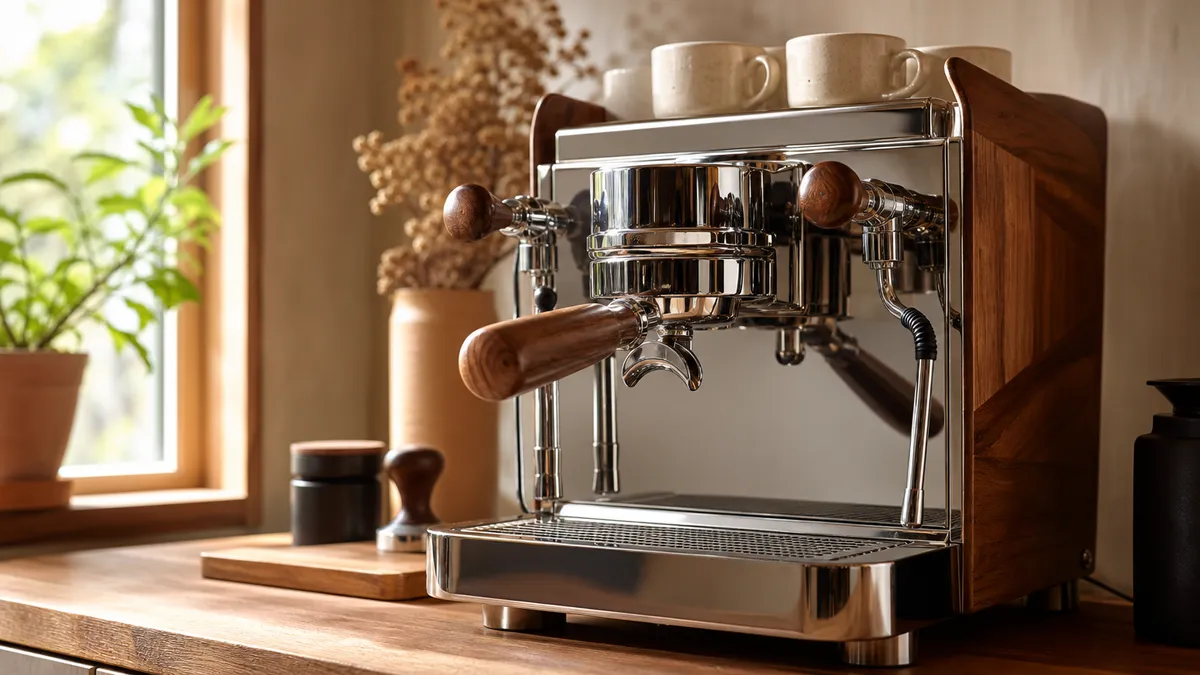
“Traditional” describes the familiar barista workflow. Ground coffee goes into a basket inside a portafilter, the removable handled holder. This locks into the group head, the assembly that delivers brewing water over the coffee.
The operator distributes and tamps the grounds, starts extraction and removes the spent coffee afterwards. A steam wand heats and textures milk.
Traditional does not mean antique or entirely manual. Electronic temperature control and automatic shot stopping can coexist with manually prepared baskets. The useful distinction is who does the preparation: a traditional machine leaves it largely to the operator; a bean-to-cup machine automates grinding and brewing internally.
Our coffee machine guide compares the main categories. Here, the focus is the portafilter workflow across enthusiast home machines and smaller workplace installations.
Groups and boilers: what actually matters?
Group design concerns how brewing water reaches the coffee and how that assembly stays hot. Boiler layout concerns the supply of brewing water and steam.
E61, saturated and other group designs
An E61-style group is the substantial exposed assembly associated with many enthusiast machines. In the original arrangement, a thermosyphon circulates hot water between the heat exchanger and group, helping maintain its temperature.
Its small operating lever controls valves and activates the pump. This differs from a piston-operated lever machine, where a lever and piston generate brewing pressure.
A saturated group is closely integrated with the coffee boiler, with brewing water extending into the group assembly. Other machines use different integrated or actively heated arrangements.
These are engineering approaches, not quality rankings. Assess the complete machine and its documented operating procedure rather than treating one group design as essential.
Single boiler, heat exchanger or separate boilers?
This comparison uses workflow and control as its criteria. Suitability is editorial judgement, not a manufacturer capacity rating.
| Architecture | How it works | Main compromise | Who it suits |
|---|---|---|---|
| Single boiler for brewing and steam | One boiler changes between brewing and steaming conditions | Waiting and a prescribed changeover procedure | Someone making drinks individually |
| Heat exchanger | Brewing water passes through a separate circuit heated by the steam boiler | Temperature management depends on the design and routine | An operator wanting a continuous espresso-and-milk workflow |
| Dual boiler | Separate boilers supply brewing water and steam | More systems to understand and maintain | An enthusiast wanting separate brew and steam control |
| Multi-boiler commercial layout | A steam boiler serves separate coffee boilers, sometimes one per group | Installation and operating requirements need assessment | A staffed setting with demanding or varied service |
A PID controller electronically regulates temperature towards a set point. Check whether the displayed temperature represents the steam boiler, coffee boiler or a calculated brewing setting.
Group count and boiler count are separate specifications. Two brewing positions do not necessarily mean two independent coffee boilers.
How much skill do traditional coffee machines need?
You do not need latte art skills, but you need a repeatable routine: adjust the grinder, measure coffee, prepare the basket evenly and check espresso yield.
Dialling in means adjusting that recipe until the coffee tastes right. A useful starting example is 18 g of ground coffee producing 36 g of espresso, a 1:2 dose-to-yield ratio, in roughly 25 to 35 seconds. These are starting points, not pass-or-fail limits.
A suitable espresso grinder is part of the system. Without grind adjustment, you have much less ability to correct an extraction that runs too quickly or slowly.
A realistic first-drink routine
This illustrates the work involved, rather than replacing the machine manual.
- Prepare the machine. Fill or connect it as instructed and let the group and portafilter reach operating condition. Where brew-temperature adjustment is available, 93°C is a reasonable initial setting.
- Measure the coffee. Use a basket suitable for an 18 g dose, or follow the basket and roaster’s recommended recipe.
- Prepare the basket. Distribute the grounds evenly, tamp level and lock the portafilter into the group.
- Brew by weight. Aim initially for 36 g out in about 25 to 35 seconds. Taste before changing the recipe.
- Steam milk if wanted. Use fresh, cold milk in a suitable jug, within its recommended working fill.
- Reset the station. Clear the basket, rinse as instructed and clean the steam wand immediately.
The espresso machine guide explores equipment and extraction choices in more detail.
Milk steaming and daily cleaning
Steaming introduces air while heating milk. Initially, the wand tip sits near the surface to incorporate air; it then sits deeper to circulate the milk and distribute bubbles into fine, glossy microfoam.
Purge before use to clear condensation. After steaming, turn off the steam before removing the jug, wipe the wand with a dedicated damp cloth and purge again as instructed.
La Marzocco’s home guidance suggests 55 to 60°C for ready-to-drink milk. This is a serving preference, not a food-safety treatment.
Baskets, portafilters, the group and drip tray also need regular cleaning. Backflushing cleans a compatible brew circuit using a blind basket. Only do it where the manual permits, using the specified product and procedure.
| Symptom | Likely cause to check | First action |
|---|---|---|
| Espresso reaches its target yield too quickly | Grind too coarse for the recipe | Adjust finer, keeping dose and yield consistent |
| Large bubbles remain in milk | Excess aeration or insufficient circulation | Introduce less air, then establish a rolling movement |
| Brewing and steaming cannot happen together | Single-boiler architecture | Follow the specified mode-change procedure |
| Milk residue dries onto the wand | Cleaning delayed after steaming | Wipe and purge immediately; remove deposits as instructed |
These are initial checks, not fault diagnoses. Stop using equipment with unexpected leaks, abnormal behaviour or electrical faults.
Brands
Compare architecture, dimensions, controls, intended use and support. These examples illustrate approaches, not a tested ranking; specifications are manufacturers’ claims checked in November 2026.
- Rancilio: the Silvia illustrates the compact single-boiler approach, including the need to change between brewing and steaming.
- Profitec: the PRO 400 is a heat-exchanger example. Its published depth increases from 448 mm without the portafilter to 558 mm with it, showing why working dimensions matter.
- La Marzocco: the GS3 combines dual boilers, a saturated group and separate coffee and steam temperature control.
- Faema: the E61 Legend manual documents the thermosyphon group and lever-operated pump workflow behind the recognisable E61 arrangement.
Features alone do not establish reliability or workplace suitability. Ask who services the exact model and whether its warranty covers your intended use.
Advantages/Benefits & Disadvantages
Advantages and benefits
Direct control: adjusting dose, yield and, where available, temperature makes traditional machines appealing for exploring different coffees.
Milk texture: manual steaming lets a practised operator vary aeration and serving temperature.
A teachable process: weighing input and output makes recipes easier to record and reproduce, helping explain why a drink changes.
Disadvantages
Operator dependence: automatic shot stopping cannot correct poorly prepared coffee.
Attention for every drink: preparing baskets, steaming milk and resetting the station are part of service.
Space and upkeep: the grinder, jugs, cleaning equipment and water treatment belong in the installation plan.
No guaranteed quality advantage: control helps only when used well. For easy workplace self-service, consider bean-to-cup machines.
Space, plumbing and water
Measure the machine, grinder, handle projection, wand movement and jug clearance. Allow access to the reservoir and drip tray, and check the supporting surface, electrical supply and service clearances against installation instructions.
Reservoir-fed machines do not need mains water. Plumbed installations may also need drainage, treatment and an accessible isolation point.
In England and Wales, connected installations must comply with the Water Supply (Water Fittings) Regulations 1999. Scotland and Northern Ireland have separate provisions. Have the installer confirm suitable backflow protection with the local water supplier.
Start with your supplier’s local water-quality information, then test against the manufacturer’s requirements. Thames Water, for example, offers a postcode checker. A drinking-water filter is not automatically appropriate espresso-machine treatment.
For workplace steam-boiler machines in Great Britain, ask the supplier and consult HSE guidance about the Pressure Systems Safety Regulations 2000. Where required, arrange a written scheme of examination and the appropriate examination before use. Servicing is not a substitute.
Who suits a traditional coffee machine?
At home, it suits someone who enjoys making espresso. Seek a demonstration covering grinder adjustment, steaming and cleaning, not just a prepared drink.
In a small workplace, our recommendation is to favour named, trained operators. Record daily drinks, peak demand and the proportion needing steamed milk, then ask suppliers to demonstrate that workload.
Do not translate headcount directly into groups or boilers. Occasional enthusiast use differs from serving a queue during a short break.
Request itemised written quotations covering the machine, grinder, installation, water treatment, training, servicing, consumables and any statutory examination. Compare these over the same period using your expected drink volume.
Consumer rights exist separately from manufacturer warranties, but a workplace purchase is not automatically a consumer transaction under the Consumer Rights Act 2015. Check the contract and intended-use terms.
Traditional coffee machines suit people who actively want the barista workflow. If nobody wants responsibility for it, choose a different system.
FAQ
Does automatic shot stopping remove the need for scales?
No, automatic shot stopping does not necessarily measure the espresso’s final weight. A volumetric system measures water delivery, while a machine with integrated brewing scales can work differently. Check what the control actually measures, and verify the drink against your recipe rather than assuming every programmed button produces the same yield.
Can a traditional machine make an Americano?
Yes, it can make an Americano by combining espresso with hot water. Whether the machine’s own hot-water outlet is appropriate for your intended volume depends on its design. Include long drinks in a supplier demonstration, rather than assessing a workplace installation solely on its ability to produce espresso and steam milk.
Is a domestic machine suitable for office use?
Not automatically: suitability depends on the manufacturer’s intended-use conditions and your actual workload. Obtain written confirmation about workplace use, warranty cover and servicing. A domestic machine serving a few carefully prepared drinks is a different proposition from equipment expected to remain available throughout a busy working day.
Where to go next
Read Commercial Espresso Machines for workplace installation and service requirements, and Manual Lever Espresso Machines if you want to understand piston-driven brewing. Return to Coffee Machines to compare the traditional workflow with the wider choice of systems.
Sources
-
Faema / Gruppo Cimbali, E61 Legend: Use and Maintenance Manual, revision 0551, publication year not stated, manufacturer document hosted by a distributor.
https://www.nimand.com/upload_dir/shop/Faema-E61-Legend-manual.pdf -
La Marzocco USA, Product Catalogue 2026, 2026, particularly the technology glossary and machine configurations.
https://lamarzoccousa.com/wp-content/uploads/2026/03/product-catalog2026.pdf -
Rancilio Group North America, Silvia Workflow, publication year not stated, current page checked in 2026.
https://www.ranciliogroupna.com/rancilio-silvia-workflow/ -
La Marzocco Home, Using Espresso Brew Ratios, 2022.
https://home.lamarzoccousa.com/using-espresso-brew-ratios/ -
Rancilio Group North America, How to Steam Milk, publication year not stated, current page checked in 2026.
https://www.ranciliogroupna.com/how-to-steam-milk/ -
La Marzocco, How to Steam Milk, 2023, searchable manufacturer guidance.
https://www.lamarzocco.com/it/en/how-to-steam-milk/ -
Profitec, PRO 400: Heat Exchanger Machine with Multifunction Switch, undated specification page, checked in 2026.
https://www.profitec-espresso.com/en/products/pro-400 -
La Marzocco, GS3 Product Brochure, undated brochure retrieved from the manufacturer’s 2023 document directory.
https://www.lamarzocco.com/it/wp-content/uploads/2023/04/product_brochure_gs3_eng.pdf -
Water Regs UK, All FAQs, backflow-protection guidance, and Booklets, current pages checked in 2026.
https://www.waterregsuk.co.uk/topics/all-faqs/
https://www.waterregsuk.co.uk/publications/booklets/ -
Thames Water, Water Quality, current page checked in 2026.
https://www.thameswater.co.uk/help/water-and-waste-help/water-quality -
La Marzocco UK, La Marzocco Water Specifications, undated searchable manufacturer guidance, checked in 2026.
https://www.lamarzocco.com/uk/en/technical-questions/la-marzocco-water-specifications/ -
Health and Safety Executive, Pressure Systems Safety Regulations 2000 (PSSR) and Introduction to Pressure Equipment, current guidance checked in 2026.
https://www.hse.gov.uk/pressure-systems/pssr.htm
https://www.hse.gov.uk/pressure-systems/about.htm -
UK Parliament, Consumer Rights Act 2015, section 2; GOV.UK, Accepting Returns and Giving Refunds: The Law, current guidance checked in 2026.
https://www.legislation.gov.uk/ukpga/2015/15/section/2
https://www.gov.uk/accepting-returns-and-giving-refunds
This guide was researched using manufacturer manuals and specifications, water-industry guidance, HSE guidance and UK consumer legislation; no first-hand machine testing is claimed.
Last checked: November 2026