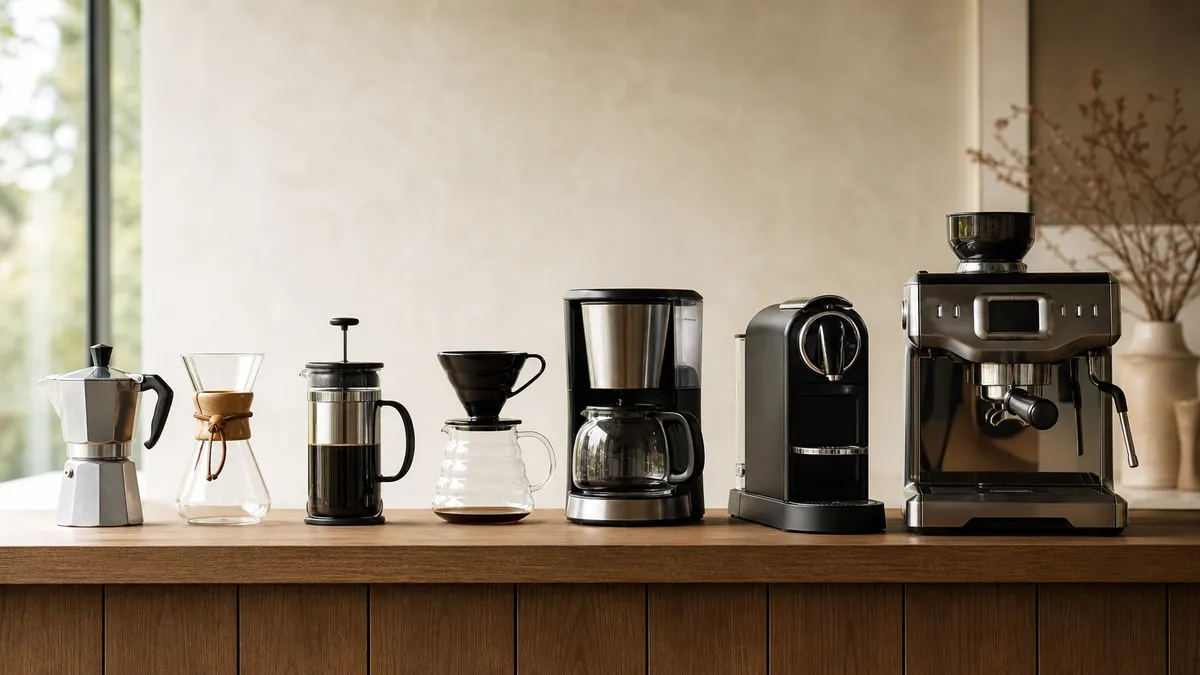
The main types of coffee machine are bean-to-cup, espresso, capsule and drip filter machines, alongside manual brewers such as the cafetière, AeroPress and moka pot. They differ in how water meets the grounds, how the drink is filtered and how much work you do yourself, so start with the coffee you want rather than the machine’s appearance.
In short
- For espresso and steamed-milk drinks, look at espresso machines or suitably equipped bean-to-cup machines.
- For a jug of black coffee, an automatic drip machine is a natural starting point; pour-over gives you control over the pouring.
- Single boiler, heat exchanger, dual boiler and thermoblock describe heating systems, not separate styles of coffee.
- A cafetière steeps coffee behind a mesh filter; an AeroPress adds a pressing stage and usually paper filtration.
- Moka, percolator, siphon and cezve brewers work differently, even when they share a hob or external heat source.
How the types of coffee machine fit together
Coffee equipment names describe different things. “Bean-to-cup” describes automation, “espresso” describes a brewing method, and “dual boiler” describes the heating arrangement. These categories overlap: a fully automatic bean-to-cup machine can brew espresso, while a manually operated espresso machine can use a boiler or an on-demand heater.
Manual coffee makers belong in this overview too, although they are not all machines in the electrical sense. Their brewing principles help explain why a cafetière produces a different texture from a paper-filtered pour-over.
Two useful terms are immersion, where grounds steep in water, and percolation, where water passes through a bed of coffee. Some brewers combine them. The coffee machines hub provides the wider equipment map.
Types of coffee machine compared
This table compares brewing mechanism, the drink each type naturally suits and the work involved. Suitability is an editorial judgement, not a ranking of flavour quality.
| Type | How it works | Best suited to | Main consideration |
|---|---|---|---|
| Bean-to-cup | Grinds, doses and brews automatically | Convenient individual coffees | Internal and milk-system cleaning |
| Pump espresso | Pumps water through compacted grounds | Espresso and steamed-milk drinks | Grinding and puck preparation |
| Lever espresso | Uses a hand-driven or spring-driven piston | Hands-on espresso | Technique and pressure control |
| Drip filter | Delivers heated water over a filter basket | Jugs of black coffee | Batch size and brewing control |
| Pod or capsule | Brews a prepared portion in a compatible system | Convenient individual drinks | Capsule compatibility |
| Cafetière | Steeps grounds, then separates them with mesh | Full-textured black coffee | Some sediment remains |
| AeroPress | Steeps, then presses coffee through a filter | Adaptable individual brews | Manual preparation |
| Moka pot | Heat-generated pressure moves water upwards | Concentrated stovetop coffee | Heat management |
| Cold brew | Extracts with cool water, then separates grounds | Cold coffee and concentrates | Advance preparation |
| Pour-over | Hand-poured water drains through grounds | Controlled black-coffee brewing | Pouring technique |
| Siphon | Moves water between chambers using pressure changes | Immersion coffee with filtration | Glassware and heat source |
| Cezve | Heats very finely ground coffee with water | Turkish-style unfiltered coffee | Grounds remain in the drink |
| Percolator | Repeatedly circulates liquid through grounds | Robust pot-brewed coffee | Repeated heating and extraction |
Automatic machines: bean-to-cup, drip and capsule
Bean-to-cup machines
A fully automatic bean-to-cup machine takes whole beans through grinding, dosing, compression and brewing, then discards the used grounds into an internal container. Many also prepare milk automatically, although the exact drink menu and milk arrangement depend on the model.
This makes the category useful when different people want individual drinks without handling loose grounds. Automatic preparation does not remove maintenance: grounds containers, drip trays, coffee circuits and milk components still need the care specified in the manual.
An espresso machine with a built-in grinder is not necessarily fully automatic. If you must move a portafilter, prepare the grounds and attach it to the machine, you are still doing part of the brewing workflow. Read bean-to-cup machines for that distinction in more detail.
Drip coffee makers and filter coffee machines
An automatic drip machine heats water and distributes it over ground coffee in a filter basket. The drink drains into a jug or server below, rather than being extracted as a concentrated espresso.
Its natural role is producing black coffee for several drinkers from one batch. You still choose the coffee, grind and dose, but the machine handles water delivery. Paper and reusable filters are not interchangeable in their effect on texture, so check which the brewer uses.
Pod or capsule machines
These machines use a prepared portion of coffee rather than asking you to grind and dose it. The capsule system determines compatibility, available drink formats and how brewing happens.
Not every capsule machine uses the same mechanism. Nespresso, for example, describes pressure extraction for Original and a spinning, centrifugal extraction process for Vertuo. Neither capsule shape nor a large foam layer tells you that two systems brew identically.
Choose by the drinks and compatible consumables you actually want, rather than treating “pod machine” as one uniform technology.
Espresso machines: the brewing method and the heating system
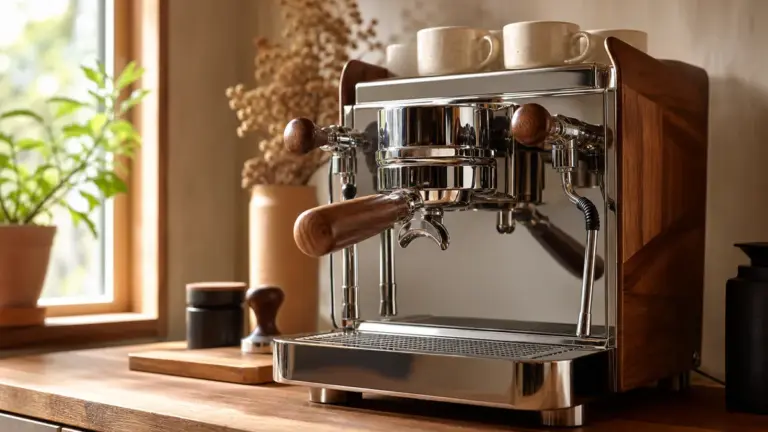
A pump espresso machine forces heated water through finely ground coffee held in a portafilter, the removable handle containing the filter basket. You normally grind, distribute and tamp, meaning compress, the grounds before attaching it.
Espresso is its core drink. Add a steam wand or another suitable milk system and it can also support cappuccinos, flat whites and lattes. The broader espresso machines guide covers preparation and machine variations.
The heating arrangement mainly changes temperature management and the sequence of brewing and steaming.
Single boiler
A conventional single-boiler machine uses the same boiler for brewing water and steam. It switches between the temperatures needed for those jobs, so you normally brew and steam in separate stages.
It suits a workflow where that pause is acceptable. After steaming, follow the manufacturer’s procedure for returning to brewing conditions rather than immediately pulling another shot.
Heat exchanger
A heat-exchanger machine heats brewing water through a separate passage inside a steam boiler. The brewing water and stored boiler water remain separate.
This arrangement can support brewing and steaming together. Temperature management varies between designs, so follow the particular machine’s instructions rather than assuming every heat exchanger needs the same flushing routine.
Dual boiler
A dual-boiler machine has separate boilers for brewing and steam. This allows the two jobs to operate at their respective temperatures and, on suitable machines, happen simultaneously.
The practical attraction is workflow, especially when preparing successive milk drinks. Two boilers do not by themselves prove that a machine makes better-tasting espresso.
Thermoblock, thermocoil and ThermoJet
On-demand heating systems heat water as it travels through a heated pathway rather than relying on a conventional stored-water brewing boiler. Thermoblock and thermocoil are common terms; ThermoJet is Sage’s branded heating technology.
Check the complete arrangement. One heater may serve brewing and steaming sequentially, while another machine may have a dedicated steam heater. The heating label alone does not tell you whether both tasks can happen together.
Manufacturer warm-up claims should also be read carefully: readiness of the heating system is not automatically a promise that every cup, portafilter and other component is fully warmed.
Lever espresso machines
Lever machines replace pump-driven extraction with a piston operated through a lever mechanism. They still make espresso, but how the pressure is produced becomes part of the user’s involvement.
With a direct lever, your movement applies force to the piston. With a spring lever, operating the lever loads a spring, which then drives extraction. The two arrangements therefore feel different in use.
Lever operation and water heating are separate questions. Check whether the particular machine has a boiler, how its brewing chamber is heated and whether it includes milk-steaming equipment. Choose a lever because you want that mechanical involvement, not because a handle guarantees superior coffee.
Manual brewers: cafetière, AeroPress, pour-over and moka
Cafetière
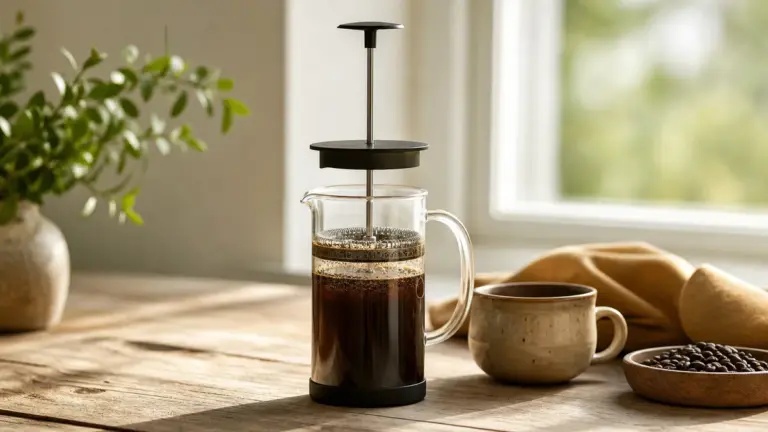
A cafetière, or French press, steeps ground coffee in hot water before a mesh plunger separates most of the grounds from the liquid. The plunger is a separator, not an espresso-pressure mechanism.
It suits drinkers who enjoy a substantial texture. Mesh filtration allows oils and some fine particles into the cup, so expect a different finish from paper-filtered coffee, including some sediment.
AeroPress
An AeroPress combines steeping with a pressing stage. You push the plunger to move brewed coffee through a filter into a suitable cup or server.
It can produce either a concentrated drink or a longer black coffee, depending on the recipe. Paper filtration gives a cleaner texture, while the optional metal filter allows more oils through. “Espresso-style” concentrate is a useful description, but it should not be confused with conventional espresso extraction.
Pour-over
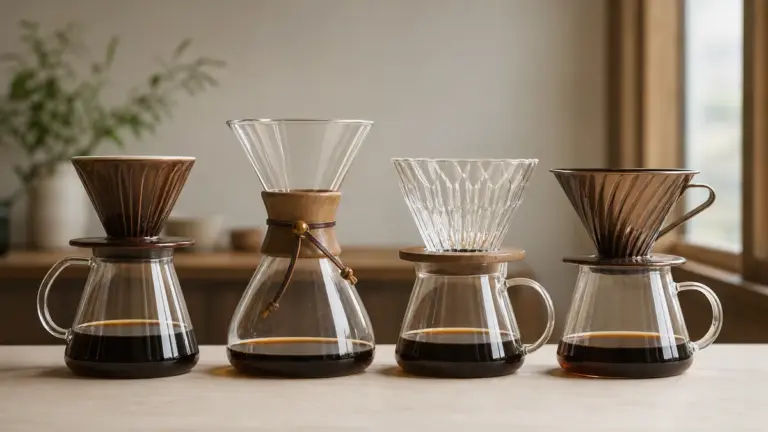
Pour-over is manual filter brewing: you pour hot water over grounds held in a dripper, and the coffee drains through into a cup or server. Unlike an automatic drip machine, you control water delivery yourself.
It suits someone who wants to adjust pouring and observe the brew. Paper-filtered versions emphasise a relatively clear texture, although filter material and recipe both affect the result.
Moka pot
A moka pot uses heat-generated pressure in its lower chamber to push water upwards through a basket of coffee and into the upper collector. It makes concentrated stovetop coffee, not conventional espresso.
It suits small, strong servings, including coffee that will be mixed with milk. Follow the pot’s filling instructions and do not tamp its grounds: Bialetti explicitly instructs users to fill the basket without pressing the coffee down.
Cold brew, siphon, cezve and percolator
Cold-brew makers
A typical immersion cold-brew maker holds grounds in cool water before separating them through a filter. Other designs slowly drip water through the coffee instead.
The defining feature is extraction without hot brewing water, not simply serving coffee over ice. Preparation is usually planned ahead: Toddy’s pitcher-pack instructions, for example, specify an 8 to 24 hour steep. Concentration depends on the recipe, so not every cold brew needs dilution.
Siphon brewers
A siphon, also spelt syphon, uses two connected chambers. Heating the lower chamber creates pressure that moves water upwards, where it mixes with the coffee.
Removing the heat lowers pressure in the bottom chamber and draws the drink back through a filter. It combines immersion brewing with a distinctive separation stage; cloth and metal filter options can produce different textures.
Cezve
A cezve is a small, long-handled pot used for Turkish-style coffee. Very finely ground coffee is heated with water, then served without filtering the grounds out.
It suits small, concentrated servings with a characteristic sediment. Let the grounds settle rather than expecting the clear finish of paper-filtered coffee.
Percolator
A percolator sends heated liquid up a central tube and over coffee held in a basket. The liquid drains back into the pot and circulates through the grounds repeatedly.
That repeated circulation distinguishes it from ordinary drip brewing and from a moka pot. It suits those who enjoy a robust pot-brewed style, but the repeated heating and extraction deserve attention rather than an unattended, indefinite brew.
Choosing your starting point
Begin with the drink, then decide which preparation tasks you want to keep. For espresso, compare automatic bean-to-cup preparation with a portafilter workflow; for black coffee, compare batch drip brewing with the hands-on approach of a cafetière or pour-over.
Next, check the actual model’s filtration, milk equipment, cleaning instructions and heating arrangement. Understanding these types of coffee machine is the first step; the complete buying guide turns those differences into a more detailed shortlist.
FAQ
Can I use pre-ground coffee instead of buying a grinder?
Yes, where the brewer accepts loose ground coffee and the grind suits the method. A cafetière and an espresso machine need different preparation, so “ground coffee” is not one universal specification. Some bean-to-cup machines also have a separate pre-ground chute, but check the particular model’s instructions before using it.
Does every coffee maker need electricity?
No, manual brewers do not necessarily need an electrical connection themselves. A cafetière, pour-over or AeroPress needs a supply of hot water, while a moka pot or cezve needs a suitable heat source. Check the whole preparation arrangement, rather than just whether the brewer has a plug.
Does a metal filter make the same coffee as paper?
No, filter material can noticeably change the drink’s texture. Paper captures oils and fine particles that can pass through a metal filter, generally giving a cleaner finish. Metal filtration tends towards a fuller mouthfeel, although the particular filter and recipe matter. Neither result is automatically better.
Where to go next
Read Coffee Machines: The Complete Buying Guide to turn your preferred brewing style into selection criteria. Continue with Bean-to-Cup Coffee Machines for automatic preparation, or Espresso Machines for the portafilter route.
Sources
Manufacturer material was used to establish mechanisms and documented features, not to endorse promotional claims about flavour or performance. Undated pages are identified as such rather than assigned an inferred publication year.
-
JURA, ENA instruction manual, undated, particularly “Grinding and brewing coffee beverages” and the pre-ground coffee instructions.
https://us.jura.com/-/media/global/pdf/manuals-na/Home/ENA/download_manual_ena_ul_english.pdf -
Gaggia, Classic UP, product information and operating FAQs, undated.
https://www.gaggia.com/manual-machines/classic-up/ -
Olympia Express, Cremina, Cremina SL and Maximatic, technical descriptions, undated.
https://www.olympia-express.ch/en/products/cremina
https://www.olympia-express.ch/en/products/cremina-sl
https://www.olympia-express.ch/en/products/maximatic -
LELIT, Bianca, manufacturer description, undated.
https://www.lelit.com/en-us/product/bianca-pesbn03 -
De’Longhi, Does La Specialista use a dedicated thermoblock heating system? and Nespresso Pixie EN124SAE, undated.
https://www.delonghi.com/en-us/faqs/Does-la-Specialista-use-a-dedicated-thermoblock-heating-system/a/82293
https://www.delonghi.com/en-us/p/pixie-nespresso-pixie-espresso-machine-with-aeroccino-by-de-longhi–aluminum—en124saeca/EN124SAE.html -
Sage, The Oracle Jet instruction book, document SES985_EU_UG8_A24, 2024.
https://assets.sageappliances.com/BES985/SES985_EU_UG8_A24_LR.pdf -
Moccamaster, How does a Moccamaster coffee machine work?, 23 September 2024.
https://www.moccamaster.eu/blog/post/how-does-moccamaster-work -
Nespresso, Difference Between Vertuo and Original, undated.
https://www.nespresso.com/ca/why-buy-a-nespresso-machine -
Bodum, Catalogue 2025, revision r3, 2025, French press and filtration sections.
https://prod-bodum-media.s3.eu-west-1.amazonaws.com/media_production/downloadable/Catalog%202025_r3.pdf -
AeroPress, How AeroPress Works, FAQs and What is the difference between the AeroPress Stainless Steel Filter and the AeroPress paper micro-filters?, undated.
https://aeropress.com/pages/how-it-works
https://aeropress.com/pages/faq
https://help.aeropress.com/en-US/what-is-the-difference-between-the-aeropress-stainless-steel-filter-and-the-aeropress-paper-micro-filters-123184 -
Hario, Basic V60 Brew Guide and “Next” Coffee Syphon, undated.
https://www.hario.co.uk/pages/brew-guides-v60-basic
https://www.hario-usa.com/products/coffee-syphon-next -
Bialetti, Moka Express instruction and warning sheet, undated manufacturer document hosted by Amazon.
https://m.media-amazon.com/images/I/913VOwvygKL.pdf -
Toddy, Cold Brew Pitcher Packs brewing instructions, undated.
https://toddycafe.com/downloads/toddy_pitcher_pack_brewing_instructions.pdf -
illy Australia, How to Make Turkish Coffee, undated.
https://illy.com.au/pages/how-to-make-turkish-coffee -
Cuisinart, Types of Coffee Makers Guide, undated, percolator section.
https://www.cuisinart.com/the-kitchen-guide/coffee-maker-guide-hub.html
This article was researched by comparing manufacturer manuals, technical descriptions and brewing instructions; no first-hand equipment testing is claimed.
Last checked: November 2026