Espresso machine backflushing cleans coffee oils and residue from the group head and its pressure-release pathway using a blind basket, water and, periodically, an approved detergent. Only backflush a machine whose manufacturer authorises it: a suitable three-way valve or equivalent exhaust arrangement is essential, and the machine’s own cleaning instructions take priority over a generic routine.
In short
- Check the instructions for your exact model before fitting a blind basket.
- A blind basket has no brewing holes; some machines instead require a supplied cleaning disc.
- Use espresso-machine cleaning detergent, not descaler, washing-up liquid or milk-system cleaner.
- Complete the specified water-only rinse after detergent cleaning.
- Stop brewing and allow pressure to discharge before removing the portafilter. Never force a pressurised handle.
What backflushing does
The group head is the assembly into which the portafilter, the removable coffee-holding handle, locks. During brewing, water passes through its shower screen and into the coffee. Coffee oils and fine particles can accumulate around the screen and in the group’s discharge pathway.
Backflushing temporarily blocks the normal outlet with a blind basket. Operating and stopping the brew cycle allows cleaning water to reach the group’s exhaust route, carrying loosened residue into the drip tray. Detergent helps remove the oily deposits that water alone does not adequately clean.
This is different from an ordinary group flush, where water runs freely through the shower screen without a blocked basket. It is also different from descaling, which addresses mineral deposits rather than coffee oils. Our coffee machine cleaning guide explains how these separate jobs fit together.
Which machines can be backflushed?
Manufacturer approval matters more than the presence of a particular feature on a retailer’s specification sheet. Look for a procedure headed “backflushing”, “brew group cleaning” or “cleaning cycle” in the instructions for your exact model.
Many suitable pump-driven espresso machines have a three-way solenoid valve: an electrically operated valve connecting the water supply, group head and discharge route. After brewing stops, it closes the supply and releases pressure from the group towards the drain.
Not every compatible machine uses an electrically operated valve. Some lever-operated groups have a mechanical exhaust arrangement and their own cleaning sequence. Profitec’s PRO 600 instructions, for example, specify particular brew-lever positions during detergent cleaning.
Use this decision rule:
- The manual specifies a blind basket: use the correct basket and its stated routine.
- The manual specifies a cleaning disc and automatic programme: use that arrangement, not an improvised manual cycle.
- The manual gives no backflushing procedure: ask the manufacturer before attempting one.
Do not apply this portafilter method to a bean-to-cup machine. Follow its dedicated cleaning programme instead, with separate care for the milk circuit as explained in cleaning bean-to-cup milk systems.
Equipment, detergent and preparation
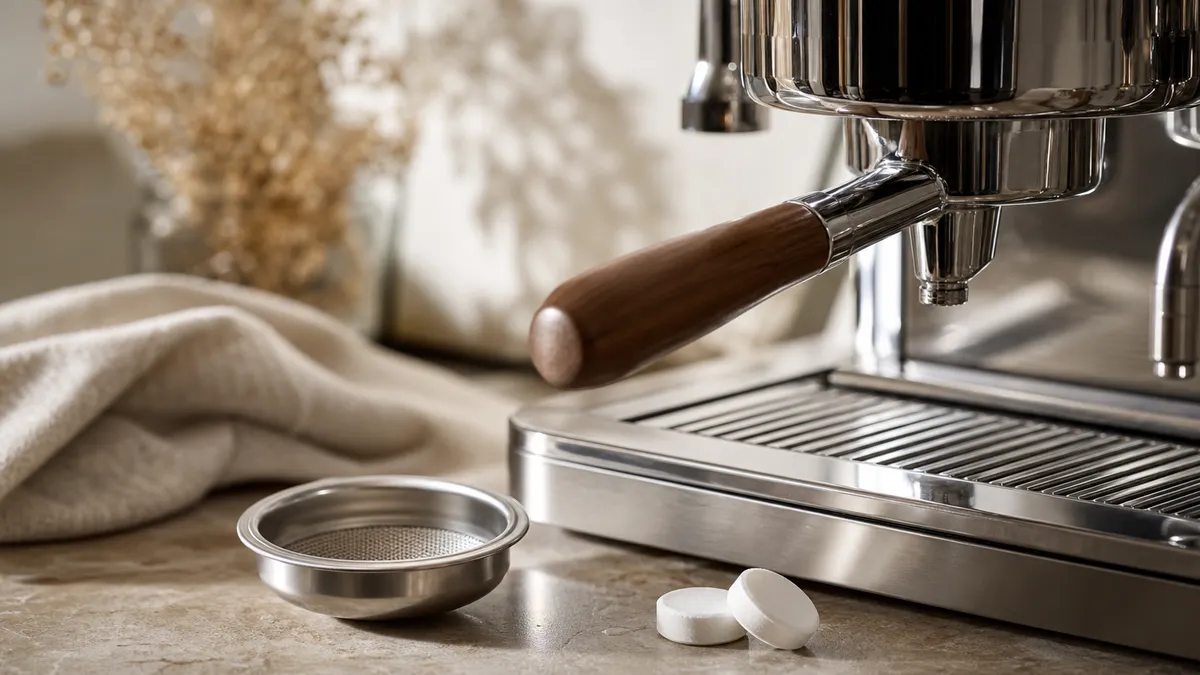
You need the manufacturer-approved blind basket or cleaning disc, suitable espresso-machine detergent, a group brush, a clean cloth and access to fresh water. Have the drip tray correctly installed and empty it before starting.
A blind basket, also called a blank basket, has a solid base rather than the perforated base of a brewing basket. A cleaning disc sits inside a basket where the manufacturer specifies it. Do not substitute one arrangement for another simply because both appear to block the outlet.
Choose a cleaner explicitly intended for espresso-machine group cleaning and compatible with your machine. Powder quantities and tablet strengths differ, so “one tablet” and “one spoonful” are not interchangeable instructions.
For example, Puly Caff Plus NSF specifies 3 to 5 g of its powder for its published commercial backflush routine. Urnex specifies up to 3 g of Cafiza powder. These are product-specific directions, not a universal dose.
Keep backflush detergent out of the water reservoir unless the machine manufacturer expressly instructs otherwise. For the routine below, it belongs in the blind basket.
Espresso machine backflushing: step by step
The example below follows Puly Caff Plus NSF’s published commercial routine. Use it only where your machine manufacturer permits that method and cleaner; otherwise follow the machine’s own programme, timings and dose.
-
Prepare the machine. Fill the reservoir as instructed, empty the drip tray and bring the machine to its normal cleaning-ready condition. Keep hands clear of hot discharge water.
-
Check temperature instructions. Follow the machine’s required operating state rather than choosing a new cleaning temperature. Profitec states that its machines have factory brewing settings within 88 to 95°C, but this is not a universal backflushing target.
-
Clean accessible residue. Remove the portafilter and brush loose grounds from the group gasket and shower-screen area. Leave the shower screen fitted during backflushing unless the manual explicitly directs otherwise.
-
Fit the blind basket and detergent. For this Puly Caff Plus NSF example, add 3 to 5 g of powder, then lock the portafilter securely into the group.
-
Run the cleaning pulses. Operate brewing for 10 seconds, then stop for 10 seconds. Complete five on-and-off cycles. Let the group discharge after each stop.
-
Remove and rinse safely. Once pressure has released, remove the portafilter, empty the blind basket and rinse it thoroughly. Flush the exposed group as directed, avoiding splashes.
-
Backflush with clean water. Refit the rinsed blind basket without detergent. Repeat five cycles of 10 seconds on and 10 seconds off.
-
Return to brewing. Remove the blind basket after pressure releases and refit the normal coffee basket. Puly Caff’s instructions finish by making and discarding an espresso.
Cleaning the removable parts alongside it
Backflushing does not replace washing the basket and portafilter. Where both the machine and cleaner permit soaking, use the cleaner’s separate soaking directions.
For example, Urnex specifies 6 g of Cafiza powder in 1,000 ml of hot water, with a 30-minute soak for suitable parts. Keep the portafilter handle out of the solution and rinse everything thoroughly with fresh water. This is a soaking mixture, not a reservoir dose or a measured volume to force through the machine.
How often should you backflush?
There is no single interval that suits every espresso machine. Separate the water-only routine from the detergent routine, then follow the model’s instructions and usage prompts.
Manufacturer examples show why a blanket weekly rule is unreliable:
| Manufacturer example | Published cleaning guidance | How to apply it |
|---|---|---|
| La Marzocco Home maintenance article | Daily water-only backflush; weekly detergent backflush | Check the model manual for its exact sequence |
| Profitec MOVE manual | Group cleaning after approximately 90 to 140 espressos | Track usage and follow the cleaning reminder |
| Sage Bambino Plus BES500 manual | Cleaning alert after 200 extractions | Use the supplied disc, tablet and automatic cycle |
These are examples, not interchangeable schedules. At a shared workplace machine, record the date, cleaning product and completed rinse so the next user knows the job is finished.
More detergent cleaning is not automatically better. Profitec warns that excessive detergent cleaning can degrease moving parts in its PRO 400 and JUMP groups, causing squeaking and potentially premature wear.
Common mistakes
Assuming every espresso machine can do it
A portafilter and pump do not prove compatibility. This mistake happens because online instructions often describe a machine category rather than a precise model. Confirm the approved procedure before blocking the outlet.
Adding extra detergent
A heaped spoonful feels reassuring, but it replaces the manufacturer’s measured instruction with guesswork. Weigh powder where a gram dose is specified, and do not add another tablet just because part of the first remains.
Confusing cleaning with descaling
Both involve cleaning products, but they address different deposits. Backflushing is not a substitute for the water-treatment and scale-management instructions covered in descaling in UK hard water.
Removing the portafilter too early
The pump stopping is not permission to force the handle loose. Wait for the machine’s pressure-release sequence to finish. If release appears abnormal, stop and obtain manufacturer or service advice rather than trying to vent pressure by loosening the handle.
Skipping the rinse
Dirty discharge disappearing does not complete the cleaning procedure. The water-only stage removes cleaner from the same pathway just treated with detergent. Finish the specified rinse before returning the machine to use.
Troubleshooting during and after backflushing
Treat the following as checks, not diagnoses. Persistent pressure-release, leakage or electrical problems need model-specific service advice.
| Symptom | Likely cause or first check | Fix |
|---|---|---|
| Cleaner or tablet remains after an automatic cycle | Incomplete dissolution | Follow the model’s repeat-cycle instructions; do not automatically add more cleaner |
| Foam remains after rinsing | Cleaner has not been fully cleared | Continue the manufacturer-approved water-only rinse |
| Water escapes around the portafilter rim | Dirty sealing area, incorrect fitting or worn gasket | Stop, allow pressure to release, then inspect and clean; seek help if leakage persists |
| Mechanical brew lever squeaks after detergent cleaning | Detergent may have removed lubrication | Follow manufacturer maintenance advice; do not spray household lubricant into the group |
| Pressure does not appear to discharge normally | Possible exhaust-path or valve problem | Stop cycling and do not force the handle; contact the manufacturer or a qualified technician |
A backflush is maintenance, not a universal repair. If an approved cleaning cycle does not restore normal operation, record what happened and seek advice through the appropriate equipment care and repairs route.
FAQ
Should I discard the first espresso after backflushing?
Yes, where the cleaner or machine instructions require it. Both Puly Caff Plus NSF and Urnex Cafiza directions include making and discarding an espresso after rinsing. This final shot does not replace the water-only rinse, and it should not be used as a taste test for whether cleaning chemicals remain.
What if a cleaning tablet has not dissolved?
Follow the instructions for your exact machine rather than adding another tablet. Sage’s Oracle manual, for example, says to repeat the cleaning steps without inserting a new tablet if the original has not dissolved completely. Afterwards, rinse the basket and portafilter thoroughly as directed before returning to brewing.
Should I remove the shower screen before backflushing?
Normally, leave it fitted unless your machine’s instructions say otherwise. La Marzocco’s backflushing guidance specifically advises keeping the screen in place during the cycle. Removing and soaking a screen can be a separate maintenance task, but dismantling instructions and safe cooling requirements depend on the machine.
Where to go next
Read Coffee Machine Cleaning Guide for the wider routine, then How to Descale a Coffee Machine in UK Hard Water for the separate problem of mineral deposits. Cleaning a Coffee Grinder covers another source of retained coffee residue that espresso machine backflushing cannot reach.
Sources
-
La Marzocco USA, What is a 3 way solenoid valve and how does it keep your espresso machine working?, 10 March 2025. Explains group supply, pressure release, discharge and valve-related faults.
URL: https://www.lamarzoccousa.com/news/blog/3-way-solenoid-valve/ -
Asachimici, Puly Caff Plus NSF Powder and Tabs: Technical Data Sheet / H.A.C.C.P. Specifications, undated retrieved edition. Provides detergent dose, cleaning pulses, rinsing and discarded-shot instructions.
URL: https://www.asachimici.com/it/system/files_force/allegati/pulycaff_NSF_polvere%2Btabs_EN_HACCP_0.pdf -
Urnex, Cafiza Powder: Instructions, undated live edition. Provides product-specific dosing, water-only rinsing, discarded-shot and accessory-soaking directions.
URL: https://urnex.com/cafiza-powder -
Profitec, Service: Frequently Asked Questions, undated live edition. Provides the manufacturer’s factory brewing-temperature range and directs owners to model-specific cleaning instructions.
URL: https://www.profitec-espresso.com/en/service -
La Marzocco USA, How to backflush your espresso machine in 5 steps (and why we do it), 3 March 2025. Covers cleaning pathways, water-only rinsing and leaving the shower screen installed.
URL: https://www.lamarzoccousa.com/news/blog/how-to-backflush-your-espresso-machine/ -
La Marzocco Home, The Tale of the Dirty Solenoid, 31 October 2025. Gives a daily water-only and weekly detergent maintenance schedule.
URL: https://home.lamarzoccousa.com/backflush-from-the-living-dead-tales-of-the-dirty-solenoid/ -
Profitec, MOVE Operating Instructions, MOVE_BA_V1.0, undated retrieved edition, sections 11.7.1 to 11.7.3. Specifies cleaning preparation, usage interval and post-rinsing.
URL: https://www.profitec-espresso.com/media/pages/produkte/move-2-0/e13fd15251-1787224888/ba-move.pdf -
Sage, The Bambino Plus, BES500 Instruction Book, undated retrieved edition, “Care & Cleaning”. Specifies the cleaning alert, supplied disc and automatic programme, separately from descaling.
URL: -
Profitec, PRO 400 and JUMP Operating Instructions, undated retrieved edition, section 7.2. Warns about hot water and excessive detergent cleaning of moving parts.
URL: https://www.profitec-espresso.com/media/pages/produkte/pro-400/6f52c5c90c-1778593561/ba_pro400-jump.pdf -
Sage, The Oracle, SES980 Instruction Book, file edition SES980_EU_UG6_C20_WEB, “Cleaning Cycle”. Covers incomplete tablet dissolution and post-cleaning rinsing.
URL: https://assets.sageappliances.com/BES980/SES980_EU_UG6_C20_WEB.pdf -
Profitec, PRO 600 Operating Instructions, undated retrieved edition, section 7.2. Demonstrates a model-specific mechanical brew-lever cleaning sequence.
URL:
Research used retrieved manufacturer manuals, technical directions and manufacturer maintenance guidance; the method is a conditional published example, not a claim of first-hand testing.
Last checked: November 2026