Choose coffee filters that match your brewer’s shape and size first, then choose the material for the cup you enjoy: paper for a cleaner texture, metal for more body, or cloth if you are happy with a more involved cleaning routine. A filter that fits properly is a better starting point than any claim about superior flavour.
In short
- Match the brewer’s specified filter shape and size, not just the number of “cups” on the packet.
- White paper is bleached and brown paper is unbleached; colour alone does not establish brewing quality or environmental impact.
- Rinse pour-over papers as the manufacturer directs, then discard the rinse water.
- Reusable filters need thorough cleaning: retained coffee oils can restrict flow.
- Check local disposal instructions for used papers, and your workplace waste contractor’s rules for office collections.
Cone Filters
“Cone filter” can describe more than one shape. A pointed cone, such as a V60 paper, is different from the flattened, wedge-shaped bag used in many filter machines. Do not assume that papers described as conical are interchangeable.
Start with the brewer’s manual or the marking on its filter holder. Melitta specifically advises checking these because the wrong size can tear or fold over during brewing. Its wedge-shaped papers also need their embossed edges folded so they sit securely inside the holder.
Understanding size markings
Filter numbers belong to particular product systems, not a universal sizing standard. Hario lists V60 papers in sizes 01, 02 and 03, with manufacturer-rated capacities of 1 to 2, 1 to 4 and 1 to 6 cups respectively. These are the maker’s serving descriptions, not a promise that each “cup” equals your usual mug.
Order by the brewer’s model and specified paper size. Keep the packet from a correctly fitting supply, or record its product reference before replenishing a shared office cupboard.
For a first purchase, choose the manufacturer’s specified paper or an alternative explicitly identifying that brewer and size. Experiment with different papers only after establishing a reliable baseline. The wider brewing accessories guide puts filters alongside the other equipment you might need.
Basket Filters
Basket filters have a flat base and raised sides, often with pleats. They appear in both automatic batch brewers and smaller manual brewers, but a similar appearance does not establish compatibility.
BUNN’s published filter reference matches papers to brewer families and gives both an overall measurement and a base diameter. That is a useful reminder to check the whole specification rather than buying a packet labelled simply “basket filters”.
For an office batch brewer, record the approved filter reference beside the machine. This makes repeat ordering straightforward and avoids relying on whoever remembers what the previous packet looked like.
Small flat-bottom brewers
Specialist flat-bottom papers are also model-specific. Kalita, for example, specifies its Wave 185 papers for the Wave 185 dripper. A large commercial basket paper is not an equivalent merely because both have flat bottoms.
Seat the paper carefully rather than forcing it into position. If it folds over or sits awkwardly, check compatibility before adding coffee. A different filter is not a substitute for the right supporting basket.
Paper, Metal and Cloth Filters
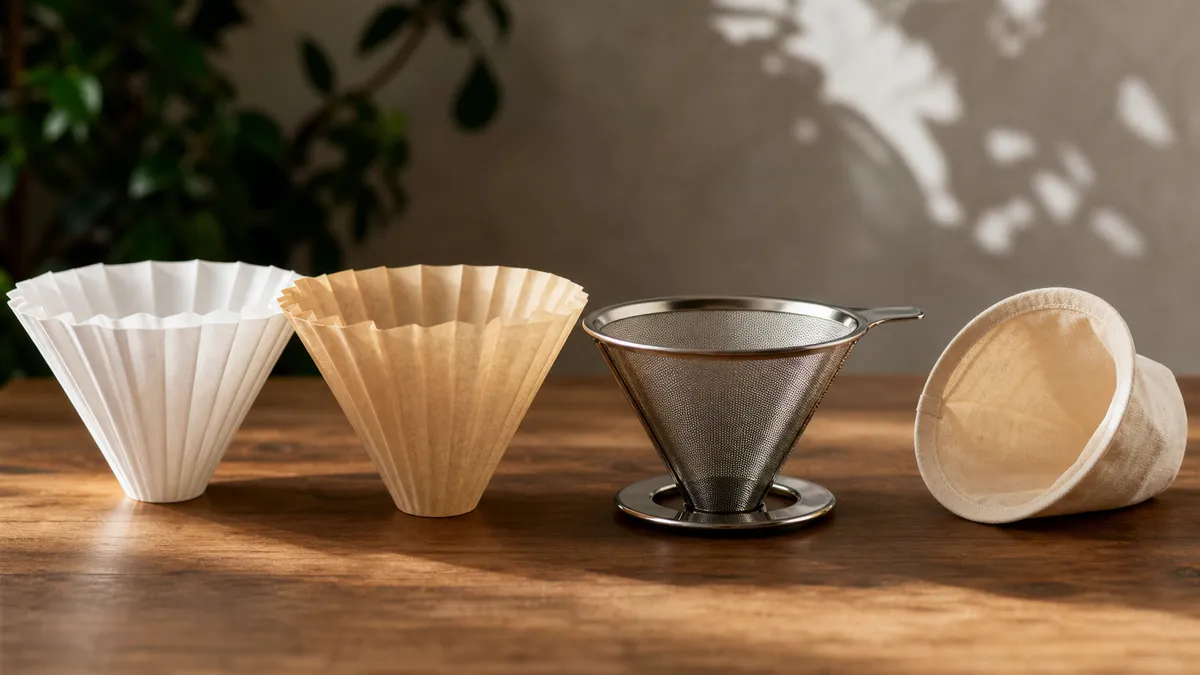
Compare materials by three practical criteria: the texture you want, the cleaning you will actually do, and compatibility with your brewer. There is no single winner across all three.
“Body” means the sense of weight or fullness in the mouth. “Clarity” describes how cleanly you perceive flavours, rather than how strong the coffee is.
| Material | Typical cup character | Main advantage | Main compromise | Best suited to |
|---|---|---|---|---|
| Paper | Cleaner texture, with oils and particles retained | Straightforward disposal after brewing | A fresh filter is needed each time | Drinkers who prioritise clarity and simple clean-up |
| Metal | More oils pass through, giving fuller body | Reusable | Thorough cleaning is essential | Drinkers who prefer a weightier cup |
| Cloth | Maker-dependent; can combine a rounded texture with particle filtration | Reusable fabric filtration | More demanding care and drying | Regular users willing to maintain it carefully |
These are starting points, not guarantees. AeroPress describes its own metal filter as producing a fuller-bodied cup than its paper filter. CoffeeSock’s claims about cloth and oil retention are based on observation and taste tests, not laboratory measurements.
Paper: bleached and unbleached
White filter paper has been bleached; natural brown paper has not. Melitta and Hario describe oxygen-bleached options, but do not assume every white paper uses an identical manufacturing process. Check the product’s published details.
Manufacturers differ in their taste advice. Melitta says its white and brown papers have identical properties and no taste difference. Moccamaster warns that brown papers may impart a paper-like flavour and recommends its oxygen-whitened papers.
The useful lesson is narrower than “white is better” or “brown is better”: assess the particular paper in your brewer. If you notice a dry cardboard note, rinsing is a sensible first check before changing coffee.
Hario directs users to rinse its papers before brewing. In a pour-over, this also warms the brewer and receiving vessel. Discard the rinse water so it does not become an unmeasured addition to the drink.
For automatic machines, follow the machine’s instructions rather than assuming every pour-over preparation step applies.
Metal: reusable, but not maintenance-free
A metal filter can suit someone who finds paper-filtered coffee too light in texture. More oils passing into the cup can give a fuller mouthfeel, but the result depends on the particular filter.
Choose a filter explicitly compatible with your brewer. AeroPress, for example, distinguishes Standard and XL filter sizes; “reusable metal filter” is not a sufficient specification.
Cleaning matters as much as fit. Moccamaster warns that inadequately cleaned mesh filters can clog and contribute to slow flow or an overflowing basket. Empty the grounds and follow the filter manufacturer’s cleaning instructions, including whether dishwasher cleaning is permitted.
Cloth: choose the care routine as well as the flavour
Cloth is worth considering if you enjoy maintaining brewing equipment, but it is not the simplest option for an occasionally used office tea point.
For its cotton filters, CoffeeSock advises emptying the grounds, rinsing thoroughly and hanging the filter to dry completely. Its published routine also includes boiling in fresh water for 10 minutes every 6 to 8 weeks to remove accumulated oils.
Those instructions apply to that product, not every fabric filter. Follow the maker’s guidance for your cloth, including preparation before first use and storage between brews. Do not borrow a storage routine from a different fabric simply because both products are called coffee socks.
Choosing and Using Coffee Filters
Use this sequence to narrow the choice:
- Identify the brewer. Find its model and the specified filter reference before shopping.
- Confirm shape and size. Distinguish pointed cone, wedge-shaped bag and flat-bottom basket.
- Choose your priority. Start with paper for a clean texture, or compatible metal if fuller body matters more. Consider cloth only if its care routine suits you.
- Establish one repeatable brew. Keep the coffee, dose and water quantity unchanged while assessing the filter.
- Change one variable at a time. If you change paper or material, record any change in drainage and taste before adjusting the grind.
A small brewing kit need not become a collection of overlapping gadgets. See essential brewing accessories for help deciding what earns its place.
A paper-filter baseline
For a V60 02, Hario UK’s published method provides a useful starting point:
- Fit the specified 02 paper, rinse it with hot water and discard the rinse.
- Add 15 g of medium-fine coffee.
- Use 250 g of brewing water, approximately 250 ml, at 92 to 96 degrees Celsius. This is a coffee-to-water ratio of approximately 1:16.7 by weight.
- Wet the grounds, wait around 30 seconds, then continue pouring slowly.
- Aim initially for approximately 2 minutes 30 seconds overall, adjusting according to taste and drainage.
This is a baseline for that brewer, not a universal filter recipe. Coffee scales help keep the comparison consistent; gooseneck kettles explain the pouring equipment without needing to duplicate it here.
Troubleshooting fit and flow
| Symptom | Likely cause | Fix |
|---|---|---|
| Paper folds over during brewing | Wrong size or poor seating | Check the specified paper and fold seams as directed |
| Basket fills towards overflowing | Grind too fine, excessive dose or restricted outlet | Stop brewing safely; check the brewer’s instructions, dose and outlet |
| Reusable filter drains increasingly slowly | Coffee-oil build-up | Clean using the filter maker’s method |
| Paper-like flavour | The particular paper or preparation | Rinse where directed, then compare another compatible paper |
Do not automatically add extra filtration to solve a problem. Moccamaster specifically advises against combining paper and reusable mesh filters in its brewers.
Why Shape and Material Both Matter
Shape changes how water moves through the bed of grounds. Material changes what passes into the finished drink. These are related but separate effects: changing from a paper cone brewer to a metal flat-bottom brewer changes several things at once.
Controlled sensory research published in the Journal of Food Science found that basket geometry affected the sensory properties of drip coffee. The comparison involved flat-bottom and semi-conical baskets, not every cone and basket brewer available.
That distinction matters. The research supports taking geometry seriously, but it does not establish that every flat-bottom brewer is sweeter, or every pointed cone produces brighter coffee. Nor does it establish a universally preferred shape.
If you want to investigate filters rather than whole brewing systems, keep the brewer and recipe fixed wherever compatibility allows. Treat the first brew after a change as a comparison, not proof that the new filter is better.
Waste and Disposal
Paper filters create a fresh used item with each brew; reusable metal and cloth filters require cleaning instead. That difference alone does not establish which option has the lower overall environmental impact.
Avoid treating “unbleached”, “reusable” or “compostable” as a complete environmental assessment. Consider how long you will use the product, its cleaning requirements and the disposal route actually available to you.
North London Waste Authority accepts paper coffee filters in the food-waste service described in its guidance. Check your own council’s instructions rather than treating that as a UK-wide rule. For an office, ask the commercial waste contractor specifically whether used filter papers may accompany the grounds.
Keep replacement papers away from water and dust, as Kalita advises. The best coffee filters for your routine are compatible, produce a cup you enjoy, and come with a care or disposal method you can follow consistently.
FAQ
Can I put a paper filter inside a permanent metal filter?
Only if the brewer manufacturer explicitly permits it. Adding paper changes the filtration arrangement and may restrict drainage. Moccamaster specifically advises against using reusable mesh and paper together in its brewers. Use the approved combination rather than assuming two filters must produce cleaner or better coffee.
Can I wash a metal coffee filter in the dishwasher?
Check the instructions for the exact filter. AeroPress permits top-rack dishwasher cleaning for its reusable metal filter, but that does not establish compatibility for other products. Whatever method is approved, remove the grounds first and check that the filter is free of accumulated coffee residue before brewing again.
Does cloth always produce a cup halfway between paper and metal?
No, that description is a useful tasting shorthand rather than a measured rule. CoffeeSock says its filters retain more oils than a French press but fewer than paper, while explicitly stating that this is based on observation and taste tests rather than laboratory testing. Other fabrics and constructions need their own evidence.
Where to go next
Read Essential Brewing Accessories to build a practical kit around your chosen filters, then Scales to make comparisons repeatable. Gooseneck Kettles is the useful next read if you want more control over manual pouring.
Sources
-
HARIO Europe, V60 Filter Paper, 01/02/03 Size (40 pcs), undated product specification, checked November 2026. Filter sizes, manufacturer-rated capacities, bleaching and rinsing instructions.
URL: https://www.hario-europe.com/products/v60-filter-paper-01-02-03-size-40-pcs -
Melitta UK, Filters, undated manufacturer FAQ, checked November 2026. White and brown paper, size identification, seam folding and fit.
URL: https://www.melitta.co.uk/faq/filter-papers -
Kalita USA, Kalita Wave 185 Coffee Filters, undated product specification, checked November 2026. Model compatibility, pre-wetting and storage.
URL: https://kalitausa.com/products/kalita-wave-185-paper-filter-100ct -
BUNN, Paper Filter Reference, undated manufacturer reference sheet, checked November 2026. Brewer-family compatibility and filter measurements.
URL: https://resource.bunn.com/assets/web/pdfs/PaperFiltersRefPage.pdf -
AeroPress, Filters, undated manufacturer support collection, checked November 2026. Paper and metal cup character, Standard and XL compatibility, and dishwasher instructions.
URL: https://help.aeropress.com/en-US/articles/filters-33629 -
CoffeeSock, FAQs and How to Clean Your Cotton Coffee Filter, undated manufacturer guidance, checked November 2026. Cloth-filter care, flow restriction and limitations of the maker’s oil-retention evidence.
URLs: https://coffeesock.com/faqs and https://coffeesock.com/sock-care -
Moccamaster USA, What type of filter should I use in my Moccamaster? and My brew basket is overflowing, undated manufacturer support articles, checked November 2026. Paper recommendations, mesh cleaning and overflow troubleshooting.
URLs: https://support.moccamaster.com/hc/en-us/articles/1500009392802-What-type-of-filter-should-I-use-in-my-Moccamaster and https://support.moccamaster.com/hc/en-us/articles/1500009427462-My-brew-basket-is-overflowing -
Hario UK, Expert V60 Brew Guide, undated manufacturer brewing instructions, checked November 2026. Dose, water quantity, temperature, rinsing and timing.
URL: https://www.hario.co.uk/pages/brew-guides-v60-expert -
Frost, Ristenpart and Guinard, Effect of Basket Geometry on the Sensory Quality and Consumer Acceptance of Drip Brewed Coffee, Journal of Food Science, 2019. Primary controlled sensory research comparing flat-bottom and semi-conical baskets.
URL: https://pages.uoregon.edu/chendon/coffee_literature/old_literature/2019%20J.%20Food%20Sci.%2C%20%20Basket%20geometry%20from%20sensory%20–%20no%20control%20for%20concentration.pdf -
North London Waste Authority, Coffee filters, undated disposal guidance, checked November 2026. Acceptance of paper coffee filters in the food-waste service described.
URL: https://www.nlwa.gov.uk/whatcanwerecycle/coffee-filters
This article was researched using manufacturers’ published specifications and care instructions, primary sensory research and local-authority disposal guidance; no first-hand product testing is claimed.
Last checked: November 2026