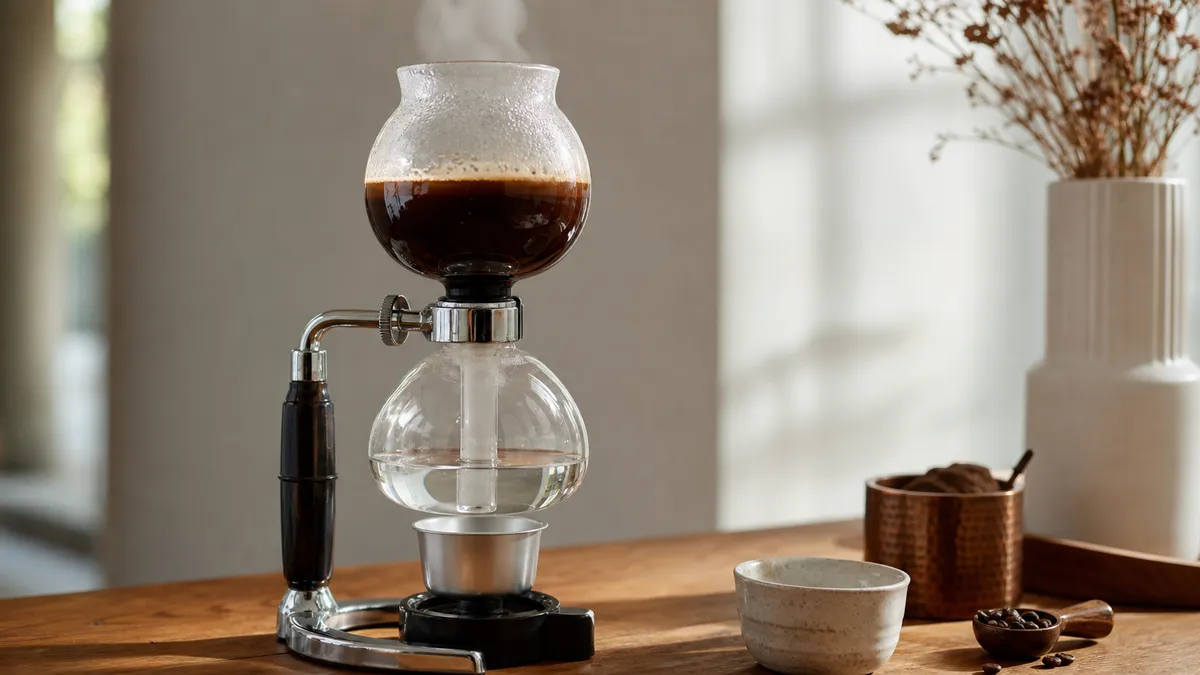
Siphon brewing uses heat to push water into an upper chamber, where coffee steeps, then draws the drink back through a filter as the lower chamber cools. Start with 20 g of coffee and 300 g of water, a 1:15 coffee-to-water ratio, and concentrate on gentle stirring, steady heat and an unobstructed drawdown.
In short
- Use a brewer whose permitted working capacity includes 300 ml, with its correct filter and an approved heat source.
- Start with a medium-fine grind and aim for approximately 93 °C in the upper chamber before adding coffee.
- For the starting method below, remove the heat after 60 seconds of steeping, then allow roughly 30 to 60 seconds for drawdown.
- Keep the lower globe dry outside, never heat it empty and never move a lit alcohol burner.
- Clean the filter after every brew. For Hario cloth filters, follow the manufacturer’s instructions for refrigerated storage in fresh water.
How a siphon brewer works
A siphon, also spelt syphon, has a lower water globe and an upper brewing chamber joined by a tube. A filter sits over the tube’s entrance inside the upper chamber.
Heating increases pressure in the lower globe, pushing water upwards. Once the heat is removed, cooling and condensation of water vapour reduce pressure below; atmospheric pressure above helps drive the coffee back through the filter. This returning flow is called drawdown.
The grounds steep together in water before filtration, making this primarily an immersion method. Our brewing methods hub puts it alongside other approaches without requiring you to master the physics before making a drink.
Equipment, filters and heat source
You need a complete siphon brewer, its compatible filter, a suitable heater, a grinder, scales, a timer and a bamboo or manufacturer-approved plastic stirrer. A thermometer is useful while learning.
Choose a batch within the manufacturer’s working limits, not simply the largest volume that fits inside the glass. The method here is for a manually controlled, stand-mounted brewer, not an automatic electric siphon.
Choosing the filter
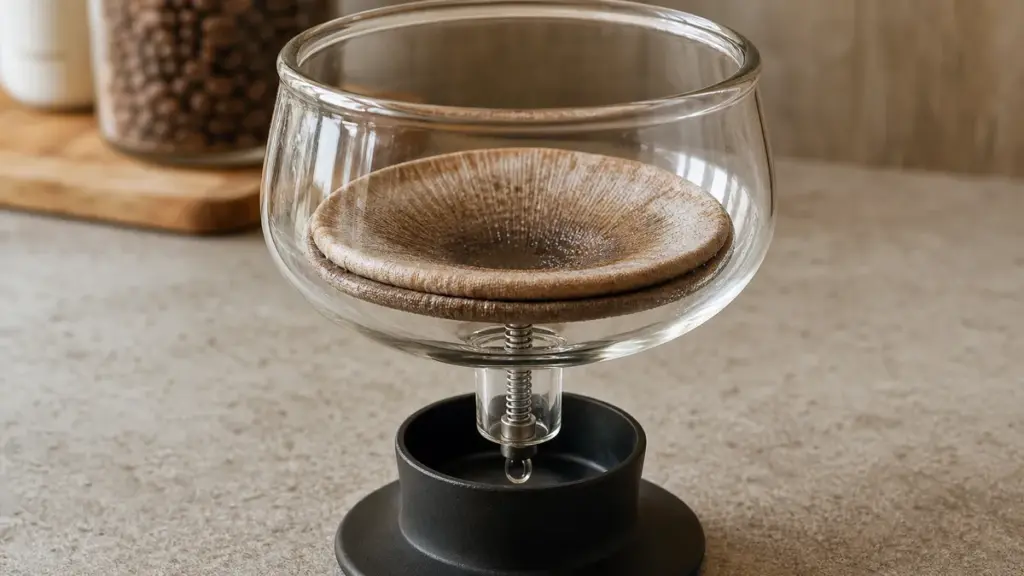
Cloth requires careful cleaning and storage. Prepare a new Hario cloth filter with boiling water before its first use, then rinse it.
Paper avoids storing a wet cloth and, in Hario’s guidance, produces a cleaner, lighter cup. Use the correct paper and holder for your brewer rather than improvising with a cut-down filter.
Metal is another available option for compatible models. Check the manufacturer’s fitting instructions: a filter that looks approximately right is not necessarily suitable.
For this first brew, use the supplied filter and keep it unchanged while adjusting your technique. If you want immersion followed by filtration without managing a heater, see immersion drippers.
Choosing the heat source
Hario lists dedicated gas or alcohol burners and its beam heater as suitable options for relevant siphons. Compatibility matters more than appearance: do not assume that a stand-mounted glass globe belongs directly on a kitchen hob.
With an alcohol lamp, use only its specified fuel, extinguish it with the supplied cover and confirm that the flame is out. Never move or refill it while lit, and allow it to cool before refilling.
Siphon brewing: step-by-step method
This is a proposed starting recipe, adapted from manufacturer guidance rather than a universal standard or a claimed test result. Hario’s published recipes differ in grind and timing, so use these settings as a consistent baseline.
Starting settings
- Coffee: 20 g
- Water: 300 g, approximately 300 ml when measured before heating
- Ratio: 1:15 coffee to water by weight
- Grind: medium-fine
- Upper-chamber water temperature: approximately 93 °C
- Heated steep: 60 seconds
- Expected drawdown: roughly 30 to 60 seconds
Measure the water before heating and transfer it to the brewer. Do not operate a burner on ordinary kitchen scales.
-
Inspect and arrange the equipment.
Check the glass for cracks, chips and scratches. Set the brewer securely on a dry, heat-resistant surface, away from flammable materials, with its upper-chamber holder ready beside it. -
Prepare and secure the filter.
Wet the prepared cloth filter, or fit the appropriate alternative according to its instructions. In a typical Hario assembly, pull the spring and chain through the stem and hook it at the bottom, leaving the filter centred over the opening. -
Grind the coffee and fill the lower globe.
Grind 20 g medium-fine and keep it ready separately. Add 300 g of hot water to the lower globe, provided your model permits hot filling, and wipe the outside completely dry. -
Heat with the upper chamber loosely positioned.
Follow your brewer’s assembly sequence. For the Hario-style arrangement described here, rest the upper chamber at an angle without making a seal while the water approaches boiling. Keep your face away from the opening. -
Seat the upper chamber and reduce the heat.
As boiling begins, seat the chamber gently so water rises through the tube. Once most has transferred, reduce the heater to the lowest setting that keeps it upstairs. A small amount remaining below is normal; do not increase the heat to chase it upwards. -
Check temperature, add coffee and start timing.
Aim for approximately 93 °C in the upper water, measured without striking the glass. Add the grounds and start the timer immediately. Stir gently until no dry patches remain, using a few controlled movements rather than beating the mixture. -
Steep for 60 seconds.
Maintain enough heat to prevent premature drawdown, without vigorous bubbling. Leave the coffee largely undisturbed. At 60 seconds, give it a brief, gentle final stir and stop heating. -
Allow drawdown without interference.
Switch off the heater or extinguish the alcohol lamp with its cover. Leave the brewer stable and let the coffee return through the filter, roughly 30 to 60 seconds for this starting method. Do not pull the chambers apart during the return flow. -
Separate and serve.
Once drawdown finishes and the pressure has equalised, remove the upper chamber gently according to the manual and place it in its holder. Protect yourself from hot components, pour the coffee and let it cool sufficiently before tasting.
The brewing timer begins when coffee meets water, not when you light the heater. Record steeping and drawdown separately so a change in warm-up time does not confuse your notes.
Troubleshooting siphon coffee
These are likely causes to investigate, not certain diagnoses. Remove the heat before investigating a stalled or abnormal brew, and let the equipment cool before dismantling it.
| Symptom | Likely cause | Fix |
|---|---|---|
| Water does not rise | Insufficient heat or a poorly seated chamber | Check assembly while cool; use the approved heater |
| Water falls before the steep ends | Heat too low or a leaking joint | Check the gasket, then maintain slightly more heat next time |
| Drawdown becomes unusually slow | Fine grind or a dirty, obstructed filter | Clean or replace the filter; try a slightly coarser grind |
| Grounds reach the lower globe | Displaced, damaged or unsuitable filter | Refit or replace the correct filter before brewing again |
| Coffee tastes of stale oils | Dirty cloth or other coffee-contact surfaces | Clean thoroughly; replace a persistently tainted cloth |
| Coffee is thin and sharply sour | Incomplete wetting or insufficient extraction | Wet every ground first; then trial a finer grind |
| Coffee is harsh or drying | Excessive agitation or unsuitable extraction settings | Stir less; then trial a coarser grind or shorter steep |
Make one change at a time. Start with filter condition and complete wetting before changing several recipe settings to compensate for a mechanical problem.
Cleaning and safe handling
Let the glass cool naturally before washing it. Hario warns against touching hot glass with a wet cloth or placing it on a wet surface because sudden temperature changes can cause breakage. Do not use cold-water cooling tricks to accelerate drawdown.
Wash glass components with a soft sponge and mild washing-up liquid, then rinse thoroughly. Avoid abrasive pads and metal utensils inside the bowls.
For Hario cloth filters, remove the grounds, wash the cloth thoroughly and store it submerged in fresh water in a container in the fridge, changing the water regularly. Hario also recommends a clean toothbrush for removing trapped grounds. Replace worn cloth rather than trying to compensate for it through grind changes.
Never leave the brewer unattended over heat or keep heating an almost empty lower globe unnecessarily. For another heat-driven brewer with its own handling requirements, read our moka pot method.
Refining temperature, water and extraction
Treat temperature as a setting, not a verdict
The SCAA’s siphon-specific best-practice document, revised in 2016, uses approximately 93.5 °C and a heated steep of 1 to 2 minutes. Our shorter baseline follows Hario’s more recent guidance. These are different recipes, not evidence that one timing suits every coffee.
Measure temperature where the grounds will steep, not only in the kettle. Water temperature in the lower globe does not tell you precisely what the coffee encounters upstairs.
Controlled drip-brewing research by Batali and colleagues found little sensory effect from brewing at 87, 90 or 93 °C when strength and extraction were held constant by adjusting other settings. That was not a siphon experiment. It supports a useful caution: temperature alone does not explain the finished flavour.
Keep the water consistent
Use fresh drinking water without distracting odours. Check your local water supplier’s published hardness rather than assuming that all UK tap water behaves alike.
The SCAE Water Chart gives a broad historical recommendation of total hardness between 50 and 175 mg/L as calcium carbonate and alkalinity between 40 and 75 mg/L on the same basis. Hardness describes principally calcium and magnesium content; alkalinity describes acid-neutralising capacity. These are reference ranges, not a siphon-specific recipe or a reason to start mixing minerals before learning the brewer.
For repeatable siphon brewing, keep the coffee, water, filter and stirring routine fixed initially. Note when you add the grounds, remove the heat and finish drawdown, then let taste guide the next single adjustment.
FAQ
Can I put the coffee in before the water rises?
Yes, some manufacturer methods place coffee in the upper chamber before water rises. Others add it afterwards, as this guide does. Adding it afterwards gives a clear starting point for the contact timer and lets you check the upper water temperature first. Follow one complete method rather than combining incompatible steps from several recipes.
Is the water left in the lower globe a problem?
A small amount remaining below during steeping is normal in Hario’s guidance. Do not increase the flame simply to force every last drop upstairs. The lower globe is already nearly empty during this stage, and unnecessary heating risks damage. If very little water transfers, stop and check assembly after cooling.
Must I use freshly ground coffee?
No, but pre-ground coffee gives you less control over grind size. You can still begin with the stated dose, water weight and timing, then assess the result. If drainage repeatedly stalls despite a clean, correctly fitted filter, try a coarser grind rather than increasing heat or forcing the chambers apart.
Where to go next
Read Clever Dripper and Hario Switch for another way to combine steeping with filtration. Moka Pot Brewing is the next read for a different heat-driven brewer, while Turkish Coffee Brewing covers a method in which the grounds remain in the served drink.
Sources
- Specialty Coffee Association of America, Guidelines for Brewing with a Siphon, revised 2 April 2016, version 02APRIL2016. Manufacturer-independent procedural reference. Retrieved document.
- Hario UK, Hario Syphon Brew Guide, undated, retrieved November 2026. Equipment, assembly, grind and stirring guidance. Retrieved guide.
- Hario UK, How to Brew Syphon Coffee at Home, 18 September 2026. Short-steep method, drawdown and troubleshooting. Retrieved article.
- HARIO, Coffee Syphon User’s Manual, TCA, document code 1507, hosted copy. Safety, heating, cleaning and handling instructions. Retrieved manual.
- Hario Canada, HARIO Syphon Cloth Filters, undated, retrieved November 2026. Manufacturer filter-care instructions. Retrieved instructions.
- Speciality Coffee Association of Europe, Wellinger, Smrke and Yeretzian, The SCAE Water Chart, undated retrieved edition. Water composition and reference ranges. Retrieved document.
- Batali, Ristenpart and Guinard, Brew temperature, at fixed brew strength and extraction, has little impact on the sensory profile of drip brew coffee, Scientific Reports, 2020, volume 10, article 16450. Controlled brewing and sensory research. Retrieved research record.
- Hario USA, “Technica” Coffee Syphon, undated, retrieved November 2026. Brewer construction and pressure-driven operating principle. Retrieved manufacturer page.
This article was researched from retrieved manufacturer instructions, coffee-association guidance and peer-reviewed research; its starting recipe is an editorial adaptation, not a claim of first-hand testing.
Last checked: November 2026