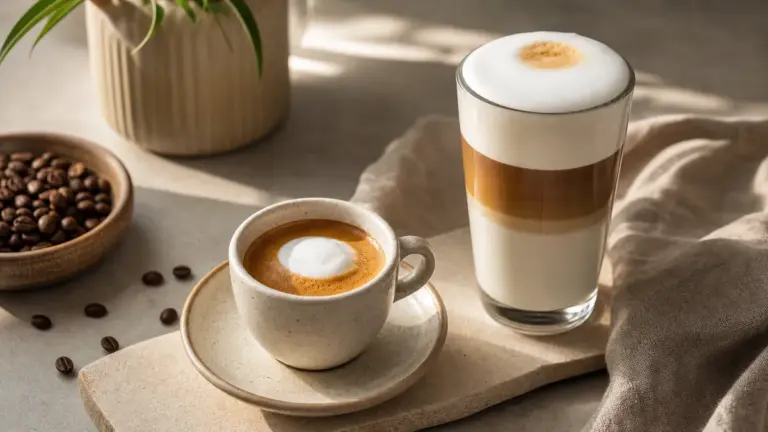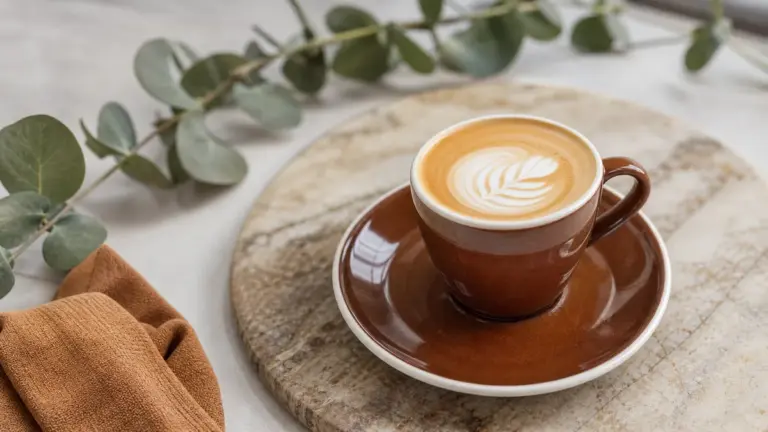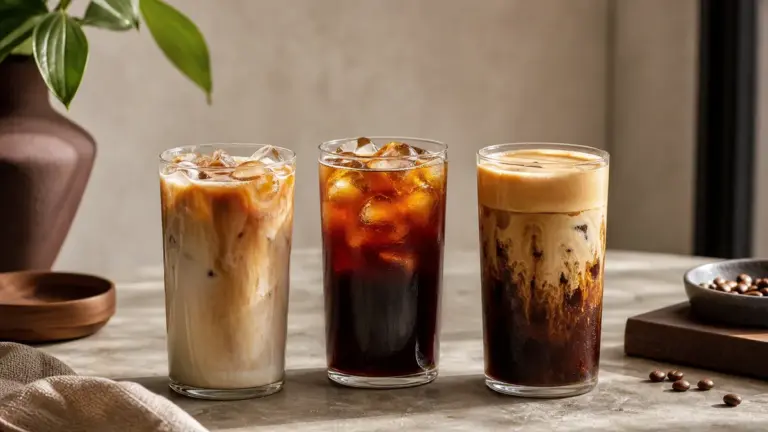
Decaf and low-caffeine coffee recipes let you make creamy espresso drinks, lighter half-caf blends and refreshing cold brew without using a full dose of regular coffee. For evenings or caffeine sensitivity, start with decaf rather than assuming that a milky drink, cold brew or naturally low-caffeine variety contains very little caffeine.
In short
- Decaffeinated coffee is not necessarily caffeine-free. Check information for the actual coffee and serving.
- Half-caf means a mixture of regular and decaffeinated coffee, not a guaranteed caffeine amount.
- Adding milk, water or ice dilutes a drink but does not remove its caffeine.
- Laurina and selected Aramosa coffees can be naturally lower in caffeine, but they are not equivalent to decaf.
- The recipes below distinguish measured reference ranges from calculated upper estimates. Neither replaces testing of your finished drink.
Choose the right coffee first
There are three useful approaches: brew decaf, mix regular coffee with decaf, or choose a naturally lower-caffeine coffee. They suit different purposes.
Decaf is the starting point when you want to minimise caffeine while keeping a recognisable coffee drink. Half-caf suits someone who wants less caffeine than their usual preparation but still wants some regular coffee. Naturally lower-caffeine varieties offer another flavour-led option, provided you do not mistake the variety name for a caffeine guarantee.
| Option | What it means | What to check |
|---|---|---|
| Decaf | Coffee that has undergone decaffeination | Residual caffeine and serving size |
| Half-caf | Regular coffee mixed with decaf | Mixing proportion and both coffees’ caffeine |
| Laurina | A naturally low-caffeine Arabica mutation | Lot-specific analysis, if available |
| Selected Aramosa | Coffee with Arabica and Coffea racemosa ancestry | Whether that particular selection is low-caffeine |
For other drink ideas, browse coffee recipes. Here, the emphasis is on controlling the coffee component rather than changing the established definitions of familiar drinks.
How much caffeine does decaf contain?
There is no dependable universal “decaf cup” figure. A laboratory study published in 2006 measured 3.0 to 15.8 mg per shot in sampled decaf espressos. That is evidence of variation, not a prediction for every home espresso.
Manufacturer figures can be more useful when they describe the exact preparation. For example, Nespresso’s published Danish FAQ gives approximately 2 to 4 mg per Original decaf capsule and 50 to 70 mg per regular espresso capsule. Those are manufacturer claims for that system, not figures to transfer to loose beans or another capsule range.
A percentage on a bean specification describes the coffee, not the finished beverage. At 0.1% caffeine by dry weight, each gram of dry coffee contains 1 mg of caffeine. That does not automatically translate into 2 to 5 mg in a cup: dose, extraction and serving size still matter.
Before making these recipes
The quantities below are suggested starting recipes, not claimed first-hand test results. Adjust flavour to your preference, but keep the coffee dose and serving size recorded if caffeine intake matters.
Caffeine note applying to every recipe: all figures are approximate reference estimates or explicitly conditional calculations. Individual sensitivity varies. During pregnancy, the NHS advises no more than 200 mg daily from all sources. If you have been advised to avoid caffeine, speak to a GP, pharmacist or midwife rather than treating decaf as caffeine-free.
Use clean equipment and fresh drinking water. For milk choices and handling differences, see milk and plant milk.
Decaf espresso drinks: one base, three finishes
Recipe card: decaf vanilla latte
A little vanilla gives this drink a dessert-like aroma without adding chocolate or another coffee shot.
Serves: 1
Time: approximately 5 minutes, after machine warm-up
Equipment: espresso machine, suitable basket, grinder, scales, milk jug and thermometer
Ingredients
- 18 g decaffeinated coffee, or the appropriate dose for your basket
- Water for brewing
- 150 ml dairy milk or a suitable plant alternative
- 1 ml vanilla extract
- 4 g sugar, optional
Method
- Grind the decaf and prepare the basket according to your machine’s instructions.
- As a starting recipe, brew 18 g in and 36 g out, a 1:2 dose-to-yield ratio. Record the extraction time so you can repeat a result you like.
- Stir the vanilla and optional sugar into the espresso.
- Steam the milk to a suggested serving temperature of 60 to 65°C, introducing enough air for a fine, pourable foam.
- Pour the milk into the coffee and serve immediately.
Approximate caffeine: the published decaf espresso study found 3.0 to 15.8 mg per sampled shot, but its doses were not matched to this recipe. Use that only as context. If your supplier confirms that the roasted coffee contains no more than 0.1% caffeine by dry weight, an 18 g dose contains at most approximately 18 mg before brewing, allowing a conservative upper estimate of about 18 mg in the drink. Actual extraction will generally be lower.
Pregnancy and sensitivity: apply the shared caffeine note above; neither figure guarantees suitability for an individual.
Make it shorter or longer
For a smaller, coffee-forward drink, use the same espresso with 60 ml steamed milk. For a longer black drink, add 120 ml hot water instead.
These are suggested serving variations, not new caffeine calculations. If you drink the whole espresso, its caffeine remains the same regardless of the amount of milk or water added. For established drink proportions and terminology, use espresso-based drinks.
Half-caf without the guesswork
Mixing equal weights of regular and decaf beans is a practical starting point. However, the resulting caffeine depends on both coffees, their proportions and how they are brewed. The decaf contribution is small, not necessarily zero.
For a clearer calculation, brew the components separately using preparations with published caffeine information, then combine measured portions.
Recipe card: measured half-caf milk coffee
Serves: 2
Time: approximately 5 minutes
Equipment: compatible capsule machine, measuring jug, spoon, milk-heating equipment and two cups
Ingredients
- 40 ml regular espresso, brewed from one capsule with a published caffeine figure
- 40 ml decaf espresso, brewed from one capsule with a published caffeine figure
- 200 ml dairy milk or a suitable plant alternative
Method
- Brew the regular and decaf espressos separately at their specified serving volumes.
- Combine them and stir thoroughly.
- Divide equally between two cups, giving each cup 40 ml of mixed coffee.
- Warm the milk and divide equally, adding 100 ml to each cup.
- Serve both drinks immediately.
Approximate caffeine: using the Nespresso reference figures above, the combined coffee contains approximately 52 to 74 mg. Dividing it equally gives approximately 26 to 37 mg per drink:
(50 to 70 mg regular + 2 to 4 mg decaf) ÷ 2.
This estimate applies only when the actual capsules and preparation match those figures. Other products need their own calculation.
Pregnancy and sensitivity: apply the shared note. Half-caf still contains a meaningful amount of caffeine.
For loose coffee, weigh your blend rather than counting beans. Equal weights are a reproducible recipe, but without product-specific caffeine data they cannot provide a dependable milligram figure.
Decaf cold brew for iced drinks
Cold brewing is a preparation method, not a decaffeination method. Use decaf coffee if reduced caffeine is the aim.
Recipe card: refrigerated decaf cold brew
Serves: 2 equal portions of the filtered batch
Time: approximately 10 minutes active preparation, plus 8 hours refrigerated brewing
Equipment: clean covered brewing vessel, scales, filter or cold-brew strainer, and jug
Ingredients
- 55 g medium-coarse decaffeinated coffee
- 700 g cold drinking water, approximately 700 ml
- 100 g ice per serving, optional
- 50 ml cold milk per serving, optional
The coffee-to-water ratio is approximately 1:12.7 by weight. Some water will remain in the grounds, so the finished volume will be lower than the water added.
Method
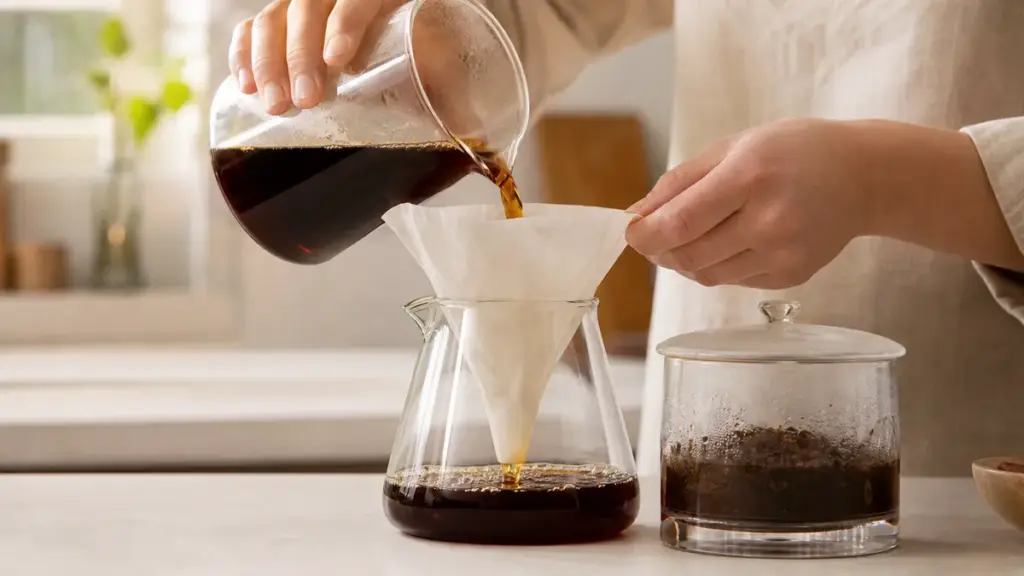
- Put the coffee into the clean brewing vessel or filter.
- Add the water, wetting all the grounds. Stir gently or close and gently agitate the vessel.
- Cover and refrigerate at 0 to 5°C for 8 hours.
- Remove the grounds or filter into a clean jug.
- Stir the finished batch and divide equally. Add ice and milk only when serving.
Approximate caffeine: a defensible estimate requires information about the beans. If the supplier confirms a maximum of 0.1% caffeine by dry weight in the roasted coffee, the 55 g dose contains at most approximately 55 mg before brewing. Even assuming complete extraction into the recovered drink, two equal portions would contain no more than approximately 27.5 mg each. This is a conditional ceiling, not the expected amount.
Pregnancy and sensitivity: apply the shared note. Do not substitute a generic hot-decaf estimate for this larger-dose batch.
The dose and brewing time follow a published cold-brew guide, with refrigeration supported by Hario’s instructions. For this home recipe, make a small batch and use it within 48 hours of starting the brew. That is a cautious editorial limit, not a validated shelf life for cold brew. Keep milk separate and follow its storage instructions.
Nitrogen changes texture rather than providing a caffeine reduction. Read nitro cold brew if that creamy, cascading finish is what you want.
Naturally low-caffeine varieties: useful, but not decaf
Laurina and Bourbon Pointu
Laurina is a naturally low-caffeine mutation of Coffea arabica, associated with Réunion’s Bourbon Pointu coffee. Its lower caffeine reflects differences in the plant’s caffeine production, rather than an industrial removal process.
Do not treat 0.4% to 0.6% as a fixed specification. The Bourbon Pointu producers’ cooperative describes 0.4% to 0.8%, while laboratory research found wider variation between individual Laurina beans and plant lines. Those sources examine different material, so their figures are not interchangeable guarantees.
For a simple tasting preparation, try 12 g coffee with 200 g water, approximately 200 ml, in a cafetière. A suggested starting method is water at 94°C, a 4-minute steep, then gentle plunging and immediate decanting. These are recipe choices, not caffeine-control settings.
A reliable caffeine estimate needs a roasted-lot analysis or a measured beverage result. Without one, label the drink “naturally lower-caffeine”, not “decaf” or a specific number of milligrams.
Aramosa is a hybrid, not an Arabica mutation
Aramosa has ancestry from Coffea arabica and Coffea racemosa, as documented by Brazil’s Instituto Agronômico. It should not be grouped with Laurina as simply another Arabica mutation.
Selected Aramosa coffees are sold for their naturally reduced caffeine, but 0.7% is not a universal specification. Daterra’s producer material explicitly distinguishes low-caffeine selections from its Guarani lineage, which has normal caffeine levels.
Ask the roaster for the selection name and supporting analysis. Neither the word “Aramosa” nor “naturally low-caffeine” alone tells you whether a generous serving fits your intended caffeine intake.
Adjust flavour without losing track of caffeine
Change the non-coffee ingredients first when a drink needs adjusting. Adding another shot may solve weak flavour, but it also changes the caffeine calculation.
| Symptom | Likely cause | Fix |
|---|---|---|
| Latte tastes mostly of milk | Too much milk for your preference | Reduce milk before increasing coffee |
| Half-caf varies between servings | Uneven mixing or portions | Mix thoroughly and measure equal portions |
| Cold brew tastes too strong | The recipe is too concentrated for you | Add measured water and retain the same coffee portion |
| Decaf espresso tastes thin and sour | Extraction may be insufficient | Check grind, distribution and the machine’s troubleshooting guide |
For evenings, remember that lower caffeine does not guarantee undisturbed sleep. EFSA’s 2015 scientific risk assessment concluded that 100 mg near bedtime can affect sleep in some adults. That is not a threshold below which everyone is unaffected.
FAQ
Can I use decaf instant coffee instead of espresso?
Yes, but treat it as a different coffee base rather than an equivalent espresso shot. Dissolve the manufacturer’s suggested dose in a small amount of hot water, then add milk to taste. Use caffeine information for that instant product and dose. Do not transfer the espresso estimates in this article to instant coffee.
Does decaf need a separate grinder?
A separate grinder is not essential for making a pleasant drink, but retained regular grounds can undermine careful caffeine control. Follow your grinder manufacturer’s cleaning instructions and avoid assuming that an empty hopper means an empty grinding chamber. If strict avoidance has been medically advised, discuss whether coffee is suitable at all.
Is dark-roasted decaf better for evenings?
Roast darkness is not a dependable caffeine guide. Choose using the coffee’s decaffeinated status, serving size and available analysis, then select a roast for flavour. A dark, bitter-tasting cup is not necessarily more caffeinated than a lighter-tasting one, and a smooth cup is not necessarily low in caffeine.
Where to go next
Use Coffee Recipes for more ways to adapt these decaf and low-caffeine coffee recipes. Milk and Plant Milk for Coffee helps with choosing and handling the milk component, while Nitro Cold Brew explains a different cold-coffee texture without confusing it with caffeine reduction.
Sources
-
McCusker et al., Journal of Analytical Toxicology, “Caffeine content of decaffeinated coffee”, 2006. Laboratory measurements of prepared decaf drinks.
https://pubmed.ncbi.nlm.nih.gov/17132260/ -
Nespresso, “Frequently asked questions”, Danish English-language site, undated; retrieved November 2026. Manufacturer caffeine figures for regular espresso and Original decaf capsules.
https://www.contact.nespresso.com/faq-3/dk/en -
Nespresso, “Frequently asked questions”, Hong Kong English-language site, undated; retrieved November 2026. Manufacturer statement on residual caffeine below 0.1% in its decaf blends.
https://www.contact.nespresso.com/faq-3/hk/en -
Blue Bottle Coffee, “Hario Cold Brew Bottle Brew Guide”, undated; retrieved November 2026. Dose, water quantity, grind and brewing duration.
https://bluebottlecoffee.com/us/eng/brew-guides/cold-brew-bottle -
Hario USA, “Cold Brew Coffee Wine Bottle”, undated; retrieved November 2026. Manufacturer instruction for approximately eight hours’ refrigerated brewing.
https://www.hario-usa.com/products/cold-brew-coffee-wine-bottle-650ml -
Food Standards Agency, “How to chill, freeze and defrost food safely”, 2017, live guidance retrieved November 2026. Domestic refrigeration and general leftover handling, not a cold-brew shelf-life validation.
https://www.gov.uk/government/publications/how-to-chill-freeze-and-defrost-food-safely/how-to-chill-freeze-and-defrost-food-safely -
Baumann et al., Phytochemistry, “Non-destructive analysis of natural variability in bean caffeine content of Laurina coffee”, 1998. Primary research on Laurina variation and caffeine biosynthesis.
https://pubmed.ncbi.nlm.nih.gov/11711066/ -
Coopérative Bourbon Pointu, “Qu’est ce que le Café Bourbon Pointu ?”, undated; retrieved November 2026. Producer description and caffeine range.
https://coopbourbonpointu.re/pages/qui-sommes-nous -
Instituto Agronômico, “Origem e Natureza Diversa de Cultivares Híbridas Interespecíficas de Café”, Documentos IAC 119, 2021. Aramosa ancestry.
https://www.iac.sp.gov.br/media/publicacoes/iacdoc119.pdf -
Daterra, “Meet the Researchers”, producer document hosted by DRWakefield, 2024 upload; publication date unstated. Distinction between low-caffeine Aramosa selections and Guarani.
https://drwakefield.com/wp-content/uploads/2024/10/Meet_the_researchers.pdf -
EFSA, “Caffeine”, summarising the Scientific Opinion on the Safety of Caffeine, 2015; live page retrieved November 2026. Scientific risk assessment and sleep guidance.
https://www.efsa.europa.eu/en/topics/topic/caffeine -
NHS, “Foods to avoid in pregnancy”, live guidance retrieved November 2026. Pregnancy caffeine advice.
https://www.nhs.uk/pregnancy/keeping-well/foods-to-avoid/ -
Sage, “the Duo-Temp Pro BES810: EN Quick Guide”, undated; retrieved November 2026. Espresso preparation and troubleshooting principles.
https://assets.sageappliances.com/BES810/SES810-instruction-manual.pdf
Researched using laboratory studies, official health and food-safety guidance, plant research and published brewing instructions; recipe adaptations and conditional caffeine calculations are identified separately from measured results.
Last checked: November 2026