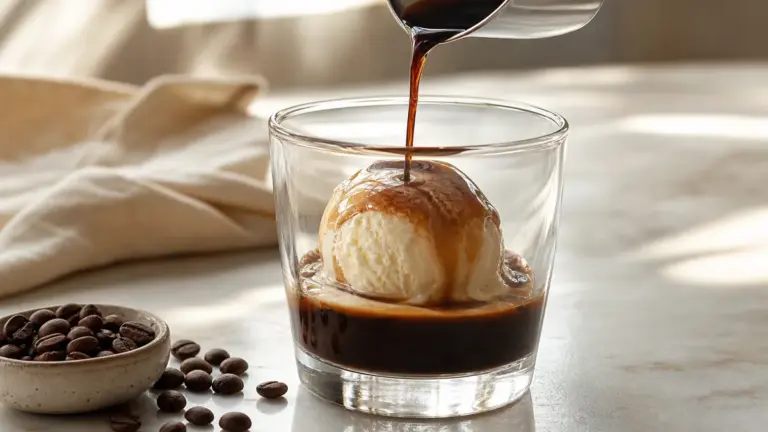
A traditional espresso macchiato is an espresso marked with a little milk and foam, not a large, sweet coffee. A latte macchiato reverses the idea, adding espresso to foamed milk, while caramel and chocolate macchiatos are flavoured variations whose ingredients and proportions depend on the recipe.
In short
- Choose espresso macchiato for a small, coffee-led drink; choose latte macchiato for a milk-led drink.
- For the espresso version, add a little foamed milk to the coffee. For the layered latte version, put the milk in first.
- Starbucks-style caramel macchiato contains vanilla syrup, milk, espresso and caramel sauce, not simply caramel-flavoured espresso.
- Aim for 60 to 65°C when steaming dairy milk, following your equipment’s instructions.
- The recipes below use a 40 ml capsule espresso for consistency. That serving size is a recipe choice, not a universal definition of espresso.
What is a macchiato?
Macchiato means “stained” or “marked” in Italian. In an espresso macchiato, also called caffè macchiato, the coffee is marked with milk; in a latte macchiato, the milk is marked with coffee.
The distinction is more useful than declaring one drink “true” and everything else wrong. Traditional Italian terminology and modern coffee-chain recipes describe different drinks that share a name.
An espresso macchiato should still taste predominantly of coffee, with a little milky sweetness and a soft patch of foam. A latte macchiato contains substantially more milk, so the coffee tastes gentler once the drink is mixed.
The comparison below concerns ingredients, assembly and drinking experience, rather than rigid café serving sizes.
| Drink | Main ingredients | Assembly | Best suited to |
|---|---|---|---|
| Espresso macchiato | Espresso, a little milk and foam | Coffee first | Someone wanting espresso with a small milk addition |
| Latte macchiato | Milk, foam, espresso | Milk first | Someone wanting a milky, visibly layered drink |
| Caramel macchiato | Vanilla syrup, milk, espresso, caramel sauce | Sweetened milk first | Someone wanting a sweet, milk-led coffee |
| Chocolate macchiato | Espresso, chocolate, a little milk | Recipe-dependent | Someone wanting a small chocolate-and-coffee drink |
For other drink ideas, start with coffee recipes. If the milk-led version appeals more than the small espresso drink, compare it with a latte.

Espresso macchiato recipe
This version follows the traditional coffee-first structure. The milk quantity is deliberately small: the aim is to soften the espresso, not turn it into a miniature mug of milky coffee.
Recipe card
Serves: 1
Time: approximately 5 minutes, excluding machine warm-up
Equipment: espresso-capable capsule machine, milk frother or steam wand, milk jug, spoon, small cup; thermometer if steaming manually
Ingredients
- 40 ml espresso, prepared from one compatible espresso capsule
- 20 ml cold pasteurised milk, for the drink
- Additional cold milk only if your frother requires a larger minimum batch
Approximate caffeine: 50 to 130 mg when using a capsule within Nespresso’s published Original Espresso range. This is a manufacturer-reported range for that preparation, not an estimate for every espresso machine or capsule system. Pregnancy and sensitivity guidance appears below.
Method
- Prepare the milk. Check your frother’s minimum fill. If it cannot handle 20 ml, froth a larger batch and reserve only a little milk and foam for this drink.
- Froth gently. With a steam wand, introduce enough air to create fine foam, then continue heating and circulating the milk. Aim for 60 to 65°C, measured with a thermometer.
- Prepare the espresso. Brew 40 ml into the small cup.
- Mark the coffee. Add a little warm milk, then spoon a small patch of foam onto the surface. You need not add the entire prepared batch.
- Serve immediately. Clean the milk equipment according to its instructions.
The result should look like espresso with a white mark, rather than a cup filled with white foam. For the next attempt, adjust the milk addition before changing the coffee: a smaller addition preserves more of the espresso’s intensity.
Using a conventional espresso machine? Substitute your usual well-adjusted espresso shot. Keep your established dose and yield rather than extending the extraction merely to reach the capsule recipe’s volume; the caffeine estimate above no longer applies.
Latte macchiato recipe
A latte macchiato puts the milk in the glass before the espresso. Nespresso’s published recipes use this sequence, while JURA’s instructions explain that a pause between milk delivery and coffee allows the characteristic layers to form.
Recipe card
Serves: 1
Time: approximately 5 minutes, excluding machine warm-up
Equipment: espresso-capable capsule machine, milk frother or steam wand, jug, small pouring vessel, heatproof tall glass with room for foam
Ingredients
- 150 ml cold pasteurised milk
- 40 ml espresso, prepared from one compatible espresso capsule
Approximate caffeine: 50 to 130 mg on the same Original Espresso capsule basis as the previous recipe. Adding milk does not reduce the caffeine supplied by that capsule. See the pregnancy and sensitivity note below.
Method
- Foam the milk. Prepare the milk with a distinct foam cap. If steaming manually, aim for 60 to 65°C.
- Fill the glass. Pour in the warm milk and its foam, leaving space for the espresso.
- Allow separation. Let the milk stand briefly while you prepare the coffee separately.
- Add the espresso. Pour gently through one point in the foam, keeping the pouring vessel close to the glass.
- Serve unstirred for presentation. Stir before drinking if you prefer a more even coffee-and-milk flavour.
Look for pale milk below, a brown coffee-rich band and white foam above. The boundaries need not be ruler-straight: these are liquids that will gradually mix, not permanent layers.
Caramel Macchiato
The familiar Starbucks-style caramel macchiato is a milk-led drink with vanilla syrup inside and caramel sauce on top. Starbucks’ own preparation instructions put the syrup and foamed milk in the vessel before the espresso.
That makes it structurally closer to a flavoured latte macchiato than to the small espresso macchiato. Caramel syrup alone will produce a different flavour from the vanilla-and-caramel combination.
Recipe card
This is a smaller editorial adaptation of the published milk-first method, not an exact reproduction of a chain serving.
Serves: 1
Time: approximately 5 minutes, excluding machine warm-up
Equipment: espresso-capable capsule machine, milk frother or steam wand, jug, small pouring vessel, heatproof glass
Ingredients
- 150 ml cold pasteurised milk
- 40 ml espresso, prepared from one compatible espresso capsule
- 10 ml vanilla syrup
- 5 g caramel sauce, suitable for drizzling
Approximate caffeine: 50 to 130 mg on the stated Original Espresso capsule basis, assuming the syrup and sauce contain no added coffee or caffeine. Check their ingredients and see the pregnancy and sensitivity note below.
Method
- Add the vanilla. Measure the syrup into the glass.
- Prepare the milk. Froth it, aiming for 60 to 65°C if steaming manually.
- Build the base. Pour the milk and foam over the syrup.
- Add the coffee. After a brief settling pause, pour the espresso gently through the foam.
- Finish with caramel. Drizzle the sauce over the surface and serve.
Treat these flavouring amounts as a starting point, not a required sweetness level. Reduce the syrup on your next attempt if it hides the coffee.
For a more even result, stir the finished drink. For visible layers and a stronger contrast between mouthfuls, leave it unstirred.
Chocolate Macchiato
“Chocolate macchiato” does not identify one recipe as clearly as espresso macchiato. For example, Nespresso publishes both a dark-chocolate version with a small milk addition and a cocoa version using more milk.
The recipe below follows the small, coffee-led approach. It is not intended to be a large chocolate-and-milk drink.
Recipe card
Serves: 1
Time: approximately 5 minutes, excluding machine warm-up
Equipment: espresso-capable capsule machine, small heatproof cup, spoon, scales, milk frother
Ingredients
- 40 ml espresso, prepared from one compatible espresso capsule
- 5 g plain dark chocolate, finely chopped
- 10 ml warm pasteurised milk
- A little additional milk foam, optional
Approximate caffeine: roughly 50 to 135 mg on the stated capsule basis, with a small allowance for chocolate. This rounded estimate uses EFSA’s illustrative figure of 25 mg caffeine per 50 g plain chocolate; actual chocolate varies. See the pregnancy and sensitivity note below.
Method
- Prepare the chocolate. Put the finely chopped chocolate into the cup.
- Add hot coffee. Brew the espresso over it.
- Stir thoroughly. Mix until the chocolate has melted into the coffee.
- Add milk. Stir in 10 ml warm milk.
- Mark the surface. Add a little foam if desired, then serve.
This drink needs mixing to distribute the chocolate, so sharp internal layers are not the objective. The contrast is between the brown coffee below and the optional pale foam above.
Layering and troubleshooting
What creates the layers?
The first useful separation is between liquid milk and milk foam. JURA explicitly builds a pause into latte macchiato preparation so that these can separate before the espresso arrives.
Pouring the coffee gently then preserves more of that separation. A forceful pour or immediate stirring mixes the drink instead. In practical terms, control the foam, the pause and the pour before changing ingredients.
| Symptom | Likely cause | Fix |
|---|---|---|
| Latte macchiato becomes uniformly brown | Milk and coffee mixed during pouring | Let the milk settle briefly and pour the espresso gently |
| Large, uneven surface bubbles | Coarse milk foam | Tap and swirl the jug gently before pouring |
| Espresso macchiato tastes mainly of milk | Too much milk added | Spoon in a smaller amount rather than emptying the jug |
| Chocolate remains at the bottom | Pieces too large or insufficient stirring | Chop finely and stir into the hot espresso before adding milk |
Milk handling and caffeine
Keep milk refrigerated and follow its storage and date instructions. The Food Standards Agency’s consumer guidance recommends a fridge temperature of 0 to 5°C; take out only what you need and keep chilled ingredients out for the shortest practical time.
The caffeine ranges here are specific to the stated capsule preparation. A different blend, capsule or conventional espresso recipe needs its own estimate.
The NHS advises no more than 200 mg caffeine daily from all sources during pregnancy. Individual sensitivity varies; if caffeine affects your sleep or you have questions about medicines, pregnancy or a medical condition, speak to a GP, pharmacist or midwife. These recipe estimates are not personal safety allowances.
FAQ
Can I make a macchiato without an espresso machine?
You can make a similar drink with concentrated coffee, but it will not be identical to an espresso macchiato. Starbucks’ home recipe suggests moka-pot coffee as an espresso-like alternative for its caramel version. Keep the coffee portion small, add milk sparingly and do not apply the capsule caffeine estimate to the substitute.
Should I add sugar to an espresso macchiato?
Sugar is optional, not a defining ingredient. Nespresso’s espresso macchiato recipe permits it, but coffee and a small milk addition provide the basic structure. Taste the drink first, then sweeten to preference. Caramel and chocolate versions already contain sweet ingredients, so additional sugar may be unnecessary.
How should I order one to avoid confusion?
Ask for an “espresso macchiato, a small espresso with a little milk and foam” if that is what you want. For the larger drink, say “latte macchiato”; for the sweet version, name the flavour. Describing the ingredients is more reliable than assuming every café uses the same serving size or terminology.
Where to go next
Return to Coffee Recipes for another drink to make, or read Latte to explore a milk-led alternative without the emphasis on layers. Cortado and Piccolo is the useful next comparison if you like a small milk coffee but want something between an espresso macchiato and a larger drink.
Sources
-
Nespresso, Your ultimate macchiato guide, undated. Terminology, traditional composition and flavour distinction.
https://www.nespresso.com/au/en/news/your-ultimate-macchiato-guide -
Nespresso, Espresso Macchiato, undated recipe PDF. Coffee-first method, 40 ml espresso and 20 ml milk.
https://www.nespresso.com/ncp/res/generated/recipes/035ESP_en_US.pdf -
Nespresso, Latte Macchiatto, undated recipe PDF. Milk-first assembly using 150 ml milk and 40 ml espresso.
https://www.nespresso.com/ncp/res/generated/recipes/23066LAT_en_INT.pdf -
Starbucks, Caramel Macchiato Recipe, undated. Vanilla, milk, espresso and caramel sequence; terminology and alternative coffee preparation.
https://athome.starbucks.com/recipe/caramel-macchiato -
Starbucks at Home, Caramel Macchiato, undated. Corroborating milk-first preparation and caramel topping.
https://www.starbucksathome.com/au/recipes/caramel-macchiato -
Nespresso, Paris Black Chocolate Macchiato, undated recipe PDF. Chocolate beneath 40 ml espresso, followed by 10 ml milk.
https://www.nespresso.com/ncp/res/generated/recipes/26040PAR_en_INT.pdf -
Nespresso, Cocoa Macchiato, undated recipe PDF. An alternative published chocolate preparation using 50 ml milk.
https://www.nespresso.com/ncp/res/generated/recipes/309COC_en_INT.pdf -
Breville, Latte, undated brewing guide. Milk steaming at 60 to 65°C and tapping and swirling the jug.
https://www.breville.com/au/en/coffee-journey/recipes/latte.html -
JURA, J80/J90/J95 Instructions for Use, undated retrieved edition, “Latte macchiato and Cappuccino”. Milk separation pause before espresso delivery.
https://us.jura.com/-/media/global/pdf/manuals-na/Home/J90/manual_download_jura_j80_j90_j95_ul.pdf -
Nespresso, Frequently asked questions, Hong Kong, undated. Manufacturer-reported caffeine range for Original Espresso capsules brewed at 40 ml.
https://www.contact.nespresso.com/faq-3/hk/en -
European Food Safety Authority, Caffeine, summarising its 2015 scientific opinion. Illustrative chocolate caffeine content and acknowledgement of variation.
https://www.efsa.europa.eu/en/topics/topic/caffeine -
NHS, Foods to avoid in pregnancy, current page checked November 2026. Pregnancy caffeine guidance.
https://www.nhs.uk/pregnancy/keeping-well/foods-to-avoid/ -
Food Standards Agency, How to chill, freeze and defrost food safely, 2017, GOV.UK. Consumer refrigeration and storage guidance, published for England, Northern Ireland and Wales.
https://www.gov.uk/government/publications/how-to-chill-freeze-and-defrost-food-safely/how-to-chill-freeze-and-defrost-food-safely
The piece was researched from retrieved manufacturer recipes and instructions, official food-safety guidance and official caffeine advice; the recipe cards are editorial adaptations, not reports of kitchen testing.
Last checked: November 2026