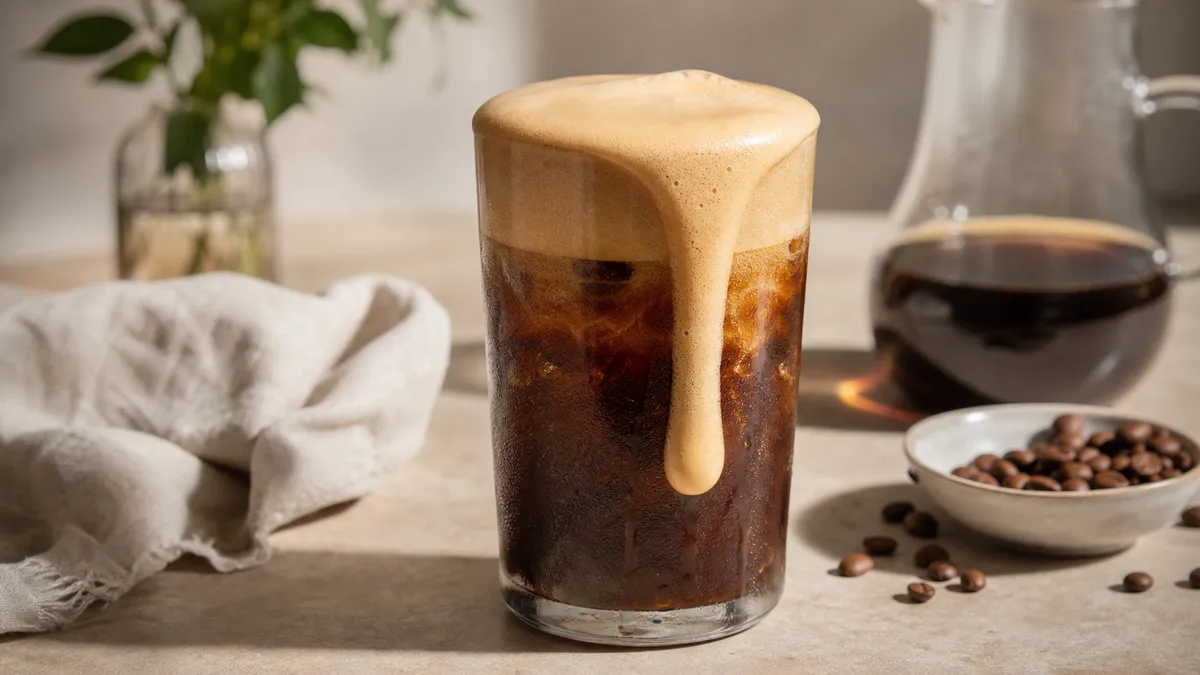
Nitro cold brew is cold-brewed coffee infused with nitrogen gas and dispensed under pressure, giving it a fine-bubbled, creamy texture and a pale foam head without needing milk. You can make it at home with a purpose-built nitrogen dispenser, but an ordinary cream whipper using nitrous oxide produces a different result.
In short
- Look for N₂, nitrogen, not N₂O, nitrous oxide, when choosing a true nitrogen-infusion system.
- Use only manufacturer-approved food-grade gas and compatible, pressure-rated equipment.
- Filter the coffee thoroughly before charging, and follow your dispenser’s own filling and operating instructions.
- Brew and store the coffee refrigerated, with the fridge set between 0 and 5°C.
- Nitrogen adds no caffeine. The coffee recipe, dilution and serving size determine how much you drink.
What nitrogen does to cold brew
Cold brew describes the extraction method: ground coffee steeps in cold water before filtration. Nitro describes what happens afterwards, when gas is introduced and the coffee is dispensed through equipment designed to create fine bubbles.
Nitrogen is only sparingly soluble in water. Pressure helps introduce it into the drink; the pressure change and agitation during dispensing help produce the fine bubbles responsible for the cloudy cascade and foam head. The nozzle or tap matters as well as the gas.
The result feels velvety rather than sharply fizzy. Unlike carbon dioxide used for carbonation, nitrogen does not form carbonic acid in the drink. It changes the drinking texture without turning the coffee into a sparkling beverage.
The creamy appearance does not require cream, milk or sugar. Coffee itself contains compounds that help bubbles form and persist. Controlled laboratory research on nitrogen-infused cold brew found that roast, brewing conditions and serving temperature affected foam stability, so changing the coffee can change the head even when the dispenser stays the same.
For other drink ideas, browse our coffee recipes.
Commercial systems versus home methods
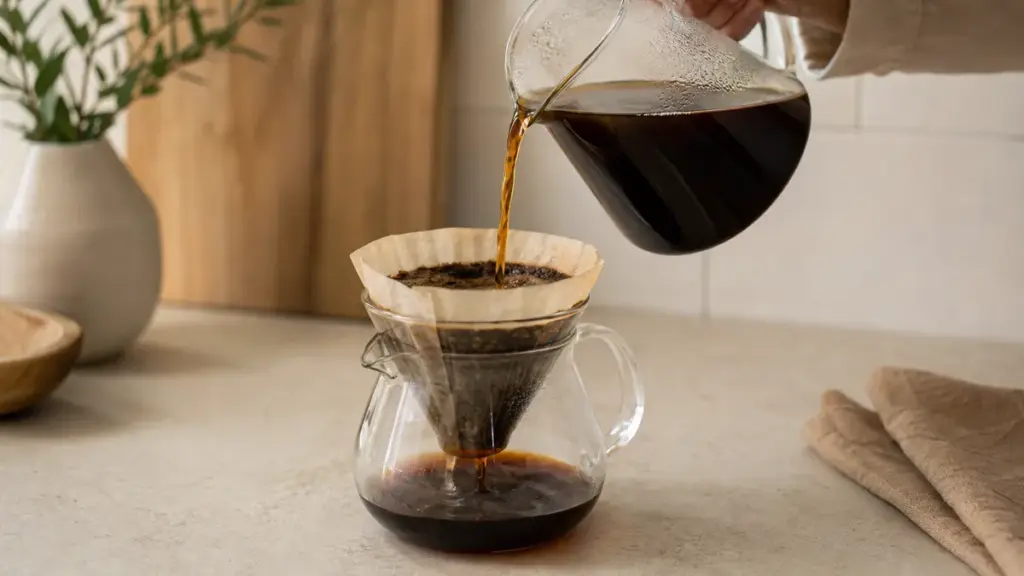
Commercial nitro coffee can come from a refrigerated keg connected to a nitrogen supply and a suitable dispensing tap. Other systems introduce gas into the coffee as it flows towards the outlet, rather than relying on a keg of previously infused coffee.
Some commercial equipment uses filtered compressed air rather than a supply of pure nitrogen. Manufacturers may describe both approaches as nitro dispensing, so check the actual gas source rather than assuming every cascading coffee has been prepared identically.
For home preparation, judge equipment by three things: the gas it is approved to use, its instructions for coffee preparation, and how its pressure-containing parts are cleaned and maintained.
| Method | How it works | Who it suits |
|---|---|---|
| Purpose-built N₂ dispenser | Approved nitrogen chargers and a dedicated dispensing nozzle | Home users making small batches |
| Refrigerated keg system | Nitrogen supply, compatible regulator, keg and suitable tap | Regular service where cleaning and gas handling can be managed |
| Commercial inline dispenser | Introduces gas during dispensing; the source varies by system | Workplaces or hospitality settings needing repeated service |
| N₂O cream whipper | Uses nitrous oxide, which behaves differently from nitrogen | Approved culinary foams, not a direct substitute for N₂ infusion |
Why a cream whipper is different
Nitrous oxide, N₂O, is a different molecule from nitrogen, N₂. It dissolves much more readily in water and fat, which helps explain its usefulness in whipping cream and its different foaming behaviour.
An N₂O whipper may produce foamed coffee when its manufacturer permits that preparation, but this is not the same process as nitrogen infusion. Do not fit nitrogen chargers to a cream whipper unless the manufacturer explicitly approves that exact equipment and gas combination. A charger fitting into a holder is not proof of compatibility.
Home nitro cold brew recipe
This recipe starts with ready-to-drink cold brew, making the nitrogen step easier to control. A homemade base is included below.
Recipe card
Serves: 4 small drinks of approximately 150 ml
Time: approximately 10 minutes with chilled coffee, subject to the dispenser’s instructions
Serving temperature: refrigerator-cold
Ingredients:
- 600 ml thoroughly filtered, ready-to-drink black cold brew
- Manufacturer-approved food-grade N₂ charger or chargers, in the quantity specified for your dispenser and fill volume
Equipment: purpose-built nitrogen coffee dispenser approved for this volume, measuring jug, coffee filter if needed, and four glasses.
Approximate caffeine: use the cold brew supplier’s declared figure where available. As a calculation example only, coffee labelled 80 mg per 100 ml would provide approximately 120 mg per 150 ml serving: 80 × 150 ÷ 100. This assumed concentration is not a measured value for homemade cold brew. Pregnancy and individual sensitivity require particular care; see the caffeine section below.
Method
- Check the dispenser. Read its manual, inspect the seals and pressure-containing parts, and clean it as directed. Confirm that a 600 ml fill is permitted.
- Prepare the coffee. Use chilled coffee at drinking strength. Dilute a bought concentrate according to its instructions before measuring the 600 ml.
- Filter if necessary. Pass the coffee through a coffee filter to remove suspended grounds. Keep it refrigerated while preparing the equipment.
- Fill and assemble. Measure the coffee into the dispenser without exceeding its maximum fill line. Fit the head and nozzle exactly as instructed.
- Charge and mix. Use only the approved nitrogen supply. Follow the specified charger quantity, shaking procedure and any resting time. These instructions are not interchangeable between models.
- Dispense and serve. Use the orientation and lever action specified in the manual. Pour into clean glasses, leaving space for the head, and serve promptly.
Making the cold brew base yourself
The iSi manufacturer’s base recipe uses 80 g coarsely ground coffee with 1 litre of water, refrigerated for at least 12 hours, then passed through a coffee filter. This is a coffee-to-water ratio of 1:12.5 by weight, using 1,000 g water.
Prepare that base in a clean, covered container, then measure 600 ml of the filtered coffee for the recipe above. Grounds retain some water, so the finished yield will be less than the starting volume. Its caffeine content cannot reliably be calculated from the coffee dose alone.
Pressure safety, cleaning and storage
Never improvise the pressure vessel, charger connection or gas supply. Use the exact combination of food-grade gas, dispenser and components approved by the manufacturer. Do not use damaged equipment, exceed filling limits, add extra chargers to improve the head, or unscrew a pressurised head.
Do not use liquid nitrogen for this home method. Nitrogen gas chargers and liquid nitrogen are not interchangeable preparations.
After use, release pressure by the approved procedure before dismantling. Clean the bottle, seals, valve and nozzle as the manual specifies, using compatible cleaning products. If a blockage prevents pressure release, stop and contact the manufacturer rather than forcing the head open.
Keep the fridge between 0 and 5°C, and refrigerate the coffee during brewing and storage. Nitrogen infusion is not a sterilisation step or a reason to extend storage. For this home recipe, make a batch you intend to serve that day; this is a conservative preparation recommendation, not a validated shelf-life claim. Follow any shorter supplier instructions for bought coffee.
Troubleshooting the pour
| Symptom | Likely cause | Fix |
|---|---|---|
| Little foam | Incorrect charging, mixing or dispensing procedure | Recheck the manual rather than adding extra gas |
| Spluttering or poor flow | Blocked nozzle or suspended ingredients | Follow the approved pressure-release procedure, then clean and filter |
| Head disappears quickly | Coffee composition or serving temperature | Keep the coffee cold and compare another coffee before changing equipment |
| Coffee tastes too strong | Concentrate used without sufficient dilution | Adjust the base before filling the dispenser |
Caffeine: the coffee matters, not the nitrogen
Nitrogen does not add caffeine or make an existing batch more caffeinated. However, a smooth texture is not evidence of a low-caffeine drink: concentration, dilution and portion size still matter.
For bought cold brew, calculate your serving from its declared caffeine content. For homemade coffee, treat the amount as uncertain unless the finished brew has been analysed. A general filter-coffee figure is not a reliable substitute.
EFSA’s 2015 scientific assessment found no safety concerns for most healthy, non-pregnant adults from single doses up to 200 mg, or habitual intake up to 400 mg a day, spread across the day. These are population benchmarks, not targets; 100 mg near bedtime can disturb sleep in some adults.
The NHS advises no more than 200 mg daily from all sources during pregnancy. Medicines, health conditions and sensitivity can change what suits an individual. Ask a GP, pharmacist or midwife about personal concerns, and consider our decaf recipe ideas.
FAQ
Can I make nitro cold brew without a dispenser?
Not the same pressure-dispensed nitrogen drink. Shaking coffee or using a milk frother can introduce air and create surface foam, but that does not reproduce the controlled gas introduction and dispensing process described here. If you do not have compatible equipment, serve the cold brew still rather than improvising a pressurised container.
Can I add milk or plant milk?
Yes, you can add it to the glass after dispensing. Only put milk or plant drinks inside the dispenser if its manufacturer permits that preparation and provides suitable cleaning instructions. Milk changes the recipe and its handling requirements. Our milk and plant milk guide explains the main differences.
Should I serve it over ice?
For this recipe, serve it refrigerator-cold without ice initially. That lets you assess the texture and coffee strength without changing dilution as ice melts. It is a serving preference, not a safety rule. If you prefer an iced drink, add ice to the glass and judge the coffee after dilution.
Where to go next
Read Iced Latte, Iced Americano and Shaken Espresso for cold drinks that do not require nitrogen equipment, or Espresso Tonic for a deliberately sparkling alternative. Decaf and Low-Caffeine Coffee Recipes is the useful next stop when you want nitro cold brew texture with more attention to caffeine.
Sources
-
iSi, Nitro: Instructions for Use, document WEB-947080002, undated retrieved edition. Equipment compatibility, pressure safety, operation and cleaning.
https://sw.isi.com/media/83/70/6d/1699274221/WEB-947080002-Nitro-GA.pdf -
iSi, Inspiring Recipes: Nitro Cocktails, undated, hosted in 2019. Refrigerated cold brew base recipe.
-
Angeloni and colleagues, Physical and Chemical Effects of Different Working Gases in Coffee Brewing: A Case Study of Caffè Firenze, Foods, 2020. Gas solubility and differences between N₂ and N₂O. This was an experimental espresso study, not a home cold brew trial.
https://pmc.ncbi.nlm.nih.gov/articles/PMC7762973/ -
Yu, Wang and Lim, Investigation of the factors affecting foamability and foam stability of cold brew coffee, Journal of the Science of Food and Agriculture, 2022. Controlled laboratory investigation of nitrogen-infused cold brew foam.
https://scijournals.onlinelibrary.wiley.com/doi/10.1002/jsfa.11937 -
BUNN, NITRON, current manufacturer product-family page, undated. Manufacturer-described inline gas infusion and drink texture.
https://commercial.bunn.com/product-families/nitron -
BUNN, Nitro Dispenser Operations Manual, version NE OM 1.7 EN, June 2024. Manufacturer-specified filtered compressed-air gas source.
https://learningcenter.bunn.com/pluginfile.php/385193/coursecat/description/OPERATIONS_ND-20-01-02_NE_OM_1.7_EN.pdf -
Food Standards Agency, How to chill, freeze and defrost food safely, 2017, current retrieved guidance. Domestic fridge temperature and chilled-food handling, not a validated cold brew shelf life.
https://www.gov.uk/government/publications/how-to-chill-freeze-and-defrost-food-safely/how-to-chill-freeze-and-defrost-food-safely -
European Food Safety Authority, Caffeine, summarising the 2015 Scientific Opinion on the Safety of Caffeine. Adult intake and sleep benchmarks.
https://www.efsa.europa.eu/en/topics/topic/caffeine -
NHS, Foods to avoid in pregnancy, current retrieved guidance. Pregnancy caffeine limit.
https://www.nhs.uk/pregnancy/keeping-well/foods-to-avoid/
Researched using manufacturer instructions, primary experimental papers and current official food-safety and caffeine guidance; the recipe has not been independently tested for this article.
Last checked: November 2026