Espresso-based drinks start with coffee brewed under pressure, then vary the shot size or add water, milk, cream or sugar. For short black drinks, the useful distinction is simple: ristretto uses a smaller beverage yield from the same coffee dose, lungo uses a larger yield, and doppio means a double espresso.
In short
- Measure espresso by weight: dose is the dry coffee used; yield is the brewed drink collected.
- The starting recipes here use 20 g of coffee: 20 g out for ristretto, 40 g for espresso and 60 g for lungo.
- A doppio changes the serving from single to double; it does not automatically mean a longer extraction.
- A lungo sends more water through the grounds. An americano adds hot water separately.
- A smaller, more concentrated drink does not necessarily contain more caffeine per serving.
The espresso-based drinks family
Start by separating how the coffee is extracted from what is added afterwards. Ristretto and lungo describe shot length; cappuccino and latte describe drinks assembled using espresso.
This table compares preparation rather than imposing universal café serving sizes.
| Drink or family | How it is made | Choose it for |
|---|---|---|
| Espresso solo | A single espresso serving | A small, undiluted coffee |
| Doppio | A double espresso serving | More espresso without added water |
| Ristretto | A restricted yield from the chosen dose | A concentrated, weighty mouthfeel |
| Lungo | A larger yield extracted through the grounds | A longer, less concentrated black shot |
| Americano and long black | Espresso combined with separately dispensed hot water | A larger black coffee |
| Milk-based drinks | Espresso combined with steamed milk, with differing amounts and textures | A softer, milk-led drink |
A solo is a single; a doppio is a double. However, “one shot” is not a dependable measurement across cafés: some use that phrase for an extraction made with a double basket. Ask about the coffee dose or number of espresso servings if it matters.
For the wider menu, use the coffee drinks guide. The coffee recipes collection is the starting point for making drinks beyond the short espresso family.
Milk drinks, briefly
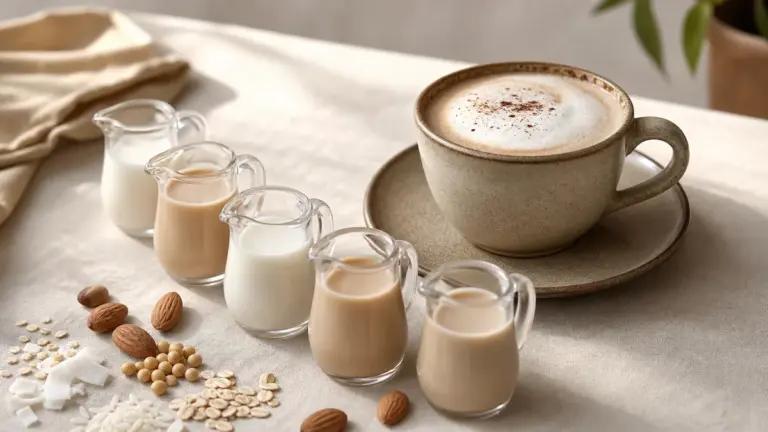
Cappuccino combines espresso with steamed milk and a substantial foam layer; latte is generally milkier, with a thinner foam layer. Their dedicated cappuccino recipe and latte recipe explain the preparation without crowding this guide with milk-steaming instructions.
Flat white, macchiato, cortado and piccolo also belong to the espresso-and-milk family. Their names should not be treated as guarantees of identical recipes everywhere.
Ristretto
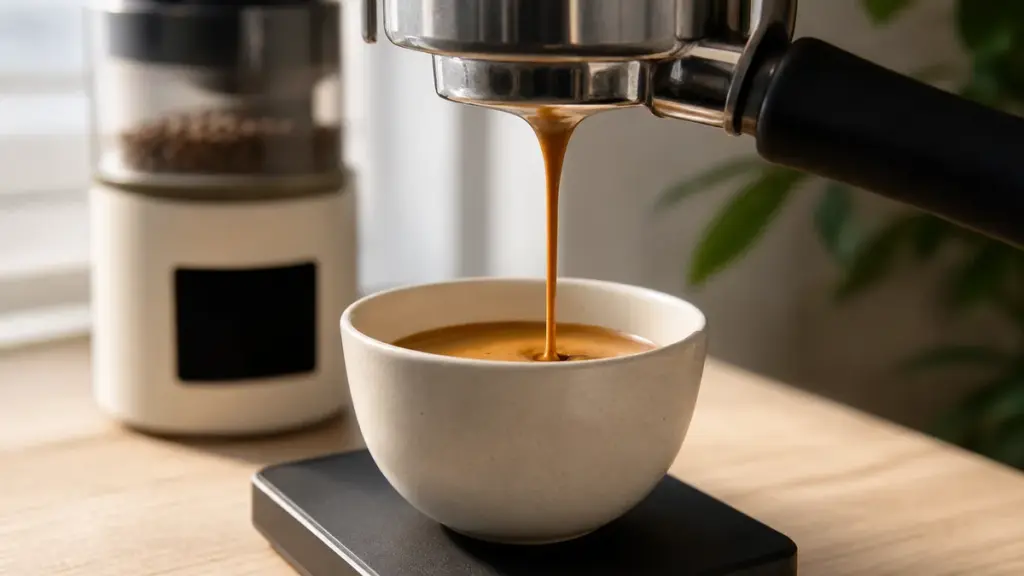
A ristretto is a restricted espresso: less beverage is collected from the same dry coffee dose. Here, the starting point is 20 g in, 20 g out, a 1:1 dose-to-yield ratio.
Expect a concentrated mouthfeel, but not guaranteed sweetness. A short shot that tastes sharply sour needs adjustment, not praise for being intense.
There is no universally fixed boundary between ristretto and ordinary espresso. Manufacturer guidance uses overlapping ranges, so the explicit recipe matters more than the name.
Ristretto recipe card
Serves: 1 double-dose ristretto
Time: allow about 2 minutes after the machine has warmed up
Ingredients:
– 20 g roasted arabica coffee beans
– Fresh water for the machine, following its instructions
– Approximately 100 ml hot water to prewarm the cup, discarded before brewing
Equipment: espresso machine, basket suitable for a 20 g dose, espresso-capable grinder, tamper, scales and a small cup.
Starting brew temperature: 93°C, where adjustable.
- Prewarm the cup, empty it and place it on the scales.
- Grind 20 g of coffee. Distribute it evenly in the clean, dry basket and tamp level.
- Fit the portafilter, zero the scales and start brewing.
- Stop at 20 g of beverage. Record the time so you can repeat the result.
- Taste before changing anything. If it rushes through and tastes thin or sour, try a finer grind on the next attempt.
Approximate caffeine: around 130 mg, used here as a study-based illustration, not a measurement of this recipe. The basis is a controlled extraction study using 20 g arabica doses and a 20 g beverage yield. Beans and preparation can produce different results. During pregnancy, keep total daily caffeine within NHS guidance; individual sensitivity also varies.
Do not simply halve an espresso’s brewing time and assume the result will be balanced. The stopping weight defines this recipe; grind and taste determine whether it works.
Lungo
A lungo is a longer extraction through the coffee grounds. Here, use 20 g in, 60 g out, a 1:3 dose-to-yield ratio.
It is less concentrated than the ristretto, although more coffee material can be extracted overall. “Less concentrated” and “less extracted” are not the same thing.
Lungo recipe card
Serves: 1 double-dose lungo
Time: allow about 2 minutes after the machine has warmed up
Ingredients:
– 20 g roasted arabica coffee beans
– Fresh water for the machine, following its instructions
– Approximately 100 ml hot water to prewarm the cup, discarded before brewing
Equipment: espresso machine, basket suitable for a 20 g dose, espresso-capable grinder, tamper, scales and a cup large enough for the yield.
Starting brew temperature: 93°C, where adjustable.
- Prewarm and empty the cup.
- Grind 20 g of coffee, distribute evenly and tamp level.
- Fit the portafilter and place the cup on the scales.
- Zero the scales, start brewing and stop at 60 g of beverage.
- Stir and taste. If the shot is unpleasantly drying or bitter, try a shorter yield next time rather than continuing towards a mugful.
Approximate caffeine: around 200 mg, rounded from the same study’s average of 204 mg for a 20 g arabica dose yielding 60 g. This is an illustrative estimate, not a reliable value for every lungo. It could approach or exceed the NHS pregnancy daily limit by itself; sensitivity varies.
For both recipes, record extraction time rather than treating it as a rigid pass-or-fail test. Manufacturer guidance commonly suggests 25 to 35 seconds for espresso, but different yields and coffees need different adjustments.
Lungo versus americano
The difference is where the extra water goes.
For a lungo, more brewing water passes through the coffee bed. For an americano, brew the espresso first, then add hot water separately. A long black conventionally reverses the assembly: hot water first, espresso afterwards.
Adding plain water dilutes the espresso but does not extract additional caffeine from the grounds. Extending extraction can add caffeine, so a lungo is not simply an americano made with a different button.
Other short espresso drinks
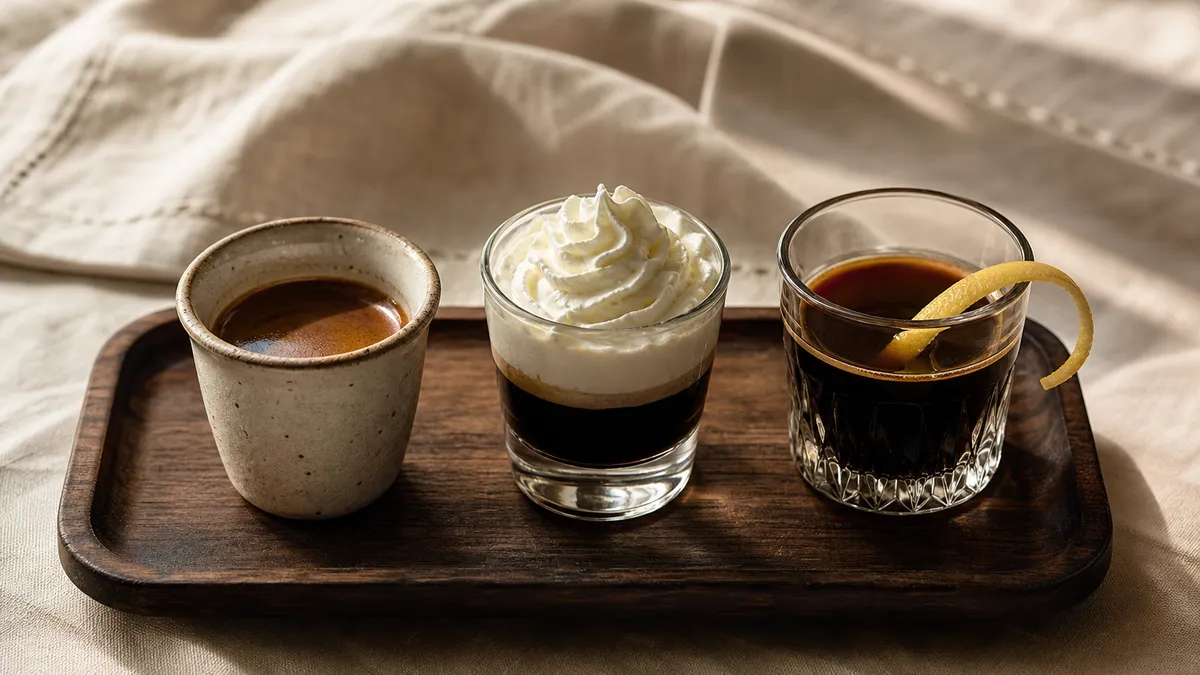
Espresso Romano: espresso served with lemon, often as a peel garnish. For a restrained version, serve the peel alongside so the drinker can decide how much citrus aroma to add.
Espresso con panna: espresso topped with whipped cream. Use chilled cream, follow its storage instructions and serve promptly.
Café Cubano: sweet coffee with espumita, a foam made by beating sugar with a little of the first brewed coffee before incorporating the remainder. Demerara can be a variation, but it is not a defining requirement. Moka-pot versions are also established, so the name does not guarantee machine-brewed espresso.
Cafezinho: belongs beside these drinks culturally, not technically. It is a small Brazilian coffee commonly prepared by filtering, rather than an espresso extraction.
Troubleshooting short espresso drinks
Treat these as starting diagnoses, not proof of a single fault.
| Symptom | Likely cause | First fix |
|---|---|---|
| Ristretto rushes through and tastes thin | Grind too coarse for the intended yield | Grind finer and keep the dose unchanged |
| Target yield changes between attempts | Stopping by eye rather than weight | Use scales and stop at the recorded yield |
| Lungo is much thinner than expected | Yield too large for the texture you prefer | Reduce the stopping weight |
Caffeine notes
Caffeine depends on the coffee and preparation, not just the drink name. Concentration describes caffeine in each gram or millilitre; total caffeine describes the whole serving.
EFSA’s evidence assessment found no safety concerns for healthy, non-pregnant adults at habitual intakes up to 400 mg daily, spread across the day, or single doses up to 200 mg. These are population benchmarks, not targets. Even 100 mg near bedtime can affect some people’s sleep.
The NHS advises no more than 200 mg daily from all sources during pregnancy. Speak to a GP, pharmacist or midwife about personal circumstances, medicines or sensitivity.
FAQ
Can a bean-to-cup machine make these drinks?
Yes, if its controls allow a suitable coffee dose and beverage yield. However, a button labelled “ristretto” or “lungo” does not guarantee the ratios used here. Check the manual and weigh the output where practical. Adjust the machine’s permitted settings rather than assuming a longer dispensing time creates the drink you want.
Can I make a doppio by brewing the same grounds twice?
No. A doppio is a double espresso serving, not a second extraction through an already-used coffee bed. Use a suitable double basket and fresh coffee, or prepare two single servings. Passing more water through the same grounds changes the extraction rather than supplying another fresh espresso.
Should I measure espresso in millilitres or grams?
Use grams when following these recipes. Beverage weight lets you compare the dry dose directly with the yield and repeat your stopping point. Millilitres remain common on menus and capsule machines, but the crema layer makes volume less straightforward to compare. Do not substitute a volume figure for a weight-based recipe.
Where to go next
Read Coffee Drinks: The Complete Guide to place espresso-based drinks within the wider menu, then use Coffee Recipes to choose your next preparation. Cappuccino and Latte are the useful next reads when you want to turn a repeatable espresso into a milk drink.
Sources
-
Specialty Coffee Association, Defining the Ever-Changing Espresso, 25 Magazine, Issue 3, 2018, reporting the 2017 espresso survey.
https://sca.coffee/sca-news/25-magazine/issue-3/defining-ever-changing-espresso-25-magazine-issue-3-zyx36
Primary professional survey reporting, not a universal recipe standard. -
La Marzocco Home, Using Espresso Brew Ratios, 2022.
https://home.lamarzoccousa.com/using-espresso-brew-ratios/
Manufacturer guidance on ratios, texture, temperature, time and grind adjustment. -
Schmieder and colleagues, Influence of Flow Rate, Particle Size, and Temperature on Espresso Extraction Kinetics, Foods 12(15), 2871, 2023.
https://mdpi-res.com/d_attachment/foods/foods-12-02871/article_deploy/foods-12-02871.pdf
Controlled laboratory extraction research, including calculated caffeine masses at different yields. -
Sage, Coffee Recipes, undated, retrieved 2026.
https://www.sageappliances.com/eu/en/coffee-journey/recipes.html
Manufacturer recipe collection covering the principal espresso-and-milk drinks. -
De’Longhi, How do I make an Americano?, undated, and The Long Black: Not Just A Black Coffee, undated, retrieved 2026.
https://www.delonghi.com/en-us/faqs/How-do-I-make-an-Americano/a/16721
https://coffeelounge.delonghi.com/aus/discover/the-long-black-not-just-a-black-coffee/
Manufacturer explanations of separate-water preparation and pouring order. -
Nespresso, Barista Recipe Booklet, “Espresso con Panna”, undated, retrieved 2026.
https://www.nespresso.com/shared_res/manuals/barista/UM_BARISTA_RB_DIGITAL_EN-FR-DE-IT.pdf
Manufacturer recipe using espresso and whipped cream. -
Terra Kaffe, TK Cocktail Hour: The TK Romano Tonic, undated, retrieved 2026.
https://www.terrakaffe.com/blogs/tk-mag/tk-cocktail-hour-the-tk-romano-tonic
Manufacturer recipe discussion identifying espresso Romano as espresso with lemon. -
Café Bustelo, Cafecito (Cuban Coffee), undated, retrieved 2026; NESCAFÉ, 5 Types of Black Coffee in the World. Already know?, undated, retrieved 2026.
https://www.cafebustelo.com/export-recipe-document?id=1301
https://www.nescafe.com/id/en-id/coffee-culture/coffee-knowledge/types-black-coffee
Producer descriptions of sugar-beating preparation, moka brewing and filtered cafezinho. -
Food Standards Agency, How to chill, freeze and defrost food safely, 2017, current retrieved guidance.
https://www.gov.uk/government/publications/how-to-chill-freeze-and-defrost-food-safely/how-to-chill-freeze-and-defrost-food-safely
Dairy storage and packaging instructions. -
European Food Safety Authority, Caffeine, summarising its 2015 Scientific Opinion; NHS, Foods to avoid in pregnancy, current retrieved guidance.
https://www.efsa.europa.eu/en/topics/topic/caffeine
https://www.nhs.uk/pregnancy/keeping-well/foods-to-avoid/
Adult caffeine benchmarks, sleep effects and pregnancy guidance.
Researched using professional espresso guidance, manufacturer recipes, controlled extraction research and current official food-safety and caffeine advice; the recipes are starting formulations, not first-hand test results.
Last checked: November 2026