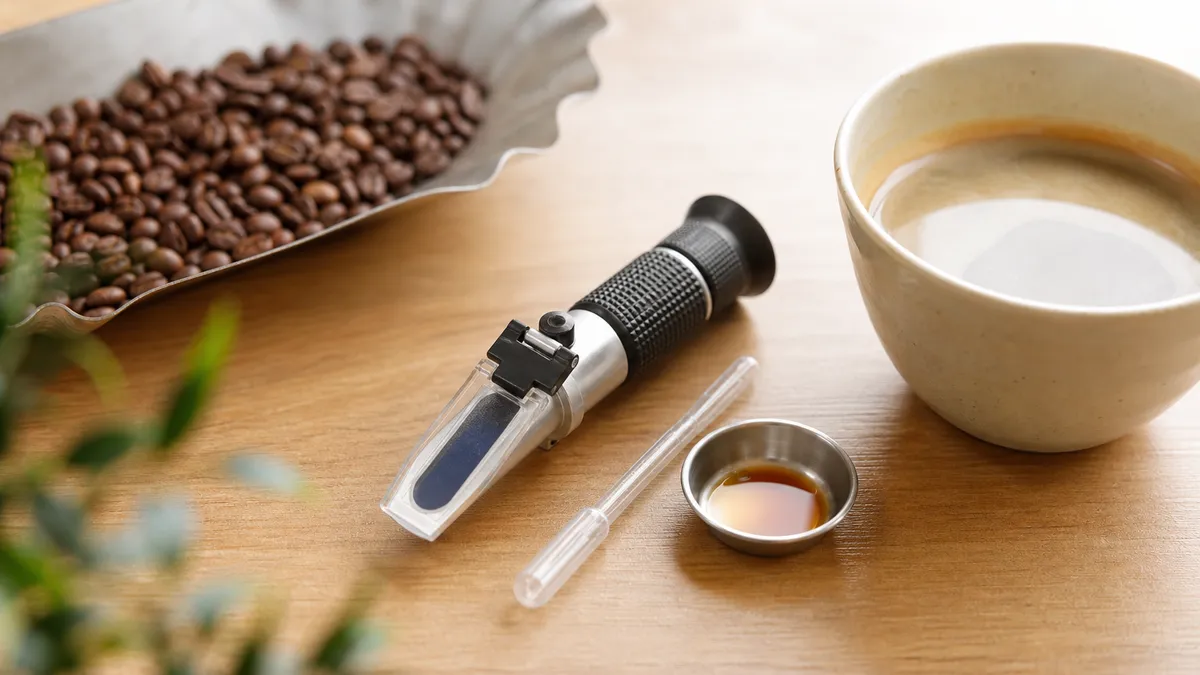
A coffee refractometer is an optical instrument that estimates how concentrated a brewed coffee is, helping you calculate extraction yield when you also know the dry coffee dose and finished drink weight. Most coffee drinkers do not need one, but it can be a useful diagnostic tool for enthusiasts, trainers and people developing repeatable brewing recipes.
In short
- TDS measures concentration: a reading of 1.40% means approximately 1.40 g of dissolved solids per 100 g of drink.
- Extraction yield measures what the dose gave up: it is different from how strong the drink tastes.
- Sample preparation matters: stir the drink, follow the maker’s cooling instructions and remove suspended particles where required.
- Zero-setting is not a full accuracy check: use the specified calibration water, and a suitable reference solution when checking accuracy.
- Our recommendation: establish consistent weighing, brewing and tasting before adding a refractometer.
What coffee refractometers measure
Two measurements make refractometers useful: total dissolved solids and extraction yield. They answer different questions, and confusing them can send your brewing adjustments in the wrong direction.
Total dissolved solids, or TDS, describes concentration. For coffee, the reading estimates the proportion of the liquid’s mass made up of dissolved material. A coffee-specific refractometer converts an optical measurement into a percentage using its manufacturer’s coffee calibration.
Extraction yield describes how much of the original dry coffee dose has dissolved. In everyday brewing calculations, it is commonly estimated from the dissolved coffee recovered in the finished drink. There are qualifications for immersion brewing, explained below.
A concentrated espresso can therefore have a similar extraction yield to a much more dilute filter coffee. The espresso contains its dissolved coffee in a smaller drink.
TDS is not a flavour score. It does not identify individual acids, aromatic compounds or undesirable flavours, and a higher reading does not automatically mean a better cup.
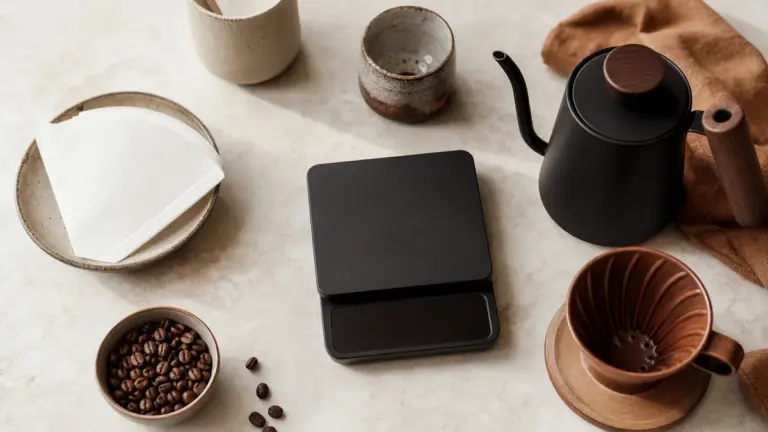
For the wider equipment picture, start with our guide to brewing accessories. Our editorial view is that a refractometer belongs after consistent brewing habits, not before them.
How a coffee refractometer works
Light changes direction when it passes between materials with different optical properties. The property describing this behaviour is called refractive index.
In a digital refractometer, a light source illuminates the interface between a prism and the sample. A detector reads the resulting optical boundary, allowing the instrument to determine refractive index. Its software then converts that measurement into estimated coffee TDS.
The conversion matters. A Brix refractometer uses a scale based on sucrose dissolved in water; its displayed number is not automatically coffee TDS. Choose an instrument with a documented coffee scale rather than assuming that any refractometer will give interchangeable results.
A water-testing TDS pen is different again. It measures electrical conductivity and estimates dissolved mineral content from that measurement. Because coffee contains dissolved substances that do not all contribute to conductivity in the same way, a water TDS pen is not a substitute for a coffee refractometer.
Who needs a coffee refractometer?
Our recommendation depends on whether you have a specific question that measurement can help answer.
An experimenting home brewer may find one worthwhile when comparing recipes and recording why a preferred cup tastes different. It gives a numerical reference alongside tasting notes.
A trainer or recipe developer can use concentration measurements to describe a recipe more clearly and check whether repeated preparations produce similar results. The instrument is most useful when everyone follows the same sampling procedure.
An office coffee enthusiast might use one during recipe development, but we would not make it a routine requirement for an ordinary workplace tea point. A reading needs someone who understands both its limitations and the brewing controls available.
A beginner who simply wants enjoyable coffee can comfortably leave it out. Our suggested priority is repeatable doses, repeatable drink weights and deliberate tasting. Measuring an inconsistent process adds numbers without necessarily making the next adjustment clearer.
Calibration and accuracy: check more than the decimal places
Before measuring coffee, follow the instrument’s zero-setting procedure. For the VST procedures referenced here, that means distilled or deionised water, with the water and instrument at a stable, similar temperature.
Do not substitute tap water when the manual specifies distilled water. Equally, do not assume every manufacturer uses the same calibration convention: follow the instructions for the particular instrument and record your method.
Zero-setting establishes a baseline. A suitable coffee reference solution provides a separate check at a known concentration. Its own uncertainty, storage requirements and usable life must also be considered.
Three specification terms deserve attention:
- Resolution: the smallest displayed increment.
- Repeatability: how closely repeated measurements agree.
- Accuracy: how closely a measurement agrees with an accepted reference.
As checked in November 2026, ATAGO claims a TDS resolution of 0.01% but accuracy of ±0.15 percentage points for its PAL-COFFEE(BX/TDS). That illustrates why two decimal places do not guarantee accuracy to two decimal places.
Before choosing an instrument, check its coffee measurement range, claimed accuracy, sample preparation requirements, reference-check procedure and technical support. These are more useful selection criteria than the display alone.
How to prepare and measure a sample
The following is a measurement workflow, not a brewing recipe. Use your normal recorded recipe, noting dose and brewing water in grams, water temperature in degrees Celsius, brewing time and finished beverage weight.
- Set up the equipment. Have the refractometer, specified calibration water, clean pipette, dry sample vessel and any required sample filters ready. Let them reach a stable room temperature.
- Clean and zero-set. Follow the manual’s cleaning and calibration instructions. Remove the calibration water and dry the well before adding coffee.
- Weigh the finished drink. Record its mass before removing a sample. Do not substitute the amount of water poured into the brewer.
- Stir before sampling. Mix the finished drink so that the sample represents the whole beverage rather than one layer.
- Clarify where required. Espresso and sediment-bearing brews need the filtering procedure specified by the instrument maker. Clear paper-filtered coffee may not require additional filtration under VST’s guidance.
- Cool and measure consistently. Use the specified sample volume and waiting time. For example, VST’s syringe-filter instructions specify drawing 3 to 4 ml of espresso after allowing one minute for cooling and gas release, then expressing approximately 2 ml through the filter.
- Repeat and record. Check that successive readings are stable. Record TDS, preparation method and tasting notes, then clean the measurement surface promptly.
Automatic temperature compensation does not remove the need for thermal stability. VST explicitly requires the sample and prism to reach a similar temperature; other instruments may specify a different operating procedure.
Filtering samples is not the same as filtering a brew
A sample filter prepares a small quantity for measurement. It is not a recommendation to change the drink you serve.
Suspended particles can interfere with refractive-index readings. Use the manufacturer-specified clarification method rather than assuming a kitchen paper filter is an equivalent substitute for a dedicated syringe filter.
VST warns against excessive syringe pressure and states that its sample filters are non-sterile: do not drink the filtered test sample.
Keep measurement vessels clean and dry. A separate tasting cup also makes the workflow easier to organise; see coffee cups and glassware for the serving side of the subject.
Worked example: calculating extraction yield
For a conventional beverage-based calculation:
Extraction yield (%) = beverage mass (g) × TDS (%) ÷ dry coffee dose (g)
When entering TDS as the displayed percentage, such as 1.40, do not multiply the answer by 100 again.
Consider this illustrative filter-coffee example, not a measured test or prescribed recipe:
- Dry coffee dose: 20 g
- Brewing water: 320 g, giving a coffee-to-water ratio of 1:16
- Finished beverage, weighed before sampling: 280 g
- Measured TDS: 1.40%
- Assumptions: plain black coffee, a representative sample, and no correction for dissolved minerals already present in the brewing water.
The estimated dissolved-solids mass is:
280 g × 0.014 = 3.92 g
The beverage-based extraction yield is:
3.92 g ÷ 20 g × 100 = 19.6%
Using the 320 g of input water instead would produce 22.4%, answering the wrong mass-balance question for this collected-beverage calculation.
For an illustrative espresso, 18 g in and 36 g out is a dose-to-yield ratio of 1:2. At 10.0% TDS, the same calculation gives 20.0% extraction. The concentration differs greatly from the filter example, while the calculated yields are similar.
Interpreting results without chasing a target
The classic brewing-control reference box places filter coffee at approximately 1.15% to 1.35% TDS and 18% to 22% extraction. Treat that as a historical reference, not a universal boundary between pleasant and unpleasant coffee.
A peer-reviewed research synthesis published in 2023 combined controlled sensory and consumer studies to develop updated brewing-control charts. It identified different preference groups rather than one concentration-and-extraction combination that suited everyone. Its consumer findings also came from a particular population, not a representative sample of all coffee drinkers.
Our practical recommendation is to taste first, record the measurement and change one brewing variable at a time. Use the number to describe a result, not overrule a cup you enjoy.
Why immersion calculations need care
With full immersion, such as a cafetière, dissolved coffee remains in liquid trapped among the grounds as well as in the poured drink. Calculating only the dissolved material recovered in the cup therefore does not capture everything that dissolved.
A peer-reviewed experimental and modelling study published in 2021 derives an immersion-specific calculation accounting for this distinction. If comparing immersion and percolation results, use a calculator with a documented method and label which definition of extraction you are reporting.
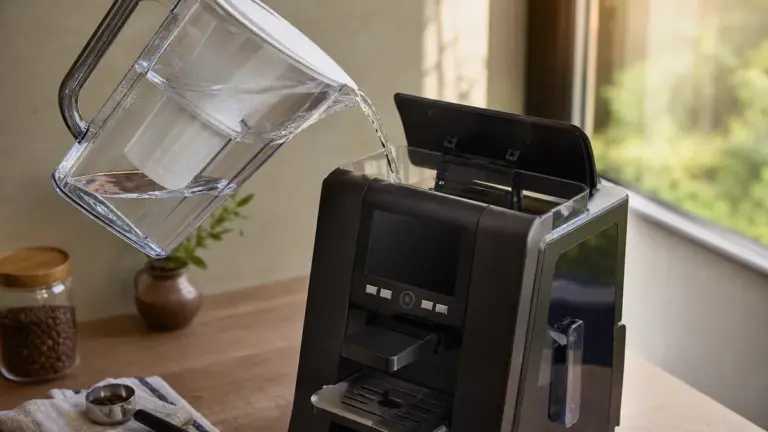
Water is another separate variable. A coffee refractometer is not a hardness test and cannot determine whether a machine needs scale protection. See water filters for coffee machines rather than trying to infer that from brewed-coffee TDS.
Troubleshooting inconsistent readings
Check the measurement process before changing the brew.
| Symptom | Likely cause | Fix |
|---|---|---|
| Readings drift as you repeat them | Sample and prism are still reaching thermal equilibrium | Follow the specified cooling and equilibration procedure |
| Cloudy coffee gives erratic readings | Suspended particles interfere with measurement | Use the maker’s recommended sample filter |
| Results change after rinsing | Residual rinse water dilutes the sample | Dry the well before refilling |
| Zero checks fail | Contamination, unsuitable calibration water or temperature instability | Clean, stabilise and repeat the specified zero-setting procedure |
| Extraction calculation looks implausible | Wrong mass, wrong display scale or percentage-entry error | Check beverage weight, coffee-TDS mode and calculation inputs |
FAQ
Can a coffee refractometer measure caffeine?
No, a coffee refractometer does not separately measure caffeine. Its coffee scale estimates the overall concentration of dissolved material from refractive index. It cannot tell you how much of that material is caffeine rather than other compounds, so do not use its reading to estimate caffeine intake.
Can I measure a latte or sweetened coffee?
Not meaningfully using an ordinary black-coffee TDS calibration. Milk, sugar and other additions change the optical properties of the sample, so the result cannot be treated as dissolved coffee alone. Measure the plain coffee before adding anything if your purpose is to calculate coffee extraction yield.
Do I need an app?
No, you can calculate beverage-based extraction yield with the equation above and record results manually. An app may make logging easier, but check its assumptions, especially whether it expects brewing-water mass or finished-beverage mass and whether it distinguishes immersion from percolation. Convenient arithmetic does not replace a documented measurement method.
Where to go next
Read Brewing Accessories to put coffee refractometers in context with the rest of your equipment. Coffee Cups, Glassware and Travel Mugs covers serving vessels, while Water Filters for Coffee Machines addresses the separate questions of water treatment and machine protection.
Sources
-
VST, About Coffee and Refractometers, copyright 2008 to 2013. Optical principles, coffee-specific calibration and conductivity-meter limitations.
URL: https://cdn.shopify.com/s/files/1/0092/7622/files/Coffee_and_VST_Refractometers.pdf -
VST, Coffee & Espresso Refractometer User Guide, revision H, undated. Zero-setting, cleaning and temperature equilibration. This is a model-specific manual, not a claim about every current instrument.
URL: https://cdn.shopify.com/s/files/1/0092/7622/files/VST_STD_COFFEE_User_Guide.pdf -
VST, How to Ensure Accurate and Repeatable Measurements, revision A, 15 September 2016. Mixing, sample clarification and measurement consistency.
URL: https://cdn.shopify.com/s/files/1/0092/7622/files/VST_LAB_Coffee_PRECISION_Notes.pdf -
VST, Syringe Filters: Safety & Operating Instructions, undated. Espresso sample volumes, timing, filtering and safety.
URL: https://cdn.shopify.com/s/files/1/0092/7622/files/VST_Syringe_Filters_Safety_and_Use.pdf -
VST, Coffee Reference Solutions: Use Instructions, version 2, undated. Reference checks, temperature conditions and combined uncertainty.
URL: https://cdn.shopify.com/s/files/1/0092/7622/files/Reference_Solutions_User_Guide_v2.pdf -
ATAGO, Coffee Refractometer PAL-COFFEE(BX/TDS), undated product page, specifications checked November 2026. Manufacturer-claimed resolution and accuracy.
URL: https://atago.net/en/atagodirect-index.php?key=CGD50756 -
Guinard and colleagues, A New Coffee Brewing Control Chart Relating Sensory Properties and Consumer Liking to Brew Strength, Extraction Yield, and Brew Ratio, Journal of Food Science, 2023. Classic reference ranges and synthesis of sensory and consumer research.
URL: https://ift.onlinelibrary.wiley.com/doi/full/10.1111/1750-3841.16531 -
Liang, Chan and Ristenpart, An Equilibrium Desorption Model for the Strength and Extraction Yield of Full Immersion Brewed Coffee, Scientific Reports, 2021. Mass-balance definitions and immersion-specific extraction calculations.
URL: https://pmc.ncbi.nlm.nih.gov/articles/PMC7994670/
This article was researched from retrieved manufacturer documentation and peer-reviewed papers; the worked examples are illustrative calculations, not first-hand instrument tests.
Last checked: November 2026