Coffee is a drink made by brewing the roasted, ground seeds of the coffee plant with water. These seeds are what we call coffee beans: they grow inside small fruits known as coffee cherries, rather than in pods like garden beans.
In short
- Coffee starts as a fruit crop, not a brown bean.
- Most coffee cherries contain two seeds, which are separated from the fruit and dried before roasting.
- Arabica and robusta are the main coffees you will encounter, but other coffee species exist.
- Whole beans and ground coffee need brewing; instant coffee has already been brewed and dried.
- Coffee naturally contains caffeine. Decaffeinated coffee has most of it removed, but is not necessarily caffeine-free.
Coffee starts with a plant and its fruit
Coffee plants belong to the botanical group Coffea. They are woody shrubs or trees, cultivated mainly in tropical regions. The familiar roasted bean is only one stage in the life of an agricultural crop.
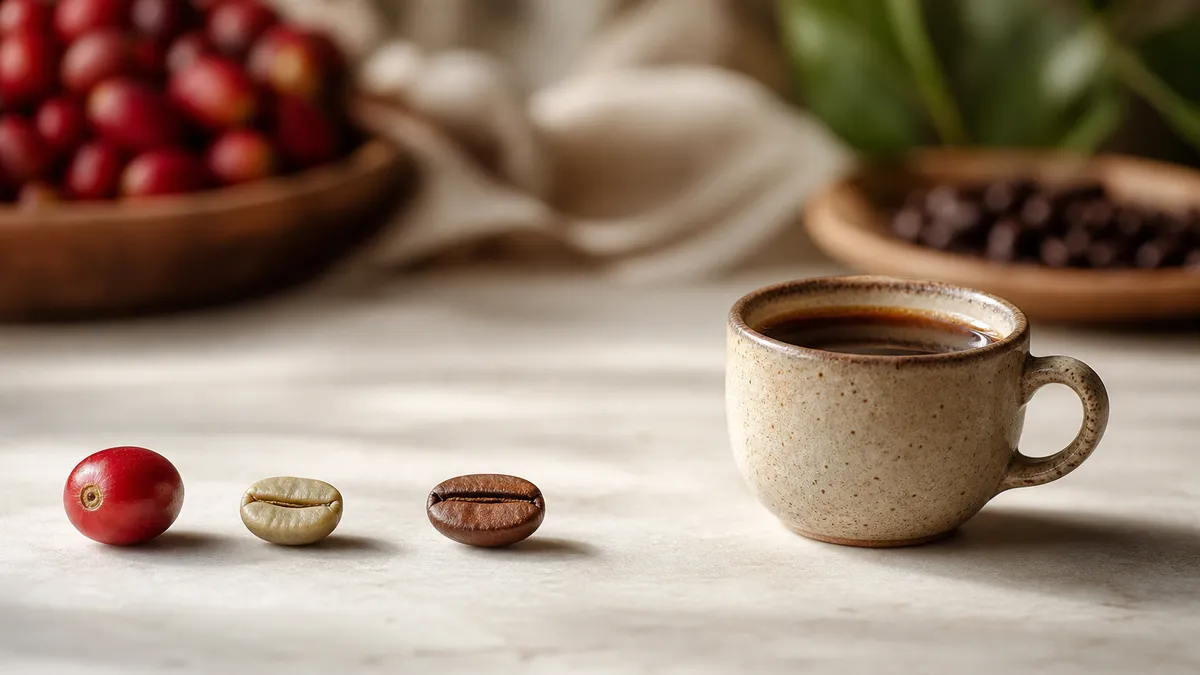
The plants produce fruits called coffee cherries because of their appearance. Inside the skin and flesh are the seeds that will eventually become coffee beans. Most cherries contain two seeds, sitting with their flatter sides facing one another.
That distinction helps make sense of the whole subject: the cherry is the fruit; the bean is the seed; the coffee in your cup is the brewed drink. We use the same word, coffee, for the plant, the beans and the beverage, so context does some of the work.
If the terminology already feels crowded, start with coffee for beginners. You do not need to learn every farming or brewing term before enjoying a cup.
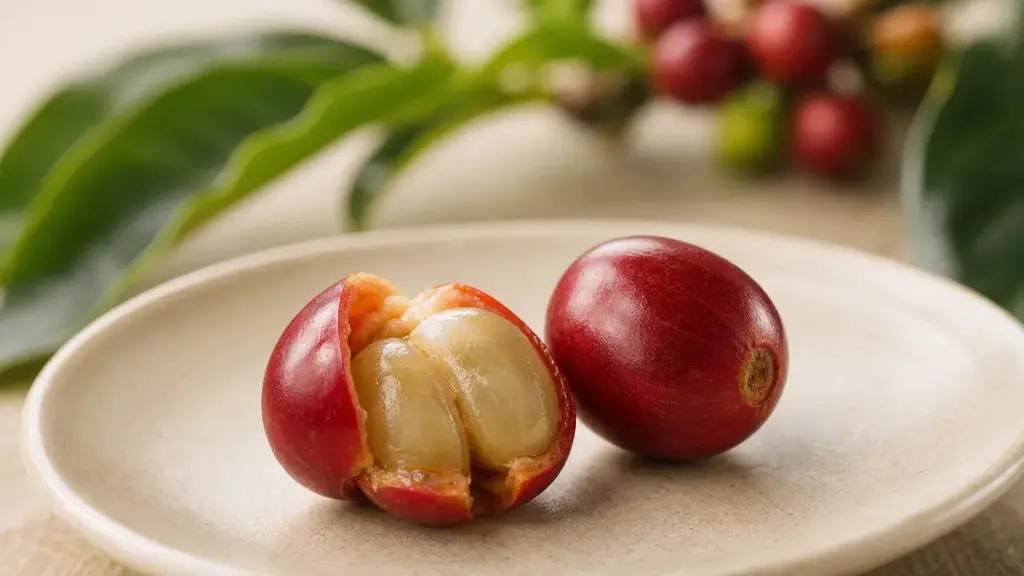
What is coffee at each stage?
This simple sequence connects the objects you might see in a photograph, a shop or your kitchen.
| Stage | What it is | What happens next |
|---|---|---|
| Coffee cherry | The fruit containing the seeds | Harvesting and processing separate the seeds from the surrounding fruit |
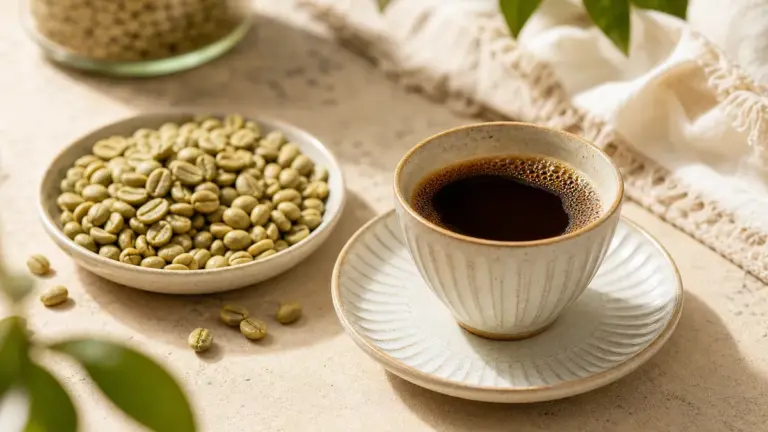
| Green coffee bean | A dried, unroasted seed | Roasting develops its brown colour and familiar coffee aromas |
| Roasted coffee bean | The seed after roasting | Grinding breaks it into smaller particles for brewing |
| Ground coffee | Particles of roasted beans | Water extracts soluble material to make the drink |
“Green” is the trade term for unroasted coffee, not a promise that every bean will be a vivid green colour. It also does not mean the beans are fresh peas waiting to be cooked.
The table is a map, not a complete production method. Fruit removal and drying can happen in different orders, depending on how the coffee is processed. For the fuller journey, read how coffee is made.
Arabica, robusta and other coffee species
The main species used for coffee are arabica, Coffea arabica, and canephora, Coffea canephora, usually traded as robusta. These are different plants, not different roast levels.
Arabica is generally associated with complex flavours and has less caffeine than robusta. Robusta is better adapted to warmer growing conditions and is valued for characteristics including its productivity and resistance to some pests. These broad differences explain why producers grow different crops, but they do not tell you exactly how an individual coffee will taste.
You may also encounter liberica, Coffea liberica, and excelsa, Coffea dewevrei. Older references often place excelsa within liberica as a botanical variety. This article follows Kew’s current treatment, informed by genomic research published in 2025, which recognises them as separate species.
For a beginner, the useful distinction is between a species and a variety. Arabica is a species; names such as Bourbon and Typica refer to varieties within arabica. There is no need to memorise the family tree, but recognising those different levels stops a coffee label looking like a list of unrelated mysteries.
Treat a species name as background information, not a verdict on whether you will enjoy the drink.
How coffee becomes a drink
After harvesting, the fruit is processed and the seeds are dried and prepared for roasting. Roasting then changes the seeds chemically and physically, developing the brown colour and aromas we associate with coffee.
Grinding breaks roasted beans into particles, exposing more of their structure to water. During brewing, water dissolves soluble material from those particles. This is called extraction: moving substances out of the ground coffee and into the drink.
You drink the resulting liquid rather than dissolving the entire bean. Much of the solid material remains as spent grounds.
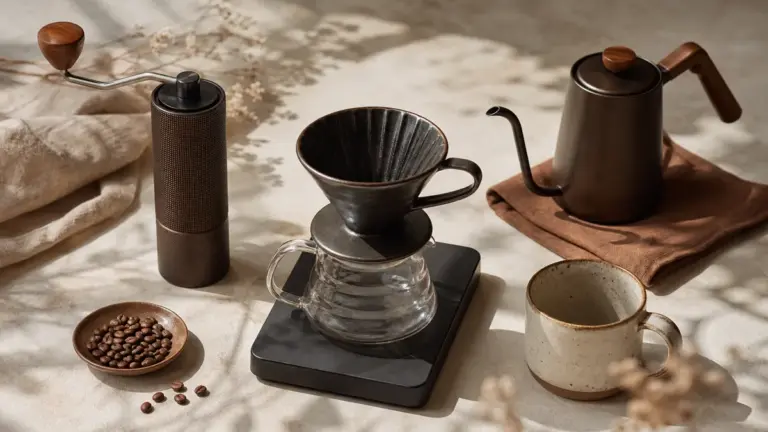
Different brewing methods organise this contact with water differently. Filter brewing lets water pass through a bed of grounds; a cafetière steeps grounds in water before a mesh plunger separates much of the solid material; espresso uses pressure to drive water through finely ground coffee.
They are different ways of making the same broad kind of drink, not separate species of coffee. You do not need an espresso machine for a drink to count as coffee.
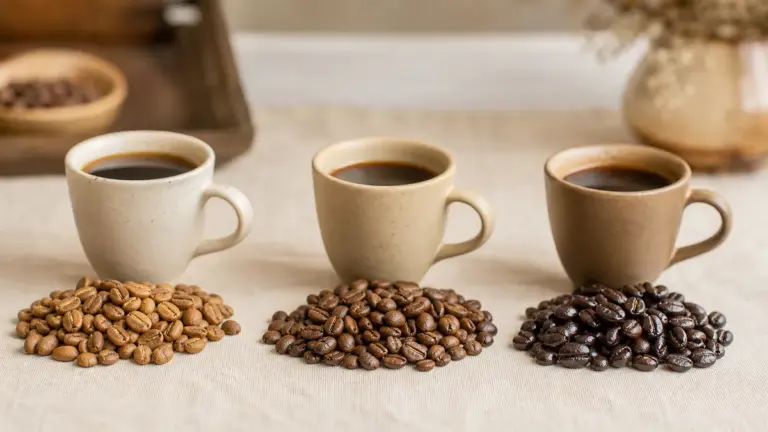
Roasting deserves a little attention because the brown beans in different bags are not all roasted alike. For an explanation of the colour and flavour differences, see understanding roast levels.
Where instant coffee fits
Instant coffee is also made from coffee beans. A manufacturer roasts and brews the coffee, then removes water from the extract to produce soluble powder or granules.
When you add water, you are reconstituting that dried extract. Ground coffee is different: it still needs brewing and generally leaves grounds behind. Putting ground coffee into a mug and stirring will not make it dissolve like instant coffee.
Neither format needs defending as “real” coffee. The useful question is which preparation suits the drink you want and the effort you want to put into making it.
Caffeine: what it does and what to watch
Caffeine is a naturally occurring compound in coffee. It stimulates the central nervous system and can increase alertness and reduce sleepiness.
There is no single caffeine figure that applies to every cup. Coffee type, preparation and serving size vary, so counting “cups” alone is an imprecise way to track intake. If caffeine matters to you, use information for the actual product or drink where available.
The European Food Safety Authority’s 2015 scientific risk assessment concluded that, for healthy non-pregnant adults:
- Single doses up to 200 mg raise no safety concerns.
- Intakes up to 400 mg across the day raise no safety concerns.
- Even 100 mg close to bedtime may affect sleep in some adults.
These conclusions come from an assessment of the available scientific evidence, not a recommendation to consume those amounts. They are population benchmarks, not personal targets.
During pregnancy, the NHS advises no more than 200 mg a day from all sources, including tea, chocolate and other caffeinated products. Individual sensitivity, medicines and health conditions also matter. Speak to a GP, pharmacist or midwife if you need advice about your own circumstances.
Decaffeinated coffee offers another way to enjoy coffee’s flavour. Most caffeine is removed from the beans before roasting, although some can remain. “Decaf” therefore means substantially reduced caffeine, not a guarantee of none.
Why people love coffee
For some people, coffee is chiefly about flavour and aroma. For others, it is the familiar act of making a drink, a reason to take a break, or something to share. Caffeine may be part of the attraction, but it is not the whole explanation.
Coffee also has social meanings beyond any individual preference. The Crop Trust describes traditions in which preparing and serving coffee expresses hospitality, friendship and respect. Your own version may be much simpler: putting the kettle on when someone visits.
There is no requirement to drink coffee black, describe it expertly or turn preparation into a hobby. Enjoying a familiar mug is as legitimate as comparing carefully brewed samples.
Coffee does not have just one flavour
“Coffee flavour” can sound like a single thing, yet sensory research identifies many different aromas, tastes and textures in brewed coffee. World Coffee Research’s sensory lexicon includes attributes associated with fruit, flowers, nuts, cocoa, sweetness, bitterness and roasted foods.
These words describe resemblances. A plain coffee described as nutty does not necessarily contain added nuts; a floral description does not mean flowers were put into the brewer. Separately flavoured products are another matter, so check their ingredients.
A few distinctions make tasting less confusing:
- Aroma is what you smell.
- Acidity, in tasting language, describes sour or bright sensations, not a caffeine measurement.
- Body describes the drink’s sense of weight or fullness in the mouth.
- Bitterness is one taste attribute, not a complete description of coffee.
You do not have to recognise a particular fruit or flower to make a useful judgement. “I like the smell, but the finish is too bitter for me” is clear, practical information.
For your first comparisons, pay attention to your own response rather than trying to reproduce the words on a packet. Ask whether you enjoy the aroma, whether the texture feels pleasant and whether you want another sip. Those observations give you a starting point without turning breakfast into an examination.
FAQ
Is coffee a bean or a seed?
Botanically, a coffee bean is a seed. “Bean” is the familiar name used in shops, kitchens and the coffee trade, so it is not wrong in everyday conversation. The distinction matters when understanding the plant: coffee seeds develop inside a fleshy fruit called a cherry, rather than inside a legume pod.
Do I have to drink coffee without milk to appreciate it?
No. Enjoying coffee does not require drinking it black or following someone else’s preferences. If you are curious, try a small taste before adding your usual milk, then decide which version you prefer. That is an optional comparison, not a test you need to pass before calling yourself a coffee drinker.
Do tasting notes mean ingredients have been added?
Not usually: tasting notes describe flavours or aromas that remind the taster of something else. They are sensory descriptions, rather than an ingredients list. However, some products are deliberately flavoured or contain other ingredients. Read the label when you need to distinguish plain coffee from a flavoured product, especially if allergens matter.
Where to go next
Now that “what is coffee?” has a clear answer, use Coffee for Beginners to choose your next topic. Read How Coffee Is Made: From Seed to Cup to follow the agricultural and production journey, then Understanding Roast Levels to understand a visible difference between bags of roasted beans.
Sources
Publication years are given where available; undated pages are identified rather than assigned an inferred publication date.
-
National Coffee Association, About Coffee. What is coffee? Undated, live version retrieved November 2026.
https://www.aboutcoffee.org/origins/what-is-coffee/
Used for the fruit, seed and coffee-cherry anatomy. -
Crop Trust. Coffee. Undated, live version retrieved November 2026.
https://www.croptrust.org/knowledge-hub/crops/crop/coffee/
Used for the crop overview, main species, growing conditions and social traditions. -
World Coffee Research. Coffee varieties catalog. Undated, live version retrieved November 2026.
https://varieties.worldcoffeeresearch.org/
Used for the distinction between species and named arabica varieties. -
Royal Botanic Gardens, Kew. Excelsa and Liberica coffee development. Undated project page, citing Davis and colleagues’ 2025 paper, Genomic data define species delimitation in Liberica coffee with implications for crop development and conservation, in Nature Plants.
https://www.kew.org/science/our-science/projects/excelsa-and-Liberica-coffee-development
Used for the current treatment of liberica and excelsa. -
National Coffee Association, About Coffee. Lifecycle of Coffee. Undated, live version retrieved November 2026.
https://www.aboutcoffee.org/origins/lifecycle-of-coffee/
Used for processing, drying, roasting and grinding. -
Specialty Coffee Association. Coffee Basics, published by the former Specialty Coffee Association of Europe. Undated educational brochure, hosted by BUNN.
https://resource.bunn.com/library/pdf/coffee_basics_brochure_scae_english.pdf
Used for extraction, soluble material, remaining bean fibre and brewing principles. -
National Coffee Association, About Coffee. Instant coffee. Undated, live version retrieved November 2026.
https://www.aboutcoffee.org/brewing/instant-coffee/
Used for the distinction between dried coffee extract and ground beans. -
European Food Safety Authority. Caffeine, topic summary of the 2015 Scientific Opinion on the safety of caffeine. Live version retrieved November 2026.
https://www.efsa.europa.eu/en/topics/topic/caffeine
Used for stimulant effects, serving variability, adult intake benchmarks and sleep effects. -
NHS. Foods to avoid in pregnancy, caffeine section. Undated version retrieved November 2026.
https://www.nhs.uk/pregnancy/keeping-well/foods-to-avoid/
Used for current UK pregnancy guidance. -
National Coffee Association, About Coffee. Decaf coffee. Undated, live version retrieved November 2026.
https://www.aboutcoffee.org/beans/decaf-coffee/
Used for caffeine removal before roasting and residual caffeine. -
World Coffee Research. Sensory Lexicon, version 2.0, 2017; accompanying resource page retrieved November 2026.
https://worldcoffeeresearch.org/resources/sensory-lexicon
Used for coffee aroma, taste and texture terminology.
This article was researched using botanical and agricultural reference sources, coffee-industry educational material, sensory research resources and current official caffeine guidance; no first-hand testing is claimed.
Last checked: November 2026