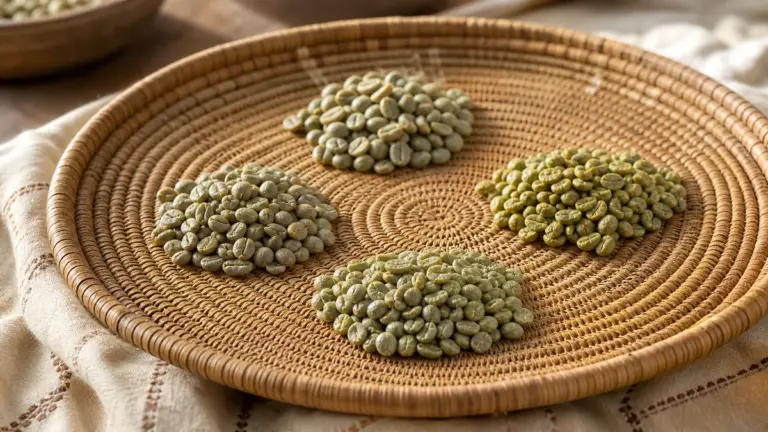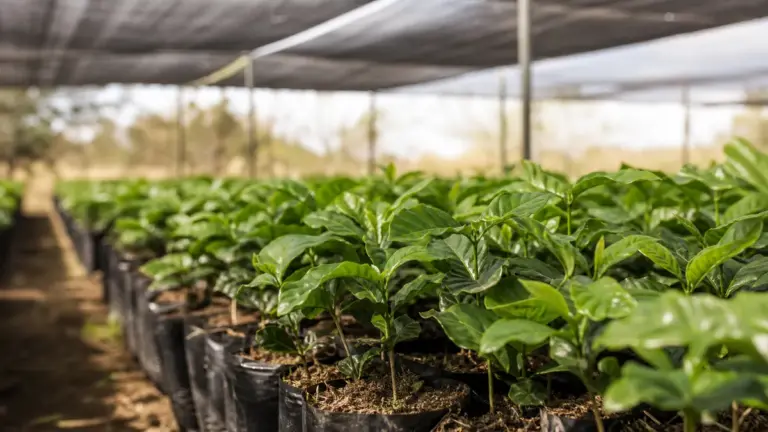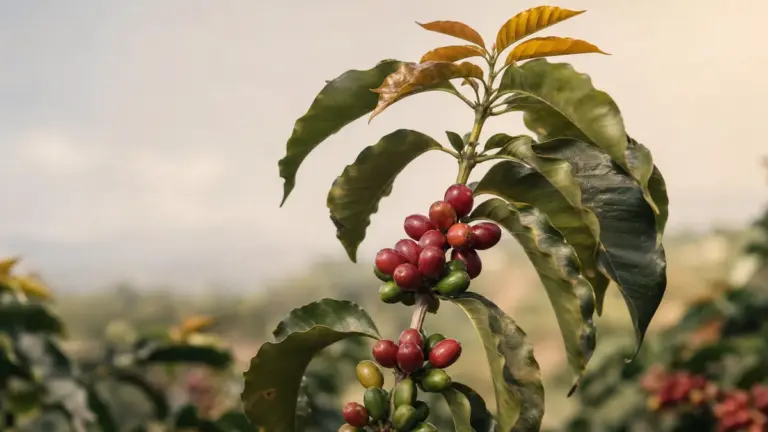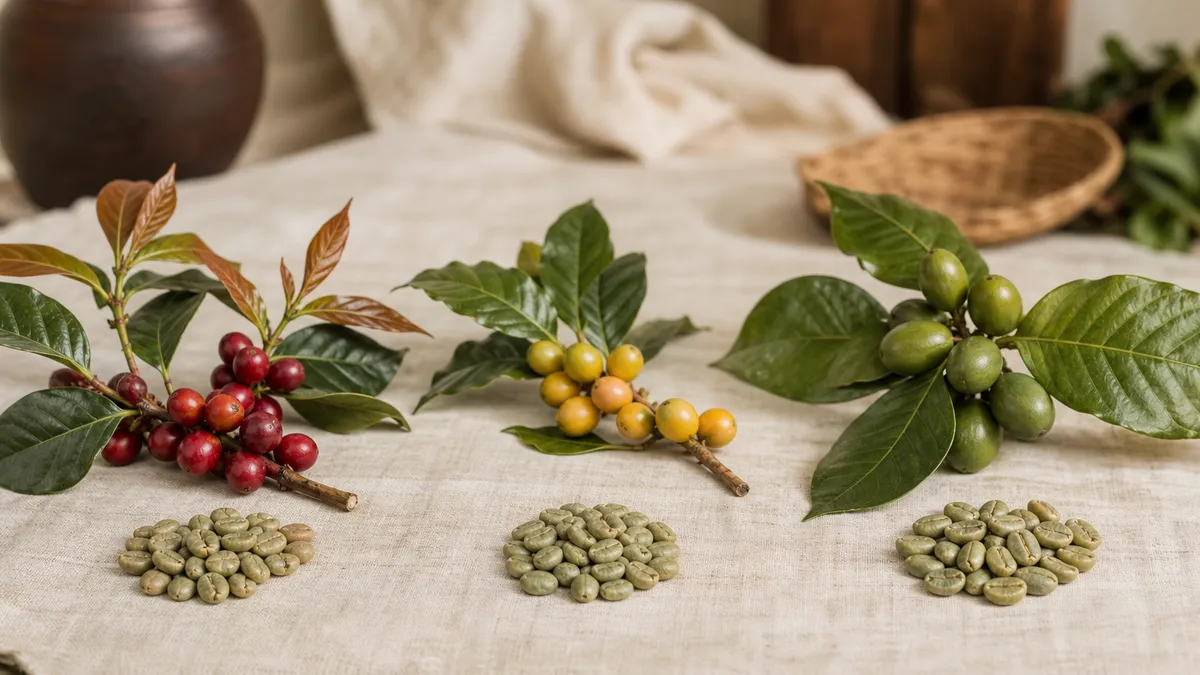
A coffee species is a botanical grouping such as Coffea arabica, while a variety identifies a more specific type, such as Typica, within it. A cultivar is a cultivated selection with recognisable characteristics maintained through appropriate propagation, but coffee traders often use “variety” for these cultivated types too. The key is to distinguish formal botanical names from the practical vocabulary on a coffee bag.
In short
- Arabica and robusta refer to different species; Typica and Bourbon are types of arabica, not separate species.
- A botanical variety is a formal taxonomic rank. A cultivated variety, usually called a cultivar, belongs to a different naming system.
- A landrace is a traditional, locally adapted cultivated population, not simply any wild coffee.
- A hybrid has genetically different parents; F1 identifies the first generation of a particular cross.
- A variety name describes plant identity, not a guaranteed flavour, growing location or processing method.
Coffee species, varieties and cultivars at a glance
Coffee terminology becomes easier when you ask what each word describes: botanical identity, a cultivated selection, local adaptation or parentage.
| Term | Plain-English meaning | What to remember |
|---|---|---|
| Species | A recognised botanical grouping within the coffee genus, Coffea | Coffea arabica and Coffea canephora are different species |
| Botanical variety | A formally named rank below species | Usually indicated by var. in a scientific name |
| Cultivar | A cultivated selection maintained for distinguishing characteristics | Short for “cultivated variety”, not another botanical rank |
| Landrace | A traditional cultivated population adapted to local conditions | Need not have the uniformity of a modern selected line |
| Hybrid | Offspring produced by crossing genetically different parents | The parents can belong to the same species or different species |
| F1 hybrid | The first generation resulting from a particular cross | Describes a generation, not a quality grade |
These are not six consecutive rungs on one ladder. A cultivar can also be an F1 hybrid, while a landrace population can provide material from which breeders make a more uniform selection.
Our coffee varieties guide maps the individual coffees. Here, the aim is to make their descriptions intelligible.
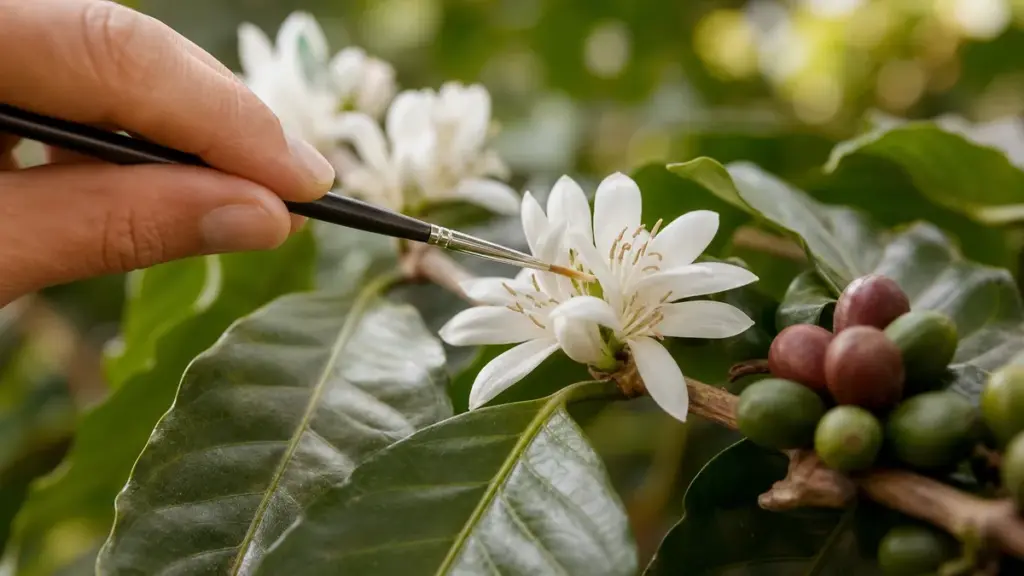
Species: the botanical starting point
A species is a unit of biological classification. In the scientific name Coffea arabica, Coffea identifies the genus, the wider grouping, and arabica completes the species name.
Arabica is therefore not a variety of robusta. They belong to different species: Coffea arabica and Coffea canephora, respectively. Robusta is the familiar commercial name used for C. canephora in World Coffee Research’s catalogue.
Typica and Bourbon, by contrast, sit within arabica. Calling Typica a species confuses the identity of the wider plant group with a particular cultivated type.
Species boundaries do not mean that crossing is always impossible. Plants can sometimes hybridise across species, and coffee provides examples. That is why “plants that can breed together” is not a sufficient definition for every botanical situation.
For the species itself, rather than its naming vocabulary, see arabica coffee.
Why “variety” has more than one meaning
A botanical variety is a formal rank
In botanical classification, a variety is a named subdivision below species. Its written name includes var., followed by the variety’s epithet, the distinguishing part of the name.
This is a taxonomic judgement about how plants are classified. It is not the same thing as a roaster placing “Variety: Typica” on a bag.
The distinction matters because “variety” can sound equally formal in both settings. In one, it identifies a botanical rank; in the other, it usually identifies cultivated planting material.
Coffee uses “variety” more broadly
World Coffee Research, or WCR, uses “variety” as practical agricultural language. Its catalogue’s general criteria are that a variety should be:
- Distinct: distinguishable from other varieties.
- Uniform: sufficiently consistent in its defining characteristics.
- Stable: able to retain those characteristics through reproduction by the appropriate method.
These criteria concern the plants, not identical flavour in every harvest.
WCR also makes its exceptions explicit. Pacamara, for example, is included despite not meeting the catalogue’s stated uniformity and stability criteria. The catalogue serves farmers who encounter these names, rather than pretending that every established trade name fits a tidy definition.
In this article, “coffee variety” follows that practical usage unless “botanical variety” is specified.
Cultivar: a cultivated selection, not necessarily a laboratory cross
A cultivar is a group of plants selected for particular characteristics that remain distinct, uniform and stable when propagated appropriately. Propagation means producing more plants, whether through seed or methods such as cuttings and tissue culture.
“Cultivated variety” explains where the word cultivar comes from. It does not mean that every plant grown on a farm automatically constitutes a cultivar.
Nor must a cultivar begin with a deliberate cross. People can select useful plants from existing populations or recognise a naturally occurring mutation, then maintain the selection.
Caturra illustrates this distinction. WCR describes it as a natural mutation of Bourbon associated with compact growth, followed by selection work. The mutation arose naturally; people subsequently selected and multiplied useful plants.
This corrects an oversimplification found in some coffee explanations: “varieties happen naturally, cultivars are made by breeders”. Cultivars can originate from natural variation as well as planned breeding. Human selection and the maintenance of distinguishing characteristics are central.
Cultivar names conventionally appear in single quotation marks and are not italicised. Species names are italicised. Everyday coffee packaging rarely needs to reproduce the full formal naming style, but the underlying distinction remains useful.
Landrace: local adaptation with a cultivation history
A landrace is a traditional, locally adapted cultivated population. WCR uses “Ethiopian landrace” for domesticated, locally adapted traditional varieties originating in arabica’s Ethiopian diversity.
The word carries both an environmental and a human history. It does not simply mean “a coffee growing wild in a forest”.
A landrace may contain genetic variation rather than behaving like one tightly selected line. That variation is part of why breeders distinguish a population from a more uniform selection drawn from it.
For reading a bag, the practical question is how specific the description is. “Landrace” supplies a category, but not necessarily the identity of every plant contributing to the lot. Ask whether the seller means a named local population, a selection derived from one, or mixed material described collectively.
Do not assume that a traditional population is untouched by people. Cultivation and farmers’ selection are compatible with landrace history.
Hybrids and F1: parentage, generation and propagation
A hybrid results from crossing genetically different parents. In coffee, that can mean crossing types within arabica or bringing together material from different species.
F1 means the first filial generation: the immediate offspring of the specified parental cross. It does not mean the first coffee hybrid ever developed, and “hybrid” alone does not establish that a plant is F1.
WCR identifies Centroamericano, also called H1, as an F1 hybrid from T5296 crossed with Rume Sudan. That description answers a parentage question, not a flavour question.
Why saved seed matters
Seed collected from an F1 plant produces the next generation, not a fresh recreation of the original parental cross. Its descendants can separate into different combinations of characteristics, a process called segregation.
Consequently, they may not retain the parent plant’s yield, disease resistance or quality characteristics. Appropriate propagation is therefore essential to maintaining the intended planting material.
This also explains why “stable cultivar” does not necessarily mean “save any seed and get the same result”. Stability is assessed with the suitable propagation method, not every conceivable method.
Hybridisation should not be confused with genetic engineering. WCR states that its catalogue varieties were developed through traditional breeding approaches. Crossing parents and selecting their descendants are not, by themselves, genetic engineering.
Arabica genetics, explained without the jargon
Arabica is predominantly self-pollinating: its own pollen can fertilise its flowers. Cross-pollination can still occur, so “self-pollinating” does not mean genetically sealed off from neighbouring plants.
Self-pollination helps breeders maintain relatively uniform lines through seed. It does not make every seedling a clone, which would be a genetically copied plant.
Arabica is also tetraploid, meaning it has four basic chromosome sets. Chromosomes are the structures that carry genetic information. Arabica has 44 chromosomes, arranged as four sets of 11, rather than the two sets found in its diploid ancestors.
More precisely, it is an allotetraploid: its chromosome sets derive from different ancestral species, C. canephora and C. eugenioides. Peer-reviewed genomic research supports this combined ancestry.
These terms answer different questions. Self-pollination describes reproduction; tetraploidy describes chromosome organisation; cultivar identifies selected cultivated material. None is a tasting note, and none establishes that one coffee must taste better than another.
How names travel through the coffee trade
Plant names do not always travel with perfectly documented planting material. WCR’s Typica profile records alternative names including Criollo, Indio and Arabigo, illustrating how one recognised type can acquire different names.
The reverse problem also occurs: one name can refer to genetically different plants. WCR warns that coffees called Geisha do not all share the distinct genetics of the Panamanian material it describes.
Treat this as a traceability question, not an automatic accusation of dishonesty. A name may be locally established without having been checked against a genetic reference.
“Varietal” adds another layer of vocabulary. It is commonly used as a noun in coffee commerce, but it is not the preferred botanical term for the plant category. Use variety for the general agricultural discussion, cultivar when that specific meaning is intended, and botanical variety for the formal rank. “Varietal characteristics” remains a useful adjectival expression.
The Typica profile provides a concrete example of the distinction between plant identity and the names encountered in trade.
How to read the information on a coffee bag
Use this short sequence rather than treating every prominent word as a variety name.
- Identify the species. “Arabica” supplies species information, but leaves the cultivated type unspecified.
- Look for a separate variety or cultivar field. A name such as Typica adds plant identity beneath that broad species description.
- Separate identity from location and processing. A country or farm answers “where”; a processing description answers “how the harvested coffee was handled”.
- Check what the name actually promises. Is it one named selection, several listed varieties, or less precisely identified material?
- Read the flavour description independently. Do not substitute the reputation of a variety for information about this particular coffee.
That last step has experimental support. WCR’s multilocation variety trial found that genetics and growing conditions interact in their effects on cup quality. A variety’s identity is useful information, but not a fixed sensory recipe.
Read coffee species, varieties and cultivars as clues to plant identity, then use the lot’s own information to decide what to expect in the cup.
FAQ
Can you identify a coffee variety by looking at its beans?
Not reliably from bean appearance alone. WCR profiles describe traits such as bean size, stature and young-leaf colour, but recognising some matching characteristics is not the same as confirming identity. WCR also documents genetically different material sharing a name. For stronger assurance, ask about planting-material records and whether identity has been checked genetically.
Does “100% arabica” mean a single variety?
No, it specifies the species rather than one variety. Arabica includes many cultivated types, so an all-arabica coffee can still contain several of them. To find out more, look for a separate variety description or ask the roaster. Species information and variety information answer different questions.
Is a cultivar necessarily genetically identical from plant to plant?
No, a cultivar need not consist of genetically identical plants. The cultivated-plant naming code allows seed-propagated cultivars whose plants retain the required distinguishing characteristics without being genetically uniform in every respect. A clone is a more specific concept. Do not use “cultivar” and “clone” as interchangeable words.
Where to go next
Start with Coffee Varieties to explore the named types behind these terms, then read Arabica Coffee for the wider species context. Typica follows one cultivated type in detail, making the vocabulary easier to connect to an actual coffee.
Sources
-
World Coffee Research, Varieties Catalog: What’s included. Undated live reference, checked November 2026. Catalogue scope, variety criteria and explicit exceptions.
https://varieties.worldcoffeeresearch.org/about-the-catalog/whats-included -
International Society for Horticultural Science, International Code of Nomenclature for Cultivated Plants, ninth edition, 2016. Articles 2 and 14, and glossary entries on botanical variety and agricultural variety. Retrieved copy hosted by the Daffodil Library.
https://dafflibrary.com/wp-content/uploads/The-International-Code-of-Nomenclature-for-Cultivated-Plants-Ninth-Edition-2016.pdf -
North Carolina State University Extension, The Nomenclature of Horticultural Plants: An Explanation, updated 2026. Cultivar origins, distinction from botanical ranks and presentation of names.
https://extensiongardener.ces.ncsu.edu/extension-gardener-plant-toolbox/the-nomenclature-of-horticultural-plants-an-explanation/ -
World Coffee Research, Varieties Catalog: Caturra; Centroamericano; Typica; Geisha (Panama). Undated live profiles, checked November 2026. Mutation and selection, F1 parentage and segregation, alternative names and genetic identity.
https://varieties.worldcoffeeresearch.org/varieties/caturra
https://varieties.worldcoffeeresearch.org/varieties/centroamericano
https://varieties.worldcoffeeresearch.org/varieties/typica
https://varieties.worldcoffeeresearch.org/varieties/geisha-panama -
World Coffee Research, International Multilocation Variety Trial, 2023 update. Definitions of Ethiopian landrace, line, hybrid and F1 hybrid clone.
-
Scalabrin and colleagues, A single polyploidization event at the origin of the tetraploid genome of Coffea arabica is responsible for the extremely low genetic variation in wild and cultivated germplasm, Scientific Reports, 2020. Primary genomic research and reproductive context.
https://pmc.ncbi.nlm.nih.gov/articles/PMC7069947/ -
Bardil and colleagues, Genomic expression dominance in the natural allopolyploid Coffea arabica is massively affected by growth temperature, New Phytologist, 2011. Chromosome organisation and ancestral species.
https://nph.onlinelibrary.wiley.com/doi/10.1111/j.1469-8137.2011.03833.x -
World Coffee Research, Evaluating cup quality in global arabica variety trial reveals complex interaction between genetics and environment, 2024. Research organisation’s report of its multilocation trial.
https://worldcoffeeresearch.org/news/2024/cup-quality-gxe-imlvt -
International Trade Centre, The Coffee Guide, fourth edition, 2021. Coffee taxonomy and terminology, including “varietal”; retrieved copy hosted by the Kenya Coffee Platform.
https://kenyacoffee.or.ke/resources/The%20Coffee%20Guide%204th%20Edition.pdf -
World Coffee Research, Varieties Catalog: Arabica. Undated live reference, checked November 2026. Traditional breeding and distinction from genetic engineering.
https://varieties.worldcoffeeresearch.org/arabica
This article was researched using WCR’s catalogue and research publications, the cultivated-plant naming code, university botanical guidance and peer-reviewed coffee genetics research.
Last checked: November 2026