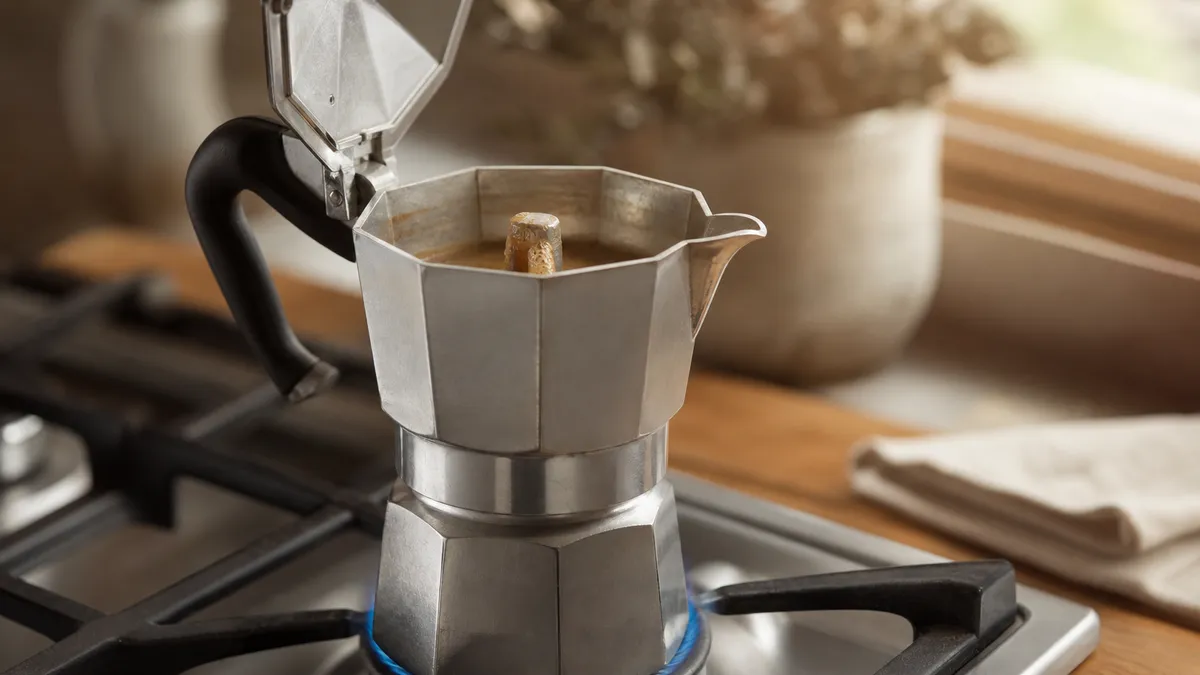
Moka pots make concentrated stovetop coffee by using pressure in a heated lower chamber to push hot water through ground coffee. They suit people who enjoy a short, strong drink or a coffee to mix with milk, but they do not make pump-machine espresso. Choose the size by its stated millilitre capacity, not the number of “cups”, and check compatibility with your hob before buying.
In short
- A moka “cup” is a small serving, commonly around 40 to 50 ml, not a mug. Bialetti lists its three-cup Moka Express at approximately 130 ml.
- Fill water only to the prescribed level below the safety valve, and fill the coffee basket without tamping.
- An ordinary aluminium pot does not work directly on induction. An induction-compatible base must also be large enough for your hob to detect.
- Use moderate heat and remove the pot when brewing finishes, rather than leaving it boiling and spluttering.
- Hand-wash aluminium moka pots, dry every component and keep the gasket, filter and safety valve in good condition.
How moka pots work
A moka pot has three main working parts: a lower water chamber, a funnel-shaped coffee basket and an upper chamber that collects the drink. A gasket, the sealing ring between the sections, helps the assembled pot hold pressure.
Heating increases the pressure of the trapped air and water vapour above the water. That pressure pushes liquid water, not simply steam, up the funnel tube, through the coffee and into the upper chamber. Brewing can begin before the water reaches its boiling point.
Near the end, the falling water level exposes the bottom of the funnel tube. Gas and water then pass through intermittently, producing the familiar gurgle. This is the signal to finish brewing, not an invitation to turn up the heat.
Is it stovetop espresso?
“Stovetop espresso maker” is a common product description, but moka coffee is a different brewing method. It produces concentrated coffee without the independently controlled pressure and temperature of a pump espresso machine.
Treat claims that every moka pot operates at “1.5 to 2 bar” cautiously. In one instrumented study, pressure rose from approximately atmospheric pressure towards 2 bar absolute late in brewing, equivalent to roughly 1 bar above atmospheric pressure. Pressure changes through the brew and depends on the setup; it is not a fixed specification comparable with the approximately 9 bar conventionally associated with espresso.
For the wider equipment categories, start with our coffee machines guide.
Choosing the right size
A moka pot’s cup count means small moka servings, not British mugs. Around 40 to 50 ml per serving is a useful starting point, but manufacturers and models differ.
Bialetti’s published indicative Moka Express capacities include:
- Two cups: approximately 90 ml.
- Three cups: approximately 130 ml.
- Four cups: approximately 190 ml.
- Six cups: approximately 270 ml.
These are manufacturer figures, not guaranteed measured yields. Bialetti notes that output varies with the water quantity, coffee, grind and model. Water added to the base and coffee collected above are not interchangeable measurements.
As a practical buying judgement, a three-cup pot is a sensible starting point for one person making a milk drink, rather than three people expecting full mugs. Measure your usual drink and decide how much concentrated coffee you want before choosing.
Do not buy a large pot assuming you can routinely halve both water and coffee. Bialetti advises using the intended full measures. Unless the manufacturer supplies a specific reducer and instructions, choose a pot that matches your normal batch.
Aluminium, stainless steel and induction compatibility
Choose first by hob compatibility, useful capacity, cleaning requirements and replacement-part availability, rather than appearance alone.
| Construction | Main attraction | Limitation to check | Who it suits |
|---|---|---|---|
| Traditional aluminium | The classic stovetop format | Usually needs hand-washing and cannot work directly on induction | Gas or conventional electric-hob users who want a traditional pot |
| Stainless steel | An alternative to an aluminium body; some models support induction | Stainless steel alone does not guarantee induction or dishwasher compatibility | Buyers who prefer steel and check the exact specification |
| Aluminium upper chamber with induction-compatible base | Combines a traditional collection chamber with a base designed for induction | Still contains aluminium and may require water-only hand-washing | Induction users who prefer the classic moka format |
For example, Bialetti specifies an aluminium body for the Moka Express. Its Moka Induction instead combines an aluminium upper chamber with a layered boiler incorporating steel outside and aluminium inside.
An induction hob needs a suitable magnetic base, but base diameter matters too. A small pot can be induction-compatible in principle yet too small for a particular cooking zone to recognise. Compare the pot’s base with the hob manual’s minimum vessel diameter.
Check each size separately. Bialetti explicitly excludes the two-cup Venus from the induction compatibility stated for the larger Venus models.
An adapter plate is another possibility where both manufacturers permit it. Bialetti lists its own induction plate for the Moka Express, but do not assume an arbitrary plate is suitable for your hob.
Brands
The following are specification-based examples, not a ranking from hands-on testing. Published construction and compatibility claims were checked in November 2026.
Bialetti
Bialetti provides useful examples of the main choices: the aluminium Moka Express, stainless-steel Venus, and mixed-material Moka Induction.
The Moka Express suits someone specifically seeking the traditional aluminium format on a compatible hob. Its disadvantages include hand-washing requirements and the need for an approved adapter on induction. Venus offers a steel alternative, but its induction exclusion for the smallest size shows why buying by brand alone is insufficient.
Before ordering, identify the exact gasket and filter set for the model and capacity. Similar-looking parts are not automatically interchangeable.
Alessi
Alessi’s 9090 is a stainless-steel stovetop brewer with a magnetic base and a lever-lock closure rather than the familiar threaded assembly. It is worth considering if those construction details appeal to you.
Its distinctive closure also means you should learn its own assembly procedure rather than transfer instructions from another pot. Alessi warns buyers to check induction-hob detection for its small base. Different construction is not, by itself, evidence of better coffee or greater reliability.
How to brew with a moka pot
Use the manual supplied with your exact model. Unlike a freely adjustable filter recipe, the basket and safe water level set much of a moka pot’s working batch.
- Inspect the cold pot. Check that the gasket, funnel and filter plate are present, correctly seated and undamaged. Check the safety valve as the manufacturer directs.
- Add drinking water. For the Moka Express, the manual specifies cold water up to the lower edge of the safety valve. Never cover the valve.
- Fill the basket loosely. Use coffee ground for moka, typically medium-fine rather than powdery espresso-machine grind. Level it without pressing it down, and clear grounds from the sealing rim.
- Assemble securely. Join the sections as instructed, without using the handle as a tightening lever. Keep the lid closed during brewing where the manual requires it.
- Apply moderate heat. Keep a gas flame beneath the base, not licking up the sides. Bialetti’s guidance gives approximately 3 to 6 minutes, depending on pot size and heat, but the finish signal matters more than the clock.
- Remove from the heat promptly. Follow the model’s finish instruction. Bialetti’s current Moka Express guidance identifies the gurgle as the signal to remove it. Stir before serving, then allow the pot to cool before opening.
For repeatability, record your correctly filled basket’s coffee mass in grams, the safe water quantity in millilitres and the brewing time. Do not force a generic gram dose or coffee-to-water ratio into a differently sized pot.
Should you start with hot water?
There is a genuine difference between manufacturer instructions and some brewing advice. Bialetti’s Moka Express manual specifies cold water; Warren King’s published thermodynamic analysis and experiments support preheating to avoid extracting much of the coffee at low temperatures.
Preheated water reduces the heating needed on the hob, but that does not establish that it universally prevents metallic or burnt flavours. The cited physics work was not a controlled sensory trial of those claims.
For a first brew, follow your manual. Do not substitute boiling water where it conflicts with the manufacturer’s procedure, and remember that a preheated base creates an additional handling hazard.
Advantages/Benefits & Disadvantages
The principal benefit is straightforward: a moka pot makes a concentrated drink using a hob, water and ground coffee, without a separate brewing machine. My view is that it is particularly appealing when you want a small, hands-on batch and enjoy the brewing ritual.
Its replaceable gasket and filter are another useful design feature. However, their availability must be checked for the particular model, rather than assumed for every pot sold under a familiar name.
The limitations follow from the same design. Batch size is relatively fixed, brewing needs supervision, and the pot must cool before safe disassembly. It neither heats milk separately nor provides the control of a pump espresso machine.
For another approach to manual brewing, compare an AeroPress brewer. If your preference is for a different style of black coffee, explore pour-over brewers rather than expecting a moka pot to imitate every method.
Care, gaskets and troubleshooting
Let the pot cool, then separate its components and remove the grounds. For the aluminium Moka Express, Bialetti specifies warm water without detergent or abrasive materials. Rinse the components thoroughly and dry them before storing the pot unassembled or loosely separated.
Never put an aluminium moka pot in the dishwasher. Alkaline cleaning agents can attack aluminium, while dishwasher conditions can discolour or dull it. Do not assume stainless steel grants permission either: Bialetti also marks the Venus as not dishwasher-safe.
Inspect the gasket for wear and replace it according to the manual. Bialetti’s January 2021 Moka Express instructions recommend replacement at least annually, and sooner when worn. Match replacements to both model and size.
Keep filter holes clear and descale only by the model’s prescribed method. For local hardness information, consult your water supplier’s report or postcode checker, not a single UK-wide hardness figure.
| Symptom | Likely cause | Fix |
|---|---|---|
| Coffee tastes burnt | Excessive heat or continued heating after brewing | Reduce heat and remove promptly at the finish signal |
| Little or no coffee emerges | Grind too fine, obstructed filter or leaking assembly | Stop heating, let the pot cool, then check the grind, filter and seal |
| Water leaks at the joint | Grounds on the rim, incorrect assembly or worn gasket | Cool completely, clean the rim and inspect or replace the seal |
| Safety valve releases steam | Restricted flow, overfilling or another fault | Stop heating safely and let it cool; do not reuse until the cause is resolved |
Never tamper with the safety valve or try to open a hot, pressurised pot. More heat is not a remedy for a blocked brewer.
FAQ
Can I put milk in the lower chamber?
No, use water in the lower chamber, not milk. Bialetti’s instructions restrict the brewer to water and suitably ground coffee. Prepare any milk separately and add it to the finished drink. The water chamber is part of a pressure-brewing system, not a saucepan for warming ingredients.
Is water left in the base a sign that something is wrong?
Not necessarily; some residual water is normal. Bialetti’s capacity guidance explicitly acknowledges water remaining in the boiler after brewing. Do not keep heating simply to force the base dry. If the coffee output changes markedly, allow the pot to cool and check the filter, gasket, grind and assembly.
Should I leave coffee oils inside to “season” the pot?
No, a moka pot does not need a deliberately dirty coating of old coffee oils. Bialetti’s cleaning guidance says accumulated oils and grease should be removed because repeated use oxidises and burns them. Follow the model’s cleaning instructions, including any restriction on detergent, rather than treating residue as protection.
Where to go next
Read Coffee Machines to place moka pots alongside the other equipment choices. Aeropress is a useful next comparison for manual brewing, while Pour-Over Brewers: V60, Chemex, Kalita Wave and Melitta Cone explores a different approach to black coffee.
Sources
-
Bialetti, Moka Express, undated product page, checked November 2026. Construction, hob compatibility and brewing finish guidance.
https://www.bialetti.com/it_en/moka-express.html -
Bialetti, Moka Express instruction manual, edition January 2021. Manufacturer document hosted by a distributor; brewing, safety, maintenance and gasket replacement instructions.
https://paramicafe.cl/wp-content/uploads/2023/07/MOKA_EXPRESS-manual.pdf -
Bialetti, How to use the Moka Express?, updated June 2023. Heat setting, approximate preparation time and washing instructions.
https://bialetti-cookware.zendesk.com/hc/en-us/articles/5416235346322-How-to-use-the-Moka-Express -
Bialetti Argentina, Cafetera Moka Express, undated, checked November 2026. Indicative capacities and explanation of output variation.
https://www.bialettiargentina.com.ar/productos/cafetera-moka-express/?variant=143941235 -
Bialetti New Zealand, Tips and Care, undated, checked November 2026. Grind, full-batch operation and replacement parts.
https://www.bialetti.co.nz/blogs/making-great-coffee/tips-and-care -
Bialetti, Venus, undated product page, checked November 2026. Steel construction, dishwasher restriction and two-cup induction exception.
https://www.bialetti.com/it_en/venus.html -
Bialetti, Moka Induction instruction manual, edition January 2021. Manufacturer document hosted by a distributor; aluminium upper chamber and layered boiler construction.
https://paramicafe.cl/wp-content/uploads/2023/07/Bialetti-MOKA_INDUCTION-manual.pdf -
Alessi, 9090 espresso coffee maker, undated product page, checked November 2026. Steel construction, magnetic base, closure and induction-detection warning.
https://us.alessi.com/products/9090-espresso-coffee-maker -
Navarini and colleagues, Experimental investigation of steam pressure coffee extraction in a stove-top coffee maker, Applied Thermal Engineering 29, 2009, pages 998 to 1004. Instrumented brewing experiments; retrieved journal-paper copy.
https://prokofe.ru/files/public/1545073690_16273_FT107421_experimental_investigation_of_steam_pressure_coffee_extraction_in_a_stove-top_coffee_maker_l.navarini_navarini2009.pdf -
Warren D. King, The physics of a stove-top espresso machine, American Journal of Physics 76, June 2008. Thermodynamic modelling and benchtop experiments; retrieved journal-paper copy.
https://www.prokofe.ru/files/public/1545073434_16273_FT107421_the_physics_of_a_stove-top_espresso_machine_warren_d_king_king2008.pdf -
Bialetti, How to clean the coffee pot at home: natural and effective remedies, undated, checked November 2026. Cleaning, accumulated oils and drying.
https://www.bialetti.com/ee_en/inspiration/post/how-to-clean-the-coffee-pot-at-home-natural-and-effective-remedies -
Miele, G 7980 operating instructions, undated retrieved edition, checked November 2026. Aluminium incompatibility with caustic alkaline cleaners and dishwasher discolouration.
https://media.miele.com/downloads/5a/e1/00_C7F12828CFD51EEF92CFD36B78005AE1.pdf -
Thames Water, Water quality, undated, checked November 2026. Access to local postcode-based water information.
https://www.thameswater.co.uk/help/water-and-waste-help/water-quality
This guide was researched using manufacturer specifications and instructions, published brewing-physics experiments and water-supplier guidance; no first-hand product testing is claimed.
Last checked: November 2026