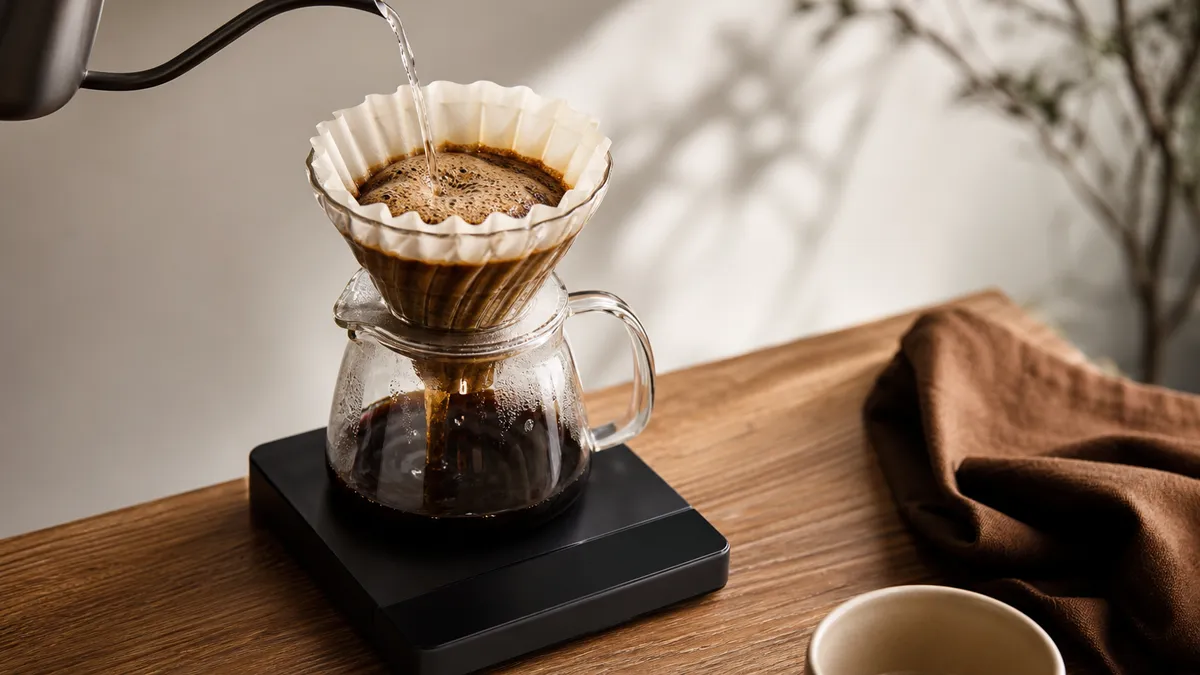
Coffee scales let you measure the coffee dose and brewing water, or the espresso collected in the cup, so you can repeat a recipe rather than guess with a scoop. For most manual brewing, choose scales with 0.1 g display increments, a readable timer and enough capacity for the complete brewing setup; for espresso, prioritise response speed and a secure fit on the drip tray.
In short
- Readability is not accuracy: a display showing 0.1 g increments does not guarantee measurements accurate to 0.1 g.
- Weigh the whole setup: the server, dripper, coffee and water all count towards maximum capacity, even after taring.
- Espresso needs clearance: measure the drip tray and the space beneath the portafilter before choosing.
- Check timer behaviour: starting at the first drop is different from starting when the machine begins brewing.
- Water-resistant does not mean waterproof: follow the specific model’s cleaning and spill instructions.
Why weight beats scoops
A scoop measures volume, not the amount of coffee by weight. Coffee’s bulk density, meaning how much mass occupies a given space including the gaps between particles, changes with roasting. Experimental research on ground Arabica coffee has also found differences between freely poured and tapped samples: how the grounds settle matters.
The practical consequence is simple: an equally full scoop need not contain the same dose when you change coffee or fill it differently. Weighing removes that uncertainty and makes a recipe transferable between people.
Consider an illustrative filter recipe of 20 g coffee to 320 g water, a coffee-to-water ratio of 1:16 by weight. If you want a larger brew using that same ratio, multiply the coffee dose by 16 to find the water target. These are example quantities, not a universal recipe.
For espresso, the ratio means something different: dry coffee dose to beverage yield by weight. An illustrative 18 g in, 36 g out is a 1:2 ratio. Keep those two conventions separate: filter recipes generally specify water added, whereas espresso recipes commonly specify drink collected.
A scale controls quantities, not every cause of flavour. It belongs within a useful set of brewing accessories, rather than replacing attention to grinding, pouring and the recipe itself.
Precision Coffee Scales
Readability, accuracy and repeatability
These terms describe different things:
- Readability or resolution: the smallest increment shown on the display.
- Accuracy: how closely the result agrees with the actual weight.
- Repeatability: how consistently the same load produces the same reading under the same conditions.
My recommendation is 0.1 g readability for a dedicated coffee scale. It gives useful control over a small coffee dose without making another decimal place the main purchasing criterion.
A 0.01 g display can be useful, but do not assume it makes a scale ten times more accurate than one displaying 0.1 g. Ask whether the manufacturer publishes repeatability and measurement tolerances, rather than only the number of decimal places.
Also check whether readability changes across the weighing range. Hario’s published specifications for the V60 Drip Scale list increments of 0.1 g from 2 to 200 g, 0.5 g from 200 to 500 g, and 1 g from 500 to 2,000 g. That is not the same specification as 0.1 g throughout the range.
Response time matters during brewing
Response time is how quickly the display follows a changing load. A scale may eventually settle on a useful reading yet be awkward while liquid is still arriving: you stop at the displayed target, then watch the number continue climbing.
This matters particularly when weighing espresso as it flows. For pour-over, a responsive display also makes it easier to approach each water target without repeatedly overshooting.
Do not confuse display refresh rate, response delay and stabilisation time. They describe related but different behaviour, and manufacturers do not always report them in directly comparable ways. Treat unsupported descriptions such as “instant” as marketing, not a measured comparison.
Electronic smoothing introduces another trade-off. Acaia explains that stronger averaging can steady readings in a vibrating environment but slows the response. The steadiest-looking display is not necessarily the quickest.
Built-in timers and automatic modes
A built-in timer keeps weight and elapsed time together. Look for controls you can operate without pushing the platform hard, and a display that remains visible behind your usual cup or server.
Automatic modes require closer reading. A timer may begin when a cup is placed on the platform, when liquid first arrives, or after a manual button press. Acaia’s Lunar manual documents different modes for these behaviours.
Choose one timing convention and record it with your recipe. A shot timed from the first liquid reaching the cup is not directly comparable with one timed from the start of the machine’s brewing cycle.
For shared equipment, straightforward manual operation is my preference unless everyone understands the automatic mode. Fewer accidental resets are more useful than a long menu of features.
Which type of scale should you choose?
The decision criteria below are dose readability, response during pouring, total load capacity, physical fit and ease of operation. These are selection priorities, not results from comparative testing.
| Type | Best suited to | Prioritise | Main limitation |
|---|---|---|---|
| General kitchen scale | Checking larger quantities and occasional brewing | Repeatable readings, suitable capacity, visible display | Check whether increments are fine enough for your coffee dose |
| Dedicated filter scale | Pour-over and immersion brewing | 0.1 g dose readability, timer, stable support for the server | May be too large or tall for an espresso machine |
| Compact espresso scale | Weighing espresso during extraction | Responsive readings, low profile, drip-tray fit, spill protection | Small platform can make portafilter weighing awkward |
| Connected or advanced scale | Recording brews and using automated workflows | Useful modes, clear manual operation, supported software | Additional setup and features you may never use |
Basic, dedicated and advanced feature tiers
Compare feature tiers rather than assuming that a more elaborate scale makes better coffee.
Basic weighing: choose this if you only need to establish the dose and water quantity. Check minimum load, readability and automatic shut-off before deciding that an existing kitchen scale is suitable.
Dedicated brewing: prioritise a built-in timer, convenient tare button, readable display and a platform that supports your actual brewer. This is my preferred starting point for regular manual brewing.
Advanced workflow: consider automatic taring, flow-rate displays or connectivity when you can identify a task they will improve. Ask suppliers for itemised written quotations showing the exact model, included accessories, warranty and support arrangements.
Two published examples illustrate the compromises:
- Hario V60 Drip Scale: the manufacturer lists a 2,000 g capacity and dimensions of 120 × 190 × 29 mm. It has a timer, but its display increments vary with load, and Hario explicitly states that it is not water-resistant.
- Acaia Lunar: the manufacturer lists 105 × 105 × 15 mm, a 2,000 g capacity, selectable 0.1 g or 0.01 g readability, and 0.1 g repeatability. Its compact dimensions suit consideration for espresso, but check support for your cup or dosing container rather than assuming everything will fit.
These are manufacturer-claimed specifications, checked in November 2026, not independently measured performance results or a reliability ranking.
If you are building a setup from scratch, essential brewing accessories helps put the scale alongside the other equipment you actually need.
Espresso scales: measure the machine first
Measure usable drip-tray width and depth, then check the vertical space available with your normal cup beneath the portafilter. Include the scale’s heat pad if you intend to use it.
Check that every foot rests securely and that the weighing platform can move freely. A cup touching the machine or another surface creates an additional point of support, so the scale is no longer carrying its full weight.
For weighing the dose, a small bowl or dosing cup may be easier than balancing a portafilter on a compact platform. Tare the empty container, add the grounds, then transfer them.
Do not assume an automatic timer also stops the espresso machine. Treat machine control as a separate compatibility feature that needs explicit manufacturer confirmation.
Capacity, size and waterproofing
Maximum capacity applies to everything supported by the scale. Taring subtracts the container from the displayed reading; it does not remove its physical weight.
For an illustrative capacity check, a 600 g server, 200 g dripper, 30 g coffee dose and 480 g water total 1,310 g before any additional accessories. Weigh your own empty equipment rather than copying those assumed figures.
A larger platform is useful only if it supports the vessel properly while leaving the display visible. For pour-over, check the arrangement with the kettle in your pouring position; gooseneck kettles covers pouring equipment separately.
Read the water-protection claim precisely. Acaia describes the Lunar as water-resistant, not waterproof, while Hario says its V60 Drip Scale is not water-resistant. A removable silicone pad is not proof that the electronics underneath are sealed.
Follow the model’s cleaning instructions and keep it away from flushing water and steam. If liquid enters, follow the manufacturer’s drying procedure rather than improvising with a hot radiator or the top of an espresso machine.
Using and checking your scale
This is a weighing check, not a brewing recipe:
- Set up on a stable surface. Fit any manufacturer-specified pad before zeroing.
- Choose grams and manual weighing mode. Place an empty container centrally and press tare.
- Add a sample dose. Use 20 g as an illustrative target and observe how readily the display follows small additions.
- Check repeatability. Remove and replace the same container and contents several times without changing anything.
- Check calibration separately. Follow the manual using the specified calibration weight. Repeating a reading consistently does not prove it is correct.
During brewing, use the scale to follow the selected recipe’s quantities and record timing consistently. Keep filters and the rest of the setup consistent while investigating a weighing problem.
| Symptom | Likely cause | Fix |
|---|---|---|
| Reading wanders without added liquid | Vibration, movement or thermal effects | Move to a stable surface and follow heat-pad guidance |
| Target is repeatedly overshot | Display delay or liquid still arriving | Slow the approach and observe the final settled result |
| Reading changes when the cup shifts | Cup touching another surface or uneven support | Reposition the scale and centre the cup |
| Timer starts at the wrong moment | Unsuitable automatic mode | Use manual timing or select the intended trigger |
| Empty container no longer reads zero | Contents, setup or tare state changed | Restore the setup and tare again before adding coffee |
For a UK consumer purchase, faulty goods or goods that are not as described may trigger rights against the seller, independently of how the manufacturer handles support. Keep the order details and published specification; for workplace purchasing, obtain the supplier’s written terms.
FAQ
Can I use one scale for both espresso and pour-over?
Yes, provided it fits the espresso machine and safely supports the complete filter-brewing setup. Check clearance, platform support, total capacity and display visibility with both arrangements. A compact espresso scale may work beneath a server, but compatibility should be established with your equipment rather than inferred from its capacity alone.
Does a flow-rate display measure extraction?
No: it reports how quickly the measured weight is changing, not how much coffee material has dissolved. Acaia’s Lunar displays flow information during espresso brewing, which can help you observe the shot. That information complements the dose, yield and timing; it is not a direct measurement of extraction.
How often should I calibrate coffee scales?
Follow the manufacturer’s instructions and the demands of the setting. Acaia recommends daily calibration for its scales on busy bars, but that is not a universal schedule for every household scale. Use the specified weight and a stable environment, and investigate inconsistent readings rather than repeatedly recalibrating without checking the setup.
Where to go next
Read Essential Brewing Accessories to decide which supporting tools deserve a place beside your scales, then Gooseneck Kettles for controlled pouring. Filters explains another part of a repeatable brewing setup, while Brewing Accessories provides the wider equipment guide.
Sources
-
Nakilcioğlu-Taş, E. and Ötleş, S., Anais da Academia Brasileira de Ciências. Physical characterization of Arabica ground coffee with different roasting degrees, 2019. Experimental research on roast degree, bulk density and tapped density.
https://www.scielo.br/j/aabc/a/F44XMrhpdQtMbjCySbg3pBM/?format=html -
Acaia. Acaia University: Accuracy vs. Display, undated webpage, checked November 2026. Definitions and distinctions between readability and measurement accuracy.
https://acaia.co/blogs/news/acaia-university-accuracy-vs-display -
Hario USA. V60 Drip Scale Black, undated manufacturer specification, checked November 2026.
https://www.hario-usa.com/products/v60-drip-scale -
Acaia. Lunar, undated manufacturer product page, checked November 2026. Dimensions, capacity, readability and repeatability.
https://acaia.co/collections/coffee-scales/products/lunar_2021 -
Acaia. Lunar User Manual, model AL011, firmware 2.8.004, manufacturer’s 2025 document directory. Operating modes, calibration, placement and flow-rate display.
https://cdn.acaia.co/web/2025_doc/manual/lunar/Lunar2021_MAN_AEAF08001_EN_LM.pdf -
Acaia Help Center. Is the Acaia Lunar 2021 Waterproof, 2021. Water-resistance limits, temperature effects and drying guidance.
https://help.acaia.co/hc/en-us/articles/4406955618324-Is-the-Acaia-Lunar-2021-Waterproof -
Acaia Help Center. Recommendations for Cafes, on Bar / High Volume, 2019. Sensor averaging, heat protection and calibration recommendations.
https://help.acaia.co/hc/en-us/articles/360035742951-Recommendations-for-Cafes-on-Bar-High-Volume -
GOV.UK. Accepting returns and giving refunds: the law, current guidance checked November 2026.
https://www.gov.uk/accepting-returns-and-giving-refunds
Research combined retrieved manufacturer specifications and operating instructions, experimental coffee-density research and official UK consumer guidance; no hands-on testing was undertaken.
Last checked: November 2026