To make French press coffee, also called cafetière coffee, start with 30 g of ground coffee and 480 g of water at 94 degrees Celsius, a coffee-to-water ratio of 1:16 by weight. Steep for 4 minutes, gently break and skim the floating crust, then either plunge slowly and serve or wait another 4 minutes for a less gritty cup.
In short
- Use 1:16 coffee to water by weight as a starting point, then adjust the dose to your preferred strength.
- Choose a coarse grind for conventional plunging, following your cafetière’s instructions.
- Start with water at 94 degrees Celsius; temperature-controlled brewing is more repeatable than guessing a cooling time.
- For the skim-and-wait method, break the crust at 4 minutes and leave the coffee undisturbed until 8 minutes.
- Pour gently into cups or a separate serving vessel, leaving the muddy final liquid behind.
French Press Techniques
A French press is an immersion brewer: the grounds sit in the brewing water rather than having fresh water pass through them. Its mesh separates much of the ground coffee from the drink, but it does not produce the same result as paper filtration.
The choice is between a straightforward steep-and-plunge routine and a longer settling method. Our recommendation is the skim-and-wait approach when a less gritty texture matters more than speed. For the wider choice of equipment and techniques, see brewing methods.
What you need
Gather a cafetière, coffee, scales, a kettle, a timer, a thermometer if needed, and a plastic or wooden spoon suitable for hot liquids. A second spoon makes skimming easier. Have your cups or a serving jug ready before brewing.
Check the cafetière’s instructions before choosing the grind or filling it. Inspect glass for scratches, chips and cracks, and do not use a damaged beaker. Keep the brewer on a stable, heat-resistant, non-slip surface.
Numbered method: skim, wait and pour
This is a recommended starting recipe, not an official SCA French press standard. Its dose follows a 1:16 ratio, while the crust-breaking and settling stages draw on published roaster techniques.
-
Prepare the water and brewer. Heat enough fresh drinking water for the brew and a warming rinse. Warm the cafetière with hot water, then discard the rinse carefully. Aim for 94 degrees Celsius when adding the brewing water.
-
Weigh and grind 30 g of coffee. Start coarse, especially where the manufacturer requires it. The grounds should be recognisable granules rather than espresso-like powder. Add them to the empty cafetière.
-
Add 480 g of water and start timing. This is approximately 480 ml measured before heating, but use the scales to preserve the ratio. Pour steadily, wetting all the grounds. Use a larger brewer or scale down if this would exceed its safe fill level.
-
Leave the coffee until 4:00. Do not plunge. If a dry pocket remains after pouring, gently wet it with the spoon; otherwise leave the brew alone.
-
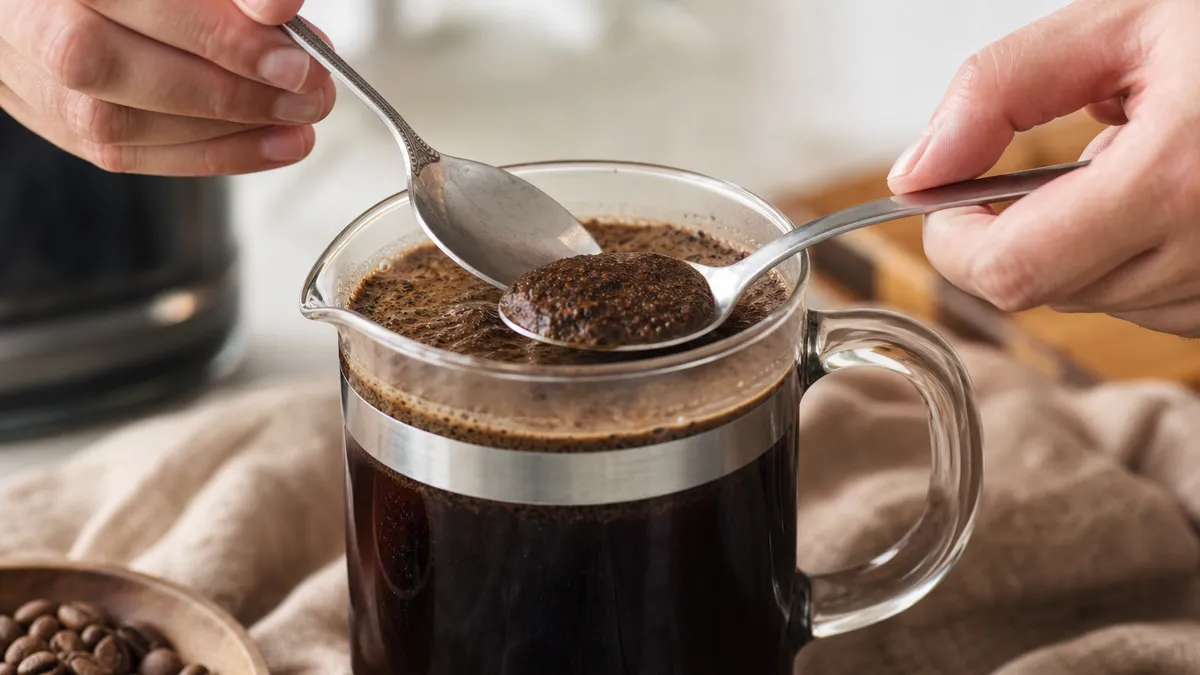
Break and skim the crust. At 4 minutes, gently stir through the floating layer so the grounds begin to sink. Scoop away the remaining foam and floating particles. With a glass beaker, avoid knocking or scraping its sides.
-
Wait until 8:00. Leave the cafetière undisturbed for another 4 minutes. Treat this as settling time as well as continued brewing: do not stir again just before serving.
-
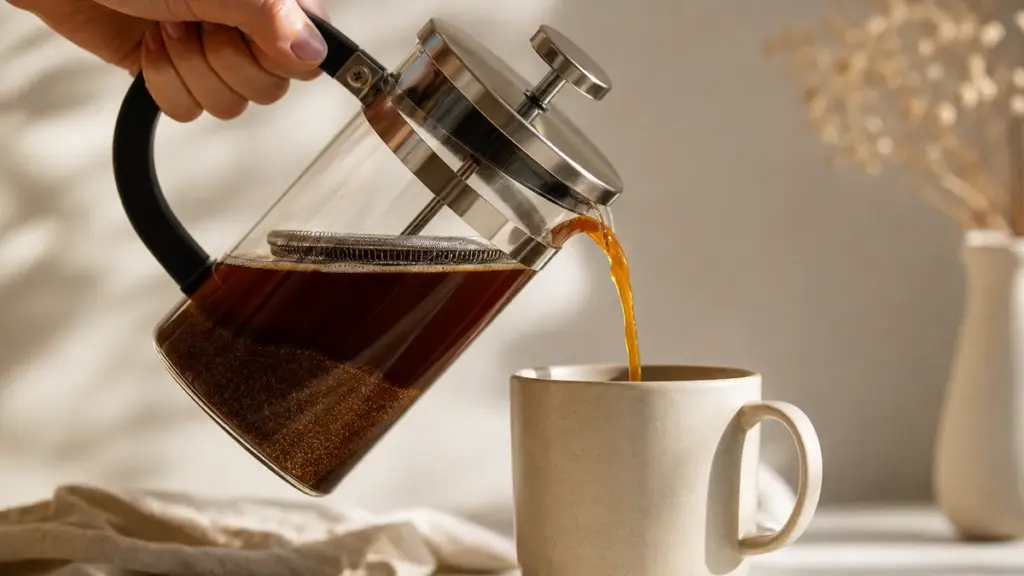
Fit the lid and serve carefully. With a conventional mesh press, lower the screen gently towards the coffee surface rather than driving it through the settled grounds. Pour slowly and steadily, stopping before the thick sediment reaches the spout. Follow the manufacturer’s full-plunge instructions instead if your brewer uses a different filter arrangement.
The aim is not to recover every last drop. A little coffee left with the sediment is preferable to tipping that sediment into the final cup.
The quicker steep-and-plunge method
For a simpler routine, use the same starting dose and water, ensure the grounds are wet, and steep for 4 minutes. Lower the plunger slowly with light pressure, then pour into cups or a separate jug.
Plunging is a separation step, not a way to squeeze more flavour from the grounds. Do not force a resistant plunger: a blocked filter can cause hot liquid to escape. Stop and follow the brewer’s instructions rather than leaning harder on it.
Serving and cleaning
Decant the coffee you intend to drink rather than leaving later servings in the cafetière. For the settling method, transfer the clear portion and leave the sludge behind. Use an insulated serving vessel if you want to keep the remaining coffee warm.
After use, dismantle and wash the filter assembly as instructed. Check that the mesh is correctly seated when reassembling it. Do not assume that every cafetière has the same dishwasher-safe parts.
Coffee-to-Water Ratios
A ratio describes the weight of dry coffee relative to the weight of brewing water, not the amount of finished drink. At 1:16, each gram of coffee receives 16 g of water.
Use the table as a scaling guide. These are calculated recipe quantities, not claims about the usable capacity of a particular cafetière.
| Brewing water | Coffee at 1:16 | Coffee at 1:15 |
|---|---|---|
| 240 g | 15 g | 16 g |
| 480 g | 30 g | 32 g |
| 720 g | 45 g | 48 g |
| 960 g | 60 g | 64 g |
The 1:15 column provides a stronger starting recipe. Keep the water amount unchanged and increase the coffee rather than changing dose, temperature and time together.
To calculate any batch:
Coffee needed in grams = water weight in grams ÷ ratio number
For example, 480 ÷ 16 = 30 g. Remember that the grounds retain some liquid, so the water you add is not the quantity you will serve.
Strength is not the same as extraction
Strength means the concentration of dissolved coffee in the drink. Extraction means how much material has dissolved out of the grounds. A watery cup does not automatically need a longer steep; it may simply need more coffee.
Controlled immersion-brewing research supports treating ratio as a major strength control. However, those experiments examined brews approaching equilibrium, where their measured concentration had stabilised. They do not establish one universally best domestic recipe.
Start by asking whether the coffee is too dilute or whether its flavour seems poorly developed. Adjust the dose for concentration; investigate grind, heat and contact time when the flavour itself needs work. The separate guide to espresso dialling in explains a different system, where dose, beverage yield and flow are closely linked.
Water temperature and water choice
The SCA’s 2018 brewing best practices recommend water at 92 to 96 degrees Celsius at contact with the coffee. Our 94-degree starting point sits within that range. This is historical general brewing guidance, not a French press-specific rule.
Published recipes differ. LAMILL recommends 96 to 99 degrees Celsius for its main French press recipe and 90 to 93 degrees Celsius for dark roasts. Use such ranges as starting points for comparison, not proof that one temperature suits every coffee.
Use fresh drinking water without an unpleasant smell. The historical 2009 SCAA water standard specifies clear, odour-free water with no chlorine, alongside mineral targets. Its figures belong to that particular edition and should not be presented as a single timeless water formula. For a first brew, concentrate on good-tasting water and repeatable preparation rather than mineral dosing.
Brewing Time Variations
Brewing time must be considered alongside grind, temperature and handling. A four-minute recipe that includes stirring and full plunging is not directly equivalent to an eight-minute recipe with a long undisturbed settling stage.
Four minutes: a practical baseline
A 4-minute steep appears in both manufacturer and roaster guidance. It is a useful baseline for a conventional coarse-ground brew, particularly when you want a straightforward routine.
Judge it after serving, not just by the timer. Keep a note of the coffee, dose, water weight and grind so that the next adjustment has a clear purpose.
Eight minutes: brewing plus settling
The longer method gives suspended particles time to settle after crust-breaking. Coffee Collective’s guide includes skimming followed by a short settling pause; La Cabra publishes a method that breaks the crust at 4 minutes and plunges at 8 minutes. Our method uses that longer schedule while prioritising gentle serving.
Skimming is a physical removal step. It removes floating grounds and foam; it is not a proven way to remove all bitterness. Likewise, waiting is not useful if you then stir up the sediment or pour the final sludge into the cup.
Why longer does not mean endlessly stronger
In immersion brewing, dissolved coffee accumulates in the surrounding water and extraction slows towards equilibrium. The laboratory evidence supports a slowing process, not an indefinitely rising concentration.
That does not mean time stops mattering after four minutes. The cited research used specific coffees, vessels and experimental conditions, including longer contact times than a normal serving routine. Its practical lesson is to avoid treating every extra minute as an identical increase in extraction.
If the settling stage leaves your coffee cooler than you prefer, try the quicker method or preheat more consistently. Choose a routine you can repeat rather than extending the wait without a clear aim.
Troubleshooting your French press
Treat these as likely explanations and suggested trials, not certain diagnoses. Change one variable at a time.
| Symptom | Likely cause | Fix |
|---|---|---|
| Thin, watery coffee | Too little coffee for the water | Move from 1:16 towards 1:15 while keeping the water amount fixed |
| Sharp, sour and thin | Insufficient extraction for that coffee | Try a longer steep or a modestly finer grind within the brewer’s instructions |
| Harsh or excessively bitter | Recipe, roast or temperature does not suit your preference | Try a lower starting temperature or a different coffee before blaming time alone |
| Muddy, gritty final cup | Suspended particles disturbed during plunging or pouring | Wait after skimming, handle gently and leave the final sediment behind |
| Plunger difficult to lower | Fine grounds or a clogged filter | Stop pressing; follow the manufacturer’s clearing instructions and check the grind |
| Large grounds in the drink | Filter incorrectly assembled, damaged or poorly seated | Inspect and reassemble the filter before brewing again |
For your next French press, keep a short brewing record and make one deliberate change. That is more useful than replacing the whole method after a disappointing cup.
FAQ
Can I use supermarket pre-ground coffee?
Yes, provided its grind is suitable for your cafetière’s instructions. Look for coffee specifically described as suitable for cafetière brewing rather than assuming every ground coffee will work equally well. If the plunger resists, do not force it. Use the same dose and water weight between brews so you can judge whether the coffee suits your method.
Do I need a separate bloom stage?
No, this starting method does not require a separate bloom stage, meaning an initial small addition of water before the main pour. Published French press recipes differ: some include one, while others add the brewing water directly. Begin with the simpler routine, ensuring that all the grounds become wet, before introducing another timed step.
Can I make cold brew in a French press?
Yes, a French press can serve as an immersion vessel for cold brew, but the hot-brewing timings here do not apply. Cold extraction needs its own recipe and handling instructions. Follow the separate cold brew guide rather than replacing hot water with cold water and keeping the four-minute steep.
Where to go next
Read Brewing Methods to place the cafetière alongside other ways of making coffee, or AeroPress to explore a different small immersion brewer. Cold Brew covers cold-water preparation, while Espresso Dialling In: Dose, Yield and Time explains why espresso needs a different adjustment routine.
Sources
-
Specialty Coffee Association, Protocols and Best Practices, revised 2018, particularly section 4, Brewing Best Practices. Retrieved copy of the association’s document:
https://www.scith.coffee/wp-content/uploads/2021/03/SCA-Protocols-_-Best-Practices.pdf
Used for historical temperature guidance and the relationship between grind and contact time. -
Specialty Coffee Association of America, Water for Brewing Specialty Coffee, revised 21 November 2009, version 21NOV2009A. Retrieved copy of the original document:
https://www.urbansaqua.com/wp-content/uploads/2023/09/www.urbansaqua.com-robust-ro-drinking-water-systems-water-standards.pdf
Used for explicitly dated water-quality guidance. -
Liang, J., Chan, K. C. and Ristenpart, W. D., University of California, Davis, An equilibrium desorption model for the strength and extraction yield of full immersion brewed coffee, Scientific Reports, 2021.
https://pmc.ncbi.nlm.nih.gov/articles/PMC7994670/
Controlled laboratory experiments and modelling, used for strength, extraction and equilibrium distinctions. -
Bodum, French Press Coffee Maker: Instructions for Use, undated, retrieved manufacturer instruction sheet.
https://www.roastmasters.com/reference/bodum-columbia.pdf
Used for coarse-grind instructions, glass safety, headspace, gentle plunging and cleaning. -
Coffee Collective, French Press, undated brewing guide.
https://coffeecollective.dk/cdn/shop/files/French_press_guide.pdf?v=16904010372972159496
Used for crust-breaking, skimming and settling technique. -
La Cabra, French Press Brew Guide, undated.
https://us.lacabra.com/pages/french-press-brew-guide
Used for the four-minute crust break and eight-minute serving schedule. -
LAMILL Coffee, French Press Brew Guide, undated, retrieved attributed guide.
https://static1.squarespace.com/static/5f3030bf191d634553dc09ca/t/6169b0a63e927f4ed4e8132d/1634316454975/FRENCH%2BPRESS%2BBREW%2BGUIDE.pdf
Used for the 1:16 starting ratio, roast-dependent temperature suggestions, preheating and decanting. -
ESPRO, How to Use a French Press (With Simple Recipes to Follow), undated.
https://espro.com/blogs/brew-guide/french-press
Used for manufacturer-specific filtering, slow plunging and alternative ratio guidance.
Research combined retrieved association documents, controlled immersion-extraction research and published manufacturer and roaster instructions; the recommended recipe is an editorial synthesis, not a claim of first-hand testing.
Last checked: November 2026