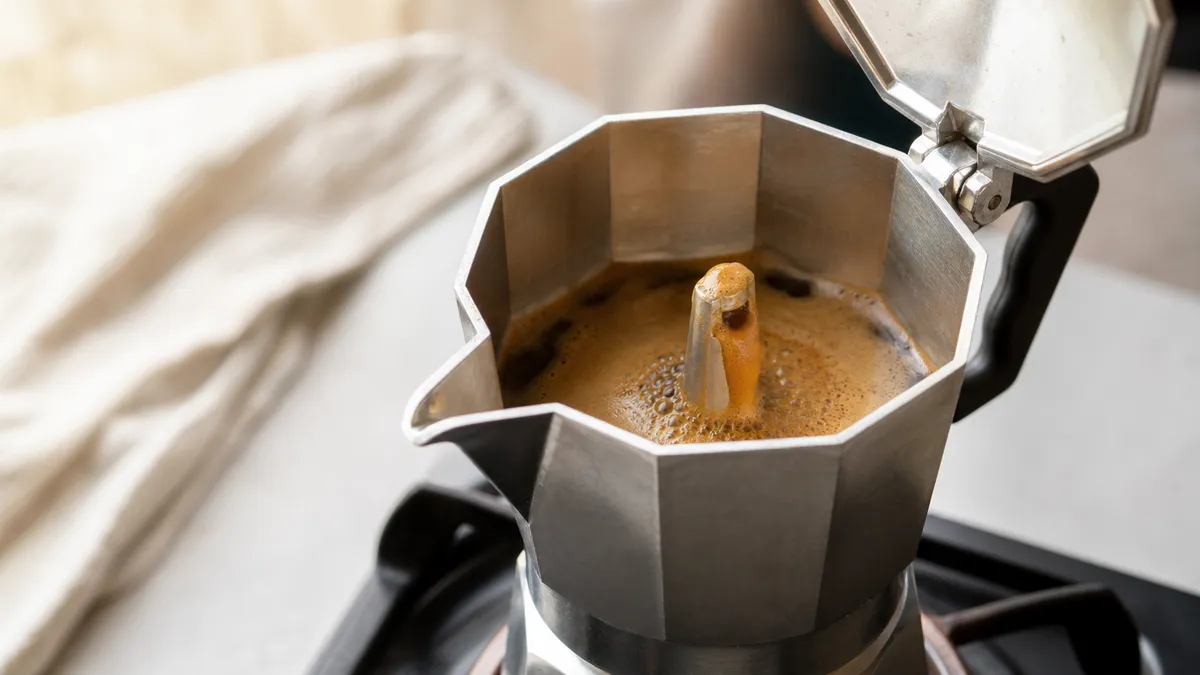
Moka pot brewing makes concentrated stovetop coffee by using pressure in the lower chamber to push hot water through ground coffee. For a sweeter, less bitter cup, fill only to the lower edge of the safety valve, use a loose basket of moka-ground coffee without tamping, and remove the pot before prolonged sputtering.
In short
- The pot’s water level and basket size set the recipe. Do not cover the safety valve or compress the grounds.
- Start with a medium-fine grind, coarser than fine espresso grind.
- Preheated water is optional. Bialetti’s Moka Express instructions specify cold water, while some roasters recommend a hot start.
- Use controlled heat, not the highest hob setting. Keep gas flames underneath the base.
- Let the pot cool completely before opening it, then clean and dry the parts after every brew.
Before you start: coffee, water and safety
You need a moka pot, suitable ground coffee, drinking water, a compatible hob and a heatproof resting surface. Scales help you record a successful brew, but the manufacturer’s fill instructions take priority over a recipe found elsewhere.
Check the gasket, the sealing ring between the chambers, for wear or damage. Make sure the funnel and filter plate are clean, intact and correctly seated, and inspect the safety valve as the maker directs. Never modify or obstruct the valve.
Check hob compatibility for your exact model. A classic aluminium Moka Express is not directly compatible with induction; other moka pots have different bases and requirements. Do not assume that appearance or material alone proves compatibility.
Choose the right grind
Start with coffee labelled for moka brewing, or grind beans medium-fine: gritty rather than flour-like. Blue Bottle recommends a grind between pour-over and espresso; Bialetti’s New Zealand guidance similarly warns against fine espresso-machine grounds, which can obstruct flow.
Descriptions vary between manufacturers and roasters, so “fine” on a bag is not a precise specification. Your useful starting point is moka-specific coffee, followed by small adjustments rather than a dramatic move towards espresso-fine powder.
For the wider comparison with other brewers, see brewing methods.
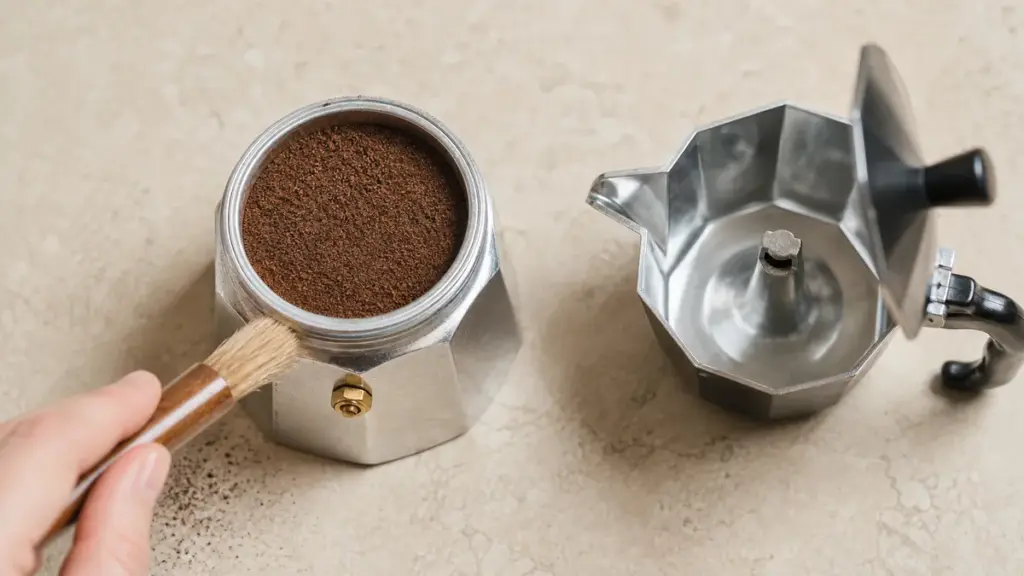
How to brew coffee in a moka pot
Example starting quantities: a small pot that takes approximately 150 ml of cold water and 15 g of coffee. Those quantities correspond approximately to the water and coffee charge used in a published investigation of a three-cup Moka Express, but they are not universal capacities.
Use your pot’s permitted water level and loosely filled basket instead if they differ. For a repeatability exercise, water around 20°C is a practical starting baseline, not a required temperature. Bialetti gives 3 to 6 minutes as a typical brewing time, depending on pot size and heat; treat that as an indication, not a deadline.
-
Inspect the cold pot.
Check the seal, filter, funnel and valve. If the pot is new, follow its first-use preparation instructions before making coffee to drink. -
Fill the lower chamber.
Add drinking water to just below the safety valve, at its lower edge. Never cover the valve to obtain a larger drink. -
Fill the basket loosely.
Add moka-ground coffee until the basket is level. Do not tamp, meaning press the grounds into a compact puck. Brush loose coffee off the rim and sealing surfaces. -
Assemble securely.
Screw the chambers together as instructed, without using the handle as a lever. If you are using the optional hot-water technique described below, protect your hands with suitable heat protection because the base will already be hot. -
Apply low to medium heat.
Keep the flame inside the base’s footprint and the handle away from the heat. On an electric or ceramic hob, avoid the highest setting. Keep the lid positioned as your manufacturer directs; the Moka Express manual says to close it during use. -
Stay with the brewer.
Do not turn up the heat simply because coffee has not appeared quickly. Once brewing is under way, the objective is controlled delivery, not a forceful rush. -
Remove before prolonged sputtering.
Move the pot completely off the heat as the smooth brewing phase ends. An initial change towards hissing or gurgling is your cue to act, not an invitation to leave it rattling. With experience, use your previous brew’s timing to anticipate that transition and remove it slightly earlier. -
Stir and serve.
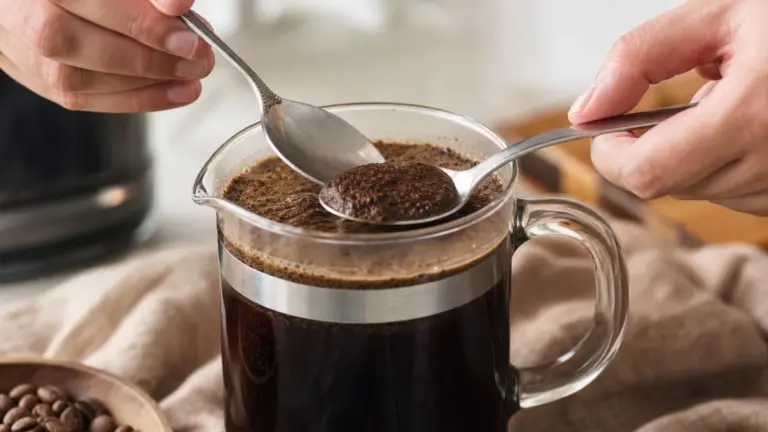
Once delivery has stopped, gently stir the coffee in the upper chamber before pouring. Add hot water to the cup if you prefer a longer drink, rather than overfilling the brewer.
Let the pot cool completely before unscrewing it. Never try to open a hot, pressurised pot to investigate slow flow.
Cold or preheated water?
Both approaches appear in established instructions. Bialetti’s Moka Express manual specifies cold water, while Stumptown recommends bringing kettle water to the boil first; Blue Bottle describes hot water as a way to speed brewing.
These are different practical approaches, not proof that one starting temperature always produces better coffee. For a beginner, following the pot manufacturer’s method removes one variable and avoids handling a preheated base.
If your manufacturer permits a hot start, prepare the coffee and heat protection before adding the water. Keep the same safe fill level and use controlled hob heat. Do not interpret preheating as permission to heat the assembled pot aggressively.
To compare the methods, keep the coffee, grind, water charge and stopping point as consistent as possible. Record the starting-water approach and total time, then taste both brews after they have cooled enough to assess comfortably. Choose the method that gives you the more balanced cup, not merely the shorter wait.
Heat control and the stopping point
Heat control matters because a moka pot does not maintain one fixed extraction temperature. Extraction, the transfer of soluble material from the grounds into the water, takes place under changing temperature and flow conditions.
The practical aim is to avoid an unnecessarily fierce finish. Stumptown advises removing the pot when the emerging coffee becomes light honey-coloured, while Bialetti instructs users to remove it when the upper chamber is full and not let the coffee boil.
Do not override a closed-lid instruction just to watch the colour. Use sound and your record of previous brews instead. Moving the pot off an electric ring matters because switching the ring off does not immediately remove the hot surface beneath it.
For this guide, the preferred flavour-focused approach is to anticipate the noisy finish rather than chase every last drop. This is practical brewing advice, not a promise that a particular colour or number of seconds guarantees sweetness.
If the drink is simply too concentrated, dilute it after brewing. If you want a cold drink, cold brew versus iced coffee explains why cooling a hot-brewed coffee is different from extracting it cold.
Troubleshooting bitter coffee and poor flow
Change one brewing variable at a time, but treat leakage or valve activity as a safety issue rather than a flavour adjustment.
| Symptom | Likely cause | Fix |
|---|---|---|
| Harsh, bitter finish | Excessive heat or a prolonged sputtering finish | Reduce heat and remove the pot earlier |
| Little or no coffee appears | Fine or compressed grounds, obstruction, or an assembly problem | Remove from heat; cool fully before inspecting |
| Water or steam escapes at the joint | Dirty sealing surfaces, worn gasket or incorrect assembly | Cool fully, clean and check the seal |
| Safety valve releases steam | Restricted flow or a valve fault | Stop heating; cool fully and follow the maker’s fault guidance |
| Coffee tastes balanced but too strong | Concentration exceeds your preference | Add hot water to the finished drink |
Do not compensate for stalled brewing by applying maximum heat. If the safety valve continues to activate after the manufacturer’s prescribed checks, stop using the pot and seek support.
Cleaning and maintenance
Once the pot is completely cool, separate the chambers, remove the grounds and clean the parts. Bialetti specifies warm water without detergent or abrasives for the aluminium Moka Express, and no dishwasher.
Do not assume that every stainless-steel model has identical cleaning instructions. Follow the manual for your particular pot, including any restrictions on cleaners.
Check the filter holes and the upper dispensing column for deposits. During periodic maintenance, remove and clean the gasket and filter plate as instructed, then refit them correctly. Replace worn components with compatible parts.
Dry everything thoroughly and store the pot unassembled or open as the manufacturer recommends. Follow its descaling method where mineral deposits develop, especially around the valve. A dirty pot is not a substitute for a well-used one.
Why moka coffee is not espresso
A moka pot makes strong coffee, but it does not reproduce espresso-machine brewing conditions. Its concentrated flavour does not mean you should copy espresso preparation by tamping the grounds or using an extremely fine grind.
Experimental research by Navarini and colleagues showed that both heated trapped air and water vapour contribute to the pressure driving extraction. Water can begin moving through the coffee before reaching the boiling temperature it would have in an open saucepan.
The same research distinguishes regular liquid flow from the later, noisy mixed steam-and-water phase. That explains why “wait until it splutters vigorously” is a poor universal brewing rule, although the engineering measurements alone do not establish one sensory optimum for every coffee.
Moka pot brewing rewards control rather than imitation: the correct fill, an uncompressed basket and a deliberate finish. For another concentrated style with a very different preparation, see Turkish coffee brewing.
FAQ
Is water left in the bottom chamber a problem?
Some water remaining below the funnel is normal. Bialetti explains that the funnel does not reach the very bottom of the chamber, so the pot cannot transfer all its water upwards. Do not keep heating to force the base dry. Wait until the pot has cooled, then discard the remaining liquid.
Can I make half a batch in a larger moka pot?
Not by simply halving both ingredients unless your manufacturer explicitly permits it. Bialetti’s standard guidance is to use the intended water and coffee measures rather than partially filling a larger brewer. A smaller pot is the straightforward choice for a smaller batch; follow separate instructions for any model with an approved reducer.
Can I put milk in the lower chamber?
No, not in a standard Moka Express: its instructions specify water and ground coffee, not other brewing liquids. Brew the coffee normally and add milk afterwards. Do not transfer recipes for specialist milk-brewing appliances to an ordinary moka pot, even if the appliances look similar.
Where to go next
Use Brewing Methods to compare moka pot brewing with other ways of making coffee, or read Turkish Coffee Brewing for a different approach to a concentrated cup. Siphon Brewing is the useful next read if the relationship between heat, pressure and water movement has caught your interest.
Sources
-
Bialetti, Moka Express instruction and warning sheet, retrieved edition undated.
https://m.media-amazon.com/images/I/913VOwvygKL.pdf -
Bialetti Cookware support, How to use the Moka Express?, updated 2023.
https://bialetti-cookware.zendesk.com/hc/en-us/articles/5416235346322-How-to-use-the-Moka-Express -
Bialetti New Zealand, Troubleshooting / FAQ’s, 2020.
https://www.bialetti.co.nz/blogs/making-great-coffee/troubleshooting-faqs -
Bialetti New Zealand, Making Great Coffee, including Tips and Care and Using Bialetti Coffee Makers, undated collection.
https://www.bialetti.co.nz/blogs/making-great-coffee -
Bialetti Cookware support, Is the Moka Express dishwasher safe?, 2022.
https://bialetti-cookware.zendesk.com/hc/en-us/articles/5416358301586-Is-the-Moka-Express-dishwasher-safe -
Blue Bottle Coffee, Bialetti Moka Pot Brew Guide, undated.
https://cdn.bluebottlecoffee.com/us/eng/brew-guides/moka-pot -
Stumptown Coffee Roasters, How to Brew Coffee in a Moka Pot, undated.
https://www.stumptowncoffee.com/blogs/news/how-to-brew-in-a-moka-pot -
Navarini, L., Nobile, E., Pinto, F., Scheri, A. and Suggi-Liverani, F., Experimental investigation of steam pressure coffee extraction in a stove-top coffee maker, Applied Thermal Engineering, volume 29, 2009, pages 998 to 1004.
https://www.sciencedirect.com/science/article/pii/S1359431108002299
Full text retrieved: https://www.prokofe.ru/files/public/1545073690_16273_FT107421_experimental_investigation_of_steam_pressure_coffee_extraction_in_a_stove-top_coffee_maker_l.navarini_navarini2009.pdf
This article was researched using manufacturer instructions, roasters’ brewing guides and peer-reviewed experimental engineering research; it does not report first-hand testing.
Last checked: November 2026